
The way most clinicians “deal” with their days is backwards. They wait until they are already burned out, then go looking for rescue.
You do not need a week-long retreat. You need 15 ruthless minutes at the end of each day. Used properly, those 15 minutes will bleed off emotional pressure, sharpen your judgment, and make you less likely to cross ethical lines when you are tired and resentful.
Let me walk you through a debrief protocol that actually works in real clinical life. No candles. No wellness posters. Just a repeatable system that fits into a resident’s schedule and a senior attending’s pride.
Why You Need a Daily Debrief (Especially in Medicine)
You are not getting emotionally exhausted because you are “too sensitive.” You are getting exhausted because you are running a high-intensity cognitive and moral load with no structured off‑ramp.
Here is what your day really contains:
- Repeated exposure to suffering and death
- Constant micro‑ethical decisions: who to see first, how blunt to be, what to disclose, how much to document
- Role conflict: healer vs. throughput machine, advocate vs. “team player”
- Time pressure and sleep debt impairing judgment
That stack creates:
- Emotional residue: the conversation you replay at 1 a.m.
- Moral distress: knowing the right thing but not doing it because of constraints
- Decision fatigue: your ability to make good ethical calls declines as the day goes on
If you do not process any of that, you do three things that ruin careers:
- You numb out.
- You get cynical.
- You start cutting ethical corners because you are too depleted to care.
A 15-minute debrief is not self-indulgence. It is PPE for your judgment.
The 15-Minute Daily Debrief: Overview
The debrief has five parts. You will be tempted to skip the “soft” ones. Do not.
- Drain the Noise (2–3 minutes) – offload the mental clutter
- Name the Emotional Load (3 minutes) – label what you feel and why
- Ethics Checkpoint (4–5 minutes) – locate today’s moral friction and your responses
- Course Correction Plan (3–4 minutes) – define one concrete adjustment for tomorrow
- Closure Ritual (1 minute) – signal to your brain that work is done
You can do it:
- In your call room
- In your parked car before driving home
- At your kitchen table before you look at your phone
Use a small notebook. Not your EMR. Not your phone. A physical notebook. There is a reason: when you write by hand, your brain processes and organizes more deeply, and you are less likely to drift into email.
Step 1: Drain the Noise (2–3 Minutes)
First move: do a “mental purge.” Fast, messy, no editing.
Set a 2–3 minute timer. Then write nonstop, in bullet form:
- Names that are stuck in your head
- Situations you are replaying
- Any “I should have…” thoughts
- Any dangling tasks that are bugging you
This is not a narrative. It is a brain dump. You are pulling tabs off your internal RAM so your brain can actually think.
Example page might look like:
- Ms. R. family meeting – son looked angry
- Code blue – felt useless just holding pressure
- Overrode nurse concern about discharge timing
- Did not follow up on that CT chest reading
- Snapped at intern in front of patient
Two key rules here:
- Do not tidy your language. If you write “totally screwed that up,” fine.
- Do not start problem‑solving yet. That comes later.

If you skip this step, the rest of the debrief will feel vague. Get the raw material on paper first.
Step 2: Name the Emotional Load (3 Minutes)
This is where people get uncomfortable. Good. Discomfort here saves you from disaster later.
Look at your brain dump. Under it, write three headers:
- Anger / Frustration
- Sadness / Grief
- Guilt / Shame / Anxiety
Then for 3 minutes, assign each item from the dump to one of those buckets (or write it again under the right header). Next to each, add one short “because” statement.
Example:
Anger / Frustration
- Ms. R. family meeting – son looked angry because I had to rush and it felt like I was selling a discharge, not explaining it
- Snapped at intern in front of patient because I was scared we were missing something and I translated that into blame
Sadness / Grief
- Code blue – felt useless just holding pressure because I wanted to actually change the outcome and could not
Guilt / Shame / Anxiety
- Overrode nurse concern about discharge timing because I prioritized bed availability over my own clinical unease
Why this matters:
- Naming turns vague dread into specific, handle‑able content.
- Patterns appear. You will start seeing that your worst moments cluster around the same triggers: being rushed, feeling helpless, feeling ignored, moral compromise.
Over a week or two, you will know your emotional hotspots the way you know your favorite procedures. That awareness alone reduces emotional exhaustion because your brain stops being ambushed by the same situations.
Step 3: Ethics Checkpoint (4–5 Minutes)
This is the core. Emotional exhaustion in medicine is rarely just “too many hours.” It is usually unprocessed moral friction.
You are going to run a daily ethical audit in four questions:
- Where did my values and the system clash today?
- Where did I act in line with my professional values despite pressure not to?
- Where did I compromise more than I am comfortable with?
- What do I never want to normalize?
Take each question in order. Short bullet answers. Do not write essays.
3.1 Where did my values and the system clash?
Scan your day and look for:
- Times throughput, metrics, or “efficiency” pushed against patient‑centered care
- Teaching moments sacrificed for RVUs or discharge speed
- Pressures to sugar‑coat consent or downplay uncertainty
Example bullets:
- Pushed to discharge patient without stable housing to free bed.
- Clinic double-booked; rushed through serious new cancer diagnosis.
- Insurance denial for medication I know is standard of care.
This is not to make you a martyr. It is to locate the pressure points so they do not diffuse into “everything is terrible.”
3.2 Where did I act in line with my values despite pressure?
You must record your wins. Or you will only remember the compromises.
Examples:
- Told family I needed more time before prognosis estimate instead of guessing.
- Documented disagreement with premature discharge in the chart.
- Backed nurse who escalated safety concern even though attending was annoyed.
- Took extra 3 minutes to sit while delivering bad news instead of standing in the doorway.
Write 2–4 of these. They feed your professional identity. They counteract the story that you are “just going along.”
3.3 Where did I compromise more than I am comfortable with?
Here is where emotional exhaustion and future ethical drift are born.
Ask:
- Did I say or do something that violated my own standard?
- Did I avoid a hard conversation to protect myself rather than the patient?
- Did I let fear (of evaluation, conflict, legal risk) override what I thought was right?
Examples:
- Suggested “we will see how it goes” instead of clearly addressing poor prognosis.
- Discharged patient faster than I felt was safe because bed management was calling nonstop.
- Let a colleague make a borderline-racist comment in front of patient and laughed weakly instead of calling it out.
You do not need to confess to anyone here. But you do need to be brutally honest with yourself. This is how you prevent these compromises from being stored as unspoken shame that later turns into detachment or anger.
3.4 What do I never want to normalize?
This is the spine of your professional ethics. One or two lines each day, max.
Examples:
- I never want to normalize rushing life-altering conversations to hit a clinic schedule.
- I never want to normalize ignoring nurses when they say “I am worried.”
- I never want to normalize charting fiction to make throughput look acceptable.
Over weeks, this becomes a personalized ethical code built from real experience, not from lectures. When you are exhausted, this list keeps you from sliding into “everyone does it” rationalizations.
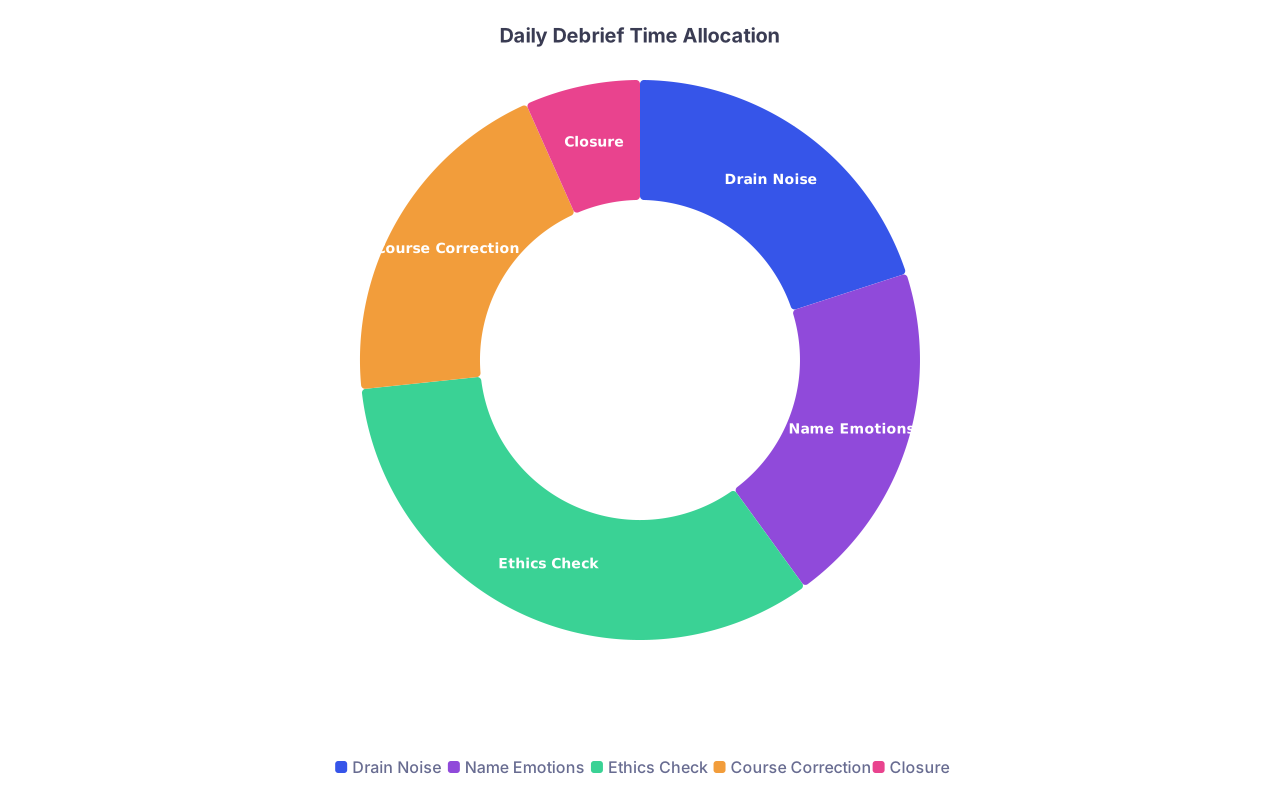
| Category | Value |
|---|---|
| Drain Noise | 3 |
| Name Emotions | 3 |
| Ethics Check | 5 |
| Course Correction | 3 |
| Closure | 1 |
Step 4: Course Correction Plan (3–4 Minutes)
Reflection without action is navel‑gazing. You are not here for that. You are here to not burn out and not become the ethically hollow version of yourself.
From what you wrote above, pick one of these focuses for tomorrow:
- A communication behavior to adjust
- A boundary to enforce
- A micro‑ethics move to try
- A support action for yourself or a colleague
Then write:
- Target situation – what kind of moment are you planning for?
- Specific behavior – what exactly you will do/say differently
- Fail‑safe – minimum standard if the ideal is impossible
Example:
- Target situation: Breaking bad news in clinic when behind schedule
- Specific behavior: Sit down, acknowledge time constraint explicitly, and say: “This is important. I will give you the key facts now, and then we will schedule a longer follow-up within 48 hours.”
- Fail‑safe: If clinic is on fire, at least avoid euphemisms and leave time for one patient question.
Another:
- Target situation: Feeling pressured to discharge borderline patient
- Specific behavior: Voice specific clinical concern out loud to team and document it once.
- Fail‑safe: If overridden, make sure I communicate my concern clearly to receiving outpatient provider.
Do not write a to‑do list. Write one tactical change. You are training your brain to see tomorrow as a laboratory for doing the job in a way that you can live with for 30 years.
Step 5: Closure Ritual (1 Minute)
Last step: you need a physical signal that the workday is philosophically over. Not that you will never log back into Epic. But that your identity as the on-duty clinician is clocking out.
Pick one short, repeatable action. Use it every day.
Examples:
- Close notebook, place pen on top, and say a single sentence (quietly) like: “Done for today.”
- Close your eyes, take three slow breaths, and visualize leaving the hospital building.
- If you are in your car: touch the steering wheel and say, “Now I am [first name], not Dr. [Last Name].”
Sounds silly. The alternative is that your brain keeps you on call emotionally 24/7, which is exactly what drives chronic exhaustion.

| Step | Description |
|---|---|
| Step 1 | End of shift |
| Step 2 | Set 15 min timer |
| Step 3 | Drain noise 2-3 min |
| Step 4 | Name emotions 3 min |
| Step 5 | Ethics checkpoint 4-5 min |
| Step 6 | Course correction 3-4 min |
| Step 7 | Closure ritual 1 min |
| Step 8 | Leave work role |
Making It Real: Where This Fits in a Medical Life
You are busy. So let’s talk logistics, not fantasy.
When to Do It
Realistic slots:
- Post‑shift in the car – before you turn on podcasts or call anyone
- Immediately after sign‑out – find a quiet corner or empty patient room
- At home, before you touch your phone or talk to family
Non‑negotiable: link it to a fixed anchor you already do every day.
| Anchor Habit | Debrief Location |
|---|---|
| Walking to parking lot | Parked car |
| Post-sign-out | Empty workroom |
| Getting home | Kitchen table |
| Pre-bed routine | Desk or bedside |
If you wait for a “good time,” you will never do it on heavy days. Those are the days you need it most.
What If You Are On Call or Post‑Call?
Adjust, do not abandon.
- During call: do a micro‑debrief – 5 minutes, focusing only on Steps 1 and 3 (drain noise + ethics checkpoint).
- Post‑call: keep it extremely short. Two questions:
- What is still gnawing at me?
- What do I never want to normalize from last night?
You are not looking for perfection. You are building a habit of not letting days disappear into a blur.
How This Prevents Emotional Exhaustion (Mechanisms, Not Buzzwords)
Let me translate the psychology into plain English.
1. You Reduce Unfinished Stress Cycles
Unprocessed events keep your nervous system in a half‑on state. By writing and labeling, you give your brain a completion signal. That reduces background anxiety and poor sleep, both major drivers of burnout.
2. You Counter Moral Injury in Real Time
Moral injury is not just “bad things happen.” It is “I could not act according to my values, and I had to stay silent about it.” The ethics checkpoint forces you to:
- Acknowledge the conflict
- Name where you did protect your values
- Plan small acts of resistance where you can
That restores agency, which is the antidote to helpless exhaustion.
3. You Train Emotional Granularity
Over time, you get better at distinguishing:
- “I am angry because the system is broken”
- vs. “I am guilty because I avoided a hard conversation”
- vs. “I am sad because this was just a human tragedy”
Different problems need different remedies. Lumping them all into “I am burned out” traps you. Granularity lets you pick the right fix.
4. You Build a Protective Professional Identity
Your “never normalize” list and your values‑aligned wins become a running record of who you are as a clinician. When a bad outcome or complaint hits, that record is psychological armor.
You are less likely to think “I am terrible” and more likely to think “I made a misstep; this does not erase who I am overall.”
Common Failure Modes (And How to Fix Them)
I have watched a lot of people try some version of this and then abandon it. The patterns are predictable.
Failure Mode 1: Turning It Into Homework
You start writing essays. You critique your writing. You try to be profound every night.
Fix:
- Cap each question to bullets. Maximum 3 bullets per section.
- If you are running late, do Steps 1, 3.3, and 4 only: dump noise, name one serious compromise, choose one course correction.
Failure Mode 2: Using It to Beat Yourself Up
You circle every misstep, rehash them, and walk away feeling worse.
Fix:
- For every “compromise” you write, force yourself to list at least one value‑aligned action from the same day.
- Ask: “If a junior colleague told me this story, would I talk to them the way I am talking to myself?”
Failure Mode 3: Dropping It on Good Days
You only debrief when you feel awful. Which guarantees you associate the notebook with pain and never build a stable habit.
Fix:
- On easy days, the debrief takes under 10 minutes. Use that to cement the routine.
- On those days, focus Step 3 on “Where did things go right and why?” You are extracting lessons from what worked, not just what hurt.
Failure Mode 4: Treating It as Private Therapy Only
You keep spotting the same systemic problems and then do nothing beyond writing about them. That becomes its own kind of helplessness.
Fix:
- Once a week, flip back through your notes. If you see the same ethical friction point 3+ times, escalate:
- Bring it to a trusted senior resident or attending.
- Raise it in M&M or ethics rounds.
- Start a simple tally on a sticky note: “times I felt pressured to unsafe discharge.”
Patterns give you leverage. Use them.
A Sample 15-Minute Debrief (Realistic Version)
To make this concrete, here is roughly how a tired second‑year resident might move through this after a bad day:
Minute 0–3: Drain noise
- 6 admissions in 3 hours
- Yelled at nurse about labs
- Missed daughter’s school event
- ICU attending dismissed my concern
- Told family “I will do everything” then could not get procedure approved
Minute 3–6: Name emotions
Anger / Frustration
- ICU attending dismissed my concern because I felt small and stupid.
- 6 admissions, no backup, because system overload and no one cares.
Sadness / Grief
- Missed daughter’s school event because I keep choosing the hospital and I am afraid I will regret it.
Guilt / Shame / Anxiety
- Yelled at nurse about labs because I was panicking about sepsis and dumped that on her.
- Told family “I will do everything” when I knew there were limits.
Minute 6–11: Ethics checkpoint
Clash of values vs system
- Unsafe volume of admissions.
- Limited access to necessary procedure but family thinks “everything” is possible.
Acted in line with values
- Rechecked antibiotics dosing myself rather than just signing.
- Double‑backed to apologize briefly to nurse even though rushed.
Compromised too far
- Used phrase “do everything” knowing it implied more than we can deliver.
- Let ICU attending shut me down without restating my concern more clearly.
Never want to normalize
- Blaming nurses for systemic overload.
- Using vague hopeful language to avoid hard truths.
Minute 11–14: Course correction
Target: Serious conversation with family when resources are limited.
Behavior: Tomorrow, use the sentence: “I want to be honest that there are limits to what medicine can do, and here is what we can realistically offer.”
Fail‑safe: If I am too rushed, at least avoid “do everything” phrasing.
Minute 14–15: Closure
Close notebook. Say out loud in the car: “Resident hat off. Dad hat on.”
Done.
The Bottom Line
You do not fix emotional exhaustion by hoping tomorrow is lighter.
You fix it by building a 15-minute daily debrief that:
- Drains the mental noise from your day so it does not follow you into the night.
- Surfaces and names the emotional and ethical friction before it hardens into cynicism or moral injury.
- Generates one specific behavioral adjustment for tomorrow, keeping you in motion instead of stuck in regret.
Keep it short. Keep it blunt. Keep it daily. That is how you protect both your sanity and your ethics in a career that will test both.