
You are here
It’s mid-January. You’re in the workroom between pages, staring at the vacation request email from GME. The deadline is in 48 hours. The chief said, “Get your picks in now or you’ll be stuck with leftovers.”
You’re PGY-1. You barely know which rotations are malignant, which are chill, or when your friends are getting married. You just know you’re exhausted and you don’t want to blow your precious weeks of vacation on poorly timed blocks that don’t actually make you feel human again.
This is where you either set up a year that lets you survive and recover—or you scatter random weeks that look fine on paper and feel terrible in real life.
Let’s walk the year chronologically and build a real plan.
Step 1: Big-Picture Year Planning (8–12 Weeks Before Vacation Requests Are Due)
At this point you should not be picking exact dates. You should be mapping seasons and energy states.
1. Get the hard constraints in front of you (Week –12 to –10)
Sit down once. For 30–45 minutes. No interruptions.
Pull up:
- Your residency’s block schedule template (4+4, 13 blocks, etc.)
- Any sample PGY schedule from prior years
- GME vacation policy (rules about:
- No vacation on ICU/ED/trauma months
- Max days off per block
- Required continuity clinic weeks
- Blackout periods—site inspections, orientation, holiday coverage)
Make a short list. What’s non-negotiable?
Examples:
- “No vacation during MICU, NICU, ED, nights.”
- “Max 5 consecutive days off on inpatient.”
- “At least one week must be taken in first half of year.”
If you do not know the rules, you will request fantasy blocks that get denied, and you’ll be stuck with scraps.
2. Mark your life events first (Week –10 to –8)
Now layer your real life. Yes, you still get to have one.
On a 12-month calendar, pencil in:
- Known weddings, partner’s graduation, major family events
- Religious holidays that matter to you (not just “big U.S. holidays”)
- Any planned big exam (Step 3, in-training exam if you’ll want a buffer)
- Partner’s or kids’ school breaks if that matters
Circle:
- 2–3 “must protect” windows (e.g., sibling wedding in July, partner’s big exam in April)
- 2–3 “ideal but flexible” windows (e.g., want a fall hiking trip, maybe October or November)
This is where you decide what you’re willing to protect and what you’re willing to lose if chiefs push back.
3. Identify your “high-burn” blocks vs “recovery” blocks (Week –8)
You don’t recover the same way from every rotation. I don’t care what the official “work hour average” is.
Make two columns and be brutally honest:
- Likely high-burn:
- MICU, SICU
- ED months with many nights
- Inpatient wards at your busiest site
- Night float
- OB on heavy call setups
- Likely recovery-ish:
- Electives you control
- Research
- Clinic-heavy ambulatory
- Admin / QI / teaching blocks
Now match that to time of year. For example:
- PGY-1: July–September is always rough. You will be slow, anxious, and tired.
- PGY-2: First MICU or senior wards month—don’t add extra strain around it.
- PGY-3: Interview season (if fellowship) is inherently fragmented.
Your goal: avoid wasting vacation wedged between two relatively easy months while leaving yourself naked around an ICU+night float cluster.
Step 2: Block-Level Strategy – Where Vacations Actually Belong
Most programs give you 3–4 weeks (15–20 days) per year. The way you slice those days determines whether you actually feel recovered or just “not at work” for a few scattered afternoons.
1. Decide your vacation pattern before picking specific blocks (Week –8 to –6)
Pick a “structure” for the year. Examples:
| Pattern | Description |
|---|---|
| 3+1 | One long 2-week trip, plus two 1-week breaks |
| 2+2 | Two medium 10–12 day breaks, no tiny fragments |
| 1+1+1+1 | Four short weeks, spread quarterly |
| Front-load | More vacation in first half of year |
| Back-load | Save bulk for late-year burnout or interviews |
My bias:
- PGY-1 → 3+1 or 2+2
- PGY-2 → 2+2 or 1+1+1+1 depending on ICU/ED clusters
- PGY-3 → 3+1 or 2+2, saving at least one week in interview season if you’re applying out
Why I don’t like the “8 random days throughout the year” approach: it kills continuity of rest. You never get into deep recovery mode. You just stop bleeding for a day.
2. Pair vacations with the right neighbors (Week –6)
Your block choice matters as much as the days off.
At this point you should be ranking relative timing:
- Best use: vacation immediately after a brutal block
- Example: 2 weeks off right after your first MICU month.
- Second-best: vacation during or just before a high-density call month
- Example: 5 days off in the middle of a 6+1 night float stretch to break it in half.
- Worst: vacation during super-light elective where you were already going home at 3 p.m.
General rules:
- Don’t put vacation right before a big new responsibility block (like starting MICU as a new senior). You’ll spend your vacation anxious and reading protocols.
- Do put vacation:
- Right after your hardest month
- During the middle of a 2–3-month grind cluster (wards → wards → ED)
- Anchoring a holiday if you care about that time
Step 3: Month-by-Month Planning – A Model Year
Let’s build a model for a 13-block year (4-week blocks), PGY-1 Internal Medicine style. You can adapt to your own specialty.
July–September: Survival and Orientation
You’re new. You’re slow. Everything takes more cognitive effort.
At this point you should:
- Avoid using major vacation time in July. You need face time, pattern recognition, and momentum.
- If allowed, take a long weekend in late August or early September—3–4 days, not a full week.
Example:
- July: Wards
- August: Wards
- September: Nights
Where to place vacation:
- Put 3–4 days off at the end of nights in late September or first days of October (if rules allow) to let your circadian rhythm reset.
- Protect at least one full week later in the fall when your brain really hits the “I’m tired of this” wall.
October–December: First Real Burnout Risk
By October, the adrenaline of “I’m finally a doctor” is gone. You’re just tired.
At this point you should:
- Schedule your first true week-long vacation in October or early November.
- Avoid placing that week on your easiest elective. Steal it from an average or slightly-hard month instead.
Concrete pattern:
- October: Wards (take 1 full week off in the second half)
- November: Elective
- December: Nights or ED, plus holidays
Holiday strategy:
- If you care about Thanksgiving, anchor 1–2 days of vacation around your assigned holiday schedule to extend a 4-day stretch into 6–7.
- If you don’t care, do not burn vacation there “just because everyone else does.” Use it when you’re actually gasping for air.
January–March: The Slump
January + February is the classic low-morale period. Dark outside, cold, and you’re halfway through the year.
At this point you should:
- Plan your longest vacation (10–14 days) in February or early March if your program allows a 2-week chunk.
- Especially if you had a stacked fall: wards → nights → ED style run.
Example structure:
- January: ICU (no vacation; protect your days off, go home post-call)
- February: Vacation block (use 2 weeks vacation, 2 weeks working a lighter rotation)
- March: Clinic/Elective
This long mid-year break matters more than you think. I’ve watched residents who skip it drag themselves through spring with chronic low-grade resentment and bad attitudes on rounds.
April–June: Finish Strong Without Crawling
End of the year feels like a sprint and a stumble at the same time. You want to appear committed, but you’re exhausted.
At this point you should:
- Keep at least 1 week of vacation unspent until spring.
- Place a final week either:
- Right after a heavy late-year ward month, or
- Before you transition to the next PGY year if you have a gap.
Example:
- April: Wards
- May: Elective + 1 week vacation
- June: Nights or ED
May week: take it in the middle of a rough April–May–June stretch or to align with a partner’s break. Just don’t leave yourself with zero buffer going into PGY-2.
Step 4: Week-Level Planning – How to Make a “Week Off” Actually Restorative
You can absolutely waste a vacation week. I’ve seen people come back more tired than they left because their “vacation” was a chaotic marathon.
At this point you should be thinking in terms of physiology, not just “days away from work.”
1. Plan the first 48 hours with intention
The first two days determine whether your body shifts into recovery mode.
Do:
- Sleep without an alarm for at least 2 mornings
- Hydrate aggressively, easy meals, minimal alcohol
- Light movement: walk, stretch, not CrossFit hero workouts
- Zero EMR, no “I’ll just pre-chart a bit”
Don’t:
- Fly a red-eye the night your block ends
- Start with a hyper-social, overstimulating event (bachelor party, Vegas weekend) on day 1
You’re not a normal tourist. You’re a sleep-deprived clinician whose stress hormones have been jacked for weeks.
2. Decide: “Recovery week” vs “Adventure week”
You can’t have both at full volume in residency. Be honest which one you’re choosing.
- Recovery week:
- Aim: recharge.
- Characteristics: low travel complexity, familiar location, consistent sleep, unstructured time.
- Adventure week:
- Aim: life experience.
- Characteristics: new city or country, sightseeing, later nights, more stimulation.
If you just finished MICU nights, taking a red-eye to Europe for a 7-cities-in-7-days tour is a physiologic joke. You’ll survive it, but don’t call it “recovery.” Call it “worth it anyway” and own the cost.
Step 5: Day-Level Planning – Protecting Rest During Vacation
At this point—once your dates are approved—you protect them like you’d protect a septic shock patient’s pressor line.
1. Establish hard boundaries before you leave
The week before vacation, you should:
- Tell co-residents and attendings:
- “I’ll be completely offline from X–Y dates.”
- Put a real out-of-office message:
- “I do not have access to email. For urgent clinical matters, contact the covering resident.”
- Hand off cleanly:
- Update sign-out
- Finish pending notes
- Close loose ends that would tempt you to “just check Epic quickly”
You are not ethically obligated to be half-working while on approved vacation. In fact, modeling boundaries is part of being a healthy physician.
2. Build a loose daily rhythm, not a rigid schedule
A simple pattern for a recovery week:
- Morning: wake without alarm, coffee, 20–30 minutes of movement
- Late morning: one “maintenance” task (bills, Step 3 registration, basic life admin)
- Afternoon: one thing that refuels you (hobby, nature, seeing a friend)
- Evening: low screens, consistent bedtime
For an adventure week:
- Keep one anchor:
- Either consistent wake time or consistent bedtime
- Do not book early-morning tours after two late nights in a row.
- Leave at least:
- One “nothing” day in the middle
- One “nothing” day at home on the back end before you return to work
The “land at 11 p.m. and start wards at 6 a.m. next day” stunt is a classic rookie move. You’ll feel that one for a week.
Step 6: Ethics and Team Dynamics – Not Being That Co-Resident
Planning vacation in residency is not just personal optimization. It’s also a professional and ethical issue. Someone is always covering for you.
At this point you should weigh three things together:
- Your recovery needs
- Service needs
- Fairness to co-residents
1. Don’t cluster all your vacation on “good” rotations
If you take all your vacation on chill elective months and never on wards, you’re gaming the system. Someone else is now doing relatively more of the hard work.
A balanced approach:
- Use some vacation on harder months (but placed smartly)
- Accept that one of your weeks might fall on a nicer block
- Coordinate within your class—if there’s only one ward resident, don’t both try to be out the same block
2. Be transparent and trade fairly
If you want a prime block (right after ICU, around a big wedding), do the legwork:
- Offer to cover an extra weekend for a co-resident later in the year
- Take a less-desirable holiday in exchange
- Be early and clear in communicating your needs rather than last-minute begging
Residents remember:
- The person who always “somehow” has off the major holidays
- And the one who quietly takes the short straw sometimes
Being the second person buys you a lot of goodwill when you actually need something.
Step 7: Real-Time Adjustments During the Year
Your initial plan will not survive contact with reality intact. Rotations shift. People go on leave. You change.
At this point (mid-year), you should be:
- Reassessing: “Am I more tired than I expected?”
- Checking: “Do I still want that spring adventure, or do I need a quiet week at home instead?”
Mid-year checkpoints
Use a simple timeline check:
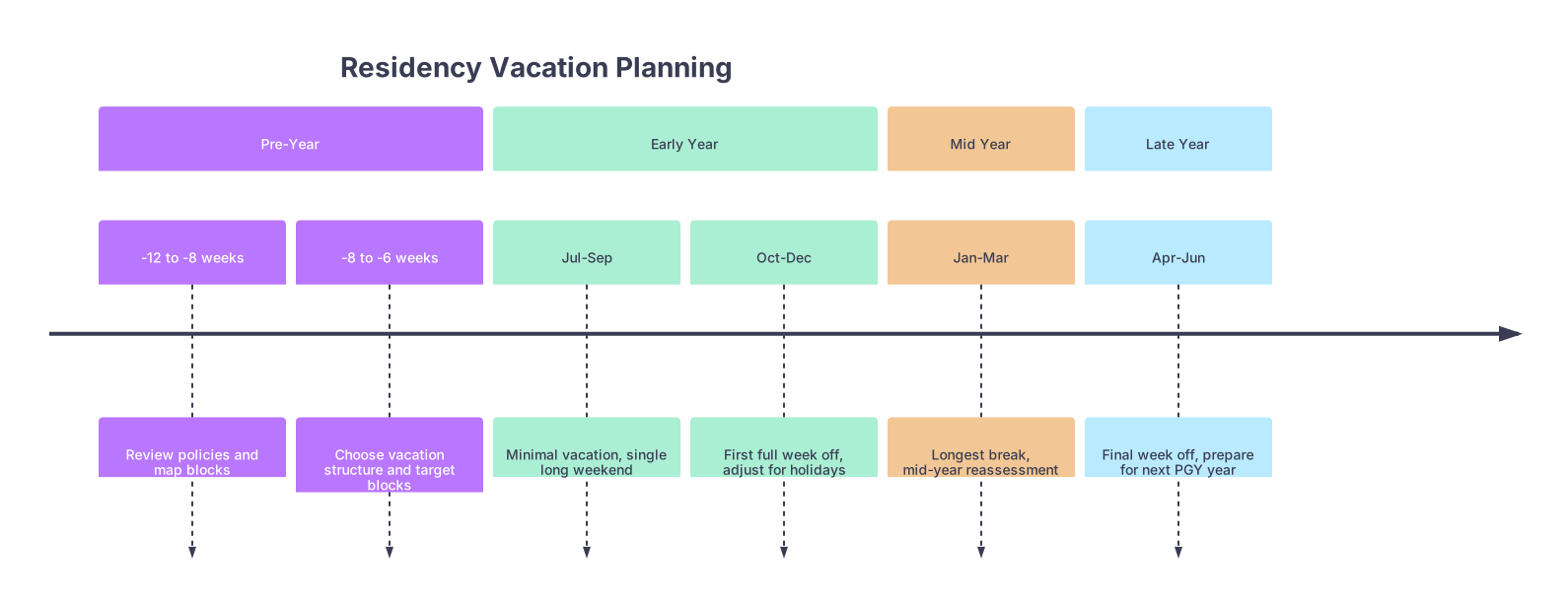
| Period | Event |
|---|---|
| Pre-Year - -12 to -8 weeks | Review policies and map blocks |
| Pre-Year - -8 to -6 weeks | Choose vacation structure and target blocks |
| Early Year - Jul-Sep | Minimal vacation, single long weekend |
| Early Year - Oct-Dec | First full week off, adjust for holidays |
| Mid Year - Jan-Mar | Longest break, mid-year reassessment |
| Late Year - Apr-Jun | Final week off, prepare for next PGY year |
Every 3–4 months:
- Look at what’s left:
- How many days of vacation unspent?
- Which upcoming blocks are high-burn?
- Adjust:
- Shift a week if an unexpectedly brutal rotation appears
- Save one small cluster of days to create a recovery window before your next ICU month
Don’t martyr yourself by “saving” vacation until there’s a perfect time. The perfect time in residency doesn’t exist. Only better and worse tradeoffs.
Quick Visual: When Residents Actually Feel Burned Out
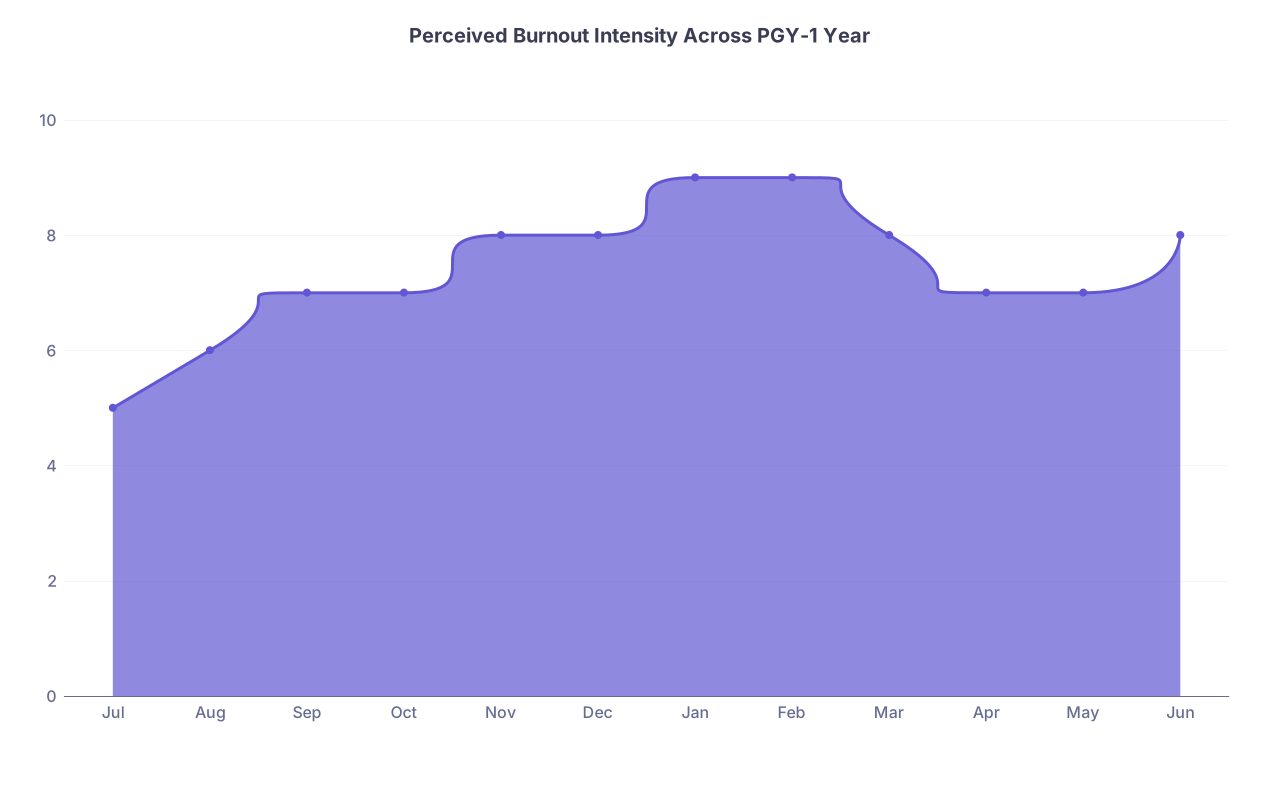
| Category | Value |
|---|---|
| Jul | 5 |
| Aug | 6 |
| Sep | 7 |
| Oct | 7 |
| Nov | 8 |
| Dec | 8 |
| Jan | 9 |
| Feb | 9 |
| Mar | 8 |
| Apr | 7 |
| May | 7 |
| Jun | 8 |
Use this pattern as a sanity check:
- Don’t stack no vacation across Oct–Feb.
- Place at least one true break in that 7–9/10 burnout range.
Final 3 Reminders
- Plan your vacations around your real energy curves and high-burn blocks, not just around cheap flights and holidays.
- Protect at least one longer mid-year break and avoid scattering all your days into forgettable long weekends.
- Communicate early, trade fairly, and hold firm boundaries while you’re off—your recovery is not optional; it’s part of staying safe and decent at your job.