
23% of residents meet criteria for clinical PTSD symptoms during training, yet almost none of them think of their “I cannot shut my brain off after call” nights as trauma responses.
That gap—between what you label as “just overthinking” and what is actually a predictable neurobiological and ethical reaction—is exactly why post‑shift rumination feels so intense.
Let me break this down specifically.
What Actually Happens To Your Brain On Call
You are not “just sensitive.” You are physiologically rewired for a few hours.
On a typical 24‑hour call, here is what is happening under the hood:
- Sympathetic system: chronically activated, because every beep could mean a crashing patient.
- HPA axis: cortisol high, sometimes very high in the last third of the night.
- Sleep architecture: fragmented; you get stage 1–2 fragments, almost no deep sleep, and minimal REM.
That cocktail alone primes you for intrusive thoughts.
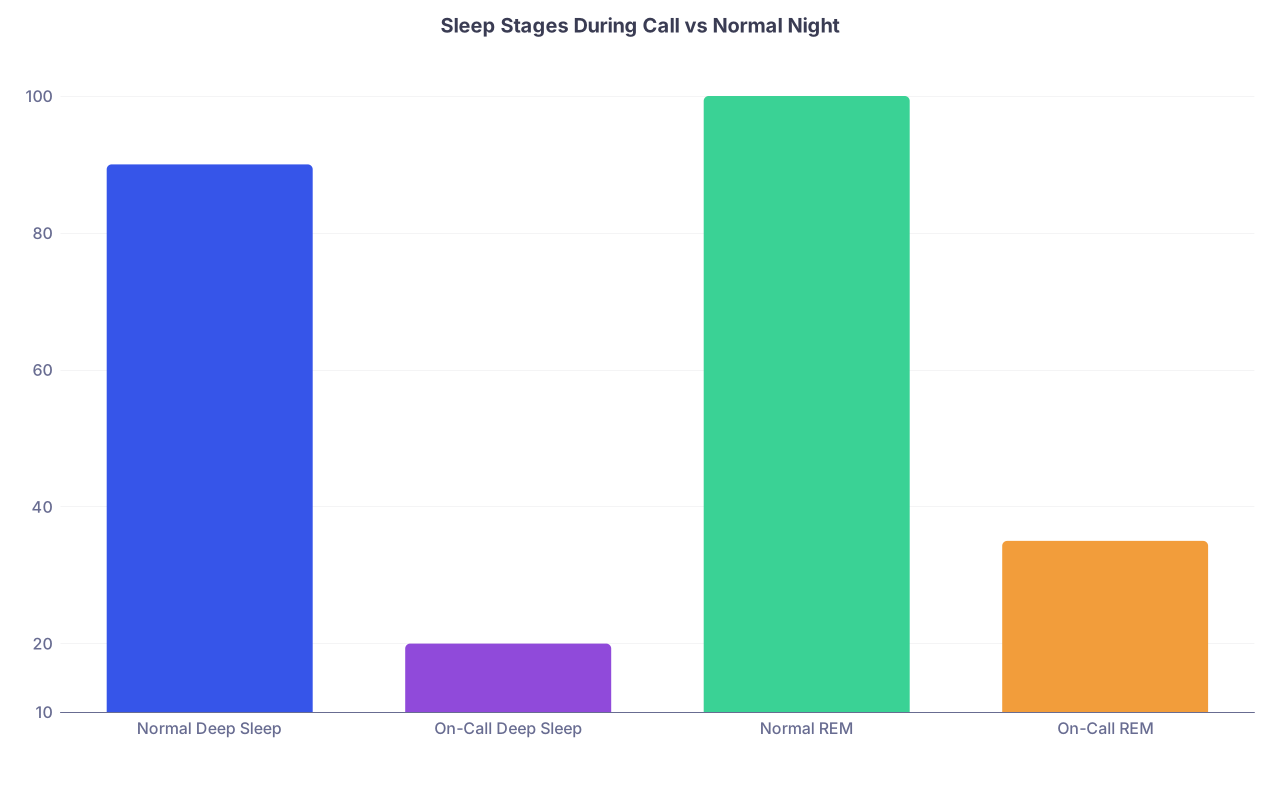
| Category | Value |
|---|---|
| Normal Deep Sleep | 90 |
| On-Call Deep Sleep | 20 |
| Normal REM | 100 |
| On-Call REM | 35 |
Neurobiologically, post‑call you are in a classic “threat hangover”:
- Threat system (amygdala) still dialed up.
- Prefrontal cortex (where nuance, perspective, and ethical weighing live) dialed down from fatigue.
- Reward system blunted—so positive feedback does not register strongly.
Then you step out of the hospital.
Silence. No alarms, no overhead codes, no team chatter. Just you, your exhausted brain, and a sudden drop in external stimuli.
The brain does not like an abrupt deceleration from 120 km/h to 0. So it keeps driving. That is the ruminative loop.
You replay:
- The airway that went well – but you only remember the desaturation.
- The borderline discharge you signed – and you imagine every bad outcome.
- The moment you snapped at a nurse – and you rewrite it 40 different ways.
This is not a personality flaw. It is predictable de‑escalation turbulence after hours of extended hypervigilance.
Why The Rumination Feels Morally Charged, Not Just Anxious
The intensity is not only biological. It is deeply ethical.
Medicine is one of the few jobs where “I might have killed someone” is occasionally a literal possibility, not a metaphor.
You are not just tired. You are:
- Ethically exposed
- Legally exposed
- Professionally evaluated
- And frequently, poorly supervised
So what you call “rumination” is often a collision of three things:
- Moral distress
- Perfectionism framed as “professionalism”
- Institutional gaslighting about what is actually possible
Moral distress vs moral injury
Let me separate these. They are not the same.
- Moral distress: You know the right thing to do, but cannot do it because of constraints (orders, policies, lack of staff, insurance barriers).
- Moral injury: Repeated or severe events where you feel you have violated your own core moral code—by action, inaction, or complicity.
Post‑call rumination spikes when a shift crosses from difficulty into moral territory.
Examples you probably recognize:
- You discharged a borderline patient because the attending said, “The hospital is not a hotel.” You knew they had no safe home setup.
- You did CPR on a patient with a DNR/DNI that no one saw until later.
- You watched a colleague speak to a family in a dismissive, almost cruel way, and you said nothing because you were afraid of the fallout.
On the drive home, your brain does not ask, “Could I have done that better?”
It asks: “Am I still a good person?”
That is why it feels so heavy. You feel like you are litigating your own character.
The Call Room As A Psychological Pressure Cooker
Call rooms look quiet from the outside. They are not.

They are ideal environments for:
- Micro‑sleep
- Catastrophic thinking
- Distorted self‑assessment
You have a narrow bed, fluorescent light from the hallway, your phone, maybe a TV no one uses, and a door that never feels fully closed because anyone can page you at any second.
You try to close your eyes. Instead, your brain pulls up:
- That lab you forgot to check on the sepsis patient.
- That slightly odd ECG you signed off as nonspecific.
- That ambiguous note the consultant left that you did not fully understand but pretended you did.
Now add the hidden curriculum messages, which are not subtle:
- “If you cannot hack call, maybe this specialty is not for you.”
- “Everyone feels this tired; you just push through.”
- “We all made mistakes. You learn and move on.”
So you learn not to say: “I went back to my room and could not stop replaying that code. I feel sick.”
You say: “Yeah, call was rough.”
Silence is a fantastic growth medium for rumination. No reality check. No calibration. Just you and your worst internal critic, locked in together from 1 a.m. to 6 a.m.
The Four Main Types Of Post‑Shift Rumination
Not all replay is the same. You probably have a primary style.
| Type | Core Question |
|---|---|
| Technical replay | Did I miss something clinical? |
| Moral self-attack | Am I a bad doctor/person? |
| Social humiliation loop | Do they think I am incompetent? |
| Catastrophic forecasting | What if this ends my career? |
1. Technical replay
Content: labs, orders, differentials, guidelines.
Example thoughts:
- “Did I calculate that heparin dose right?”
- “Should I have called neurosurgery sooner?”
- “I should have checked a lactate.”
This type is uncomfortable but potentially useful if contained. It is basically your brain doing delayed case review.
The problem: at 3 a.m., without references, teammates, or context, you are doing solo QA with zero safeguards against distortion. You remember the one abnormal lab, not the 19 things you did correctly.
2. Moral self‑attack
This is where intensity jumps.
Typical content:
- “I abandoned that family when I stepped out because I was uncomfortable.”
- “I cared more about my sleep than my patient.”
- “I lied by omission when I presented that case.”
Instead of criticizing actions (“That decision may have been off”), you condemn identity (“I am dishonest”, “I am selfish”).
This is what burns people out. Not fatigue. Self‑contempt.
3. Social humiliation loop
Shifts where you were:
- Pimped harshly on rounds
- Publicly corrected
- Rolled eyes at by a nurse
- Mocked by a senior
You replay tone of voice, facial expressions, and exact wording.
Not: “I got the answer wrong.”
But: “I looked stupid in front of everyone.”
This is magnified in hierarchical cultures where humiliation is still mislabeled as “teaching.”
4. Catastrophic forecasting
The classic late‑night storyline:
- “What if that ECG was actually ischemia, they come back in cardiogenic shock, and I get sued?”
- “What if I missed this once and that means I am not competent and someone dies?”
- “What if I fail Step 3 and get kicked out of the program?”
Your brain runs worst‑case scenarios as if they are likely rather than just logically imaginable.
Why Distraction Alone Rarely Works
You have probably tried what everyone suggests:
- Put on Netflix post‑call
- Scroll social media in bed
- Exercise intensely before sleeping
- “Just sleep it off”
These work for certain types of stress. They are terrible for morally and clinically loaded rumination.
Because your brain has an unresolved question:
“Am I safe—clinically, ethically, professionally?”
If you jump directly from that to mindless distraction, the question does not get answered. It just waits. Often, it wakes you up at 2 p.m. post‑call, stronger.
The move is not “numb it out.”
The move is: acknowledge, contain, and then redirect.
Not touchy‑feely. Very practical.
A Concrete Framework: The 15-Minute Post-Shift Decompression
You do not need a 1‑hour ritual. You will not do it. You are exhausted.
You do need structure for the first 15 minutes after a heavy call. That window is where you decide whether the rest of your day is bearable or a spiral.
Here is a system I have seen actually work for residents:

| Step | Description |
|---|---|
| Step 1 | Leave Clinical Area |
| Step 2 | Micro Check-In |
| Step 3 | Act - Call, Message, Document |
| Step 4 | 2-Minute Grounding |
| Step 5 | Categorize Thoughts |
| Step 6 | Capture On Paper |
| Step 7 | Plan Follow-Up Slot |
| Step 8 | Deliberate Disengagement |
| Step 9 | Any acute safety concern? |
Step 1: The micro check‑in (2 minutes max)
Before you leave the building:
Silently ask:
- Is there any patient I am actively worried is unsafe because of something I did or failed to do?
- Is there any time‑sensitive task I clearly left undone?
If yes to either:
- Go back. Fix what you can: order the lab, write the note, clarify with the team.
- Or hand off intentionally: send a message, call the covering team, and document.
Once you have done what is realistically possible in this moment, you are done. Not morally perfect. Operationally complete.
Step 2: 2‑minute grounding
On the way out or in your car:
- Feel your feet on the ground or your back on the seat.
- Take 6 slow breaths, exhale longer than inhale.
- Name 5 neutral things you see. Not deep psychology. Just orienting.
This shifts the nervous system from full threat to “slightly less on fire.” That is enough to widen thinking.
Containing The Rumination Instead Of Letting It Run
Here is where you build a container around your thoughts instead of wrestling each one.
Name the category
When a thought hits, do not treat it as objective reality. Quickly tag it:
- “Technical replay”
- “Moral self‑attack”
- “Social humiliation”
- “Catastrophic forecasting”
Research on rumination shows that just labeling the mental process, not just the content, weakens its grip. You are shifting from “I am in the story” to “I am watching the story.”
Example:
“I am having a catastrophic forecast about that chest pain discharge.”
That is different from:
“I definitely missed an MI and will be sued.”
Capture, do not analyze
Open your phone notes, or a tiny notebook. Spend 3–5 minutes.
Write only in bullet fragments, not full narrative:
- “Worried: night admit with borderline vitals, did not escalate.”
- “Shame: snapped at nurse when I was short on time.”
- “Fear: wrong dose of insulin, what if hypoglycemia at home.”
Then stop. You are not adjudicating now. You are collecting evidence for a later, more rested version of you.
Schedule a specific “review window”
Choose a realistic slot:
- 15 minutes before your next shift, or
- After a nap, not before
During that 15 minutes you can:
- Look up guidelines relevant to your “technical replay” cases.
- Ask a trusted senior, “Can I run a case by you?”
- Formulate a one‑sentence learning point or follow‑up plan.
The rule: outside that window, when the brain starts replaying, you say—literally, to yourself:
“Not now. I have time booked to look at this properly.”
Sounds corny. It works because you are acknowledging the concern, not dismissing it, but refusing to let it hijack your entire off‑shift.
The Ethics Piece Everyone Avoids Talking About
You can do all the breathing exercises on earth. If you are practicing in a system that constantly forces you to violate your own morality, your rumination is not a bug. It is a signal.
I have heard versions of this from residents in medicine, surgery, EM, psychiatry:
- “I discharge people to a shelter I would not leave my dog in.”
- “We do procedures on people who clearly do not understand what they are signing.”
- “We code people with zero chance of meaningful recovery because the family cannot let go and no one wants to be the ‘bad guy’.”
Post‑shift, this does not show up as clear political anger. It shows up as vague disgust with yourself. You start telling yourself a story:
“I am becoming someone I do not like.”
Here is the uncomfortable truth: some rumination is your conscience trying very hard not to go numb.
So you have to draw lines. Not theoretical lines. Concrete ones.
Examples:
- “I will not knowingly misrepresent prognosis to make a family accept or decline care.”
- “I will not speak to a nurse in a way I would be ashamed to see on video playback, no matter how tired I am.”
- “If I see gross disrespect to a patient, I will say at least one sentence: ‘Can we step outside and talk about that?’”
You will not always meet your own standards. You are human in a broken system. But having the lines written—literally written somewhere—gives you a benchmark.
Then after call, your question is not “Am I a good person?”
It is: “Did I get closer to or further from my lines? And if further, what is my repair?”
Repair might be:
- Apologizing to a nurse for snapping.
- Going back to a family the next day and saying, “I explained that poorly yesterday; let me try again.”
- Filing an incident report when care was truly compromised.
Moral distress intensifies when you do nothing after the event. Some form of repair—however small—often cools the rumination dramatically.
Calibrating Reality: You Are A Trainee, Not An Attending In Disguise
A subtle but toxic distortion: many residents evaluate themselves as if they had attending‑level authority and experience.
So the nighttime thought process goes:
- “I should have insisted on the CT even though the attending said no.”
- “I should have overruled that unsafe discharge.”
- “I should have independently changed the chemo plan.”
You forget:
- You cannot order half the things without attending approval.
- You do not control bed availability, staffing, or institutional policies.
- You are functioning under supervision by design—both legally and educationally.
That does not erase responsibility. It does calibrate it.
A more accurate self‑audit question post‑call is:
“Given my role, experience, and authority at the time, did I act with reasonable diligence and honesty?”
If the answer is no, fine. There is work to do.
If the answer is yes but the outcome was still imperfect, that is not moral failure. That is clinical reality.
When Rumination Is No Longer “Normal”
There is a line where post‑shift replay stops being a training side effect and starts being a mental health problem.
Look for:
- Intrusive scenes from shift popping up unbidden, like flashbacks
- Avoidance: you go out of your way to avoid certain patients, diagnoses, or areas
- Hyperarousal: jumpy with alarms, trouble relaxing even on vacation
- Persistent guilt or shame not tied to specific events: “I am fundamentally dangerous”
- Sleep destroyed even on non‑call nights
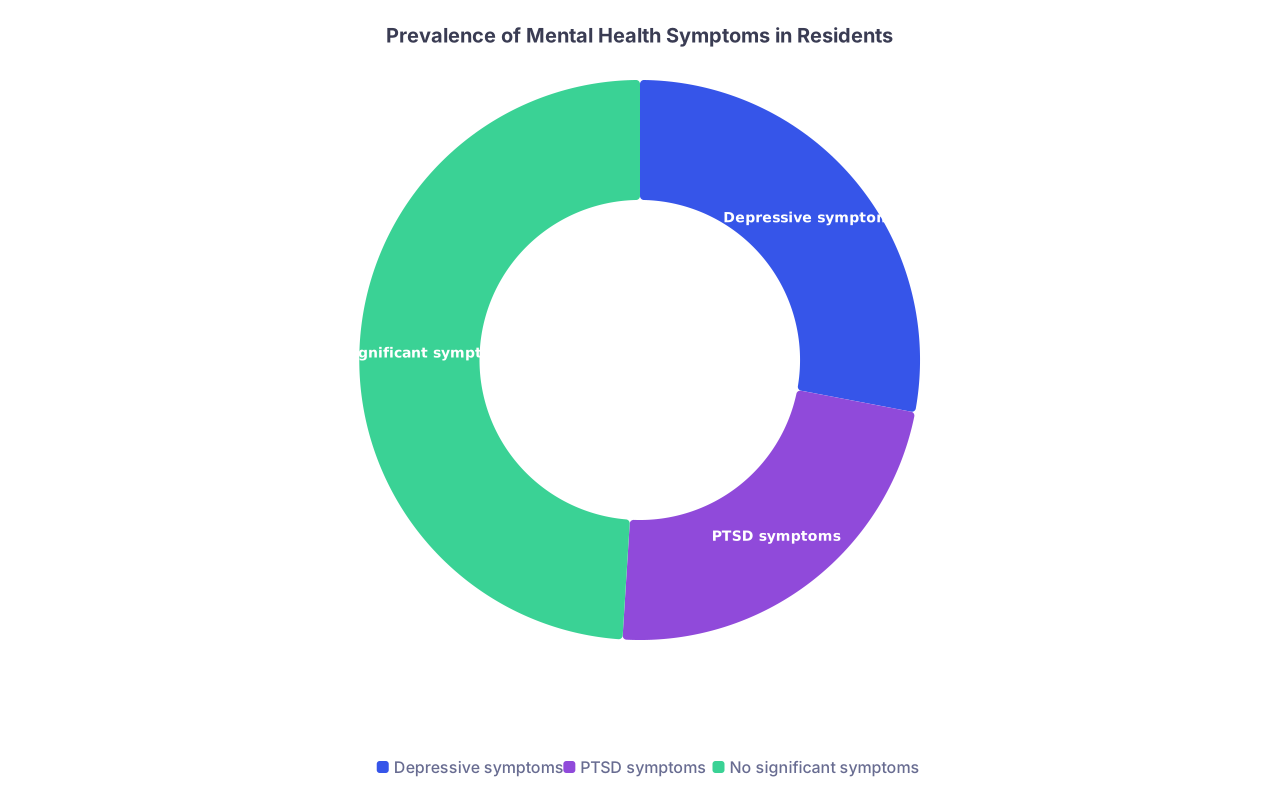
| Category | Value |
|---|---|
| Depressive symptoms | 28 |
| PTSD symptoms | 23 |
| No significant symptoms | 49 |
Those PTSD‑like symptoms are not dramatic. They are common. And treatable if you stop labeling them as “just residency.”
This is the point to involve:
- A therapist or psychiatrist with familiarity in medical culture
- Employee assistance programs that offer confidential counseling
- Peer support programs, if your institution has them (many now do after code events or adverse outcomes)
One practical tip: when you meet a therapist, do not sugarcoat. Say:
“I am having repeated, intrusive distressing thoughts about patient care events. I feel on edge and blame myself constantly.”
That language gets attention. You are not being “dramatic.” You are providing diagnostic information.
Building Micro-Habits That Actually Survive Residency
If a “tool” requires 45 minutes, quiet, and artisanal tea, you will not use it post‑call. You need interventions that fit into 30–180 seconds.
Here are ones I have seen residents actually stick with:

The doorway pause: Every time you walk out of the unit at shift end, pause with your hand on the door for 2 breaths. Mentally say, “I am leaving the role here for now.”
The 3-line note: Before sleep, write exactly three lines:
- One thing that went objectively well.
- One thing that is unsettled and will be reviewed later.
- One thing you are grateful you did or chose not to do.
The “would I chart it this way?” test: When a ruminative thought attacks you with “You were negligent,” ask, “Would an objective chart of events justify that accusation?” If not, your brain is catastrophizing, not reporting.
The ally call: Have one colleague at a similar level you can text: “Bad call, brain spinning. 5‑minute debrief?” That short verbal recounting, with someone who understands context, often cuts rumination in half.
None of these fix abusive systems. They give you a fighting chance not to be crushed by them.
Why This Matters Ethically, Not Just For Your Comfort
Last point, and it is blunt.
A numb doctor is dangerous.
If the only way you can cope with medicine is to shut off emotionally, withdraw from patients, and never revisit difficult cases, you will cause harm. Not because you’re cruel, but because you’ve stopped letting reality reach you.
Rumination, in its healthy form, is how you integrate experience into judgment. It is how you build the inner compass that separates technicians from physicians.
The goal is not to stop thinking after call. It is to:
- Stop attacking your own character
- Stop shouldering systemic failures as personal sins
- Learn what is learnable, repair what is repairable, and sleep without turning every imperfect shift into a moral indictment
You are allowed to be a trainee. You are allowed to be tired. You are allowed to need help.
What you do not have to do is spend every post‑call afternoon retrying yourself in a mental courtroom with no defense attorney present.