
The most dangerous thing about moral injury is that everyone keeps calling it “burnout.”
Why this distinction actually matters
Let me be direct: if what you are experiencing is moral injury and you treat it like standard burnout, you will blame yourself for a problem that is largely systemic. That is how good people get crushed.
Burnout says: “You are depleted.”
Moral injury says: “You are being asked, repeatedly, to betray your own moral code.”
Those are not the same. They overlap, but they are not interchangeable. And if you are in medicine, you are at high risk for both.
I am going to break this down in a way you can actually apply to yourself:
- What burnout looks and feels like, clinically and practically
- What moral injury looks and feels like, especially in healthcare
- How they overlap and how they diverge
- Concrete questions you can use to self‑diagnose which one is dominant
- What to do differently depending on which you are facing
This is not wellness-poster fluff. This is about whether you can stay in this work without losing your integrity—or your health.
Burnout: when the tank is actually empty
Classically, burnout has three core components (Maslach framework). You have seen this, even if no one called it by name.
- Emotional exhaustion
- Depersonalization / cynicism
- Reduced sense of personal accomplishment
Let me translate that from textbook to clinic.
How burnout usually feels
Emotional exhaustion first. You are not just “tired.” You are used up.
- You wake up tired. Weekends and vacations help a bit but the fatigue snaps back fast.
- Charting, inbox messages, discharge summaries feel physically heavier than they did a year ago.
- Normal work tasks feel like walking through wet cement.
Then depersonalization creeps in:
- You catch yourself referring to “the appendectomy in 212” instead of “the 27‑year‑old scared guy with an appendix.”
- You notice less empathy. A patient starts crying and your brain goes, “I do not have time for this.”
- Dark jokes in the work room that used to be a coping valve now feel like your default voice.
Finally, reduced accomplishment:
- You are doing more than ever and feel you are achieving nothing.
- A full clinic day completed on time feels… flat. No satisfaction, just “next.”
- Your self‑talk sounds like: “I am not good at this. I am just trying to survive the list.”
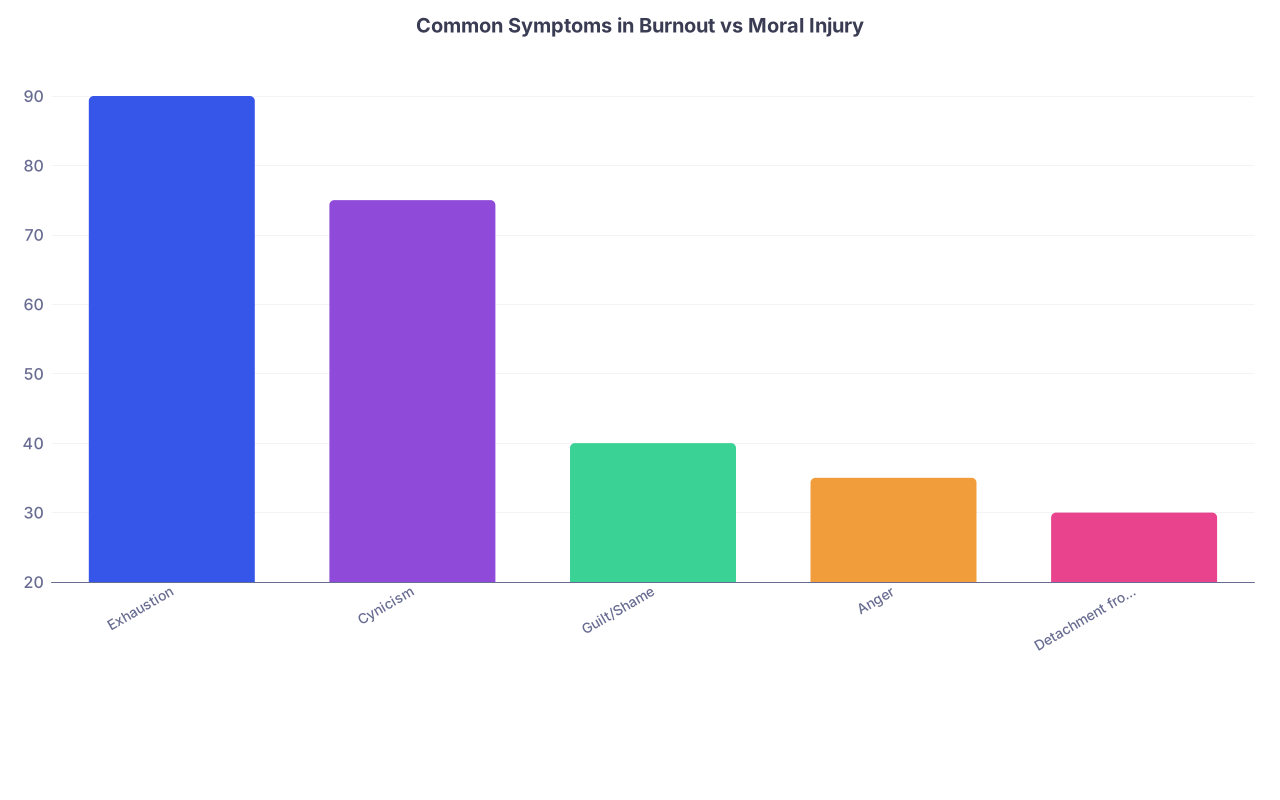
| Category | Value |
|---|---|
| Exhaustion | 90 |
| Cynicism | 75 |
| Guilt/Shame | 40 |
| Anger | 35 |
| Detachment from Values | 30 |
Numbers above (rough ballpark percentages from burnout literature) are what you see in classic burnout populations: exhaustion and cynicism dominate; guilt, anger, and value-conflict are there but not the headline.
What burnout is usually about
Underneath, burnout is largely about demand–resource mismatch.
You have:
- Too much work, too little time
- Too little control over your schedule
- Too few staff or supports
- Too much cognitive load, too many open “loops” in your brain
Sometimes compounded by poor sleep, chronic stress outside work, physical health issues, or untreated anxiety/depression.
The key point: in pure burnout, the core wound is your energy and capacity. Your values can still be intact. You still believe the work is good and worthwhile; you just do not have enough internal or external resources to do it sustainably.
Burnout responds—imperfectly but realistically—to:
- Workload reduction or redistribution
- Protected time
- More staff, better systems, fewer clicks
- Rest, vacations, treatment for comorbid mental health conditions
If a month off and a schedule adjustment would significantly reset you, you are probably dealing with predominant burnout.
Not fixed, but meaningfully improved.
Moral injury: when your values are under attack
Moral injury is different. It originally came from military psychology: soldiers asked to participate in or witness acts that violate their moral code, then live with the aftermath.
Medicine adopted the term because the parallels were obvious to anyone who has actually worked on the front lines.
Core ingredients of moral injury
Moral injury typically involves one or more of these:
- You are prevented from doing what you believe is right.
- You are forced or pressured to do what you believe is wrong.
- You witness serious moral wrongdoing by the system or leaders, and you feel complicit because you are part of it.
The emotions are different:
- Guilt or shame (even when, rationally, you know it is not “your fault”)
- Anger and moral outrage
- Betrayal—of trust, of promises, of professional ideals
- Loss of meaning, not just loss of energy
Ask any ICU team who watched patients die alone during visiting bans, or any physician whose plan was denied by insurance for the fifth time in a week, and you will hear it in their voice.
How moral injury feels in day‑to‑day medicine
Concrete scenarios. Because vague abstractions will not help you recognize this in yourself.
Scenario 1: The insurance denial loop
You have a patient with a clear clinical indication for a certain medication or imaging. You:
- Write a detailed note.
- Submit the prior auth.
- Do a peer‑to‑peer where the reviewer has never seen the condition you are treating.
- Get denied. Again.
The patient worsens. Maybe they are hospitalized. Maybe their cancer stage progresses.
You go home and think: “They got worse because we could not get them what they needed. I am part of this absurd system that chooses profit over care.” You feel anger + guilt, not just fatigue.
Scenario 2: Unsafe staffing
You are on night float covering 60–80 inpatients. The hospital called it “safe” on paper.
You have:
- Two active GI bleeds
- One patient on high‑flow teetering on intubation
- Three new admissions waiting
You know, in your bones, that no human can safely care for this many high‑acuity patients. You do your best. Someone still decompensates before you can get there.
You go home not just exhausted, but morally wounded. “I knew this was not safe. And I still participated.”
Scenario 3: COVID triage and visitor restrictions
You are in the middle of the COVID surges. Visitor policies say no family at bedside. A patient is dying. The spouse is in the parking lot.
You are the one who has to tell them over the phone. You are the one holding an iPad while they say goodbye. You leave the room and want to scream. Or cry. Or both.
The violation is not just emotional, it is moral: “This is not how a good death should happen. This is not the kind of physician I wanted to be.”
That is moral injury.
What makes moral injury distinct
Several features reliably separate moral injury from basic burnout:
The primary pain is value-based, not energy-based.
You may be tired, but the sharpest edge is moral distress: “This is wrong.”There is a clear sense of perpetrator or betrayal.
Insurance. Administration. Government policy. Leadership. Or even your own profession. Someone broke the deal.Time off helps only superficially.
You can go on a two‑week vacation, feel a bit human again, and yet the dread spikes as soon as you imagine going back to those same value-violating conditions.The thoughts are intrusive and sticky.
You replay cases. You think about the patient you discharged “too early” because you needed the bed. You cannot fully compartmentalize it.Your identity and meaning are directly attacked.
You start saying things like “Medicine is broken,” “I am a cog,” “I am part of a machine that harms people.” Not “I am tired,” but “I am complicit.”

Burnout vs moral injury: side-by-side
Let me put the contrasts where you can see them cleanly.
| Feature | Burnout | Moral Injury |
|---|---|---|
| Core problem | Energy depletion, overload | Values violation, ethical betrayal |
| Dominant feelings | Exhaustion, cynicism, detachment | Guilt, shame, anger, betrayal |
| Target of blame | Mostly self (“I cannot cope”) | Systems/leadership (“They made this impossible”) |
| Response to time off | Often significantly improves | Returns quickly when re-exposed |
| Intrusive memories | Less prominent | Common, especially around cases |
| Identity impact | “I am not effective enough” | “I am not the clinician I promised I would be” |
Both can coexist. In fact, they often do. But one usually dominates.
When burnout dominates, interventions like schedule changes, rest, better workflow, maybe therapy for stress and coping, move the needle.
When moral injury dominates, those same “wellness” solutions can feel insulting. You do not need another mindfulness app; you need the ability to practice ethical medicine without structural sabotage.
A quick self-assessment: which one is louder in you?
You want something practical. Here it is. Read these questions and answer honestly—no performative toughness, no “other people have it worse.”
Cluster A – Burnout-leaning questions
- How often do you feel emotionally drained by your work?
- Do you feel you have little energy to give to patients, even when they have done nothing “wrong”?
- If you imagine having:
- Reasonable patient volumes
- Adequate staffing
- Predictable schedule with protected time
would you expect your distress to drop by 70–80%?
- Do you feel detached or numb more than angry or morally outraged?
- Do you mostly think “I cannot keep this up,” rather than “I should not be asked to do this”?
Cluster B – Moral-injury‑leaning questions
- How often do you feel you are forced to choose between what is best for the patient and what the system will allow or reimburse?
- Do you go home replaying decisions that felt ethically compromised—even if they were “standard of care”?
- Do you feel angry or betrayed by leadership, payers, or the larger system more than by patients?
- Do you find yourself saying (even just in your head), “This is wrong,” during normal workdays?
- If your schedule, pay, and workload improved, but the ethical conflicts stayed the same, would you still feel deeply distressed?
If your “yes” answers cluster heavily in A, burnout is probably primary. If they cluster in B, moral injury is driving the bus, even if burnout is riding shotgun.
If both are lighting up? You are in very common—and very dangerous—territory.
How moral injury and burnout feed each other
These are not siloed conditions. They cross‑contaminate.
- Moral conflicts drain you faster, pushing you into deeper burnout.
- Burnout erodes your resilience and ethical bandwidth; doing the right thing takes more effort, so moral compromises become more tempting or more frequent.
- The more exhausted you are, the less you advocate, the more complicit you feel, the more morally injured you become.
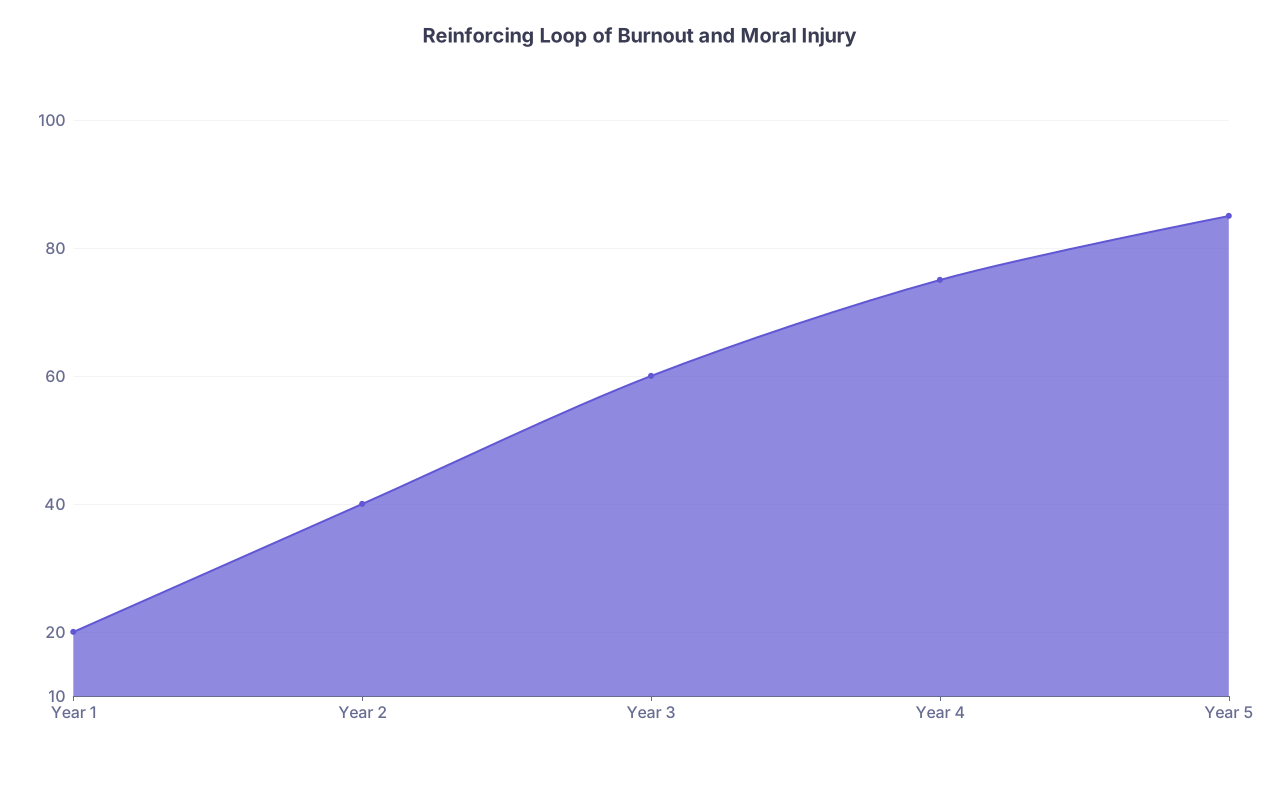
| Category | Value |
|---|---|
| Year 1 | 20 |
| Year 2 | 40 |
| Year 3 | 60 |
| Year 4 | 75 |
| Year 5 | 85 |
That rising area could be a lot of people’s residency-to-attending trajectory. Slow build, then sharp climb.
If you do not name moral injury explicitly, everything gets dumped into the “you need better self-care” bucket. Which is how structurally generated ethical harm gets reframed as a personal resilience failure.
That story is wrong. And corrosive.
What to do differently if it is burnout vs moral injury
You cannot yoga your way out of moral injury. You also cannot policy‑change your way out of untreated depression or sleep deprivation. The interventions need to match the dominant problem.
If burnout is dominant
Focus on resource, capacity, and physiology.
Fix the basics ruthlessly
Sleep, nutrition, movement, actual time off. Boring, yes. But if your brain is running on fumes and inflammation, every ethical dilemma feels worse.Attack workload and inefficiency
- Negotiate patient caps or template adjustments.
- Get help offloading non‑physician tasks (inbox triage, forms, prior auths where possible).
- Use scribes or dictation if your EMR is eating your life.
Separate burnout from self-worth
I have watched residents assume, “I am burned out, therefore I am not cut out for this specialty.” That is nonsense. Burnout is a signal that the environment and demands are misaligned, not a verdict on your character.Pull in actual treatment if needed
Chronic burnout often coexists with depression, anxiety, substance misuse. You do not get extra points for white‑knuckling.
If after these changes the moral distress quiets down substantially, then moral injury may have been less central than it felt. If, however, your body feels better but your conscience is still screaming, you know where the spotlight really is.
If moral injury is dominant
Now we are in a different arena. Here the target is integrity and agency, not just rest.
Name the violations specifically
Vague misery is harder to address. Write them down if you have to. For example:- “Being told to discharge patients I know are not safe at home due to bed pressure.”
- “Spending more time fighting insurance than being with patients.”
- “Lack of institutional transparency when harm occurs.”
When I have clinicians do this exercise, you can feel the emotional charge drop a bit the moment the words are clear.
Identify where you actually have agency
You will not fix U.S. healthcare this month. But there are layers of control:- Micro level: How you communicate with patients about constraints; how honest you are; how you document your ethical concern.
- Meso level: How you engage in your department—committees, QI projects, pushing for safer staffing, backing colleagues who raise concerns.
- Macro level: Professional societies, advocacy, policy activism, even career pivots.
Agency does not mean “you must fix it.” It means you choose where you will not silently comply.
Rebuild moral community
Moral injury isolates. You start thinking “I am the only one who cares.” You are not.Find or create spaces where people speak plainly about the ethical compromises—without gaslighting. That might be:
- A Balint group or ethics‑focused reflection group
- A small, trusted peer circle that is explicitly about moral distress
- Mentors who have stayed in medicine without becoming cynics
I have seen a single honest monthly group do more for moral injury than a dozen generic “resilience workshops.”
Decide your non‑negotiables
Every clinician I respect has lines they will not cross. They are different for everyone, but they exist.Examples:
- “I will not falsify documentation to satisfy an insurer.”
- “I will not participate in unsafe staffing ratios without documenting clear objection and escalating.”
- “I will not lie to families about prognosis to make metrics look good.”
Once you know your lines, you can decide—eyes open—when the environment is demanding repeated line‑crossing. That is when serious decisions come into play: change teams, change institutions, change practice models, sometimes change specialties.
Consider ethical repair, not just coping
Moral injury often involves a sense of having failed your own ideals. Even if the system boxed you in.Repair can include:
- Owning your distress out loud: “What happened with that patient did not sit right with me; I want to talk about it and learn from it.”
- Apologizing where appropriate, not for systemic failures you did not control, but for your role, your limitations, your humanity.
- Doing something concrete in response: QI project, policy review, ethics education for juniors. Action, not just rumination.

| Step | Description |
|---|---|
| Step 1 | Distress at Work |
| Step 2 | Assess Workload and Resources |
| Step 3 | Map Value Conflicts |
| Step 4 | Adjust Schedule, Seek Support |
| Step 5 | Monitor Symptoms |
| Step 6 | Identify Non Negotiables |
| Step 7 | Seek Moral Community |
| Step 8 | Advocate or Change Setting |
| Step 9 | Dominant Feeling |
Where medical ethics and personal development collide
You labeled this as “personal development and medical ethics.” Good. Because moral injury lives exactly at that intersection.
Ethics is not just grand rounds about double effect or end‑of‑life algorithms. It is the micro‑moments:
- Do I tell this patient exactly how long the wait list is, knowing it will crush them?
- Do I discharge this borderline‑safe patient because there is a more critical one in the ED and leadership is pushing?
- Do I sign off on productivity targets that I know incentivize shorter visits and more procedures, not necessarily better care?
Personal development, in this context, is not about polishing your CV. It is about:
- Knowing what kind of clinician you actually want to be
- Being brutally honest about where you are deviating from that
- Deciding, with intention, which compromises you will accept and which you will not
That is how you prevent moral injury from turning into permanent moral erosion.
You cannot avoid all moral distress in medicine. You can avoid becoming someone you no longer recognize.

When do you need outside help?
Let me be blunt: by the time many clinicians seek help, they are already at the edge.
You should not wait for:
- Persistent thoughts of quitting medicine with no real plan, just desperation
- Recurrent thoughts that patients would be better off without you
- Escalating use of alcohol, sedatives, or stimulants just to function
- Intrusive memories about specific cases; nightmares; physiological arousal when reminded (we are now in PTSD-ish territory)
- Serious relationship deterioration at home because you cannot switch off the anger/emptiness
Burnout or moral injury, these are danger signs.
Help can mean:
- A therapist or psychiatrist who actually understands healthcare (ask explicitly)
- An ethics consultant or chaplain who works with staff, not just patients
- Occupational health, if the primary issue is workload and ergonomics
- A trusted senior colleague who will not gaslight you with “this is just how it is”
And if you raise moral concerns and your institution punishes you or ignores obvious harm? That is information. It may be telling you that you are in a place where moral injury is not a bug, it is a feature.
At that point, leaving is not weakness. It is self-preservation.
The bottom line: what you should walk away with
Three points, and then you can go back to your life.
Burnout and moral injury are not synonyms.
Burnout is about depletion; moral injury is about violation of your values. They often coexist, but the dominant one determines what kind of “treatment” will actually help.If rest and workload changes do not touch the core distress, look at moral injury.
When the worst part of your experience is anger, guilt, or betrayal—especially tied to specific cases or systemic constraints—you are not just “burned out.” Treating it like burnout alone will keep you stuck.Your job is not to tolerate the intolerable.
Your job is to be honest about what this work is doing to you, to find or build moral community, and to decide—deliberately—where you can practice in a way that allows you to keep your integrity and your health. You are allowed to redraw that line as you grow.
If you can clearly say, “This part is burnout; this part is moral injury,” you have already taken back a piece of control. And in medicine, that is no small thing.