
The myth that “good doctors take their work home” is quietly wrecking clinicians’ lives.
You are not paid to be a 24/7 emotional sponge. You are paid to provide competent, ethical, time‑limited care. The science is very clear: clinicians who cannot detach from patient care outside of work perform worse, burn out faster, and make more mistakes. Detachment is not abandonment. It is a clinical skill.
Let me break this down precisely.
What “Detachment” Actually Means (and What It Does Not)
Most people use “detachment” as a vague buzzword. That is part of the problem. In the occupational psychology literature, we are talking about psychological detachment from work.
Technically, psychological detachment has four common dimensions:
- Detachment – mentally switching off; not thinking about work.
- Relaxation – low activation; body and mind down‑regulating.
- Mastery – engaging in absorbing, competence‑building non‑work activities.
- Control – feeling you have choice over your off‑duty time.
In medicine, people hear “detachment” and imagine:
- Coldness.
- Lack of empathy.
- “Clock‑punching” mentality.
That is not what the science supports.
A more accurate, ethical definition for clinicians:
Clinical detachment is the deliberate, time‑bound separation of your professional responsibilities and emotional engagement from your personal psychological space, once appropriate handover and continuity of care are ensured.
You can be deeply compassionate from 07:00–19:00 and then stop replaying the code blue at 23:30 in your bed. In fact, if you cannot, you are gradually destroying your capacity for compassion.
The line between care and fusion is where most physicians get lost:
- Care: “I did everything available and appropriate for this patient today. My team will continue their care. I will rest so I can show up again.”
- Fusion: “If I stop thinking about them, I am a bad doctor. Maybe if I had stayed later, checked one more lab, re‑read the CT…”
Fusion feels virtuous. It is actually self‑indulgent and often ego‑driven. You are centering your discomfort rather than the patient’s care system.
We need to replace fusion with structured detachment.
The Evidence: Why Detachment Is a Performance Tool, Not a Luxury
Detachment is not a spa concept. It is a cognitive and physiological recovery process with measurable effects.
Repeated across multiple meta‑analyses in high‑strain professions (including health care):
- Better psychological detachment → lower emotional exhaustion and depersonalization.
- Higher detachment → fewer self‑reported errors and cognitive failures.
- Poor detachment → higher rates of insomnia, depression, and “presenteeism” (being at work but functioning at 60%).
Hospitals quietly know this. They just rarely build systems to support it.
Look at a few patterns that show up repeatedly in clinicians who struggle to detach:
- They check the EHR from home “just to see how they are doing.”
- They mentally re‑litigate every bad outcome at 2 a.m.
- They replay difficult conversations with families and imagine alternate scripts.
- They feel guilty if they experience joy on a day when someone on their service died.
That is chronic sympathetic activation. Sustained hypervigilance. Your nervous system never gets to stand down.
Over time, you see:
- Narrowed cognitive bandwidth. More black‑and‑white thinking.
- Emotional numbing at work, emotional lability at home.
- Increasing irritability with patients, staff, and family.
This is why psychological detachment is not “nice to have.” It is a core safety mechanism and an ethical obligation to maintain your competence.
The Ethical Tension: Detachment vs Abandonment
Here is where physicians get stuck: “If I detach, am I betraying my duty to the patient?”
This is partly moral injury, partly training culture.
You have been told versions of:
- “The patient comes first. Always.”
- “If you are not thinking about your patients, you picked the wrong field.”
- “Real doctors go the extra mile.”
Let me be blunt. Taken literally and chronically, these statements are ethically incoherent.
Medical ethics does not require:
- Unlimited time commitment.
- Unlimited availability.
- Unlimited emotional labor.
Ethically sound care does require:
- Competence.
- Continuity.
- Non‑abandonment.
- Informed, compassionate communication.
Those are about what happens during your patient encounters and within your contractual role, not what fills every spare synapse at home.
A more accurate ethical frame:
- You owe the patient a safe system of care, not your continual personal rumination.
- You owe the patient reliable follow‑up and handover, not your insomnia.
- You owe future patients a functioning physician, not a martyr.
So the line is here:
You may detach after you have ensured: (1) appropriate handoff, (2) clear documentation, (3) realistic follow‑up plans, and (4) no outstanding action items that reasonably fall to you.
Once those are complete, continuing to spin mentally is not ethically required. It is just unskilled coping.
Step Zero: Build a Detachable Workday (Systems Before Mindset)
You cannot “just relax” if your system design guarantees unfinished loops.
Psychological detachment is almost impossible if you leave work in a cloud of half‑done tasks, ambiguous plans, and unsent orders.
You need what I call a Detachable Closure Routine at the end of each shift or clinic.
Here is a concrete template I have used with residents and attendings.
1. Objective closure checklist (10–15 minutes)
Before you even think about “self‑care,” you need cognitive closure. A quick, repeatable checklist:
- Open your patient list.
- For each patient, ask:
- Are all critical results acknowledged and acted on?
- Are orders for the next 12–24 hours clear?
- Does the covering team know the key “if X then Y” contingencies?
- Is my note sufficient for someone else to safely act?
- For clinics:
- Critical labs/imaging flagged and routed.
- Refill requests and urgent messages triaged.
- Follow‑ups scheduled or explicitly delegated.
You are aiming to reduce open loops—unfinished tasks that your brain will obsess over at night.
2. Structured, not sentimental, handoff
Detachment is easier if handover is robust. Vague “he is kind of sick, watch him” language is a recipe for worry.
During sign‑out, use a contingency‑focused structure:
- “Most likely scenario over the night is X.”
- “If hypotension → do A then B.”
- “I am worried about Y; triggers for escalation are Z.”
Once you say this out loud to a competent colleague, you have passed the ethical baton. You are no longer the only safety net.

| Step | Description |
|---|---|
| Step 1 | Last Patient Seen |
| Step 2 | Closure Checklist |
| Step 3 | Structured Handoff |
| Step 4 | Documentation Final Check |
| Step 5 | Micro Debrief |
| Step 6 | Physical Transition Out |
| Step 7 | Detachment Ritual |
3. Micro‑debrief, not emotional dumping
Before you walk out, do a 2–3 minute micro‑debrief with a peer, chief, or attending if possible.
The structure I push:
- “Hardest case today was…”
- “What I did well was…”
- “What I would do differently next time is…”
That is it. No spiraling. No 40‑minute catastrophizing. You are converting raw emotion into a learning artifact and then closing it.
If there is serious moral distress (wrong‑seeming decision, system failure, missed diagnosis), flag it for a planned, time‑bounded debrief later (M&M, ethics, supervisor meeting). Do not try to resolve the entire existential crisis in the hallway at 19:00.
4. Physical transition out
Your body needs a cue that work mode is ending:
- Take off badge and stethoscope and put them out of sight.
- Change shoes or clothes if possible.
- Wash hands and face with deliberate, slow movements.
- Step outside and take 5 conscious, slow breaths before opening your phone.
Sounds trivial. It is not. These are conditioned stimuli. Over time, your nervous system learns: “When I put my badge away and exhale at the door, the war is over for today.”
The Core Skill: Cognitive Off‑Switch Techniques
Detachment is not “stop thinking.” That instruction is useless. You need replacement tasks for your attention.
I will walk you through techniques that actually map to how clinicians’ minds work.
Technique 1: The “Parking Lot” Note
The ruminative mind hates loose ends. So give it a container.
At the end of the shift:
- Open a small notebook or secure electronic note labeled “Clinical Reflection – Parking Lot.”
- For each sticky patient/situation, write 3 short bullet points:
- Key factual summary (“45M septic shock, delayed source control, family conflicted.”)
- One learning or unresolved question (“Need to review evidence on early vs delayed laparotomy in X.”)
- Explicit permission statement: “I will revisit this at [specific time: e.g., Friday M&M / study block]. Not tonight.”
Total time: 2–4 minutes.
When your brain resurfaces the case at 23:00, the response is: “Already parked. Scheduled. Not now.”
This sounds almost childish. It is textbook externalization of intrusive thoughts, and it works.
Technique 2: Compartmentalization by Time Box
You may not be able to flip from “trauma code” to “Netflix and chill” in five minutes. Fine. Give yourself a time‑boxed decompression window.
Example:
- Commute home: consciously allow thinking about the day. Ruminate, process, replay. No restriction.
- First 10 minutes at home: maybe share a 2‑minute summary with a partner or roommate.
- After that: hard stop. No more clinical analysis until a scheduled space (journal block, supervision, teaching conference).
You tell yourself explicitly: “I get 30 minutes to think about today. After that, any new thoughts go into the Parking Lot.”
This is cognitive‑behavioral 101. You are scheduling worry rather than letting it colonize the entire evening.
Technique 3: Attentional Anchoring (Your Brain Needs a Different “Case”)
Your mind has been solving diagnostic puzzles all day. If you get home and scroll social media, that low‑grade, unstructured input is too weak to occupy your problem‑solving circuits. They drift back to the ICU.
You need high‑engagement, non‑medical anchors:
- Playing a musical instrument with full focus.
- Language learning exercises.
- Rock climbing, martial arts, or any sport with real-time demands.
- Deep reading of dense, non‑medical material (history, philosophy, complex fiction).
The principle: give your cognition something else to “diagnose.”
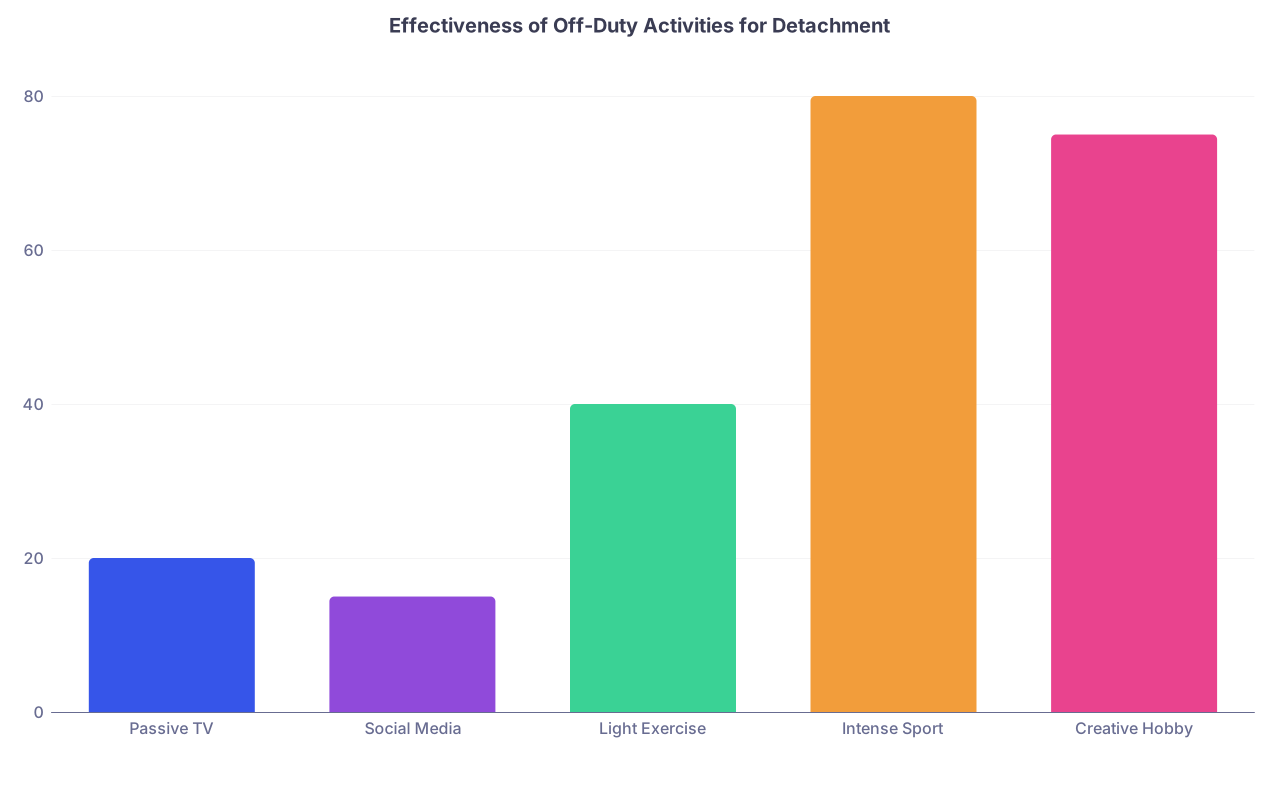
| Category | Value |
|---|---|
| Passive TV | 20 |
| Social Media | 15 |
| Light Exercise | 40 |
| Intense Sport | 80 |
| Creative Hobby | 75 |
The more actively your prefrontal cortex is engaged in a structured task, the less room there is for patients to invade.
Technique 4: Body‑First Downregulation
Some of you are trying to think your way out of a biochemical problem. At the end of a heavy call, your cortisol and catecholamines are still high. That is biochemical, not moral.
Quick, evidence‑backed levers:
- 10–15 minutes of moderate physical activity post‑shift (walk, light jog, bike) → faster sympathetic downshift.
- Respiratory exercises: 5–10 cycles of prolonged exhalation breathing (inhale 4s, exhale 6–8s) → vagal activation.
- Hot shower or bath within 1–2 hours of sleep → improved sleep onset latency.
This is not wellness‑poster fluff. These are physiological interventions designed to tell your limbic system, “We are not in a trauma bay anymore.”
Handling the Hard Cases You Cannot Stop Thinking About
Let us be honest. There are cases you can let go of quickly, and there are the ones that sit in your chest for months.
A 4‑year‑old with a missed sepsis. A maternal hemorrhage that spiraled. A patient whose values clashed violently with your own.
For these, you need more than a commute ritual.
1. Separate three questions
Most clinicians blend these into an undifferentiated guilt soup:
- Clinical question – Did we miss something diagnosable, preventable, or fixable?
- Systems question – Did the system fail (staffing, resources, communication structures)?
- Moral question – Did this outcome violate my moral expectations or values?
Write them down. Literally three headers on paper. Put elements under the right column.
Why? Because:
- Clinical questions need study and supervision.
- Systems questions need M&M, QI, leadership channels.
- Moral questions need ethics, peers, and sometimes therapy or spiritual counsel.
If you try to “detachment ritual” your way through what is actually a lingering moral injury, you will fail and then blame yourself.
2. Convert pain into a plan
For the clinical and systems columns, ask:
- What specific change in my practice or environment would reduce recurrence?
- Who can I present this to? (Attending, QI committee, chief).
You detach after you define the plan, not before.
Example:
- Clinical: “I want to review early signs of nec fasc and present a 10‑minute teaching at morning report.”
- Systems: “This case exposed a communication gap between ED and surgery; I will submit a brief incident report and propose a standardized signout template.”
You are not ruminating; you are architecting. Different mind state.
3. Ritualized remembrance
For especially painful deaths or bad outcomes, some physicians need symbolic closure.
I have seen all of the following work:
- Lighting a candle and holding 1 minute of silent reflection after a child death.
- Writing the patient’s initials in a private journal next to one sentence about what they taught you.
- Attending or sending a short letter to a memorial service (if appropriate and supported).
The ethical line: no boundary violations, no inserting yourself into the family’s grief to soothe your own. The ritual is for you and should stay on your side of the professional boundary unless explicitly invited.
Dealing With EHR, Phones, and “Always On” Culture
Here is the modern trap: even if your mind could detach, your devices will not let it.
Common patterns:
- “I just checked the labs from home because I was curious” → now you are responsible again.
- “I saw that in‑basket message come through, so I felt guilty ignoring it” → so you answer at 21:30.
- “Our group text blows up every time something crazy happens overnight” → constant vicarious arousal.
You must implement hard boundaries or the detachment work above gets erased.
| Tool/Channel | Recommended Boundary |
|---|---|
| EHR Access at Home | Disable routine access or schedule limited checks only when on call |
| Work Email | No push notifications; check only during work blocks |
| Messaging Apps | Separate threads: clinical vs social; mute clinical when off duty |
| Personal Phone | No patient or family texting except through approved systems |
Practical moves:
EHR from home
- If you are not on call and not covering that patient, do not open the chart. Curiosity is not a clinical indication.
- If your group expects after‑hours chart work, negotiate time‑boxed windows rather than drip‑feed interruptions.
In‑basket and email
- Turn off push notifications.
- Batch checking: e.g., 07:30, noon, 16:30 on clinic days. Never “whenever it pings.”
Messaging culture
- Advocate for structured communication: secure messaging for active clinical care, not gossip or venting.
- Mute or leave group chats that keep your nervous system in the hospital all night.
Explicit norms
- As an attending or senior, say the words: “I do not expect replies to emails or messages after 18:00 unless you are on call or this is emergent.”
- Then do not punish people silently for following that boundary.
You cannot claim to value detachment and then reward residents who answer messages at midnight. That is just hypocrisy dressed up as dedication.
Relational Detachment: What You Share at Home, and How
Bringing work home verbally is not the same as bringing it home psychologically. But they interact.
Two dysfunctional extremes:
- You say nothing. Your family senses you are distressed but has no idea why. They walk on eggshells.
- You overshare every detail. Your partner becomes your untrained therapist; your entire living room turns into a de facto ICU.
You want a middle ground: bounded sharing.
A simple frame:
A brief, structured check‑in:
- “Day rating: 3/10. Had one tough case.”
- “I have the energy for a 5‑minute summary if you want to hear it, then I need a break.”
No gore. No identifying information. No HIPAA issues. Ever.
Clear signal when the topic is done:
- “Thank you for listening. I am going to stop talking about work now.”
You will be tempted to keep going because it feels relieving. That is fine sometimes. But if every evening becomes a case conference, your home has no protected non‑medical space.
If your distress is intense and persistent, that is what peer support programs, Balint groups, therapy, or spiritual care are for. Not your 10‑year‑old and not your exhausted spouse every night.
Training Yourself Out of the Martyr Narrative
The biggest barrier to detachment is not technique. It is identity.
Many physicians secretly hold one or more of these beliefs:
- “If I am not always available, I am not a real doctor.”
- “My patients need me personally, not just any doctor.”
- “Rest is selfish when others are suffering.”
This is ego, not ethics.
Let me be direct:
- You are not that special. For almost every clinical scenario, there is another competent clinician.
- The system is fragile, but you personally catastrophizing at 23:00 does not stabilize it.
- Chronic self‑sacrifice makes you worse at the thing you are sacrificing yourself for.
You need to reframe:
- From: “I must always be thinking about them.”
- To: “I must be reliably functional when I am actually with them.”
A few practical cognitive reframes:
When guilt arises as you switch off:
- Old script: “I am abandoning them.”
- New script: “They are in a staffed, monitored system. What keeps them safest long‑term is my intact skills and judgment. That requires rest now.”
When you feel pride in overwork:
- Old script: “I stayed 3 extra hours. That shows dedication.”
- New script: “I stayed 3 extra hours. That erodes my endurance and sets a bad precedent.”
When you imagine the exceptional case:
- “But what if something catastrophic happens overnight and I was not there?”
- Response: “Catastrophes will sometimes happen even when I am there. My job is to build systems, not to be omnipresent.”
You are allowed to be finite. You are, in fact, required to be finite.
Building a Sustainable Weekly Rhythm, Not Just a Nightly Ritual
Detachment is not about one evening. It is about a recovery rhythm across the week.
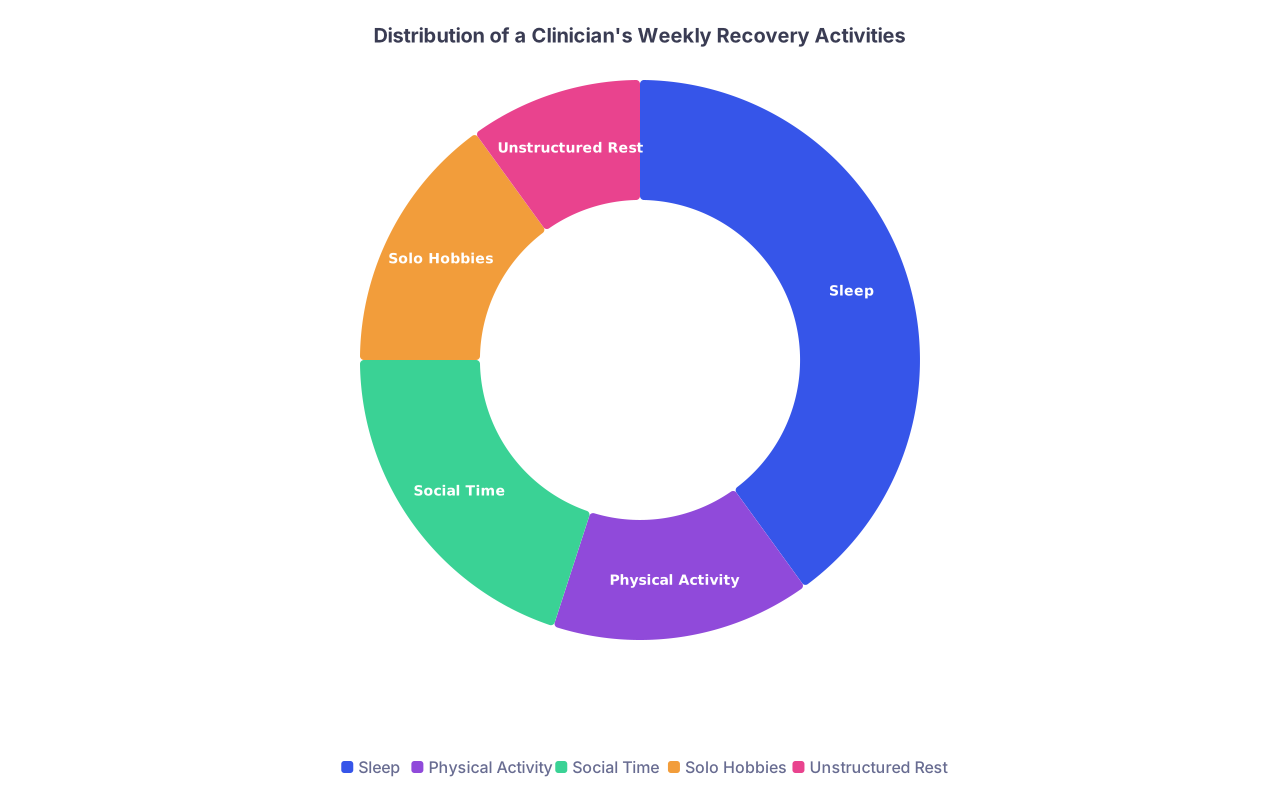
| Category | Value |
|---|---|
| Sleep | 40 |
| Physical Activity | 15 |
| Social Time | 20 |
| Solo Hobbies | 15 |
| Unstructured Rest | 10 |
Key patterns common to clinicians who maintain detachment over years:
- Protected sleep windows even on busy weeks. They treat sleep like medication, not a negotiable luxury.
- Anchored non‑work identities: parent, musician, runner, volunteer, writer. Something that exists entirely outside the hospital’s hierarchy.
- Scheduled reflection rather than constant rumination:
- One hour a week for chart review, reading, “what did I learn from last week’s hard cases?”
- Mentorship or supervision blocks where they bring the tough moral and clinical questions.
The point: You give your brain trusted containers for clinical reflection, so it does not hijack every off‑duty moment.
You will never fully prevent intrusive thoughts about patients. You can prevent those thoughts from owning your entire life.
When You Cannot Detach Despite Doing All the “Right” Things
If you have:
- Built end‑of‑shift closure routines.
- Implemented tech boundaries.
- Practiced parking thoughts and anchoring your attention.
- Scheduled proper debriefs for the hardest cases.
…and you are still:
- Waking nightly with patient images.
- Feeling dread going into work.
- Experiencing emotional numbness with family.
- Considering quitting medicine weekly.
Then this is not a “detachment technique” problem. This is likely:
- Burnout (emotional exhaustion + depersonalization + low sense of accomplishment).
- PTSD or secondary traumatic stress from repeated exposure to trauma.
- Depression or anxiety.
At that point, the ethical move is not to tough it out. It is to:
- Involve occupational health or employee assistance if available.
- Seek formal mental health care with someone who understands health care work.
- Consider systemic changes: reduced FTE, different role, specialty shift, temporary leave.
You are not weak for reaching this point. You are living in a system that routinely chews people up and then acts surprised when they bleed.
But here is the line: it is professionally irresponsible to simply continue practicing in a highly impaired state without intervention. Getting help is, again, an ethical action.
A Concrete 7‑Day Experiment
If you want something actionable, do this for one week. No half‑measures.
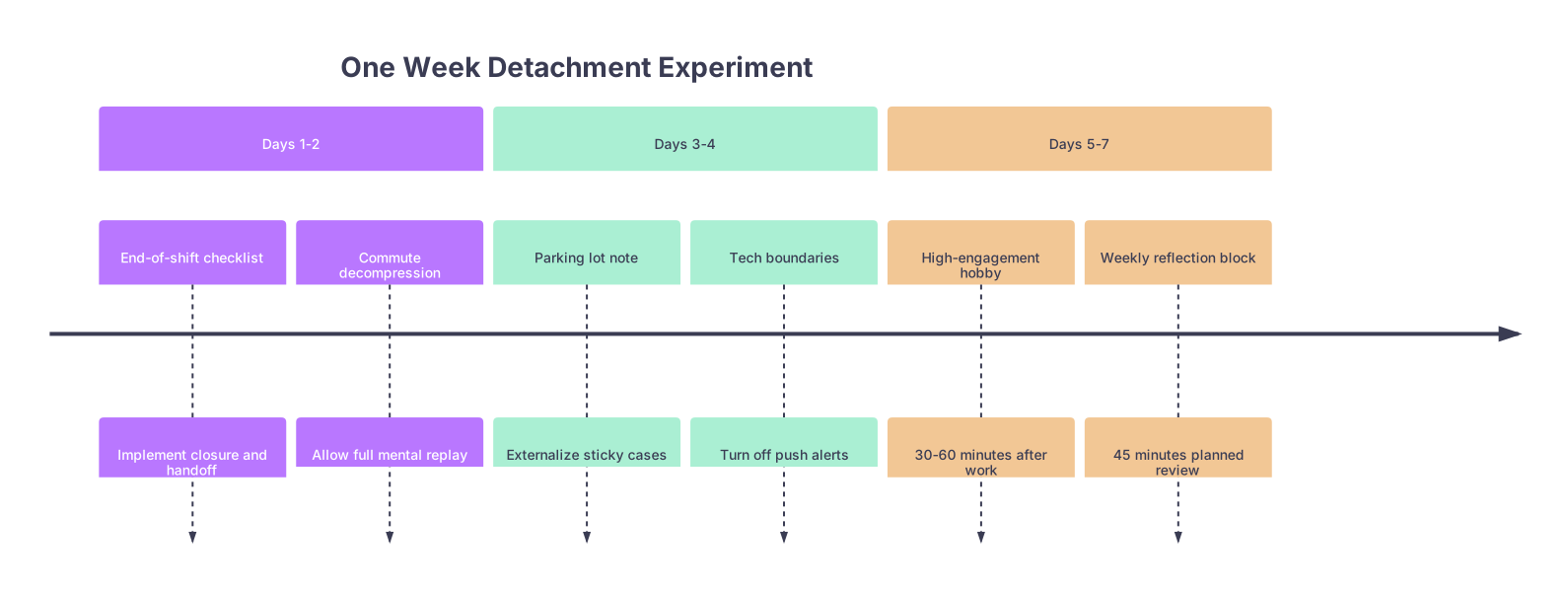
| Period | Event |
|---|---|
| Days 1-2 - End-of-shift checklist | Implement closure and handoff |
| Days 1-2 - Commute decompression | Allow full mental replay |
| Days 3-4 - Parking lot note | Externalize sticky cases |
| Days 3-4 - Tech boundaries | Turn off push alerts |
| Days 5-7 - High-engagement hobby | 30-60 minutes after work |
| Days 5-7 - Weekly reflection block | 45 minutes planned review |
Each workday:
- Run the closure checklist + structured handoff.
- Use commute as scheduled replay time; once home, use Parking Lot note for any new intrusive case thoughts.
- Hard boundary on EHR and work messages when not on call.
- At least 20–30 minutes of high‑engagement, non‑medical activity after work (no doomscrolling).
At the end of 7 days, ask yourself:
- How often did I wake up at night thinking about patients?
- How long did post‑shift hyperarousal last?
- Did my patience or empathy at work change?
You will not fix a decade of bad habits in a week, but you will have data. Clinicians respect data.
Three Things to Remember
- Detachment is a clinical skill, not a character flaw. You are not less caring for switching off; you are more sustainable.
- You detach after you hand off, not instead of handing off. Good systems and closure routines are the ethical foundation of leaving work at work.
- Guilt is not a reliable compass. Use evidence, ethics, and physiology to guide your boundaries—not the martyr narrative that medicine quietly worships and then discards when it breaks.