
Most residents are not “just tired”; they are walking neurobiology experiments in chronic stress.
Let me break this down specifically, because hand‑waving about “burnout” and “resilience” is useless without understanding what your brain and body are actually doing.
You are not weak. You are running a human nervous system through a workload and culture that are profoundly mismatched to its design. Once you see the mechanisms, a lot of your “mystery” symptoms stop being mysterious.
1. What Chronic Stress Really Is (Not Just “Busy”)
Chronic stress in training physicians is not “I had a long day.” It is a persistent activation of your stress systems with inadequate recovery. Weeks to months. Sometimes years.
Acute stress:
• Code blue.
• Trauma activation.
• Airway going bad.
Heart rate jumps, cortisol rises, attention narrows. You perform. Then, in a healthy system, things come back down.
Chronic stress:
• Six 12–14 hour days in a row.
• Pager going off at 2:00, 3:30, 4:15 a.m.
• Constant dread about evaluations, complaints, the Match, the board exam.
• No real “off switch” even on days off.
That pattern keeps your hypothalamic–pituitary–adrenal (HPA) axis and sympathetic nervous system hovering at “medium‑high” all the time. Not explosive. Just relentlessly on.
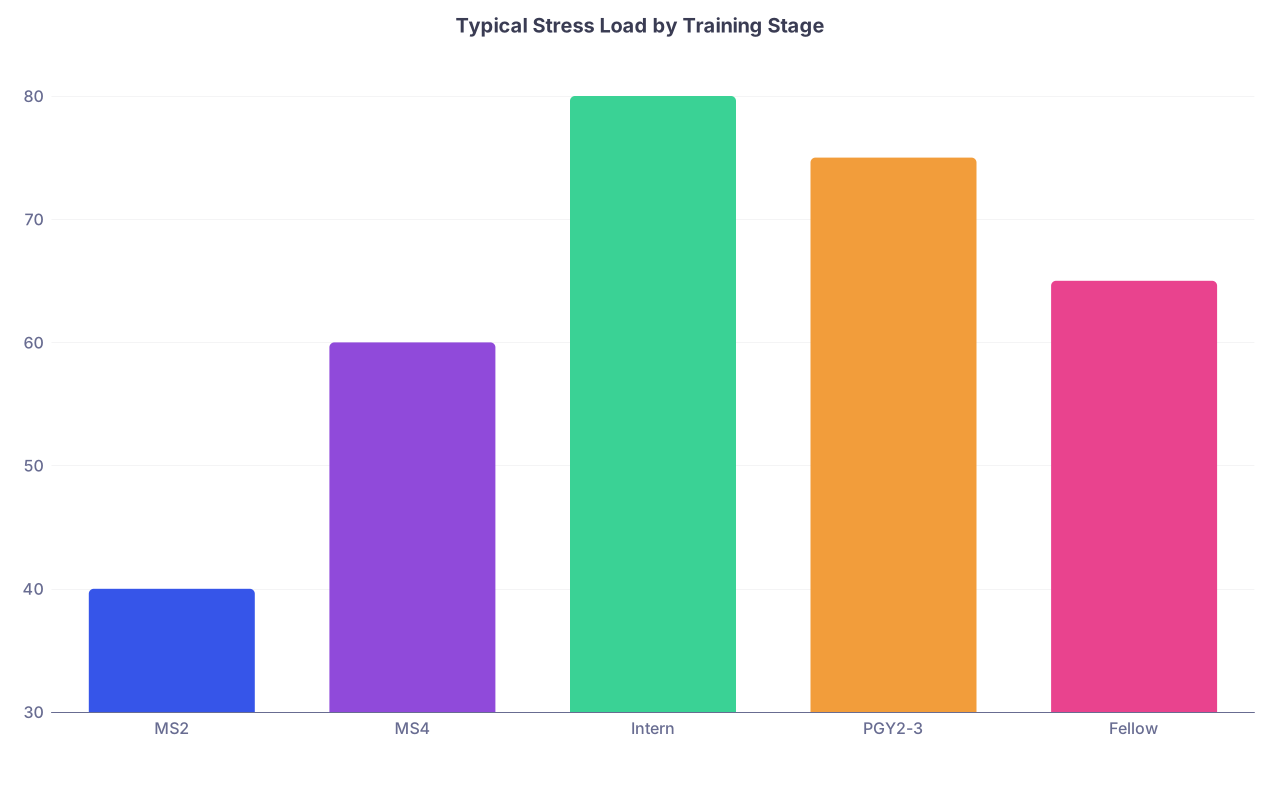
| Category | Value |
|---|---|
| MS2 | 40 |
| MS4 | 60 |
| Intern | 80 |
| PGY2-3 | 75 |
| Fellow | 65 |
Those numbers are not literal. They reflect what most trainees describe: a steep jump at intern year that never fully comes down.
Neurobiologically, chronic stress means:
- Baseline cortisol is higher and more prolonged.
- Sympathetic tone (fight‑or‑flight) dominates over parasympathetic (rest‑and‑digest).
- Brain regions for threat detection are overtrained.
- Brain regions for reflection, empathy, and executive control are under‑supported and sometimes structurally altered.
This is not moral weakness. This is circuitry.
2. The Core Circuits: HPA Axis, Autonomic System, and Key Brain Regions
2.1 HPA Axis: The Stress Thermostat That Will Not Turn Off
The HPA axis is the spine of the chronic stress story.
Stimulus: pager goes off, attending snaps, EHR messages stack up.
Hypothalamus: releases CRH (corticotropin‑releasing hormone).
Pituitary: releases ACTH (adrenocorticotropic hormone).
Adrenals: secrete cortisol.
Cortisol, in short bursts, is adaptive. It mobilizes glucose, sharpens attention, modulates the immune system.
Under chronic load, two things happen that I see constantly in residents:
Blunted feedback
The system is supposed to have negative feedback: cortisol rises, receptors sense it, hypothalamus and pituitary back off. With persistent stress, glucocorticoid receptors in the brain downregulate. The signal “we have enough cortisol” is muffled. You get:- Elevated or dysregulated cortisol rhythms.
- Non‑restorative sleep even when you get 8 hours.
- That wired‑but‑tired feeling: exhausted body, racing mind.
Flattened circadian pattern
Normal cortisol: high in the morning, lower throughout the day, lowest at night. Night float, 28‑hour calls, and rotating shifts absolutely wreck that pattern.Once cortisol becomes flat or erratic, you see disrupted sleep architecture, memory problems, and increased anxiety. You also start craving carbs and caffeine at weird times. That isn’t lack of discipline. That is physiology.
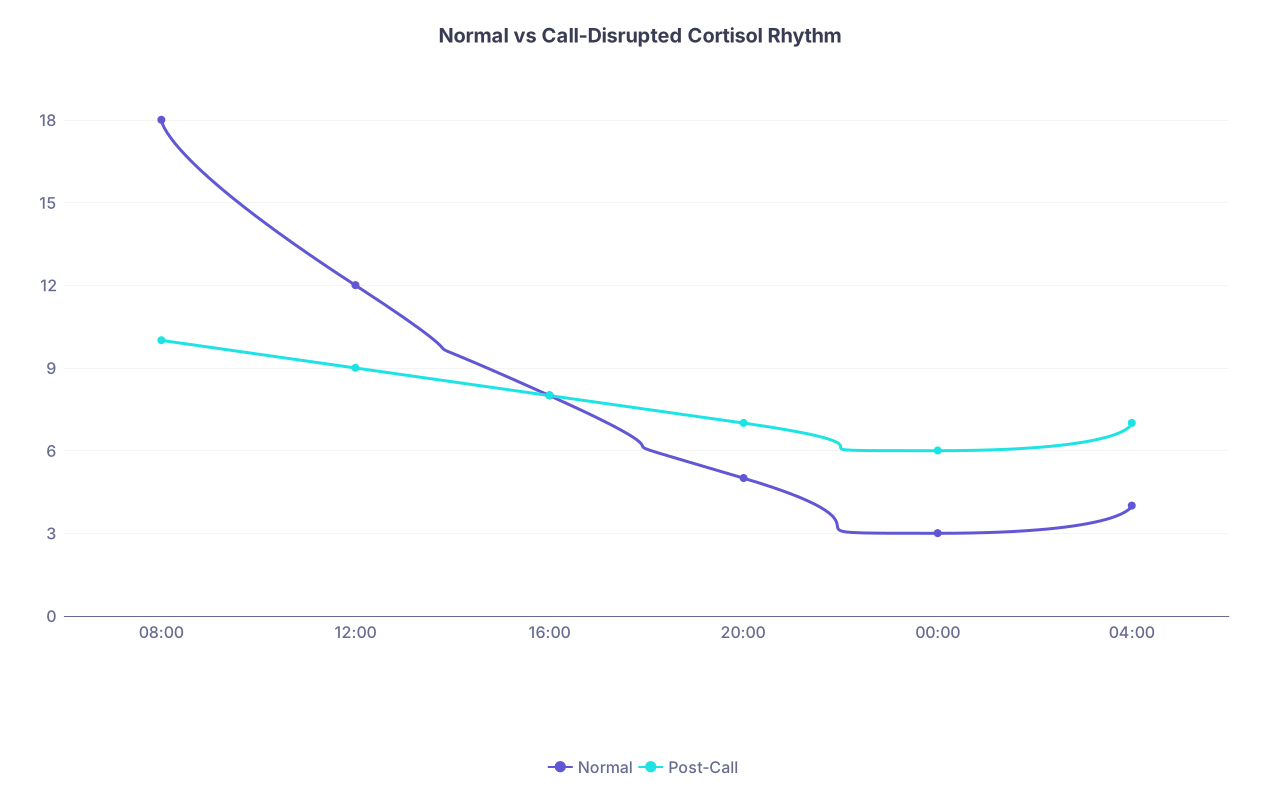
| Category | Normal | Post-Call |
|---|---|---|
| 08:00 | 18 | 10 |
| 12:00 | 12 | 9 |
| 16:00 | 8 | 8 |
| 20:00 | 5 | 7 |
| 00:00 | 3 | 6 |
| 04:00 | 4 | 7 |
2.2 Autonomic Nervous System: Stuck in “Prepare for Threat”
Two arms:
- Sympathetic (“fight‑or‑flight”)
- Parasympathetic (“rest‑and‑digest”, strongly via the vagus nerve)
You need both. Acute stress correctly cranks sympathetic. Then parasympathetic should reassert control.
In training environments that:
- Normalize staying late “for the team”
- Ping you on WhatsApp / Epic even post‑call
- Tie your self‑worth to attending moods and patient scores
…you rarely get a clean “off” window. Sympathetic tone stays high. Parasympathetic activity (heart rate variability, vagal tone) is suppressed.
On the floor this looks like:
- Resting heart rate 10–15 bpm above your pre‑med baseline.
- Cold hands, GI issues, shallow breathing as your body prepares for threat that never fully arrives.
- Difficulty shifting from “work brain” to “home brain.”
I have seen residents sit at home on their couch, physically safe, but their physiology is still in the hospital.
3. Brain Regions Under Chronic Fire
Let us walk through the big three: amygdala, prefrontal cortex, hippocampus. Then we will hit reward and social pain circuits that drive some of the ugly ethical fallout.
3.1 Amygdala: Threat Amplifier on Overdrive
The amygdala is your internal alarm system. It flags things as threatening or salient.
Under chronic stress:
- It becomes hyper‑reactive.
- It responds faster and more broadly.
- It generalizes: a single bad attending interaction colors your whole day, then your whole rotation.
Clinically, that becomes:
- Constant sense of dread before shifts.
- Over‑interpretation of neutral feedback as criticism.
- Startle response to your pager sound even off‑service.
A hyperactive amygdala also pushes more bottom‑up signals to the rest of the brain, bulldozing thoughtful, top‑down prefrontal regulation. You move from “I choose” to “I react.”
3.2 Prefrontal Cortex: Executive Control Eroded
The prefrontal cortex (PFC) is your CEO. It handles:
- Working memory
- Planning, prioritization
- Inhibitory control (not snapping at the nurse, not writing that email)
- Moral reasoning and perspective‑taking
Chronic cortisol exposure and sleep deprivation reduce PFC efficiency:
- Functional: neurons fire less coherently, networks are noisy.
- Structural: long‑term, animal and human data show decreased dendritic complexity and volume.
In plainer language: your capacity to choose well under pressure is being biologically eroded by the system that demands you choose well under pressure.
You see it in:
- “Stupid” charting errors from otherwise sharp residents at 3 a.m.
- Black‑and‑white thinking: “I’m a terrible doctor” vs nuanced reflection.
- Ethical shortcuts: “I’ll just copy‑forward this entire note, I don’t have time.”
This is not a character collapse. It is PFC bandwidth collapse.
3.3 Hippocampus: Learning and Memory Under Cortisol
The hippocampus encodes new memories and contextual details. It is also rich in glucocorticoid receptors, which means cortisol hits it hard.
Over time, chronic stress can:
- Impair new memory formation (you read the same UpToDate page three times and still do not remember it on rounds).
- Disrupt spatial and contextual memory (you forget exact med changes or subtle exam findings more easily).
- Alter volume and connectivity, especially under prolonged sleep deprivation plus high cortisol.
On the ground:
- You notice that reading after a 14‑hour day yields very little retention.
- You blank on details during pimping that you “definitely studied.”
- You increasingly rely on checklists and templates, not because you are lazy, but because your hippocampus is not firing on all cylinders.
That directly undercuts what residency is supposed to be: a period of maximal learning.
4. Reward, Motivation, and Why Medicine Starts Feeling Empty
This is where things get dark if we are not honest. Chronic stress does not just make you tired. It remaps your motivation system.
4.1 Dopamine, Reward Prediction, and the Moving Goalposts
The mesolimbic dopamine system (ventral tegmental area → nucleus accumbens → PFC) responds strongly to:
- Novelty
- Anticipation of reward
- Surprising successes
In training, the reward structure is:
- Delayed (board scores years away, fellowship later)
- Unreliable (praise depends on which attending you get)
- Often overshadowed by criticism
So you get constant effort, little predictable positive reinforcement, and frequent negative feedback. Chronic stress plus this reward pattern leads to:
- Anhedonia: you stop enjoying things that used to feel meaningful. Even a “thank you” from a family lands weakly.
- Shift to relief‑based motivation: you are not working for satisfaction; you are working to avoid being yelled at or failing.
- Narrowed reward repertoire: quick dopamine hits start winning: scrolling, junk food, alcohol, endless YouTube nights.
This is not weak willpower. It is a brain trying to find any reliable reward in a hostile environment.
4.2 Social Pain Circuits: Shame, Comparison, and Evaluation
The dorsal anterior cingulate cortex (dACC) and anterior insula respond both to physical pain and social rejection. That is not metaphor; fMRI data show overlapping activation.
Training is built on:
- Public pimping.
- Group evaluations.
- Constant comparison to peers (“She already published three papers; I have none”).
- Implicit shaming (eye rolls, sarcastic comments).
Social evaluation stress lights up these regions repeatedly. Over time:
- You develop a chronic background of social threat.
- You replay conversations with attendings at 2 a.m.
- You ruminate about what your co‑residents “really think” of you.
Pair that with hyperactive amygdala and underpowered PFC, and you have a pipeline to chronic shame and self‑criticism. Ethically, this matters, because people in chronic shame are much more likely to:
- Hide mistakes.
- Avoid asking for help.
- Under‑report impairment (sleep, substance, mental health).
You are watching neurobiology actively undermine the foundations of safe medical practice.

5. Chronic Stress, Ethics, and Professionalism: The Ugly Connections
Let me be blunt: chronic neurobiological stress states do not stay “in your head.” They change how you treat patients, colleagues, and yourself. That is the ethical dimension.
5.1 Empathy Erosion: Not Because You Do Not Care
Empathy is not magic. It is a network:
- Medial PFC
- Temporoparietal junction
- Anterior insula
- Mirror neuron systems
All of which require:
- Adequate PFC function.
- Enough bandwidth to simulate another’s experience.
- A nervous system that does not feel constantly under siege.
Chronic stress and sleep loss push you into self‑preservation mode. Your brain unconsciously triages:
“My survival and performance come first. Emotional resonance with this patient can wait.”
So you see:
- Short, transactional patient interactions.
- Irritation at “noncompliant” patients.
- Subtle dehumanization: “the appy in room 3” instead of “the college kid who is terrified.”
Ethically, you are now at risk of violating core professional commitments: respect for persons, beneficence, nonmaleficence. Not because you intended harm, but because your capacity for empathy is biologically compressed.
5.2 Moral Distress and Moral Injury
Moral distress: you know the right thing, but cannot do it due to system constraints.
Moral injury: repeated, serious betrayal of what you believe is right, by yourself or others, in high‑stakes contexts.
Chronic stress makes both more likely and more damaging by:
- Narrowing your cognitive flexibility (so options look more black‑and‑white).
- Amplifying every instance of perceived failure (“I discharged too early; I am a bad doctor”).
- Dampening your ability to integrate these events into a coherent professional identity.
I have watched residents carry a single bad outcome for years, replaying it daily, while the system labels it “expected complication.” That dissonance plus chronic stress is a direct path to depression, substance use, or complete disengagement.
5.3 Safety, Honesty, and the Slippery Slope
Under high cognitive load and stress:
Error detection networks (ACC, PFC) have less capacity.
You rely more on heuristics (“I’ve seen this before, it’s fine”) and autopilot.
You become more tempted to cut corners and rationalize them.
Pre‑charting labs you have not actually checked.
Copy‑forwarding physical exams you did not fully perform.
Minimizing the significance of near‑misses.
That is not just professionalism. That is ethics. Patients assume your brain is functioning at a level your neurobiology often cannot sustain at 3:00 a.m. on your sixth consecutive shift.
| Neuro Change | Clinical/Ethical Risk |
|---|---|
| Hyperactive amygdala | Overreacting to feedback, avoidance |
| Impaired PFC | Poor judgment, cutting corners |
| Hippocampal dysfunction | Memory lapses, documentation errors |
| Blunted reward system | Anhedonia, disengagement from patients |
| Low vagal tone | Irritability, reactive communication |
6. Concrete Neuro‑Informed Strategies That Actually Help
You are not going to fix residency. But you can work with your neurobiology instead of against it. This is not “self‑care” fluff; this is targeted modulation of the systems I just described.
6.1 Micro‑Recovery: Short Doses, High Impact
You will not get consistent 2‑hour breaks. Forget that fantasy. What you can get:
- 60–120 seconds between tasks
- 5–10 minutes between pages or patients
- 10–20 minutes post‑signout or pre‑rounds
Use them deliberately:
Physiologic sigh (2 breaths)
Two quick inhales through the nose (second one smaller), long exhale through the mouth. Repeat 3–5 times.- Lowers sympathetic output.
- Increases parasympathetic activity (vagal).
- Deactivates some of the limbic overdrive.
Visual down‑regulation
Stop staring at screens in your “breaks.” Instead:- Look at a distant point (out a window, down the hall).
- Let your visual focus go broad rather than tight.
This shifts your brain from threat‑focused tunnel vision to a more relaxed, exploratory mode.
Name and frame
Quietly label your state: “I feel overloaded and tense.” That simple cognitive labeling, shown in imaging studies, decreases amygdala reactivity by recruiting PFC.
None of these require crystals or an app. They require 60 seconds and minimal dignity loss.

| Step | Description |
|---|---|
| Step 1 | Acute stressor |
| Step 2 | Notice body state |
| Step 3 | Physiologic sigh x3 |
| Step 4 | Visual reset 30 sec |
| Step 5 | Label emotion |
| Step 6 | Resume task |
6.2 Sleep: Strategic Damage Control
You will not get perfect 8‑hour nights. Reality:
- Fragmented sleep
- Rotating schedules
- Call shifts
But you can blunt the worst neurobiological damage:
- Protect the first 3–4 hours of sleep post‑call like they are a procedure. No scrolling. Dark, cool room. Caffeine stopped 6 hours before leaving the hospital if possible.
- Nap policy: 20–30 minutes, or a full 90 minutes if you can. The middle ground (45–60 minutes) is where you wake up in deep sleep and feel wrecked.
- Light exposure: bright light (sunlight if you can) in your first 30–60 minutes awake. This anchors your circadian rhythm and helps cortisol re‑establish a pattern, even if imperfect.
Sleep is not “selfish.” It is what keeps your PFC and hippocampus from breaking further. That is a patient safety issue.
6.3 Boundaries as Neuro‑Protection, Not Attitude
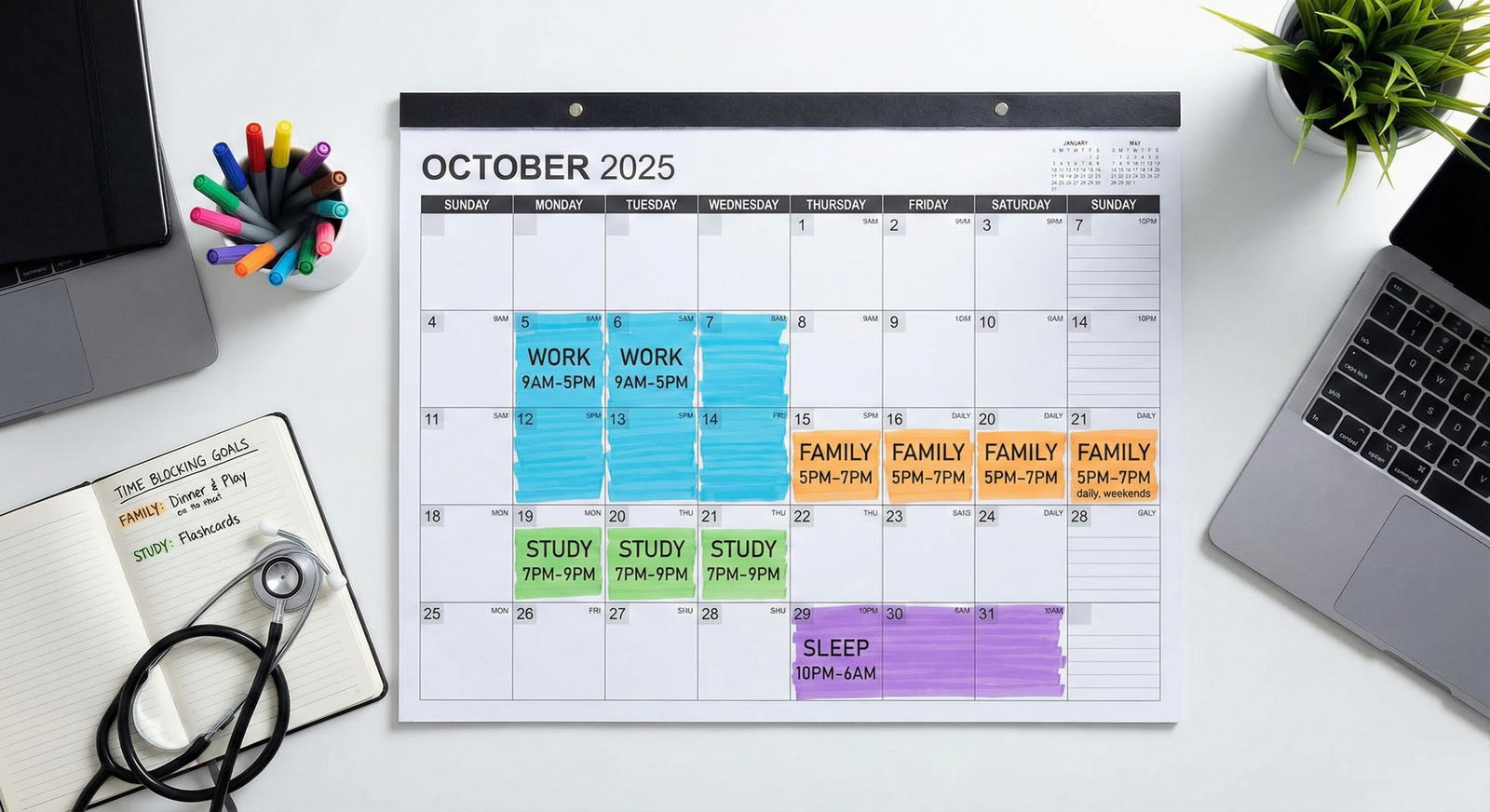
Saying no and turning off work channels is not just psychological. It is literal stimulus control.
- One communication channel for urgent issues only (pager or specific phone). Mute everything else after hours.
- No EHR “just checking labs” when you are post‑call at home. Unless your program truly expects it (and then that is an ethics conversation).
- Say out loud to teammates: “I’m off now and will be back at X. If something urgent arises, page me; otherwise I will address it when I am back.” You are training their expectations and protecting your amygdala from 24/7 threat scanning.
If your brain believes “I could be pinged any second,” your stress circuits never fully shut down. Boundary setting is not optional; it is preventive neuro‑care.
6.4 Pro‑Social Buffering: Specific, Not Generic “Support”
Humans regulate each other’s nervous systems. Measurably. Oxytocin, vagal tone, all of that.
But vague “lean on your support system” is useless. Be specific:
- One colleague you can text “I might have messed up” without fear of gossip.
- One attending or senior who actually remembers what nights feel like and responds with guidance, not judgment.
- One non‑medical friend or partner you deliberately see without talking about the hospital for at least half the time.
Social safety literally reduces amygdala activation and helps restore PFC control. Without it, your brain treats the entire world as an extension of the ward.
6.5 Ethical Micro‑Practices to Counter Dehumanization
Tiny behaviors that push your brain toward empathy rather than detachment:
- Use the patient’s name once per encounter, even if rushed. Activates social circuits rather than “object” processing.
- One sentence of perspective‑taking in your head: “She has been in this bed for 6 days; of course she’s frustrated.”
- Debrief morally loaded events (bad outcomes, near misses) with at least one other person instead of burying them. Creates a narrative rather than fragmented, intrusive memories.
You are not just being “nice.” You are actively conditioning your neural pathways for empathy under stress rather than letting them atrophy.
7. System‑Level Reality Check (Without the Fantasy Fixes)
You cannot self‑care your way out of a structurally unsafe system. Let us not pretend.
But understanding neurobiology is also a weapon in advocacy:
- When you argue for caps on consecutive night shifts, you can point to PFC and hippocampal dysfunction, not just “fatigue.”
- When pushing back on punitive responses to errors, you can explain how shame and chronic stress increase hiding and future errors.
- When discussing well‑being, you can demand changes that actually affect HPA and autonomic load (schedule design, staffing), not just yoga classes.

Ethically, institutions that understand this neurobiology and choose to ignore it are not just “behind the times.” They are culpable for preventable harm to trainees and, indirectly, patients.
8. Bringing It Back To You
If you remember nothing else, remember this:
Your brain under chronic stress is not broken. It is adapting to persistent threat cues, sleep disruption, and inconsistent reward. Those adaptations, however, have costs: cognition, memory, empathy, and ethics all take hits.
You will not have a perfect training environment. But you can:
- Recognize your patterns as neurobiological, not moral.
- Use targeted micro‑interventions to give your PFC and parasympathetic system some breathing room.
- Be honest about how stress is shaping your ethical and professional behavior, and correct course before you slide further.
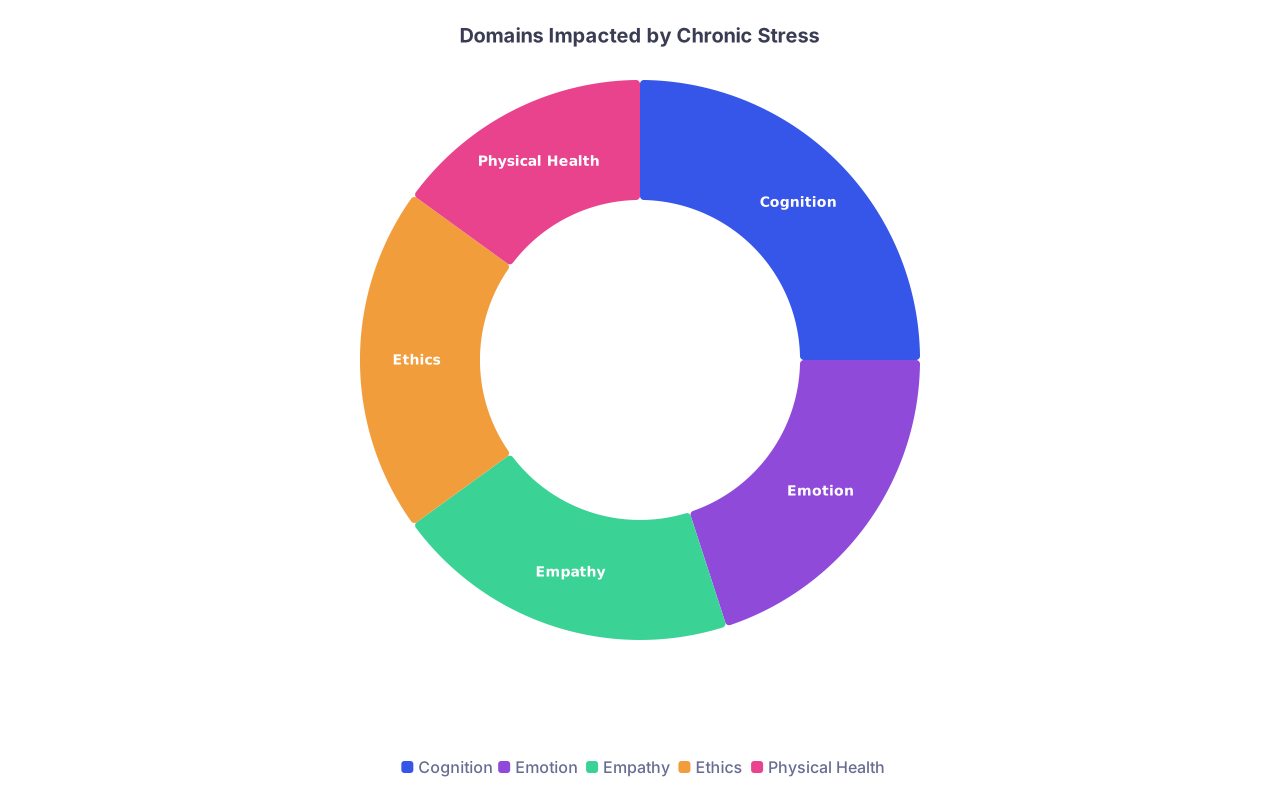
| Category | Value |
|---|---|
| Cognition | 25 |
| Emotion | 20 |
| Empathy | 20 |
| Ethics | 20 |
| Physical Health | 15 |
FAQ (Exactly 5 Questions)
1. How do I know if what I am experiencing is “chronic stress” versus just being busy or tired?
Busy resolves with rest. Chronic stress persists despite days off and starts to permeate everything. Warning signs: you wake up already tense, you cannot “switch off” even on vacation, you feel detached from things you used to enjoy, and small stressors trigger outsized reactions. If your baseline feels wired‑and‑exhausted most days for weeks, you are in chronic territory.
2. Does chronic stress during residency cause permanent brain damage?
“Permanent damage” is the wrong frame, but there are real structural and functional alterations documented in chronically stressed populations: reduced hippocampal volume, altered PFC activity, heightened amygdala responsivity. The good news: many of these changes are at least partially reversible with sustained stress reduction, adequate sleep, and supportive environments. The sooner you intervene, the more plastic your system remains.
3. Why do I feel emotionally flat with patients even though I still care about medicine?
That flatness is classic reward and empathy circuit fatigue. Chronic stress and sleep loss push your brain into energy conservation. Emotional engagement is metabolically expensive, so your nervous system starts cutting it back. You still care cognitively (“I want to do right by them”), but your affective response is blunted. Rebuilding small areas of joy and genuine rest outside work often precedes any improvement in empathic capacity at work.
4. Are there specific red flags that mean I should seek professional help, not just “cope better”?
Yes. Neurobiology aside, seek help urgently if you notice: persistent thoughts of death or suicide, using alcohol or other substances to sleep or get through shifts, episodes of uncontrolled anger or rage, memory gaps you cannot explain, or a level of detachment where you catch yourself not caring about major patient outcomes. Those are not normal adaptations; they are signs your system is past its safe operating range.
5. What is one change programs could make that would have the biggest neurobiological impact?
Stabilizing schedules and enforcing protected sleep would have the largest single effect on PFC function, hippocampal health, and HPA regulation. That means: strict caps on consecutive long shifts, predictable off‑days that are actually off (no hidden admin work), and eliminating marathon calls as a “badge of honor.” Everything else—wellness lectures, free snacks, even therapy access—helps, but without schedule reform you are treating symptoms, not the disease.
Key points:
- Chronic stress in training physicians is a specific neurobiological state—HPA overdrive, autonomic imbalance, and structural/functional brain changes—not a character flaw.
- Those changes directly impair cognition, memory, empathy, and ethical decision‑making, with real consequences for patient care and professional identity.
- You can partially counter this with targeted, neuro‑informed strategies (micro‑recovery, sleep protection, boundaries, pro‑social buffering) while pushing hard for system‑level schedule and culture changes that reduce the underlying load.