
Pager Anxiety: Understanding and Managing Anticipatory Stress
It is 02:37. You are not on call. You are in your own bed, in your own apartment, but your body does not care. You bolt awake because you are sure you heard the pager. Or the phone. Or a code alarm. You grab the hospital phone from the nightstand. Screen blank. Silent.
Your heart is still going 130.
You are not crazy and you are not alone. That wired, on‑edge, “about to get called” feeling has a name and a physiology. If you do not understand it and manage it, it quietly eats your sleep, your relationships, and your judgment. This is pager anxiety: anticipatory stress wired into the way we train physicians.
Let me break this down specifically.
What Pager Anxiety Actually Is (And Is Not)
Pager anxiety is anticipatory stress tied to the expectation of being interrupted, summoned, or needed urgently. It is not just “being annoyed” by calls.
Conceptually, it sits at the intersection of:
- Classical conditioning
- Hypervigilance
- Sleep fragmentation
- Occupational moral stress
You pair an aversive stimulus (pager tone, unknown number, secure chat “STAT”) with high‑stakes demands (sick patient, angry family, impatient attending, impending code). Over and over. Eventually, your nervous system starts firing just from the possibility of the sound. Or from anything that resembles it.
You see this clearly in a few typical patterns:
- Phantom pages: “I keep hearing my pager in the shower / OR / grocery store.”
- Startle response: Normal text tone → jolt, adrenaline surge, racing thoughts.
- Conditioning to visual cues: Seeing the unit number or “Blocked caller” and feeling your stomach drop.
- Persistent arousal off‑duty: You check your phone every few minutes, “just in case,” even when not on call.
This is not “weakness” or “poor coping.” It is a predictable nervous system response to intermittent, uncontrollable, high‑salience stimuli.
Why medicine is the perfect breeding ground
Medicine combines several features that supercharge anticipatory stress:
Intermittent reinforcement
You do not get called every minute. You get called unpredictably. Some calls are trivial; some are life‑and‑death. That kind of variable ratio schedule is exactly what keeps slot machines addictive. Here, the “reward” is avoiding catastrophe.High perceived cost of missing a call
You know the story: “There was a delay in responding to the page and the patient crashed.” Whether that was fair or not, you learn: instant response = moral safety. Anything less feels dangerous.Role ambiguity and blame culture
Nurses, consultants, families, administrators—all have the power to summon you. The message you absorb: if something goes wrong, “why didn’t you respond sooner / earlier / more thoroughly?”Lack of control over workload
You do not control timing, volume, or content of calls. Loss of control is one of the biggest drivers of stress physiology. You are at the mercy of the next beep.
So you learn to live in “pre‑alert” mode. Chronic low‑grade fight‑or‑flight, ready to spike at any sound.
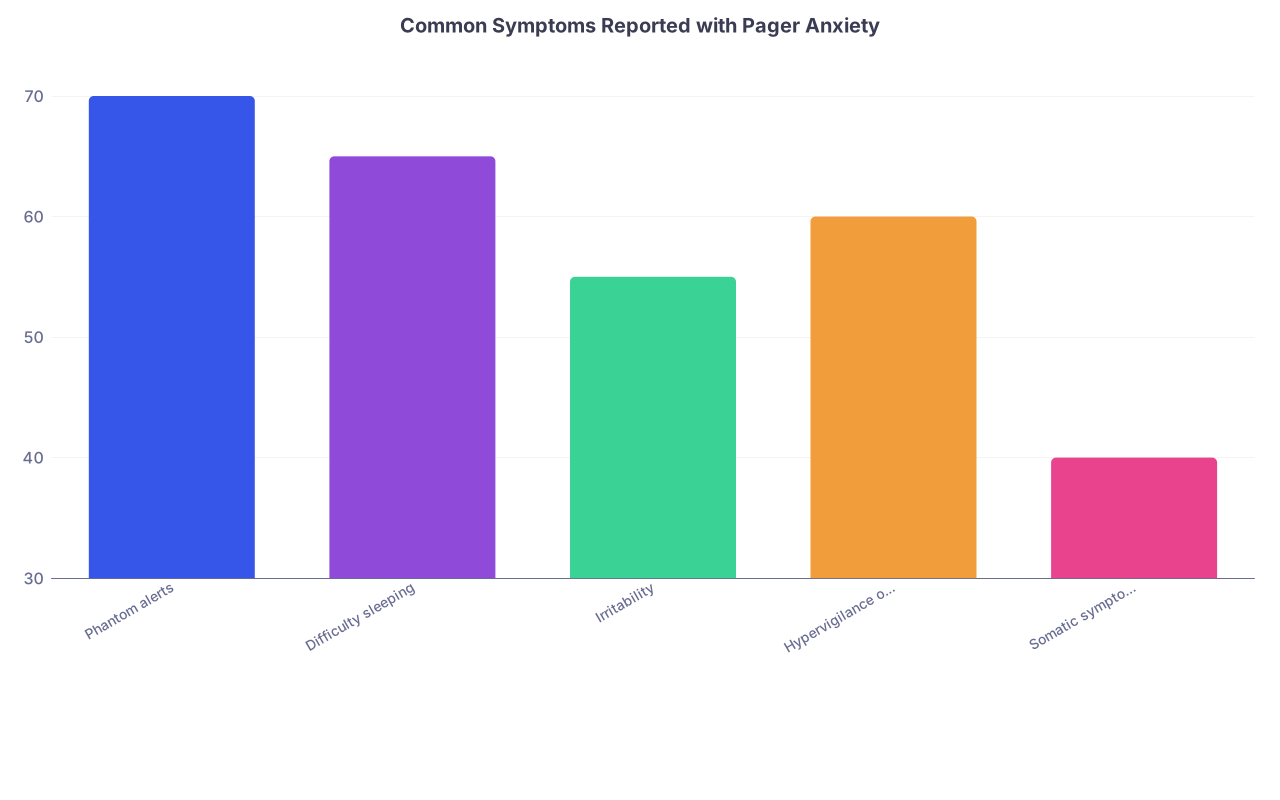
| Category | Value |
|---|---|
| Phantom alerts | 70 |
| Difficulty sleeping | 65 |
| Irritability | 55 |
| Hypervigilance off-duty | 60 |
| Somatic symptoms (palpitations, GI) | 40 |
Numbers in that chart are roughly what I see when I ask a residency class informally. The point is not exact percentages. The point is: this is the norm, not the exception.
The Physiology: What Your Body Is Actually Doing
Let us be concrete about what is happening under the hood.
Acute response
Pager goes off. Before you are consciously aware of it, your amygdala has decided this might be threat:
- Sympathetic activation: heart rate up, blood pressure up.
- Cortisol and catecholamines surge.
- Blood flow shunts to muscles; GI motility changes.
- Prefrontal cortex function narrows: you tunnel on the “problem.”
That is adaptive if your patient is hypotensive. It is less adaptive if the page is “please renew multivitamin.”
Chronic response
Repeated unpredictable activation does several things:
- Lowers your threshold: smaller cues now trigger larger responses.
- Disrupts sleep architecture: more awakenings, more time in lighter stages, less restorative deep sleep.
- Raises your baseline arousal: you live in a semi‑alert state.
Result: you are tired but wired. Exhausted but unable to truly relax. Your brain stays on “call light” even when the call light is off.
How Pager Anxiety Shows Up in Real Life
If you are wondering whether this applies to you, do a quick internal audit against some very specific patterns I see over and over.
Sleep and rest
- You wake up multiple times “just to check the phone” on home call, even when it rarely rings at night.
- You struggle to fall asleep the night before call, replaying worst‑case scenarios.
- On your first post‑call night, you still jolt awake at every small sound.
- You cannot nap effectively because you are half‑listening for alerts.
Behavior on and off service
- You carry your phone even to the bathroom at home. You feel naked without it.
- Going to the gym, shower, or movie on a call day feels “reckless,” even if coverage is clear.
- You feel a surge of irritation (sometimes rage) at non‑urgent calls, but you answer immediately anyway.
- You over‑document or over‑order “just in case someone pages me about this later.”
Emotional and ethical landscape
This is where it intersects with work‑life balance and ethics, not just personal comfort.
- You feel guilty for silencing or delaying alerts for any reason, including basic human needs (eating, using the bathroom).
- You stay longer than necessary after shift change because “they might need me,” even with formal sign‑out done.
- You read policies on response times as moral commandments, not guidelines to balance competing duties.
- Saying “This can safely wait 20 minutes” feels unethical—even when medically true.
You start equating moral worth as a physician with instantaneous availability. That is where pager anxiety stops being a nuisance and starts eroding your sense of self and your boundaries.
The Ethical Core: Duty, Limits, and “Being a Good Doctor”
Let us be blunt: a lot of pager anxiety is not pathology. It is the predictable outcome of mixed messages about what it means to be a “good doctor.”
You are taught three competing things:
- Patient care is your highest priority.
- You must maintain wellness, boundaries, and work‑life balance.
- You must obey hierarchical expectations, implicit and explicit.
When those three collide on a call night, patient care wins, wellness loses, and the hierarchy decides how far you are allowed to push back. So you internalize:
- Good doctors never miss a call.
- Good doctors respond immediately—even if the call is non‑urgent.
- Good doctors always say yes.
- Good doctors feel guilty when they rest.
This is ethically sloppy.
A more accurate, adult framework:
- Your duty is to ensure safe, timely care, not to be personally available every second.
- System design (coverage, triage, escalation protocols) shares that duty. It does not all sit on your shoulders.
- You have concurrent ethical duties: to yourself, to other patients, to your team. You are allowed to prioritize.
Ethically, ignoring all limits because “the patient might need something” is not virtue. It is negligence toward your other obligations. Including not harming yourself.
Practical Management: What You Can Actually Do
You cannot change the fact that patients crash at 3 a.m. You can change how your nervous system, your workflow, and your boundaries respond to the constant possibility.
I will break this into three levels:
- Individual nervous system training
- Practical workflow / behavioral modifications
- Team and system‑level adjustments
You need a bit from each.
1. Training Your Nervous System, Not Just “Relaxing”
If you treat this as “I should relax more,” you will fail. Your body is doing exactly what you trained it to do. You need to re‑train it.
A. Deliberate “safe sound” exposure
Right now, pager‑like sounds = threat. You can condition a competing association.
Simple drill, 5–10 minutes a day, especially on non‑call days:
- Pick a neutral or pleasant activity at home: reading, music, stretching.
- Set a recurring, gentle tone on your phone that mimics but is distinct from your pager.
- Every 60–90 seconds, have it chime. When it rings, you:
- Pause.
- Take one slow diaphragmatic breath with a long exhale (4 in, 6–8 out).
- Visually confirm “not urgent / I am off.”
- Resume your pleasant activity.
You are wiring: “sound → check → safe → exhale.” Instead of “sound → panic → adrenaline.”
Over weeks, that pattern bleeds into your real response. I have watched residents go from heart‑racing to mild annoyance in 2–3 months.
B. Micro‑downregulation on every page
On call, you cannot sit and meditate for 20 minutes. You can steal 4 seconds.
When your pager or phone goes off:
- Before looking, exhale fully. Not a sigh, a deliberate emptying.
- Then one slow inhale, normal exhale.
- Then look and decide.
This does two things:
- Blunts the immediate sympathetic spike.
- Inserts a cognitive beat: “What is this? How urgent is it? What is my plan?”
Sounds trivial. It is not. Those 3–4 seconds prevent automatic, panicked, over‑responding to trivial issues. Over a night, that is dozens of reps of “I can be calm and still respond fast.”
C. Sleep protection rituals off‑call
Your brain will not quiet without evidence that you are, in fact, off duty.
Concrete moves:
- Physically separate work and personal devices if possible. If you have to carry the same device, change the notification profile dramatically when you are off (different tone, volume, or no tone at all).
- Create a shutdown ritual on the last day before days off: last in‑basket check, last Epic message, deliberate “off” act (power cycle phone or change lock screen). Simple, symbolic actions matter.
- Use a single, consistent wind‑down routine that does not involve screens 30 minutes before bed on off days: shower, light stretching, a non‑medical book. You are building a cue: “this sequence means no one will page me.”
You are teaching your nervous system: there are times when vigilance is not required.
2. Concrete Behavioral Changes to Reduce Anticipatory Stress
Let us move from physiology to logistics. A lot of your anxiety is not about the sound itself. It is about what happens after: chaos, unclear expectations, perceived judgment.
You can blunt that with better structures.
A. Pre‑call “containment planning”
Loose, unspecific dread feeds anxiety. Specific, concrete plans shrink it.
Before call or a heavy service block, spend 5–10 minutes answering:
- What are my real, not imagined, responsibilities tonight?
- What is my plan for:
- New admissions?
- Cross‑cover pages on stable patients?
- True emergencies?
- Where are my red lines for calling my senior or attending?
Write it down if you need to. Something like:
- “Any SBP < 90, O2 sat < 88% on 6 L, new chest pain with concerning features = I will see the patient and call my senior.”
- “Routine meds, bowel regimens, TSH checks: I will batch them and handle in 15–30 minute blocks, not immediately interrupting critical tasks.”
This is not “being lazy.” It is allocating finite cognitive bandwidth ethically. Having that template reduces the anticipatory “what if” noise.

| Step | Description |
|---|---|
| Step 1 | Start of Call Shift |
| Step 2 | Emergent issues |
| Step 3 | Urgent but stable |
| Step 4 | Non-urgent |
| Step 5 | See patient and call senior |
| Step 6 | Address within 30 min |
| Step 7 | Batch and address in blocks |
| Step 8 | Define responsibilities |
B. Structured triage language with nurses and staff
Unstructured paging amplifies chaos. Your goal is not to be less responsive. Your goal is to shape the inflow.
Work with the charge nurse or unit early in the shift. A short script works better than vague “call me whenever.”
Example conversation, early evening:
“From now until midnight, if anyone is hemodynamically unstable, short of breath, altered, or in severe pain, please page me STAT and I will come immediately.
For routine orders, sleep meds, or chronic labs, it is OK to bundle those every 30–60 minutes, unless you are worried. That way I can also make sure I am not missing the sicker ones.”
You will be surprised how often nursing appreciates the clarity. They are also trying to manage their own version of anticipatory stress.
C. Setting and communicating response expectations
Some services pretend that “instant response” is the only safe standard. In practice, safe response has a range.
You can make that explicit:
- When you answer:
“I am with a crashing patient right now, but I hear you. I will get to this in about 20 minutes. If the situation changes before that, page me STAT and I will reprioritize.”
You have:
- Acknowledged the call
- Given a concrete timeframe
- Created a back‑up escalation path
This reduces your internal pressure to “do everything now” and reduces others’ need to keep pinging you “just to check.”
D. Using technology intentionally instead of letting it use you
Some of you are dealing with pagers; others, with phones and secure chat. Either way, stop letting default settings dictate your life.
Examples:
- Different tones for:
- Rapid response / code
- Direct nursing line
- Secure chat / non‑urgent
- During rounds or critical tasks:
- Silence non‑urgent channels but keep emergency alerts.
- Off duty:
- Turn off all work apps and tones except the one channel that truly should reach you (if any).
That is not rebellion. That is aligning the salience of the sound with the actual urgency of the content.
3. Team and System-Level Changes (Yes, You Can Push Here)
You are not going to redesign paging infrastructure as an intern. You can, however, push small levers that matter.
A. Coverage clarity
A huge driver of pager anxiety is not knowing whether you are truly “off.”
Demand clarity:
- Who is covering you when you are in a procedure / clinic / on break?
- Who covers cross‑cover for your service when you leave at 1800?
- How are responsibilities handed off?
If the answer is “Just keep the pager on, in case,” you are in a dangerous culture. This is an appropriate moment to escalate politely:
- “I am concerned that if there is no clear coverage, we increase the risk of both missed calls and unsafe fatigue. Can we define who is primary overnight?”
You will be labeled “difficult” in some places for saying this out loud. Say it anyway. That label is code for “this person is forcing us to confront our systems problem.”
B. Protected boundaries for off‑duty time
You are entitled to truly off‑duty periods. Ethically, not just contractually. Pagers undermine this when they bleed across shifts.
Two moves:
- On sign‑out, physically hand off the pager or explicitly log out of call roles in apps. Do not “just keep it for now.”
- If you are routinely getting contacted off duty for things that are not true emergencies, start documenting and bringing this to your chief or program director as a pattern, not a complaint. Patterns get attention.
| Feature | Healthier Culture | Unhealthy Culture |
|---|---|---|
| Off-duty contact | Rare, true emergencies only | Routine questions, loose ends |
| Response time expectations | Stratified by urgency | Implicit expectation of instant |
| Coverage clarity | Explicit, written, redundant | Vague, dependent on goodwill |
| Reaction to delayed but safe reply | Neutral / understanding | Shaming, stories of “bad doctors” |
| Role of leadership | Models boundaries | Brags about 24/7 availability |
You cannot fix all of this alone. But you can refuse to silently play along.
The Intersection with Work‑Life Balance and Identity
Pager anxiety does not stay at work. It bleeds.
You may notice:
- You snap at your partner for texting “too much” because your brain tags all alerts as demands.
- You resist any plan that requires you to be offline—movies, hikes, travel—because your body is not convinced you are allowed to be unavailable.
- You “relax” with your phone in hand, compulsively checking, which is not relaxation at all.
This is how anticipatory stress undercuts your entire life.
Ethically, there is another layer: you are a person, not a utility. If you internalize that your only value is in urgent responsiveness, then any boundary, any “no,” feels like a moral failure. That is how people end up staying in toxic jobs, unsafe schedules, or abusive environments far longer than they should.
You have a professional duty to patients. You also have a duty to sustain a self that can keep doing this work without becoming hollowed out or dangerous.
When This Crosses the Line into an Anxiety Disorder
A certain baseline of pager‑related anticipatory stress is endemic to training. But there is a point where this is not “normal residency stress” any more.
Pay attention if you recognize:
- Persistent, intrusive worry about pages even off service and on vacation.
- Panic‑like episodes (palpitations, dyspnea, chest tightness) triggered by alerts or thoughts of work.
- Avoidance behavior: delaying logging into the EMR, avoiding checking results, procrastinating on calling back.
- Sleep so disrupted that you struggle to function cognitively.
- Spillover into generalized anxiety about other areas of life.
At that point, you are not just dealing with “pager culture.” You are dealing with an anxiety disorder that deserves treatment.
Treatment can include:
- Structured CBT focusing on anticipatory anxiety and exposure.
- Short‑term pharmacologic support, particularly if sleep is wrecked.
- Explicit work adjustments (temporary change in call load, type of rotations).
If your institution’s “wellness resources” are mainly yoga posters and pizza, you may need to look outside for real care. Do not romanticize suffering as commitment.
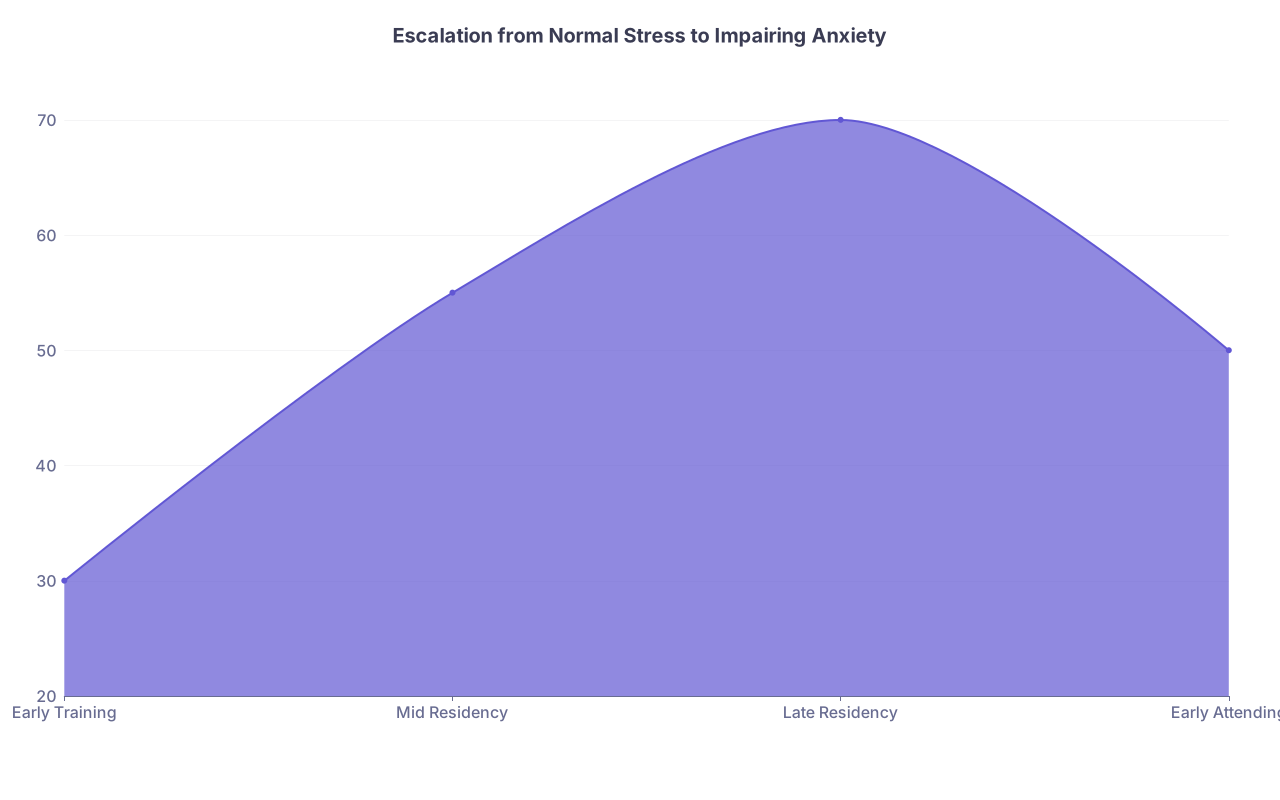
| Category | Value |
|---|---|
| Early Training | 30 |
| Mid Residency | 55 |
| Late Residency | 70 |
| Early Attending | 50 |
The area here is subjective, but the pattern is real: if unaddressed, anticipatory stress tends to worsen mid‑training and then either partially recovers or calcifies into chronic anxiety as an attending.
Realistic Expectations: What Improvement Looks Like
You are not going to become someone who loves getting paged at 3 a.m. That is not the goal. The goal is to move from:
- Constant dread → Tolerable vigilance
- Spikes of panic → Manageable alertness
- Identity fused with availability → Identity grounded in judgment and values
In practical terms, people who work on this seriously for a few months report:
- Fewer “phantom” pages.
- Less startle at non‑urgent alerts.
- Actual relaxation on off days.
- Clearer triage and less resentment on call.
- More capacity to say “This can wait,” without guilt.
None of those require your hospital to become enlightened overnight. They require you to stop treating your nervous system as an enemy and start training it like an ally.




| Step | Description |
|---|---|
| Step 1 | Pager/phone rings |
| Step 2 | Pause and exhale |
| Step 3 | Check message content |
| Step 4 | Go immediately, call for help as needed |
| Step 5 | Assign priority level |
| Step 6 | Schedule task in next 15-60 min |
| Step 7 | Return to current activity if safe |
| Step 8 | Emergent? |
Three Things to Take With You
- Pager anxiety is not a character flaw. It is a conditioned physiologic response to an unhealthy mix of unpredictability, high stakes, and vague expectations.
- You can and should retrain your response—through tiny, repeatable habits: brief breathing before answering, clear triage plans, deliberate off‑duty rituals, and structured communication with your team.
- Your worth as a physician is not measured in milliseconds from beep to callback. It is measured in judgment, presence, and sustainability. Build habits and boundaries that protect those, and the pager becomes a tool again—not a threat.