
You Are Here
It is the middle of PGY‑2. You just finished a brutal stretch of nights. Your email pings: “Reminder – unused PTO will not roll over to the next academic year.”
You have:
- 16 vacation days “available”
- A chief who says, “We really need coverage that month…”
- Co-residents who brag about “not taking a single day off this year”
- A vague plan to “save days for fellowship interviews later”
So you do what too many residents do.
You click “Mark as read.”
You take zero days.
You call it “being a team player.”
This is the mistake I am warning you about.
Skipping vacations in residency is not a small sacrifice. It is a career-level unforced error with consequences you will feel five, ten, twenty years from now—in your physical health, your judgment, your professionalism, and your personal ethics.
Let me walk you through the traps so you do not repeat what I have watched residents regret over and over again.
The Biggest Myth: “I’ll Rest After Residency”
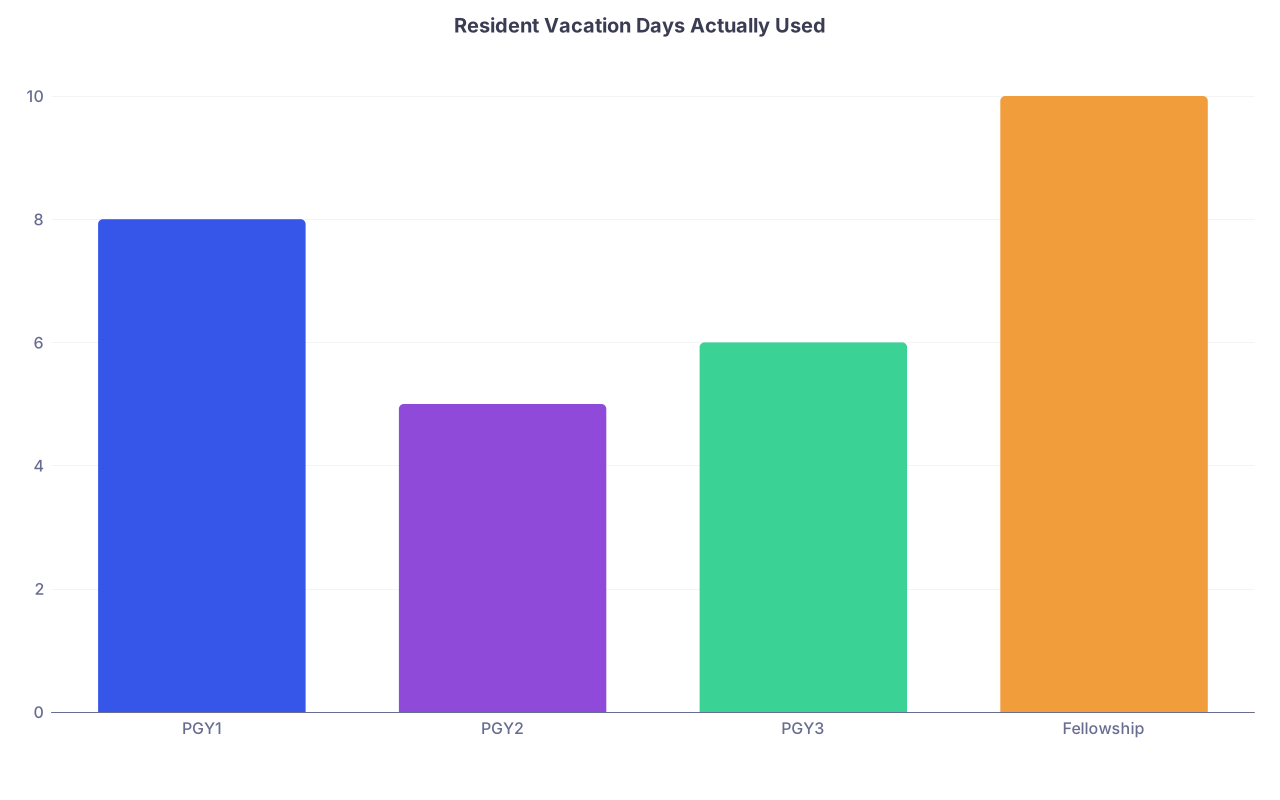
| Category | Value |
|---|---|
| PGY1 | 8 |
| PGY2 | 5 |
| PGY3 | 6 |
| Fellowship | 10 |
The most common story I hear is some version of:
“I’ll just power through now. I can rest after boards / after fellowship / after attending life stabilizes.”
This thinking is wrong on three levels.
1. You Are Training Your Brain in a Bad Habit Pattern
Residency is not just training your medical knowledge. It is training your default operating mode.
If your default during training is:
- Never disconnect fully
- Ignore your own fatigue
- Feel guilty for being off
- See rest as a luxury, not a requirement
Guess what you carry into attending life?
You will not suddenly become “balanced” the day you get an attending contract. You will be an exhausted, hyper-responsible, boundary-impaired attending who:
- Answers every non-urgent message instantly
- Picks up extra shifts constantly
- Cannot say no to committees
- Still “forgets” to take PTO
I have watched this play out in hospital after hospital. The residents who never take vacation become attendings who burn out early and hard.
2. You Are Overestimating Future Control
You think:
- “As an attending, I will set my own schedule.”
- “Fellowship will be lighter; I can rest then.”
Reality:
- Many fellowships are just as grueling as residency, sometimes worse.
- You inherit new pressures: RVUs, billing, metrics, leadership roles, kids, mortgage.
- Time feels even tighter, not looser.
If you choose not to learn how to fight for your own rest while in residency, you are practicing being passive with your own life. That pattern does not magically reverse later.
3. Chronic Exhaustion Quietly Rotates Your Moral Compass
This is the uncomfortable part.
Ethics is not just about knowing what is right. It is about having the capacity to act on it. Chronic sleep deprivation and never stepping away erode that capacity.
Exhausted residents:
- Cut corners on communication
- Snap at nurses and patients
- Document less carefully
- Delay difficult family conversations
- “Forget” to follow up on tasks
Not because they are bad doctors. Because their tank is empty. And it has been empty for months.
Skipping vacation is not just “working hard.” It is choosing to reduce your ability to practice medicine ethically over the long run.
Red Flags You Are Slipping Into the No-Vacation Trap

If you recognize yourself in any of these, you are headed for trouble.
1. You Call It “Vacation” But It Is Actually Work
Common pattern:
- “I used vacation for interviews.”
- “I used my days to move apartments.”
- “I had to use it when I got COVID.”
Those are not vacations. Those are functional absences.
If 100% of your PTO is:
- Board exams
- Interviews
- Illness
- Mandatory life logistics
Then you have effectively taken zero actual restorative time.
The mistake: telling yourself “I used my vacation” when in reality you have not had a single week that was truly detached from clinical responsibility.
2. You Feel Guilty Even Thinking About Time Off
Phrases I have heard from residents:
- “My co-interns will hate me if I take that week.”
- “I do not want the attendings to think I cannot hack it.”
- “What if something bad happens while I am gone?”
Read that last one again. “What if something bad happens while I am gone?”
Something bad will eventually happen while you are off. That is how hospitals work; they run 24/7. If you cannot tolerate that reality, you will imprison yourself in permanent hypervigilance.
The mistake: confusing indispensability with professionalism. You are not indispensable. You are part of a system designed for coverage. The system is not as fragile as your guilt makes it feel.
3. You “Save Up” Vacation and Then Lose It
Every year there is at least one resident who:
- Saves vacation “for interviews”
- Gets fewer interviews than expected
- Ends the year with 2–4 unused weeks
- Cannot roll them over
- Gets nothing in return but burnout and regret
I remember one PGY‑3 in surgery:
She had 22 days available. Used only 6. Left 16 days on the table. That is more than three weeks of paid time that simply vanished so the service “would not be short.”
The program did not give her a medal. They did not promote her faster. She just arrived to fellowship already depleted and more cynical.
You do not get extra credit for being the martyr who never leaves.
How Skipping Vacations Damages Your Career (Not Just Your Mood)
Let me be blunt: this is not about “self-care” Instagram rhetoric. It is about long-term professional competence.
| Domain | With Regular Vacations | Skipping Vacations Long-Term |
|---|---|---|
| Clinical Judgment | Sharper, fewer cognitive slips | More errors, slower thinking |
| Reputation | Seen as balanced and reliable | Seen as resentful, brittle, or checked out |
| Networking | More energy for conferences etc. | Declines invites, misses opportunities |
| Burnout Risk | Modulated, manageable | High risk of early, severe burnout |
| Ethical Resilience | Better boundaries, less cynicism | Boundary erosion, moral fatigue |
1. Your Clinical Brain Degrades Quietly
You will not notice this on day 1. You will feel it on month 16.
Signs I have watched:
- Residents forgetting simple follow-ups repeatedly
- Needing to re-check basic dosing they used to know cold
- Taking 3x longer to write notes because their attention keeps fracturing
- Missing early sepsis or subtle deterioration they would have caught a year earlier
Chronically exhausted brains compensate by:
- Defaulting to heuristics ("they are probably fine")
- Avoiding complex thinking
- Over-relying on others’ plans
That is not what you want your clinical identity to become.
A simple truth: regularly detached vacation time gives your brain a chance to consolidate, reset, and strip away accumulated noise. Without that, you become slower, sloppier, and more dangerous. Period.
2. Burnout Changes How You Are Perceived
Attendings know which residents are burning out. It is not a secret.
Patterns:
- Shorter temper on rounds
- Rolling eyes at patient questions
- Choosing words like “train wreck,” “noncompliant,” “frequent flyer”
- Checking out in teaching sessions
You may think you are hiding it well. You are not.
This affects:
- Who feels comfortable writing you strong letters
- Who recommends you for competitive fellowships or jobs
- Who wants you on their team later
Ironically, the residents who do take real vacation usually show up more engaged and more teachable. They are the ones people want to invest in.
3. You Miss Strategic Career Windows
Residency is not just service. It is your launchpad.
When you are too depleted to ever step back, you are likely to:
- Skip conferences that could connect you with mentors
- Avoid research meetings because “I just cannot add one more thing”
- Say no to interesting projects since you have zero bandwidth
- Put together sloppy fellowship/job applications because you are rushing between shifts
Taking deliberate time away from clinical work gives you the mental space to:
- Reflect on your actual career goals
- Polish your CV / personal statements
- Reach out to people you respect
- Think: “Where do I want to be in 5 years?” without a pager going off every 6 minutes
You do not get that level of clarity on day 19 of a ward block at 8:45 PM.
The Ethical Dimension: You Are Not Exempt from Being a Patient
Here is the part residents like to ignore.
You are a future attending counseling patients on:
- Sleep
- Stress
- Work-life integration
- Preventive health
If you consistently live in direct opposition to what you preach, that is not just “hypocritical.” It chips away at your professional integrity.
I have watched this progression:
PGY‑1:
“I tell my patients to prioritize their health, but this schedule is insane.”
PGY‑3:
“You do what you have to do. Patients do not get how hard this is.”
Early attending:
“Yeah, everyone is stressed. That is life. You just keep going.”
The danger is not that you are tired. It is that, over time, you normalize the idea that constant self-neglect is acceptable. That leaks into how seriously you take your patients’ efforts to care for themselves.
There is also a more uncomfortable ethical point:
A knowingly impaired physician (chronically sleep deprived, emotionally depleted) who chooses not to use available restorative time is stepping closer to practicing irresponsibly.
You do not get moral credit for harming yourself in the name of “the team” if it ultimately harms your patients.
Concrete Mistakes to Avoid With Vacation Planning

| Step | Description |
|---|---|
| Step 1 | Check contract vacation days |
| Step 2 | Review block schedule |
| Step 3 | Select 1 block per 6 months |
| Step 4 | Talk to chiefs early |
| Step 5 | Submit formal request |
| Step 6 | Book personal plan immediately |
| Step 7 | Negotiate alternate week |
| Step 8 | Protected weeks available |
| Step 9 | Approved |
Here are the landmines that quietly erase your PTO.
Mistake 1: “I Will Request Later When the Schedule Is Clearer”
By “later” you almost always mean “never.”
Everyone who:
- Waits to see the rotation schedule
- Waits to see interview invites
- Waits to see co-resident plans
Ends up:
- With the scraps of remaining weeks
- Fighting with others for the same holiday slots
- Or simply… not requesting at all
Fix:
- At the start of the academic year, identify at least two target windows (even if approximate).
- Request them early with the expectation you may tweak dates a bit.
- Protect those weeks aggressively.
Mistake 2: Letting Chiefs Make the Decision for You
Chiefs and schedulers have pressures:
- Coverage
- Fair distribution
- Service needs
They will not prioritize your wellbeing for you. That is not their job.
I have heard chiefs say:
- “You can probably wait until spring for time off.”
- “January is really busy; can you skip vacation that month?”
- “You already had the long weekend; maybe that is enough this year.”
If you treat these comments as orders instead of input, you will end the year empty.
Fix:
- Come with specific dates, not a vague “I want some time off.”
- Use phrases like: “I am committed to using my contract vacation this year; I need to identify a week that works for both service and my schedule.”
- Suggest coverage solutions where possible (swap, cross-cover, etc.).
- Do not open with “only if it is not a problem…” You have to own the ask.
Mistake 3: Using Every Day for Something “Productive”
Vacation is not mainly for:
- Boards
- Courses
- Conferences
- Research sprints
You can use some days this way. Not all.
Fix:
- Set a minimum: at least 5 consecutive days per year that are not tied to exams, moving, interviews, or conferences.
- For that block, you are not allowed to call it “wasted” if you are not “getting ahead.” That is the point.
How to Take Vacation Without Sabotaging Your Team (and Feeling Like a Jerk)
Your guilt is not completely imaginary. Poorly planned vacation can hurt colleagues. The move is to be intentional, not avoidant.
Basic principles:
Give maximum notice
Do not ask for a week off that starts in 10 days unless there is a genuine emergency.Offer coverage swaps
“I can cover your nights in March if you can cover my weekend in June.”Leave clean signouts
- Clear problem list
- Outstanding tests flagged
- Explicit “if X then Y” plans
Clarify communication boundaries before you leave
- Tell your team: “I will be offline unless there is a true emergency.”
- Do not check the EMR “just to see how they are doing.”
Refuse to work remotely
No “I will just answer messages in the portal.” No writing notes on vacation. If your program expects this, that is a structural problem, not your personal obligation.
If you handle coverage and communication like a professional, taking vacation is not abandonment. It is exactly how a sustainable career operates.
The One Thing You Should Do This Month
Open your contract or residency handbook.
Find the exact line that lists:
- Number of vacation days
- Rules for rollover (if any)
- Blackout dates (if any)
Then open your calendar and:
- Choose one 5–7 day window in the next 6–9 months that could realistically be vacation.
- Draft the email or message to your chief now. Do not send it later. Do not “think about it.” Write it:
- “I would like to request the week of [dates] for vacation. I can offer to swap [specific shifts] to help with coverage.”
- Save it as a draft for no more than 24 hours. Then send.
If you cannot do that simple action, you are not “too dedicated.” You are already stuck in the no-vacation trap.
FAQ (Exactly 5 Questions)
1. Is it unethical to skip vacation if I feel fine and want to work more?
Feeling “fine” during residency is a notoriously bad barometer. Chronic stress blunts your self-awareness. Ethically, the issue is not whether you enjoy working more; it is whether you can sustain safe, thoughtful care long term. Skipping all vacation when you have paid, protected time is choosing to ignore decades of data on fatigue and performance in high-stakes professions. That choice has downstream impact on patient safety. You are not morally superior for overriding your own basic needs; you are accepting higher risk for your patients and yourself.
2. What if my program culture shames residents for taking vacation?
Then you have a culture problem, not a personal weakness. In those settings, the residents who protect their time often feel like outliers, but they are usually the ones who survive training without burning out or quitting medicine entirely. You cannot fix the culture alone, but you can refuse to collude with it fully. Take your contractual time, communicate clearly, and document requests if necessary. Quietly aligning your actions with what is healthy and ethical is more important than pleasing a few loud martyrs on your service.
3. How much vacation is “enough” during residency?
You are not aiming for ideal; you are aiming to avoid the “zero real breaks” disaster. If your contract offers 3–4 weeks, a realistic minimum for sanity is:
- At least one uninterrupted 5–7 day block purely for rest or personal life.
- Another block that might be partly used for life tasks or travel. Anything less than one clean week off in a year is a bad sign. More is better, but if you are starting from zero, that is the threshold I would fight for.
4. Should I ever use vacation for exams, interviews, or moving?
Sometimes you have no other choice, especially with rigid rotation schedules. Using some days for those things is not the problem. The mistake is burning 100% of your PTO on “work-adjacent” obligations and then pretending you had a break. If you must use vacation for interviews or boards, be intentional about preserving at least a smaller block (even 3–4 days) for real rest. Do not let logistics quietly cannibalize all your recovery time every year.
5. What if taking vacation really does make the service unsafe or unfair to co-residents?
Then the structural staffing is broken. That is not on you to fix by sacrificing your health indefinitely. You can be thoughtful—time requests away from historically fragile blocks, help coordinate swaps, and avoid dumping your work on someone else unannounced. But if a service only feels “safe” when residents never take vacation, the institution is depending on unethical overwork. Participating in that by never taking time off does not solve it; it just hides the problem and teaches leadership they can keep staffing this way.
Now, open your calendar, pick that week, and draft the request. Not next month. Today.