
The worship of “more research” is warping careers and ethics—and you are not immune.
You are being sold a lie: that one more abstract, one more middle-author paper, one more poster at a minor conference will “change everything” for your residency or fellowship chances. I have watched smart, capable trainees burn out, cut corners, and quietly lose their moral compass chasing that lie.
You are not supposed to become a worse clinician, colleague, or human just to add three extra lines to your CV.
This is not an argument against research. It is a warning against overcommitting to research—when the pursuit of productivity becomes toxic for your work–life balance, mental health, and ethical judgment.
Let’s walk through the traps you are most likely to fall into, and how to avoid them before you become another cautionary story people whisper about in the residents’ lounge.
The First Big Mistake: Treating Research as a Numbers Game
The most common—and most damaging—error is reducing research to a scoreboard.
“I need 10 publications for derm.”
“People matching ortho all have at least 15.”
“Everyone else in my class has more than me.”
I have heard versions of that in every specialty. It is usually wrong on the facts and disastrous on the mindset.
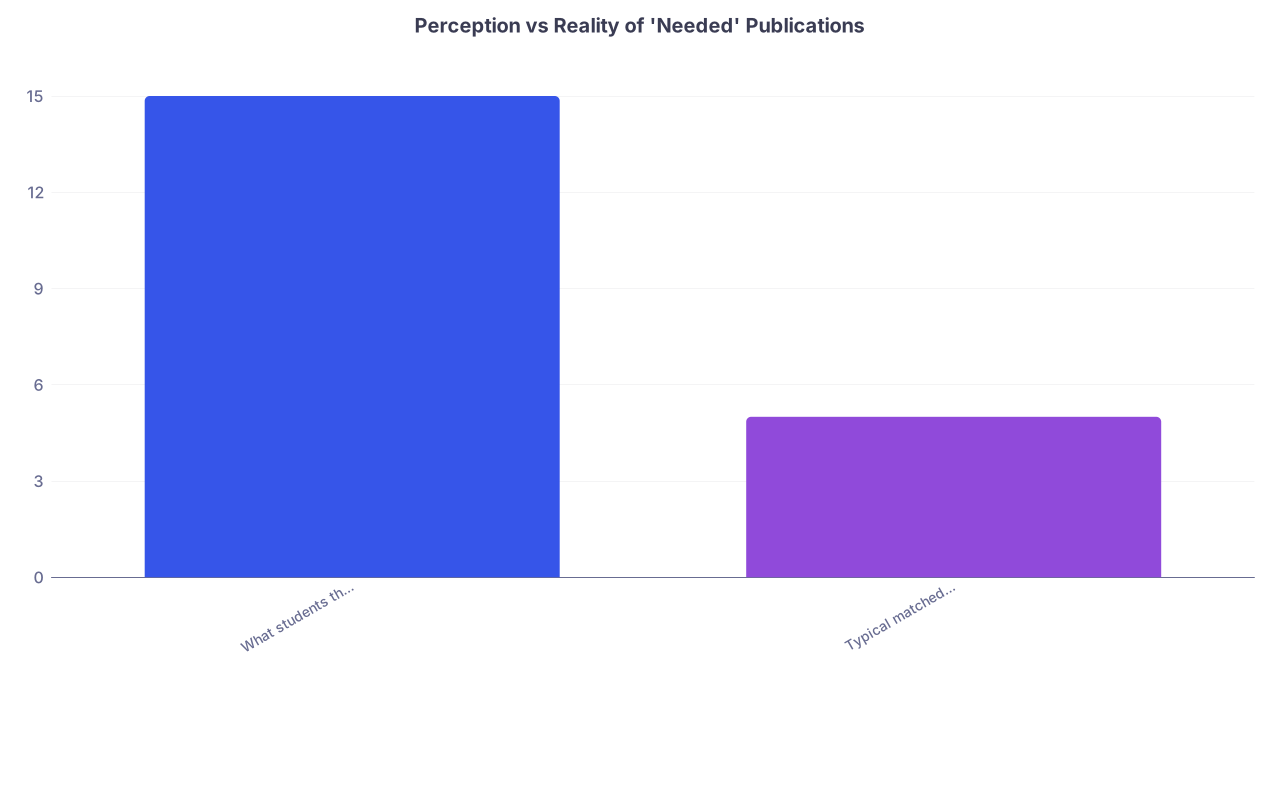
| Category | Value |
|---|---|
| What students think | 15 |
| Typical matched applicant | 5 |
The danger is not just wasted time. It is what this mindset pushes you to do.
You start to:
- Say yes to every project offered, no matter how chaotic or poorly designed.
- Join “authorship chains” where 10–20 people are slapped onto every paper.
- Accept roles you cannot realistically fulfill (“Sure, I can clean the data by next week.” No, you cannot. You have 3 exams and 5 calls.)
- Prioritize volume over integrity, learning, and patient relevance.
Overcommitting starts subtly. You agree to one extra chart review because “it is just data entry.” Then you join a systematic review that is already 6 months behind. Then someone adds you last-minute to an abstract and you feel indebted.
Suddenly you are “on” seven projects and not truly doing good work on any of them.
Why this mentality is toxic
It trains you to see patients as data sources, not people.
Obsessive hunting for “interesting cases” can warp your clinical lens. You start thinking, “This would be a cool case report” before you think, “Is this person OK?”It numbs you to authorship ethics.
When the goal is line-count, questions like “Did I do enough to be on this paper?” or “Does this person really deserve authorship?” get quietly pushed aside.It sets you up to cut corners.
Too many deadlines, not enough time. That is when people start “rounding” data, skipping verification steps, or retrofitting methods sections to what they actually did.It destroys work–life balance.
Evenings, weekends, post-call “protected time”—all sacrificed for projects you barely care about and will not even remember in 5 years.
Do not make the mistake of treating research output like Instagram followers. The number that impresses your classmates may not impress the programs that matter—and can quietly erode your ethics and sanity in the process.
When Extra Research Becomes Ethically Dangerous
At some point, overcommitment stops being merely unwise and starts becoming unethical. I have seen that line crossed more than once.

| Step | Description |
|---|---|
| Step 1 | Reasonable research load |
| Step 2 | Too many projects |
| Step 3 | Missed deadlines and poor quality |
| Step 4 | Cutting corners |
| Step 5 | Questionable ethics |
| Step 6 | Serious misconduct |
Here are the most common red-flag scenarios.
1. “Borrowing” work and data
You are on five projects. Two of them are behind. The PI is annoyed. The deadline for a conference is tomorrow.
Temptations appear:
- Reusing parts of a prior introduction or discussion “just to save time” → self-plagiarism.
- Pulling numbers from an old spreadsheet without reconfirming sources.
- Quietly excluding messy outliers to get nicer p-values.
- Massaging inclusion/exclusion criteria after peeking at results.
You rationalize: “Everyone does this,” “It’s minor,” “We’ll fix it later.” That is how research misconduct usually sounds in someone’s head before it becomes public.
When you are overcommitted, your capacity to do things properly is gone. That is where ethical risk explodes.
2. Ghost- and gift-authorship
Another classic consequence of saying yes to too many things: your real contribution becomes thin and scattered.
Then you are:
- Listed as an author on a paper where you barely did anything.
- Asked to add a senior person who never touched the project.
- Pressured to include friends or labmates “so they have something on their CV too.”
Gift authorship and ghost authorship are not harmless. Journals, institutions, and specialty boards formally classify them as ethical violations.
The underlying cause? Too many people spread across too many superficial projects rather than fewer, deeper collaborations with clear roles.
3. IRB and consent shortcuts
The worst cases I have seen had the same root cause: too much research load, not enough oversight.
Patterns include:
- Starting data collection on “just a pilot” without IRB approval, planning to “submit later.”
- Stretching IRB exemptions beyond what is actually approved.
- Sloppy de-identification because there “is no time” to properly scrub identifiers.
If you are consistently exhausted and juggling multiple half-understood projects, you are exactly the person most at risk for these kinds of missteps—even if you think “I would never.”
Overcommitment and ethical erosion are strongly correlated. Ignore that at your peril.
The Work–Life Balance Crash: How Overcommitting Actually Feels
Let us talk about the human cost. Not the policy language. What this looks like month-to-month in your actual life.

Typical pattern:
- You say yes to multiple projects during a “light” rotation.
- Two months later, you are on nights, the projects are all hitting deadlines, and the “light” time is gone.
- Your inbox becomes a constant low-grade source of dread: “Any updates on the analysis?”, “We need your section by Friday”, “Reminder: abstract due tomorrow.”
- You start writing sections between patients, on your phone, post-call, or instead of eating.
Signs your research load has become toxic:
- You feel guilty any time you are not working on something research-related.
- You are regularly late on deliverables and constantly apologizing in group threads.
- Your clinical performance or exam prep has obviously slipped.
- You hide how many projects you are on because you know it is unreasonable.
- You fantasize about backing out of everything and disappearing for six months.
Let me be blunt: no program director is impressed by an overstuffed CV if your evaluations say you are unreliable, disorganized, or distracted on the wards. They have seen this combination plenty of times.
Overcommitting to research is not just bad for you; it is bad for patients and your team. That matters ethically, not just practically.
The CV Illusion: What Programs Actually See (and Care About)
You might think “But everyone else is doing it. If I do not, I will be left behind.” That is the fear driving all of this.
Look at what actually happens.
| Applicant Profile | Research Output | Program Reaction |
|---|---|---|
| Solid, focused | 3–6 meaningful projects | Seen as serious and balanced |
| Inflated, scattered | 15+ tiny, low-quality items | Skepticism about depth, possible red flag |
| Minimal, but coherent | 1–2 well-explained projects | OK for many non-research-heavy fields |
| Massive output, poor clinical evals | 20+ items | Major concern about priorities |
And here is the part nobody tells you: interviewers can smell “CV inflation” quickly.
Red flags they notice:
- Long lists of “submitted” or “in preparation” papers that never seem to become real publications.
- Dozens of middle-author case reports from different departments where you cannot describe your actual role clearly.
- Weak or vague explanations when they ask, “So what did you personally do on this project?”
If you still think quantity alone will save you, you are ignoring how selection committees actually read applications.
They are looking for:
- Evidence you can own a project from idea to completion.
- Clinical competence and professionalism as the foundation.
- Consistency between what your CV claims and what letters and interviews reflect.
Overcommitting and scattering your efforts undermines all three.
Ethical Self-Check: Are Your Research Commitments Already a Problem?
Do a quick, honest audit. If you lie to yourself here, you are the only one who pays.
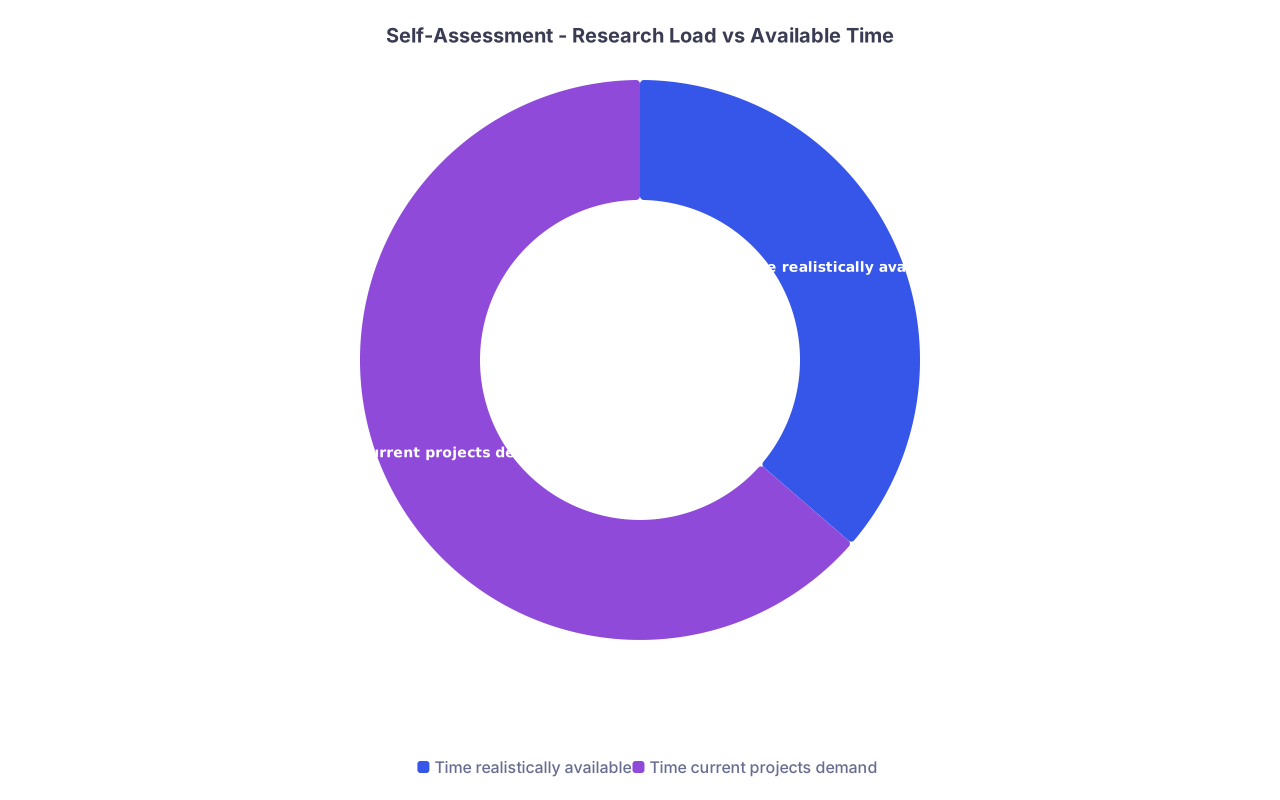
| Category | Value |
|---|---|
| Time realistically available | 40 |
| Time current projects demand | 70 |
Ask yourself:
How many active projects am I on, where someone is expecting work from me in the next 4–6 weeks?
If the number is higher than 3–4 and you are full-time clinical or preclinical, you are probably overextended.For each project, can I clearly state my role in one sentence?
If you are saying “a bit of everything” or “helped with some data,” that is code for “authorship risk and minimal true learning.”Do I have any project where I would be embarrassed to describe my real contribution to a PD in detail?
That is a serious red flag. You should not be on that paper, period.Have I ever skipped a recommended step (data check, protocol consult, extra verification) because I felt too rushed?
If yes, your ethics are already under pressure from overcommitment.Has a mentor or attending hinted that I might be taking on too much?
They rarely say this without reason. They have seen careers derailed by the exact path you are on.
If you wince at those questions, do not brush it off. This is your warning light.
How to Say “No” Without Sabotaging Your Career
You are allowed to protect your time and ethics. You just need to stop making amateur mistakes when you do it.

Strategy 1: Hard caps and transparent math
Decide your maximum number of active projects based on your phase:
- Preclinical: ~2–3 at a time.
- Clinical clerkships: usually 1–2 with deadlines, maybe 1 slow-burn in background.
- Intense residency rotations: often 0–1 that actually need work from you.
Then do the math out loud with the person inviting you:
“Right now I am primary on two projects with manuscript deadlines in the next 2 months. If I join this third one, I will not be able to give it the attention it deserves or meet tight deadlines. I would rather say no than commit and underperform.”
That is not weakness. That is professionalism. The kind of answer good mentors respect.
Strategy 2: Replace vague yeses with specific conditions
Instead of “Sure, sounds great,” use:
- “What is the realistic timeline and what exactly would you need from me?”
- “Where in the authorship order are you expecting I would be?”
- “Is the IRB already approved and data collected, or are we starting from scratch?”
Then, if the answer reveals chaos (no timeline, unclear roles, no IRB yet), you say:
“Given my current schedule, I need clear timelines and structure to do good work. This sounds less defined than I can commit to right now, so I should decline.”
You just avoided a year of stress for one awkward 20-second sentence.
Strategy 3: Exit projects ethically when overextension is obvious
If you are already on too much, you are not stuck forever.
You can say:
“Over the last month it has become clear that I cannot contribute at the level this project needs, especially with my current clinical schedule. I do not want to hold the team back. It is best if I step away so someone with more bandwidth can take this on.”
Yes, it feels uncomfortable. Leaving it unsaid while you delay everyone and ship poor work is worse—and more damaging to your reputation.
Building a Research Portfolio That Is Impressive and Ethical
Stop thinking in raw numbers. Think in coherent stories. Committees are not stupid; they are reading for patterns.
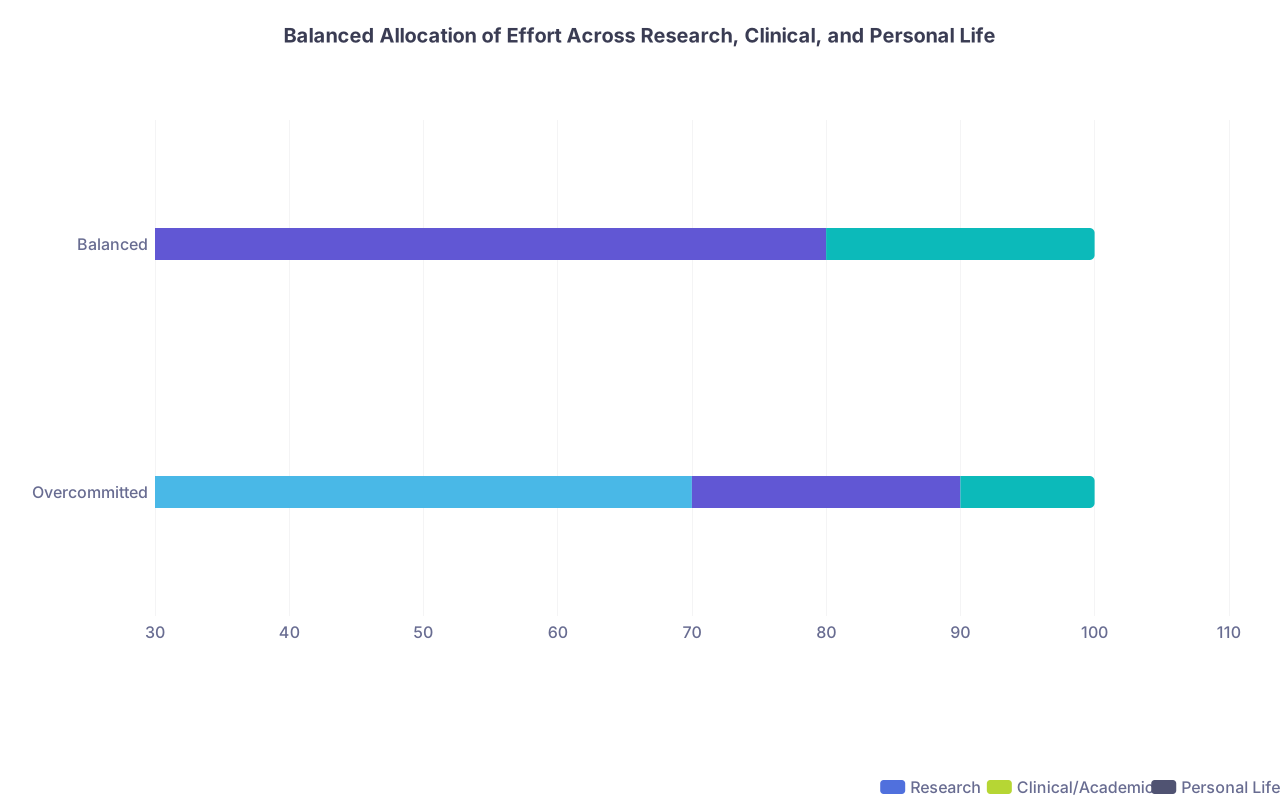
| Category | Research | Clinical/Academic | Personal Life |
|---|---|---|---|
| Overcommitted | 70 | 20 | 10 |
| Balanced | 30 | 50 | 20 |
You want:
- A small cluster of related projects that show real interest in a topic or field.
- At least one project where you had a substantial, defensible role (analysis, first draft, key design input).
- A record free of ethical gray areas you would dread explaining under oath or in front of a board.
Practical guidelines:
- Prefer depth over breadth. One serious, multi-year project can beat ten flimsy abstracts.
- Ask mentors what quality looks like in your field, not just numbers.
- Document your contributions as you go (what you did, what decisions you made).
- Protect time for reading, reflection, and actual learning from your research, not just producing outputs.
Ethically mature research is not just about avoiding fraud. It is about aligning your work with patient benefit, truth-seeking, and sustainable work–life balance.
Your future self, your colleagues, and your patients all have to live with the habits you are building now.
Work–Life Balance Is an Ethical Issue, Not a Luxury
One last thing you should stop pretending is optional: your well-being.
Overcommitting to research does not just give you less free time. It degrades:
- Your decision-making.
- Your attention to detail.
- Your empathy and patience with patients and colleagues.
- Your willingness to ask for help when something feels off.
That is an ethical problem. Not just a lifestyle choice.

A clinician-researcher who is exhausted, resentful, and corner-cutting is not serving anyone well. Not the literature. Not patients. Not their team. Not themselves.
Protecting your limits is not selfish. It is part of professional integrity.
FAQ (Exactly 3 Questions)
1. How many research projects are “enough” for a competitive residency?
There is no universal number, and anyone who gives you one is oversimplifying. For most specialties, 3–8 meaningful items (mix of posters, abstracts, and a few papers) is perfectly adequate, especially if you can clearly explain your role and what you learned. Hypercompetitive fields may skew higher, but even there, programs notice depth and coherence far more than raw count. Your goal is a believable, ethically clean story—not a bloated list.
2. Is it wrong to be a middle author on several projects where my role was small?
Not inherently. Large collaborations often have many authors, and junior trainees naturally take smaller roles. The ethical problem appears when (a) your contribution was so minimal you cannot justify authorship by standard criteria, or (b) the volume of such papers creates a misleading impression of your experience. If you would feel uneasy describing your exact contribution in an interview, you probably should not be on that paper.
3. What if I already overcommitted and made some questionable choices under time pressure?
Then you fix what you can, now. Talk to a trusted mentor or PI, document what happened, and correct any issues in ongoing projects (clarify authorship, check data, amend IRB deviations). Do not double down on the mistake by hiding it and piling on more commitments. Use the discomfort as a signal to radically reduce your research load, rebuild good habits, and recommit to ethical standards before something becomes public or formally investigated.
Key points:
- Chasing endless CV lines by overcommitting to research damages your ethics, your reputation, and your work–life balance.
- Programs care much more about coherent, defensible, high-quality work than bloated lists of superficial projects.
- Saying “no,” setting hard caps, and exiting misaligned projects early are not career suicide; they are how you protect both your future and your integrity.