
The biggest mental health risk in residency isn’t hours. It’s feeling trapped.
You picked a specialty. You signed a contract. You moved cities. And now you’re realizing: I might hate this. Or at least, it feels wrong in your gut. Too late to change? Financially stuck? Visa-bound? Family depending on you?
This is where people start to mentally disintegrate. Not because the specialty is “bad,” but because the loss of agency feels absolute.
Let me be blunt: this “I’m trapped” narrative is dangerous. It fuels burnout, depression, and makes small problems feel like life sentences. So we’re going to treat this like an emergency — mental health first aid for the “wrong specialty” crisis.
You’re not planning your 5-year career today. You’re stabilizing your brain enough to think clearly again.
Step 1: Name the Actual Emergency (It’s Not Just “Wrong Specialty”)
First, you need a clear diagnosis of the real problem. “I chose the wrong field” is usually a vague label slapped onto a much more specific pain.
Ask yourself — and answer in writing, not just in your head — these six questions:
Am I mostly suffering from:
- Sleep deprivation?
- Toxic culture?
- Specific rotations (e.g., nights, ICU)?
- Identity crisis (who am I if not this ideal specialty I imagined)?
- Moral distress (how we treat patients, trainees, or colleagues)?
- Financial/visa/family pressure that makes me feel trapped?
Are there any parts of my day I don’t hate?
- A certain patient population?
- Procedures?
- Teaching juniors/med students?
- Notes/admin (yes, some people like systems and structure)?
When did I start feeling this way?
- First month?
- After a bad attending?
- After a major personal event (breakup, illness, death in family)?
How severe is the distress, honestly?
- Annoyed and disappointed?
- Dreading work daily but coping?
- Having intrusive thoughts about self-harm or running away?
What have I actually tried so far to make it better?
- Switched rotations?
- Spoken with chief/residency leadership?
- Talked to a therapist?
- Or just silently spiraled?
If I weren’t scared about money/reputation/visa, what would I do:
- Right now (this month)?
- In 6–12 months?
No one else sees these answers. So don’t perform. Be a little ugly and honest.
You’re not “treating the wrong specialty” here. You’re treating:
- Acute distress
- Loss of agency
- Isolation
The rest (career path, program changes, etc.) comes after you’re mentally safer.
Step 2: Stop the Bleeding – Immediate Mental Health First Aid
Mental health first aid is exactly like physical first aid: stabilize before definitive treatment.
There are four immediate goals:
- Make work survivable for the next 2–4 weeks.
- Reduce cognitive load so you can think.
- Interrupt isolation so your brain stops lying to you.
- Screen for red-flag symptoms that need urgent care.
A. Check for Red Flags — No Negotiation Here
If any of the following are true, you do not white-knuckle your way through:
- You’re having thoughts of self-harm, suicide, or wishing you’d get hit by a car so you don’t have to go to work.
- You’re misusing substances to get through shifts or to sleep (benzos, alcohol, stimulants, opioids).
- You’re making dangerous clinical errors because you’re too foggy to function.
- You’ve pulled away from everyone — partner, friends, family — and feel like it wouldn’t matter if you disappeared.
That’s not “I picked the wrong specialty.” That’s a mental health emergency.
What you do today if that’s you:
- Call your institution’s confidential mental health service (almost every residency has one; ask GME, chief, or check your resident handbook).
- If you’re afraid of program leadership knowing, use an external option: national physician support lines, your own therapist, or local crisis hotlines.
- If you’re at the point of imminent self-harm: ER. Tonight. Colleagues have done this and gone on to have normal careers. The shame story is bigger in your head than in real life.
You cannot think clearly about specialty, visas, or anything while your brain is on fire.
B. Shrink Your World Temporarily
If you feel trapped, your instinct is to think more. Analyze more. Spiral more. That backfires.
For the next 2 weeks, your only non-negotiables:
- Show up to work safely.
- Get basic sleep, food, and movement.
- Have one real conversation per week about how you’re doing.
Everything else becomes optional. Research? Optional. Extra shifts you said yes to? Renegotiable. Being “the good resident” who never says no? On pause.
Create a minimal survival routine:
Morning:
- Two minutes of honest check-in: “Scale 1–10, how far down the drain am I?” If you’re under 4, you text one trusted person: “Having a rough one today, just a heads up.”
- Caffeine, water, something with calories. No, coffee alone doesn’t count.
During work:
- 30–60 seconds between tasks: 3 slow breaths, shoulders down, feel your feet. You’re resetting your nervous system, not being “mindful” for Instagram.
After work:
- 10 minutes of decompression that’s not a screen: shower, short walk, sit in silence. You’re telling your body: “Shift is over for now.”
Night:
- Guard 1–2 hours of sleep window like it’s a code. Phone on Do Not Disturb except favorites.
Step 3: Reintroduce Agency – Where You Actually Have Control
The sensation of being trapped is often worse than the reality. The system is rigid, yes. But not completely.
Let’s map what can and cannot be changed in the short term, so you don’t burn energy on dead ends.
| Domain | You Can Change Soonish | Fixed For Now |
|---|---|---|
| Specialty choice | Future direction, niches | This year’s contract |
| Daily work environment | Rotation requests, mentors, tasks emphasis | Core rotation requirements |
| Workload intensity | Extra shifts, side projects, unrealistic expectations | Baseline call structure |
| Support system | Who you talk to, therapy, peer support | Your program’s default culture |
| Long-term path | Fellowships, side skills, exit options | The past choice you already made |
You’re not changing everything. You’re picking one or two levers to pull now.
A. Tactical Moves Inside Your Current Program
If the problem is “I can’t breathe here,” there are usually micro-adjustments possible:
- Talk to your chief or APD, not with “I hate this specialty,” but with specifics:
- “The current rotation setup is crushing me — is there any flexibility to adjust my next block?”
- “I’m really drawn to [XYZ] aspects — can we tilt my electives or clinics that way?”
- “I’m struggling more than I expected. I’m getting the work done but it’s costing me. What supports do people usually use?”
Most chiefs have heard versions of this twenty times. The good ones will get it. The bad ones reveal themselves quickly — which gives you data on whether this is a program problem, not just a you problem.
Ask for a mental health day or short leave if things are acute. The story that “I can’t miss a single day” is often exaggerated. People go on medical leaves for less serious issues than what you’re dealing with.
Identify one rotation that’s less awful and aim towards it. Even knowing, “In six weeks I’m on clinic-heavy block instead of nights” can reduce the feeling of infinite doom.
B. Tiny Reframes That Actually Change How Work Feels
No toxic positivity here. But some reframes are tools, not lies.
Three that help:
“This is a chapter, not a sentence.”
You’re serving a term. That term ends. Even if you stay in the specialty, this level of grind and lack of autonomy will not last forever.“I’m doing reconnaissance.”
Treat your year like field research. You’re gathering data:- What kind of colleagues destroy me vs sustain me?
- What parts of medicine do I always dread vs secretly enjoy?
- What ethical compromises am I not willing to normalize?
“It’s not me vs my specialty. It’s me in this system.”
I’ve watched brilliant residents think they’re “weak” because they’re dying in a trash system. Then they switch to a different environment and thrive in the same field. So be slow to blame your core self.
Step 4: Build a Real Support Triangle (Not Just Venting)
You need three types of people around you. One person can fill more than one role, but all three roles must exist somewhere in your life.
Same-level peer who gets it.
Someone in your program or a nearby one who knows the day-to-day reality. This is where you say, “My attending just said X, am I crazy?” and they answer, “No, he does that to everyone.”Someone slightly ahead of you.
Senior resident, recent grad, or fellow. They’ve seen where this road leads. They can say, “I felt exactly like you during my PGY-2 winter. Here’s what changed, here’s what didn’t.”Someone outside medicine or outside your specialty.
To reality-check the “everyone in life is doing X” narratives. They remind you there are other worlds, other ways to live.
If you currently have zero, you start with one:
- Text a co-intern: “Hey, random, I’m realizing I’m struggling more than I’ve admitted. You ever get that ‘did I pick the wrong thing’ feeling?”
- Message an alum on LinkedIn: “I’m a PGY-1 at your old program. Would you be open to a 20-min chat about how you thought about specialty fit and burnout?”
- Tell one non-medical friend: “I’m not okay. I’m safe, but I’m really not okay. Can I brain dump for 15 minutes tonight?”
You’re not asking them to fix it. You’re asking them to witness it. That alone changes the weight.
Step 5: Decide What You’re Actually Deciding This Year
You don’t need to decide your forever specialty this month. You need to make one of three interim decisions:
- Stay and complete training as is (but with better coping and adjustments).
- Stay for now, while quietly preparing exits or pivots.
- Actively pursue a change (program, specialty, or even out of residency).
Think in seasons, not lifetimes. For the next 6–12 months, your question is:
“What keeps me safest and gives Future Me the most options?”
Option 1: Staying Put (But Not Stagnant)
This is reasonable when:
- Your distress is more “I’m disappointed and tired” than “I’m destroyed.”
- You can identify parts of the work you do like.
- You believe a different setting (fellowship, outpatient, academic vs community) might make this same specialty livable.
If you stay, you still do three things:
- Get a therapist or coach who understands physicians. Not a luxury. A tool.
- Build skills that are specialty-adjacent and widely portable (teaching, QI, admin, informatics).
- Start noticing niches: outpatient vs inpatient, sub-specialty clinics, procedural vs cognitive, academic vs community.
You’re not passively enduring. You’re shaping your eventual landing zone.
Option 2: Stay While Quietly Building the Exit Ramp
This is where a lot of trapped-feeling residents land once they calm from crisis-mode.
You might:
- Start exploratory conversations about other specialties (psych from IM, PM&R from neuro, palliative from almost anything, etc.).
- Build non-clinical skills on the side: data, writing, education, leadership.
- Research fellowship paths that are more aligned with what you want (e.g., leaving gen surg misery for breast, colorectal, or palliative; leaving IM angst for allergy, rheum, or hospice).
You don’t tell everyone you’re dissatisfied until you’ve figured out who’s safe. You pick one or two mentors who are known to handle hard conversations without blowing them up.
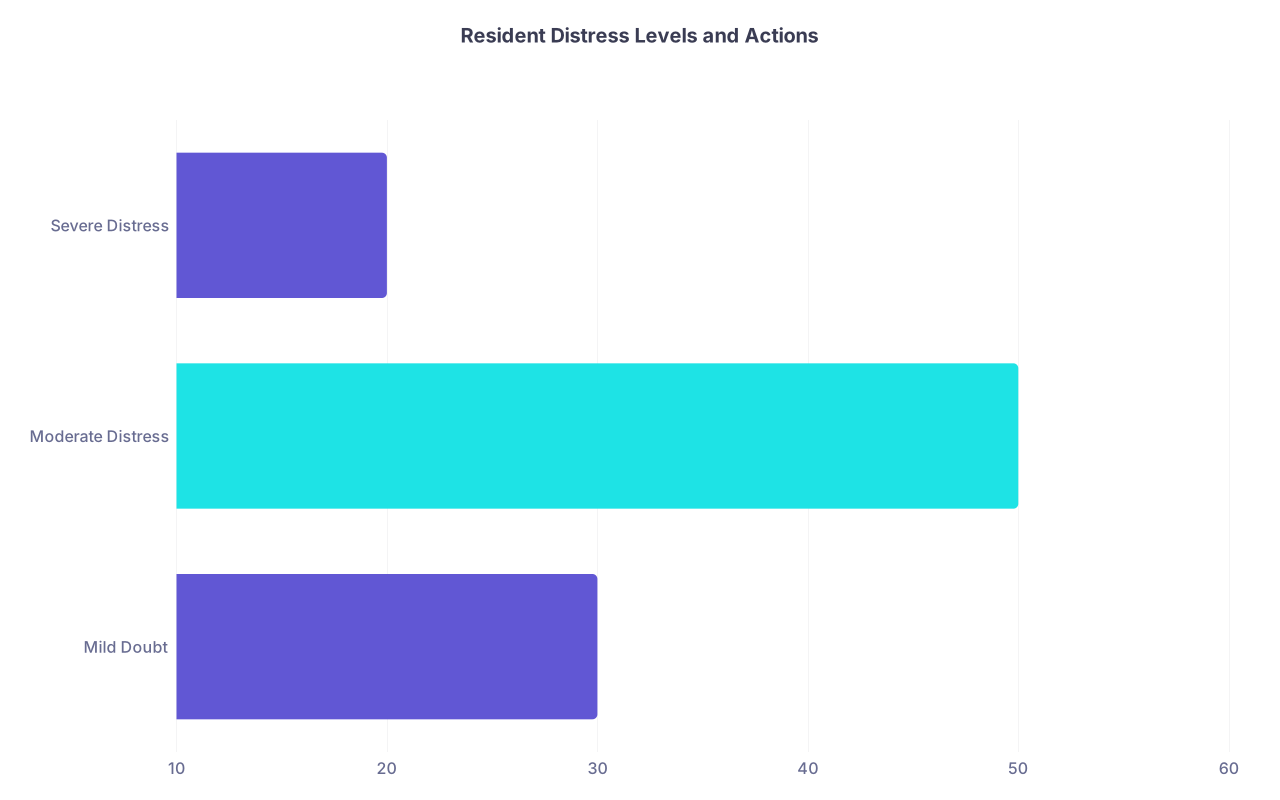
| Category | Value |
|---|---|
| Mild Doubt | 30 |
| Moderate Distress | 50 |
| Severe Distress | 20 |
Option 3: Actively Changing Course
Sometimes the answer really is: this specialty is a terrible fit for my brain, my values, or my body. That’s not failure. That’s data.
You consider actively pivoting when:
- Even on your “best” rotations, you feel fundamentally misaligned.
- You feel dread that’s not tied to specific people or situations, but the entire nature of the work.
- You’ve had at least 1–2 months of reasonable sleep and support, and the core feeling hasn’t changed.
If you’re here, your order of operations:
- Stabilize mental health. You do not make a huge career decision in the middle of full burnout collapse.
- Identify safe advisors: maybe one APD, one trusted attending, one mentor from med school.
- Get facts about:
- Transfer policies.
- Visa constraints (if applicable).
- Financial repercussions.
- Alternative paths (research year, non-clinical roles, switching specialties).
And yes, people have successfully:
- Left surgical fields for psych or FM.
- Left IM for anesthesia, EM, or radiology.
- Done one residency, then a second. Not common, but not unheard of.
You’ll hear a lot of “but that’ll cost you years.” Counterpoint: so will grinding out a life you hate and then burning out at 40.
Step 6: Ethics: When Your Misery Feels Unethical
There’s a reason this sits under “personal development and medical ethics.” Practicing while deeply distressed isn’t just bad for you. It bleeds into patient care.
Here’s the ethical balancing act:
- You have a duty to your patients. That includes being honest if you’re too impaired to practice safely.
- You also have a duty to yourself. Self-destruction is not noble. It’s not good for patients, colleagues, or long-term contribution.
If you’re so checked out or resentful that you’re cutting corners, snapping at patients, or missing things regularly, that’s a signal. Not to self-flagellate, but to escalate.
You can say to leadership:
- “I’m concerned about my functioning. I’m not unsafe yet, but I’m heading that way. I want to address this before it becomes a patient safety issue.”
That’s not weakness. That is ethics in action. It’s professional.
On the flip side, don’t let guilt convince you you’re unethical for simply disliking your specialty or having dark thoughts. The ethical line is about behavior and impairment, not emotions.
Step 7: What To Do Tomorrow Morning
Let’s make this brutally concrete. Tomorrow, you:
Decide your distress tier:
- Tier 1: “This sucks but I’m okay.”
- Tier 2: “I’m not okay, but I’m safe.”
- Tier 3: “I’m not sure I’m safe.”
Based on that:
Tier 1:
- Pick one small lever: email to schedule a check-in with chief, or text a peer to talk this weekend.
- Start a 2-week “data log”: each day, write one thing you liked and one thing you hated about your work.
Tier 2:
- Schedule an appointment with a therapist (institutional or external).
- Tell one colleague or friend: “I’m hitting a wall. Can we talk this week?”
- Ask your program for any existing wellness/mental health resources. Use them. Yes, even the ones with cringey flyers.
Tier 3:
- Reach out to crisis or mental health services today. Not after this block. Today.
- Request time off if at all possible, even a few days.
- Loop in someone who can help with logistics (partner, close friend, trusted chief).
Give yourself one permission:
- Permission to change your mind later.
- Permission to not justify your feelings to everyone.
- Permission to not have a 5-year plan right now.
You’re doing first aid, not life design.

| Step | Description |
|---|---|
| Step 1 | Feeling trapped in specialty |
| Step 2 | Seek urgent mental health help |
| Step 3 | Stabilize basics 2 to 4 weeks |
| Step 4 | Identify specific sources of distress |
| Step 5 | Build support triangle |
| Step 6 | Adjust within current specialty |
| Step 7 | Explore exits or pivots |
| Step 8 | Plan next 6 to 12 months |
| Step 9 | Immediate safety OK? |
| Step 10 | Still misaligned after support and rest? |
FAQ (Exactly 3 Questions)
1. How long should I “wait it out” before deciding I chose the wrong specialty?
You need at least a few months where you’re not in acute sleep deprivation or crisis to judge accurately. That doesn’t mean you suffer in silence; it means you stabilize first (sleep, support, therapy if needed), then re-evaluate. Many residents hit a wall early PGY-1, feel trapped, and find that by later PGY-2 with better rotations and more competence, the field feels very different. If after 6–12 months of reasonable conditions you still feel fundamentally misaligned, then a serious pivot conversation makes sense.
2. Won’t talking to my program about this hurt my reputation or future career?
It depends how you do it and who you pick. Saying “I hate this and want out” to a random attending is risky. Saying to a trusted APD or chief, “I’m struggling more than I expected, and I want to make sure I’m functioning well and not compromising patient care. Can we talk about support and options?” is actually what competent, ethical physicians do. Many leaders quietly respect honesty far more than fake perfection. Be selective in who you confide in, but don’t let fear of gossip keep you from getting help.
3. What if I’m on a visa / have huge loans and truly feel I can’t leave?
Then your first priority is still your mental stability, not the visa paperwork. Once you’re out of crisis mode, you look for ways to create micro-agency inside the constraints: optimize rotations, find more tolerable niches within your field, build non-clinical skills that could open doors later, and talk early with advisors who understand immigration or debt realities. You may choose to finish the residency for financial or visa reasons, but that doesn’t mean this is your forever life. I’ve seen IMGs and heavily indebted grads finish training, then pivot to more aligned roles (fellowship, outpatient-only, admin, industry) once they had a foothold. Your current box is real, but it is not your final container.
With your mental triage done and a few levers identified, you’re no longer just “the resident who chose wrong.” You’re someone gathering data, protecting your mind, and quietly reshaping your future. The bigger questions about identity, purpose, and what kind of doctor you want to be—those come next. And that’s a different conversation entirely.