
It’s 7:45 a.m. You just signed out. You’re walking to your car or the call room shower, and you can already feel it coming. That tightness in your throat, the heaviness in your chest. By the time you close the door—car, bathroom, stairwell, doesn’t matter—you’re crying. Again. This is not a once-a-year meltdown. This is “every week after call I lose it.”
You’re not just tired. You’re starting to dread call two days in advance. Your partner or friends tiptoe around you post-call because they know you’re either going to collapse, snap, or both. You’re starting to wonder: “Is this normal? Am I weak? Is this just residency?”
Let me be blunt: crying every week after call is a signal, not a personality flaw. It means something is off—either in your workload, your support, your health, or your boundaries. The goal is not to become the kind of person who can “just suck it up.” The goal is to stabilize enough that you’re not disintegrating every week.
Here’s how to take first steps, in order.
Step 1: Name What’s Actually Making You Cry
Before you try to “fix” anything, you have to know what you’re responding to. Exhaustion? Moral distress? Humiliation? Chaos? All of the above?
Most people mash all of that into “I can’t handle this.” That’s useless. You need to break it down.
Right after call—once the tears start but before you knock yourself out with sleep—ask yourself three specific questions and actually write down the answers (in your notes app if nothing else):
- What were the 2–3 worst moments of the last 24 hours?
- What emotion did I feel most strongly in each of those moments? (Not “tired”—that’s constant. I mean: shame, fear, helplessness, anger, grief.)
- What thought keeps looping in my head right now?
Example answers I’ve seen:
“Worst moment: Attending tearing into me on rounds in front of everyone when I didn’t know the K level from 3 days ago.”
Emotion: shame.
Looping thought: “I’m an idiot, I shouldn’t be here.”“Worst moment: Two admissions at once while I was trying to transfer a crashing patient and the cross-cover pager wouldn’t stop.”
Emotion: panic/overwhelm.
Looping thought: “It is literally impossible to be safe.”“Worst moment: Telling a family their dad died when we all knew he never should have been discharged last week.”
Emotion: grief + anger.
Looping thought: “This system is broken and I’m complicit.”
Different drivers need different responses. If you treat all of them as “just need to be tougher,” you will burn out faster.
Step 2: Stabilize the Next 24 Hours (Not Your Whole Life)
Right now you don’t need a five-year plan. You need to survive the next day without spiraling.
Think in 24-hour chunks after call. There are three levers you can usually move, even in malignant or disorganized programs:
- Sleep
- Food and fluids
- One small grounding action
Non-negotiable post-call minimum
Build a “post-call protocol” and stick to it like it’s an order set.

Bare minimum on a typical post-call day:
- Hydrate before you lie down. 8–16 oz of water or an electrolyte drink. Set it by your bed/sofa.
- Eat at least something with protein and carbs before or immediately after waking: yogurt, protein bar, sandwich, leftover pasta, whatever you can tolerate.
- Sleep window: Aim for 3–5 hours, not an 11-hour coma that wrecks your circadian rhythm. Two alarms: one near you, one across the room.
- Light and movement when you wake: open blinds, step outside for 5 minutes, walk around the block or at least the hall.
Then add one grounding action that is not medicine-related and not a screen:
- 10–15 minutes of something that keeps your nervous system from staying in “code blue mode”:
- Hot shower with phone in another room
- Brief walk with a podcast or music
- Journal dump of everything spinning in your head
- Sitting on the floor, leaning against a couch, breathing slowly (4-second inhale, 6-second exhale) for 5 minutes
If you’re thinking “I don’t have time for this,” you’re missing the point. You’re hemorrhaging functioning. Five to fifteen minutes here saves you hours of misery and cognitive fog later.
Step 3: Decide if This Is “Hard but Fixable” vs “Unsafe and Unsustainable”
Not every “this sucks” situation is the same. Some are fixable with support and boundaries. Some are over-the-line unsafe.
Use this simple mental triage. Answer honestly, not how you wish things were.
| Question | If "Yes" Most of the Time | If "No" Most of the Time |
|---|---|---|
| Are you making clear clinical mistakes due to fatigue? | Red flag: unsafe | Distress may be more emotional/moral |
| Do you recover emotionally between calls? | Distress is situational but maybe fixable | Indicates chronic overload or depression |
| Can you name even 1–2 people at work you trust? | You have some support to build on | That isolation needs attention fast |
| Do you still feel *any* joy or meaning in medicine some days? | Burnout, but the pilot light is on | Higher concern for depression/PTSD |
If your answers are mostly red-flag territory, you’re not being dramatic. You’re in trouble. That means you need outside help now, not “after this rotation.”
Step 4: Get One Real Human Involved
This is where people screw up. They try to white-knuckle it alone because they’re ashamed, or afraid of looking weak, or convinced everyone else is coping fine.
They aren’t. I’ve seen multiple interns each year quietly falling apart and thinking they’re the only one.
You need one real human in the loop. Preferably in this order:
- A trusted co-resident or recent grad from your program
- A supportive chief resident or faculty advisor
- If those are unsafe: someone outside your program but in medicine (mentor from med school, resident at another hospital, therapist who knows med culture)
How to start the conversation without sounding vague or whiny:
“Hey, can I be blunt? I’ve been crying after almost every call. It’s happening weekly now. I’m functioning but I feel like I’m on a knife edge. I need help thinking through whether this is just a rough stretch or if I’m in real trouble.”
That’s clear. Concrete. Harder for them to brush off with “Yeah, residency is hard.”
If they immediately minimize (“That’s just intern year, you’ll toughen up”), clock that. Not your person. Find another.
What you’re looking for is someone who does at least two of these:
- Validates that your distress is real
- Helps you identify specific problems (schedule, team culture, depression, etc.)
- Points you toward resources (program director, GME office, therapist, PCP)
- Offers some ongoing check-in (“Text me after your next call night”)
This is how stabilization starts: not with a grand solution, but with one other brain and nervous system helping to carry the load.
Step 5: Separate “I Am Broken” From “This System Is Broken”
A lot of the crying-after-call spiral is interpretation, not just events.
Two residents can both get wrecked by the same night. One says, “Last night was brutal; the system is insane.” The other says, “Last night proved I’m not cut out for this.” Guess who crashes harder over time?
You need to pull apart those two storylines.
Examples:
- Intern asked to admit 8 patients overnight solo with cross-cover on 60 others? That is a systems problem. It’s not proof you’re incompetent.
- Getting publicly humiliated by an attending for missing a minor lab from 72 hours ago? That’s an attending problem. Unprofessional and frankly lazy teaching.
- Being deeply upset after a patient death, especially a preventable one? That’s a healthy response. If that stops bothering you completely, that’s when you should worry.
Start labeling the source:
- “This is grief.”
- “This was moral distress—I was forced to do something I felt was wrong or inadequate.”
- “This was humiliation by a superior.”
- “This was pure volume/chaos.”
Once labeled, your brain has somewhere to put it besides “I suck.”
Step 6: Adjust What You Can This Month, Not Someday
You may not be able to change rotations or dodge call, but there are almost always a few dials you can turn this month.
A. Micro-boundaries around sleep
If you’re falling apart, your sleep can’t be optional. You might need to get blunt with household members, partners, even yourself.
Examples:
- “On post-call days, I’m unreachable from 10 a.m. to 2 p.m. unless someone is literally dying.”
- Phone goes on airplane mode or Do Not Disturb. Not “vibrate.” Silent. Screen down.
- One “no call the night before clinic” or similar ask, if your schedule has any wiggle room and your chief is human.
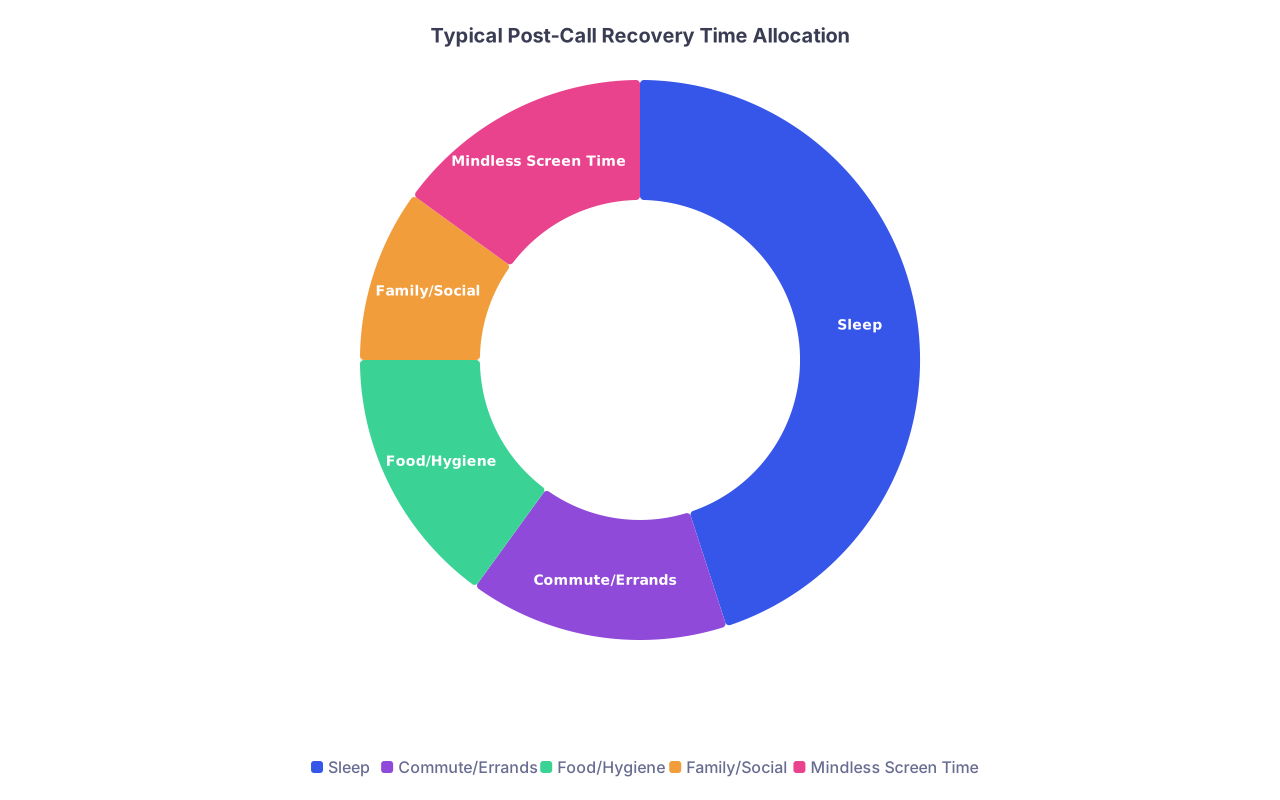
| Category | Value |
|---|---|
| Sleep | 45 |
| Commute/Errands | 15 |
| Food/Hygiene | 15 |
| Family/Social | 10 |
| Mindless Screen Time | 15 |
You’re not chasing perfect sleep. You’re chasing enough to keep you from crying every week.
B. Cut one non-essential obligation for 4 weeks
This is where high-achievers sabotage themselves. They’re drowning but still trying to run three projects and be the perfect partner/parent/friend.
You are allowed to temporarily be “less impressive” to survive.
- Pause one research project or side hustle. “I need to hit pause for four weeks; I’m drowning on service.”
- Drop one volunteer teaching shift or committee meeting.
- Tell family/friends: “For this month, I may be slower to respond. It’s not personal.”
You’re carving out a little margin so you don’t break.
Step 7: Use the Ethics Lens: Are You Practicing Safely?
This isn’t just self-care. This is about medical ethics and patient safety.
If you’re so depleted that you’re:
- Forgetting critical tasks or orders regularly
- Snapping at nurses or families out of sheer frustration
- Feeling emotionally numb about serious events because you have nothing left
…then this is no longer just “residency is hard.” This is ethical territory. You have a duty to practice safely, and you can’t do that if you’re clinically depressed, traumatized, or constantly on the edge of collapse.
This doesn’t mean confessing to incompetence. It means being honest that your functioning is impaired and you need support.

| Step | Description |
|---|---|
| Step 1 | Notice weekly breakdowns |
| Step 2 | Talk to trusted senior or chief |
| Step 3 | Seek mental health and support |
| Step 4 | Discuss schedule or call adjustments |
| Step 5 | Access GME or wellness resources |
| Step 6 | Reassess after 4-6 weeks |
| Step 7 | Are patients at risk? |
If you feel like you might actually harm a patient because you’re so out of it, that’s a red-alert moment. That’s when you bypass “I don’t want to bother anyone” and go straight to: chief, PD, GME, or occupational health.
Step 8: Bring in Professional Mental Health Help Sooner, Not Later
If the weekly cry sessions have been going on for more than a month, or you’re noticing:
- Persistent hopelessness
- Loss of interest in things that used to matter
- Thoughts like “If I got into a car accident, at least I’d get a break”
- Panic or dread that doesn’t lift even on easier days
then it’s time for actual mental health care. Not just venting to co-residents.
You do not need to wait until you’re suicidal to deserve help.
Places to look:
- Hospital or GME-sponsored confidential counseling (yes, some are better than others; ask around who people actually like)
- Your own therapist, ideally one with experience in healthcare workers
- Telehealth options that cater to professionals and have evening slots
If you’re worried about licensing questions: check your specific state’s wording. Many now distinguish between having sought help vs. having an active impairment. Therapy often puts you on the right side of that line, not the wrong one.
Step 9: Handle the “I’m Weak” Narrative Directly
This one is poison, and it’s common.
“I’m crying weekly, so I’m weaker than my co-residents.”
Let me be direct: I’ve seen some of the apparently “toughest” residents snap later in much uglier ways—rage, substance use, total shutdown—because they spent three years pretending none of this touched them.
Crying is not weakness. It’s discharge. The questions that matter more:
- Are you learning from the nights that wreck you?
- Are you adjusting anything or just repeatedly crashing into the same wall?
- Are you getting at least occasional moments of pride, connection, or meaning in the work?
The strongest residents I’ve seen:
- Admit when they’re overloaded
- Ask for help before everything collapses
- Have enough humility to say, “This is breaking me a bit; I need to adjust”
Your weekly tears are data. Use them.
Step 10: Make a Concrete 2-Week Plan
Stabilization isn’t a feeling. It’s actions you can point to.
For the next two weeks, write down a short, specific plan:
Post-call routine
- “Hydrate, 3–5 hr sleep, basic food, 10-minute grounding action.”
One person you’ll talk to about this
- Name and when/how: “Text co-resident Sara to grab coffee post-rounds this Friday and tell her what’s going on.”
One obligation you’ll pause
- “Email research PI to say I need to stall progress for 4 weeks while I’m on nights.”
One mental health step
- “Email GME wellness to schedule intake” or
- “Search psychologytoday for therapist, send 3 inquiries.”
One boundary with yourself
- “No doom-scrolling for an hour post-call; shower + 10-minute walk first.”
Write it. Not in your head. On your phone or paper.

After two weeks, reassess:
- Are you still crying after every call?
- Is anything slightly less awful? (Even 10% better is progress.)
- Do you have a clearer sense of what’s driving your distress?
If yes, good. You’re moving from chaos to information. If not, that’s a data point that you need stronger interventions—schedule changes, leave, formal treatment.
When It Might Be Time to Consider Bigger Moves
I’m not going to sugarcoat this. Sometimes stabilization isn’t possible while staying in your current exact situation.
Red-flag combinations:
- You’ve been in weekly post-call breakdowns for >2–3 months
- You’ve tried: support, therapy, sleep boundaries, cutting obligations
- Your program culture is openly hostile to any sign of struggle
- You’re having intrusive memories, nightmares, panic attacks, or significant suicidal thoughts
That’s when you start considering:
- Rotation changes or modified schedule
- Temporary medical leave for mental health
- In extreme cases, switching programs or specialties
Those are nuclear options. But they exist. And they’re sometimes the ethically correct choice—for you and for patients.
Practical Scripts You Can Actually Use
A few word-for-word lines you can steal, because people always ask.
To a co-resident:
“Can I be honest? I’ve been crying after almost every call. It’s more than just being tired. I feel like I’m barely holding it together. Can we talk through whether you think this is normal-hard or too much?”
To a chief:
“I’m functioning and getting my work done, but the cost is getting extreme. I’m in tears after most call nights, and it’s been going on for weeks. I’m worried this isn’t sustainable and may affect my safety. I’m not asking for special treatment, but I need help problem-solving this.”
To a therapist/mental health intake:
“I’m a resident on heavy call. I’m not in immediate crisis, but I’m crying after call almost every week, I’m exhausted, and I don’t see a way for this to improve on its own. I need help stabilizing so I can function safely.”
To yourself, post-call, in the mirror or notes app:
“Last night was brutal. That doesn’t mean I’m a failure. It means I just did an inhuman amount of work with limited support. I’m going to do my post-call routine and make one concrete ask for help this week.”

Final Thoughts
If you’re crying after call every week, here’s the bottom line:
- This is a signal, not a character flaw. Treat it as urgent data about your limits and your environment.
- Stabilization starts small: a post-call routine, one real human in the loop, and one concrete step toward mental health support.
- If weekly breakdowns persist despite those efforts, you owe it to yourself and your patients to escalate—adjust your schedule, get professional help, and, if necessary, consider bigger structural changes.
You’re allowed to need help. You’re also allowed to fight for a version of this career that doesn’t break you on a weekly timer.