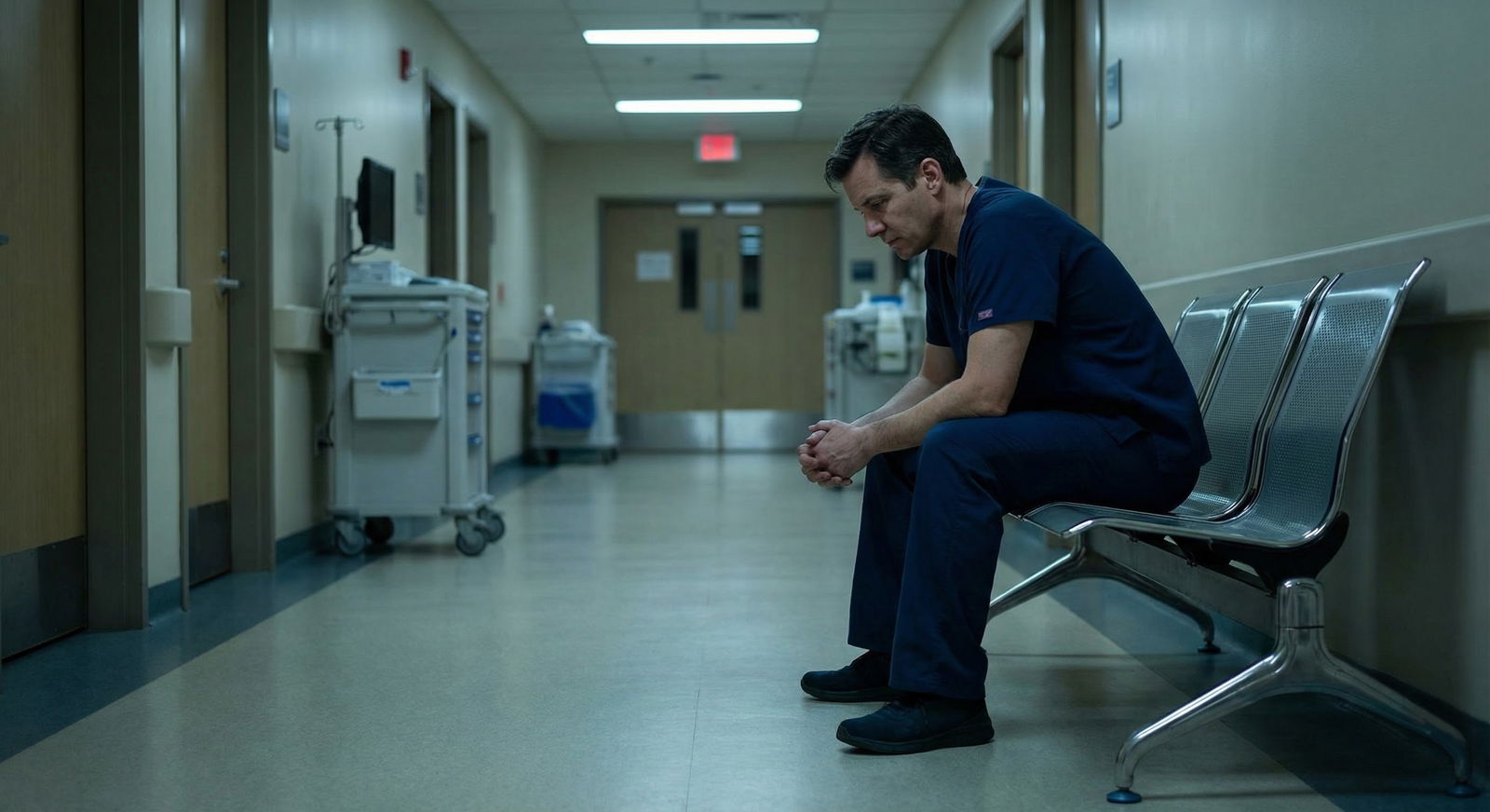
What do you actually do when a case goes bad, you go home, lie down, close your eyes—and the scene just keeps replaying?
Not a wellness poster question. A real one. Because if you practice long enough, you will have a case that sticks to you like smoke.
This is about what you do the week after. The month after. When the chart is closed but your brain refuses to close the file.
Step 1: Name What Is Actually Haunting You
People lump all of this under “guilt” or “burnout.” That’s lazy. The first move is to get specific.
Most clinicians I’ve seen in this situation are actually wrestling with a mix of:
- Moral injury: “What happened violated what I believe good care should look like.”
- Regret: “I should have done X instead of Y.”
- Shame: “Maybe I’m not good enough to do this.”
- Trauma: “I keep seeing/hearing it again and my body reacts.”
Sit down—yes literally sit down—with a blank page. Write, without editing:
- What happened
- What I did
- What I wish I’d done
- What I’m afraid this says about me
You’re not making a legal statement. You’re unloading the mental noise onto paper.
If you’re resisting this, that’s a sign you probably need it.
Here’s the point: “Something bad happened” is too vague. Your brain will just loop it. Once you put more precise language to it, you have something you can work with instead of a fog that just hangs over you.
Step 2: Separate Three Different Questions
Bad outcomes blur three different questions into one nasty “I’m terrible” conclusion. You need to pull them apart:
| Question Type | Core Question | Who Helps Most |
|---|---|---|
| Clinical | Did I make a medical error? | Senior clinician/mentor |
| Systems | Did the system set us up to fail? | Leadership / QI team |
| Emotional / Ethical | What do I do with what I feel? | Peer, therapist, chaplain |
If you’re in your car thinking, “I killed that patient,” you’re mixing all three.
Instead, ask them separately:
Clinical: “Based on what I knew at that moment, did I make a reasonable decision according to current standards and available info?”
Systems: “Were there delays, understaffing, missing resources, or communication breakdowns that contributed?”
Emotional/Ethical: “Regardless of cause, how do I live with this? What does it mean for who I am as a clinician and person?”
You cannot answer all three in your own head. That’s how people spiral. You need other brains involved, especially on the first two.
Step 3: Do a Real Case Review—Not a Self-Beating
If you’re replaying the case alone at 2 a.m., your “review” is probably just punishment. That’s not analysis. That’s torture.
You need a structured, time-limited review. Something like:
- 30–60 minutes, not 6 hours of rumination.
- With at least one other human who knows your field.
- Goal: clarity and learning, not confession.
Here’s a simple framework you can use with a trusted colleague or mentor:
- Timeline: Walk through the case step by step. What was known and when?
- Decision points: Where did you actually make a choice? What were the options based on guidelines and data at that moment?
- Standards: Compare to guidelines, attending/department norms, and actual constraints (time, staffing, patient factors).
- Unknowns: What would have changed your decision if you’d known it then?
If you’re early in training or at a place where feedback culture is weak, you might need to explicitly ask for this:
“Can I walk you through a case that’s bothering me and get your honest view of whether my decisions were within reasonable practice?”
You want someone who will actually tell you, “This was a reasonable choice, this part you could have done differently, and this was completely system-level.” Not “You did your best” on repeat.
If your institution has an M&M (morbidity and mortality) or root cause analysis, do not skip it because you’re ashamed. Show up. Listen more than you talk. Take notes.
Step 4: Be Honest About Actual Error vs. Bad Outcome
Sometimes a bad outcome happens despite good care. Sometimes there was a true error. Often there’s a mix of both plus system mess.
You have to be ruthlessly honest here, but not masochistic.
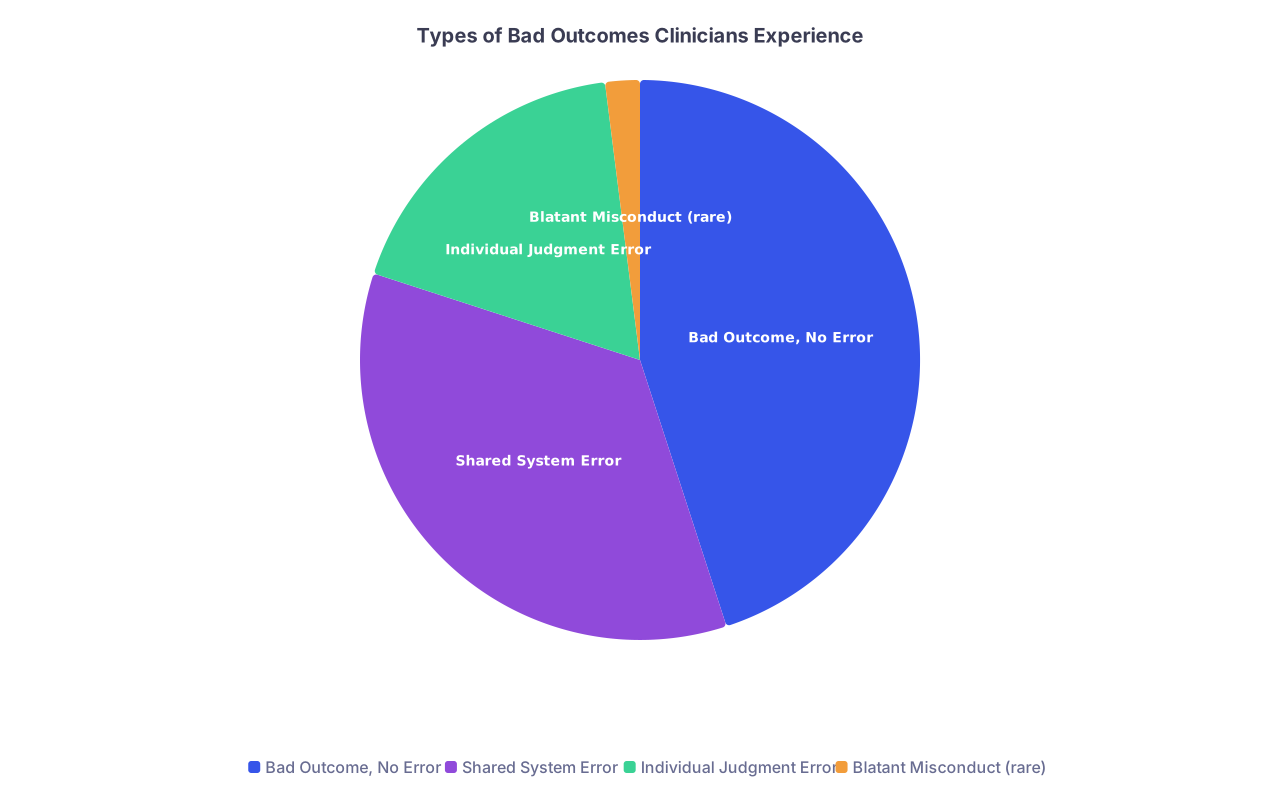
There are four broad buckets:
| Category | Value |
|---|---|
| Bad Outcome, No Error | 45 |
| Shared System Error | 35 |
| Individual Judgment Error | 18 |
| Blatant Misconduct (rare) | 2 |
These numbers are illustrative, but the pattern matches what I’ve seen: the majority are not pure “you screwed up” situations.
If review shows:
Care was appropriate: You followed standards, consulted appropriately, documented. The outcome still hurts, but this is medicine being medicine. Your “work” here is grief and acceptance, not self-destruction.
There was a judgment error: You missed something or chose an option that, in retrospect, wasn’t best but was not reckless. Your work: own it, learn from it concretely, and make process changes.
There was clear negligence or misconduct: You cut a corner, ignored a result, came in impaired. This is rare but real. Your work: full accountability, remediation, potentially legal/disciplinary navigation, and serious internal work. Not just “I’ll try harder.”
Many clinicians feel equally awful across all three. The feelings are real, but the response can’t be the same. That’s why the clinical and system review from Step 3 matters.
Step 5: Talk to Someone Who Is Not in the Chart
Peer support is great. It’s also not enough when your nervous system is essentially stuck in “that code” or “that delivery” or “that 3 a.m. call.”
You need at least one conversation with someone whose only job is to hold your emotional/ethical mess. Therapist, psychologist, chaplain, or a formal peer-support person trained for this. Not just your co-intern in the call room between admissions.
Typical signs it’s time:
- You’re avoiding that unit/room/type of patient.
- You keep having flashes of the scene at random times.
- You feel a cold dread before every shift.
- Your sleep is trashed. Not just one night—weeks.
- You’re thinking about leaving medicine solely because of this case.
You don’t need to “qualify” with PTSD to deserve help. You just need to be human, reacting like a human does.
If you’re worried about confidentiality/reporting: ask clearly up front what is and isn’t confidential, especially if you’re a trainee. Many institutions now have confidential clinician support services specifically separated from performance evaluation.
Step 6: Avoid the Two Big Coping Traps
I keep seeing the same two failed strategies:
Overcompensation Mode
“I will never miss that again. I will order every test. I will never discharge anyone.”Short-term, this feels safer. Long-term, you burn out, over-test, and ironically create new harms.
Numbness / Shutdown Mode
“I just don’t let it get to me anymore.”People brag about this like it’s maturity. It’s not. It’s armor. And armor gets heavy. You become more mechanical, less connected, and resentful.
You want a third option: integrated sensitivity. Still caring. Still feeling the weight. But with boundaries and tools.
That looks like:
- You remember the case, but it doesn’t hijack your entire body.
- You’re a little more careful in similar scenarios, but not paralyzed.
- You use the story to teach juniors—not to scare them, but to sharpen their thinking and their ethics.
Step 7: Turn the Case Into Specific Changes (Not Vague Promises)
“I’ll never let that happen again” is emotionally satisfying and practically useless. You need concrete behavioral changes.
Example shifts:
From: “I’ll be more careful.”
To: “For any septic-appearing patient over 65, I’ll write a 1–2 line ‘worst case’ note and revisit at least once before sign-out.”From: “I’ll never miss that lab again.”
To: “I’m adding a checklist item at discharge to double-check labs and imaging from the last 24 hours.”From: “I should have escalated.”
To: “If I’m uneasy and another service is blowing me off, I’ll explicitly say: ‘I’m documenting that I requested your evaluation due to concern for X.’ And if needed, I’ll involve my attending or chain of command.”
Write 2–3 specific, realistic changes you’ll make. That’s your “interest” on the pain. That’s how you convert suffering into better care instead of just scars.
Step 8: Deal with Disclosure, Families, and the “Facing Them” Fear
One of the ugliest parts: facing the patient or family. Or the idea of them.
If your hospital has a formal disclosure policy, follow it. If they don’t, you still have ethical obligations: honesty, respect, avoiding cover-up.
General principles that actually work in the room:
- Don’t hide behind jargon. “We’re sorry for what happened” is better than pretending everything was within “expected risk parameters.”
- Don’t speculate beyond what you know. Stick to facts and process.
- “I wish this hadn’t happened” is allowed. It’s human. It’s not an admission of legal fault.
- Listen more than you talk. Let them be angry. Don’t argue with their emotions.
If you’re a trainee, disclosure should never be a solo mission. You should not be the only white coat in that room. Ask clearly: “Who is leading disclosure, and what is my role?”
If the idea of seeing the family makes you physically ill, that’s a sign you need support before and after the conversation—not that you should vanish.
Step 9: Watch for Moral Injury, Not Just “Burnout”
What haunts many clinicians is not just “patient died.” It’s “I could not give the care I believe people deserve because of how the system is built.”
That’s moral injury. Different beast than just being tired.
Clues you’re dealing with moral injury:
- You’re angry more than sad. At policies, leadership, insurance, constraints.
- You feel complicit in something you don’t endorse (rushing discharges, unsafe understaffing, forced shortcuts).
- You fantasize about quitting not because you hate the work, but because you hate the compromises.
You are not going to fix moral injury by meditating more or downloading another wellness app. You need:
- Naming it for what it is.
- At least one colleague with whom you can speak honestly about it.
- Some level—however small—of systems engagement: QI project, staffing committee, speaking up in forums.
No, you can’t fix the whole hospital. But you also can’t carry it all alone and pretend it’s just “my resilience.”
Step 10: Build a Ritual to Mark the Case, Then Close the Day
Your brain loves rituals. Trauma and grief especially need them.
If you’re feeling haunted, you probably have no endpoint. The case is “always happening.” So create a small ritual that says: I will remember, but I will not be trapped.
Options I’ve seen work:
- Writing the patient’s initials on a card with one sentence: “From you, I learned X.” Keeping it in a drawer, not your pocket.
- Lighting a candle or saying a quiet line before bed the first week: “I did what I could with what I had. I’m still learning.”
- Walking one loop around the block or parking lot after a heavy shift, on purpose, before getting in the car. That’s your transition.
- If you’re spiritual/religious, dedicating a moment of prayer or reflection to that case once a week, then letting it go for the day.
It’s not magic. But it gives your nervous system a boundary. “I think about this now; I rest now.”
Step 11: Know When You Should Not Be Working
Sometimes the right move after a bad outcome is not “push through.” It’s “I need a pause.”
Red flags that you may need to step back, even briefly:
- You’re dissociating in patient rooms. Zoned out. Not present.
- You’re more irritable or reckless than usual—snapping at nurses, skipping double-checks.
- You’re having persistent intrusive images during procedures or critical tasks.
- You’re having thoughts like: “I don’t care what happens anymore.”
That’s not you “being weak.” That’s a safety issue. For you and for patients.
It can be as small as: “I need to step out for 15 minutes and talk to someone” during a shift, or as big as “I need a few days off and to loop in occupational health/employee assistance.”
If you’re a trainee, talk to your program director or chief resident, and if those channels are unsafe, go to someone outside your direct evaluative chain you trust. Document your outreach. You’re not asking for a 6-month sabbatical. You’re asking not to crumble.
Quick Scenario Walkthrough
Let me walk one scenario straight through so you see how this looks in real life.
You’re a PGY-2 in internal medicine. Night float. 54-year-old with chest pain. EKG is non-diagnostic; trop borderline. You’re juggling 10 admissions. You admit to telemetry, plan serial trops, no immediate cath. Three hours later, the patient arrests and dies. Later trops come back higher; cards attending questions your decisions. You go home absolutely wrecked.
What to do in the next 7–10 days?
- Within 24 hours: Write the story out for yourself. Then identify the three questions: clinical, system, emotional.
- Within 48–72 hours: Ask your senior or a trusted cardiologist to walk the entire case with you for 30–60 minutes. Get their honest view: Were you within reasonable practice given what you knew? Was there a missed indication?
- Within a week: Schedule a session with a therapist/chaplain/peer support to talk about the emotional and moral weight. You bring your written account.
- Same week: Identify 2–3 process changes: maybe a low threshold for immediate attending call on atypical chest pain, or a personal checklist for chest pain admissions on nights.
- Over the next month: Watch your reactions—sleep, avoidance, dread, irritability. If persistent, escalate support and consider brief time off if you’re not safe to practice.
- Long term: Use the case—appropriately anonymized—to teach interns about uncertainty, risk thresholds, and how to talk to families when outcomes are bad.
This is how you walk through it instead of being stuck in it.

| Step | Description |
|---|---|
| Step 1 | Bad outcome occurs |
| Step 2 | Write personal account |
| Step 3 | Ask 3 questions - clinical, system, emotional |
| Step 4 | Structured case review with mentor |
| Step 5 | Focus on grief and acceptance |
| Step 6 | Define 2-3 concrete changes |
| Step 7 | Seek legal and formal guidance |
| Step 8 | Professional support for emotions |
| Step 9 | Create small closing ritual |
| Step 10 | Monitor for ongoing distress |
| Step 11 | Error present? |
FAQ (Exactly 5 Questions)
1. How do I know if what I’m feeling is “normal” vs. something I need professional help for?
Some distress is absolutely normal after a bad outcome—sadness, rumination, second-guessing for a few days or weeks. You should seek professional help if: the images or thoughts are intrusive and constant, your sleep is significantly impaired beyond a week or two, you’re avoiding certain patients/units/procedures, or your functioning at work or home is clearly deteriorating. Also, if you’re having any thoughts that patients would be “better off without you” or life would be easier if you weren’t here—that is immediate grounds to get help, not a sign of weakness.
2. What if my attending or leadership just shrugs and says, “That’s medicine, move on”?
Then you have a culture problem, not a you problem. You still do the steps: find a different mentor (even in another department if needed), document your own learning points, and get emotional support elsewhere (therapy, peer groups, chaplain). You don’t need your attending’s permission to treat this seriously. You also file away that interaction as data for your future career decisions: this may not be the place you stay long term.
3. Should I talk about this case in future job or fellowship interviews?
Sometimes, yes, but carefully. If the case led to clear practice improvements, QI work, or changed how you approach care in a mature way, it can be a powerful story. You must present it with: clarity that you’ve processed it, evidence of learning, and without dumping raw emotion or blaming others. Do not overshare clinical or identifying details. Do not pick an example that’s still actively destabilizing you; you want to show reflection and growth, not ongoing crisis.
4. What if I truly think the system failed the patient more than any individual did?
Then your task is twofold: first, process your own moral distress (you were still there, it still hurts); second, do one concrete thing to address the system issue, even if small. That could be joining a QI project, bringing it to an M&M or safety committee, or proposing a protocol tweak. You will not fix the whole system, but doing nothing will increase your sense of helplessness and guilt. Doing something—anything—starts to convert moral injury into moral action.
5. Is it ever reasonable to leave medicine because of a bad outcome?
Sometimes a bad outcome is the final straw in a story that’s been building for years: chronic moral injury, misalignment with the work, or mental health that’s hanging by a thread. In that context, yes, leaving can be sane. But don’t make a permanent decision in the acute phase of shock and grief. Get support, give yourself time, work through the steps above. If months later, with a clearer head, you still feel that this work is incompatible with the kind of person and life you want, then you can explore transitions from a place of choice, not pure escape.
If you remember nothing else:
- Do not process this alone in your own head. Get at least one clinical review and one emotional/ethical support person.
- Turn the case into 2–3 specific changes. Vague guilt changes nothing.
- Mark it, then close the day. You can carry the memory without letting it run your entire life.