
It’s 2:30 a.m. on nights. You’ve just finished admitting your fourth DKA in six hours. You walk into the workroom and your co-resident says, loud enough for the whole team to hear: “Wow, you’re still working on that note? I finished all my admits an hour ago.”
The intern next to you suddenly types louder. The nurse at the desk glances over. Your cheeks burn. You are exhausted, behind, and now publicly undermined by the person who’s supposed to be your teammate.
You are not “too sensitive.” You are not imagining it. You have a toxic co-resident problem.
Let’s talk about what to do when you’re stuck on a team with someone who makes every shift heavier, who erodes your confidence, and who somehow poisons the entire workroom without ever technically “violating policy.”
This is not a vibes issue. It’s a survival and professionalism issue.
Step 1: Name What You’re Dealing With
Before you decide what to do, you need to be honest about what this person is actually doing. Not just “they’re mean.” That’s useless. You need behavior-level clarity.
Common toxic co-resident patterns I see:
The Underminer
Publicly questions you in front of attendings, students, nurses:- “You ordered that?”
- “That doesn’t make sense, but okay.”
- Corrects you with a smug tone even when you’re right.
The Blamer
Throws you under the bus when things go wrong.- “The overnight resident didn’t sign this out.”
- “I told them to order it; they didn’t.”
- Omits their role in any mistake.
The Credit Thief
Takes ownership of your work:- Presents your patient as if they did the work.
- Tells the attending “we decided to…” when you did the thinking.
- Leaves your name out repeatedly.
The Boundary Violator
Constantly shifts work onto you:- “Can you just do this discharge? I have to ‘call family’,” then spends 30 minutes scrolling.
- Always “on a call,” “with a nurse,” “charting” when scut appears.
The Emotional Saboteur
Plays mind games:- Compliments with a knife: “You’re doing great… for a prelim.”
- Sighs, rolls eyes, mutters when you speak.
- Makes you feel small for asking questions.
You may have a combo pack. Great. Now you know.
Write down 3–5 concrete examples with dates and people present. Not because you’re dramatic. Because later, if this escalates, you’ll need specifics.
Step 2: Lock Down Your Own Professional Baseline
Before you decide whether to confront or escalate, you have to clean up your side of the street.
Ask yourself, bluntly:
- Are you frequently late?
- Are your notes half-finished at 3 p.m.?
- Are orders lagging?
- Have nurses or attendings hinted that you seem disorganized?
If the honest answer is “yes,” fix those holes first. Not because the toxicity is your fault—it’s not—but because when you push back, this person will defend themselves by attacking your performance. They always do.
Your goal over the next 1–2 weeks:
- Show up on time. Early, if possible.
- Close the loop with nurses. Be visibly responsive.
- Make your sign-outs tight.
- Communicate clearly with attendings: short, clean updates, no rambling.
You’re building receipts: you are reasonable, professional, not the problem. That matters.
Step 3: Decide Your Strategy: Contain, Confront, or Escalate
There are three basic approaches. You can mix them depending on the day.
| Strategy | When To Use | Risk Level |
|---|---|---|
| Contain | Mild but chronic issues | Low |
| Confront | Repeated clear patterns | Medium |
| Escalate | Harm to patients/you | High |
3A. Contain: If You’re Stuck with Them but Don’t Want a War
Sometimes you just need to survive a two-week rotation and get out.
Containment looks like this:
Shrink the surface area
Limit casual banter. Keep interactions short and specific:- “Can you see 405 for the chest pain?”
- “I’ll discharge 312; can you do 318?”
You’re not there to be their friend. You’re there to get through the block intact.
Move work to written channels
When possible, push decisions into messages or the EMR:- “Per our discussion, I’ll place the MRI order for 408 and you’ll follow up the result.”
- “Plan from rounds: I’ll handle 301–305 admits; you’ll take 306–310.”
This makes it harder for them to distort what happened.
Build alliances quietly
You do not start a smear campaign. You do quietly align with sane people:- Be consistently kind to nurses and students.
- Offer help to the other resident on the team.
- Do your work well around attendings.
Toxic co-residents usually have a pattern. Others have seen it.
Emotionally detach (as much as possible)
Their comments are not reality. They’re data about them.
When they roll their eyes or say, “You’re always behind,” mentally translate to:
“I’m insecure and need to feel superior right now.”You are not required to participate in their drama.
Step 4: Direct Confrontation – When and How to Do It Without Blowing Yourself Up
Sometimes containment isn’t enough. The behavior is constant, public, or visibly affecting patient care. Then you consider a direct, calm confrontation.
The key rules:
- Never do it in front of patients, nurses, students, or attendings. Ever.
- Do not do it while you’re both flooded and angry.
- Keep it short, factual, and about behavior.
Script structure that works:
- State the behavior.
- State the impact.
- State your boundary or request.
Example 1 – Public undermining
“Hey, I want to check in about something. On rounds this morning when I presented 412, you corrected my plan in front of the attending in a way that made it sound like I hadn’t thought it through. It undermined me in front of the team. In the future, if you have concerns, can you bring them to me directly before rounds or after, instead of calling them out like that?”
Example 2 – Dumping work
“Yesterday, I covered three admissions and then ended up writing both discharges after you left. That’s not a sustainable split. Today I need us to divide the work more evenly—if I take the first two admits, I need you to own the next two plus at least one discharge.”
You don’t ask permission. You state reality.
If they respond with:
“You’re too sensitive.”
Response: “We can disagree about that. I’m telling you this is affecting how I function on the team.”“It’s not that serious.”
Response: “It is for me, which is why I’m bringing it up directly instead of going around you.”“Well, you do X, Y, Z…”
Response: “If you have feedback for me, I’m open to it. But I still need you to stop [specific behavior].”
You’re not trying to fix their personality. You’re drawing a line. Even if they don’t change, you’ve created a record in your own timeline: you tried to address it professionally.
Step 5: Document Quietly and Objectively
If your gut says, “This might end up in the chief’s office,” start writing things down. Not rage-paragraphs. Just facts.
Use a personal private document (not on hospital servers, not shared):
Include:
- Date
- Location (ICU, wards, clinic)
- Who was present
- What was said or done (direct quotes when possible)
- Impact if any (delay in care, you had to redo work, team morale shot)
Example entry:
1/7 – Night float, 3 a.m., MICU workroom. Co-resident said to nurse in front of team, “You should ask [my name], but they’re pretty slow with orders.” Nurse later checked in directly with me about that comment. I had already placed orders within 10 minutes of request.
Why? Because if you do escalate, vague “they’re mean” complaints get dismissed. Specific patterns get taken seriously.
Step 6: Know When It’s an Ethics/Patient Safety Issue, Not Just a Personality Clash
Some behavior crosses into “you have a duty to speak up,” whether you want the hassle or not.
Watch for:
- They routinely block or delay consults because they are annoyed.
- They refuse to call attendings overnight “because they’ll just tell us to watch.”
- They discourage nurses from escalating concerns.
- They alter documentation to shift blame.
- They retaliate against nurses or interns who question them.
That’s not just toxicity. That’s a professionalism and ethics problem.
Your responsibility as a physician (even a trainee) is patient safety first. That can mean:
- Quietly clarifying orders with the nurse: “If you’re worried, page me again or go up the chain.”
- Correcting the record in your own note if something’s wrong.
- If it’s clear and repeated: bringing it to a chief, program director, or trusted attending.
You’re not “telling on them.” You’re protecting patients and yourself.
Step 7: Escalate Strategically (Without Setting Yourself on Fire)
Escalation is not whining to whoever will listen. It’s targeted, strategic, and proportional.
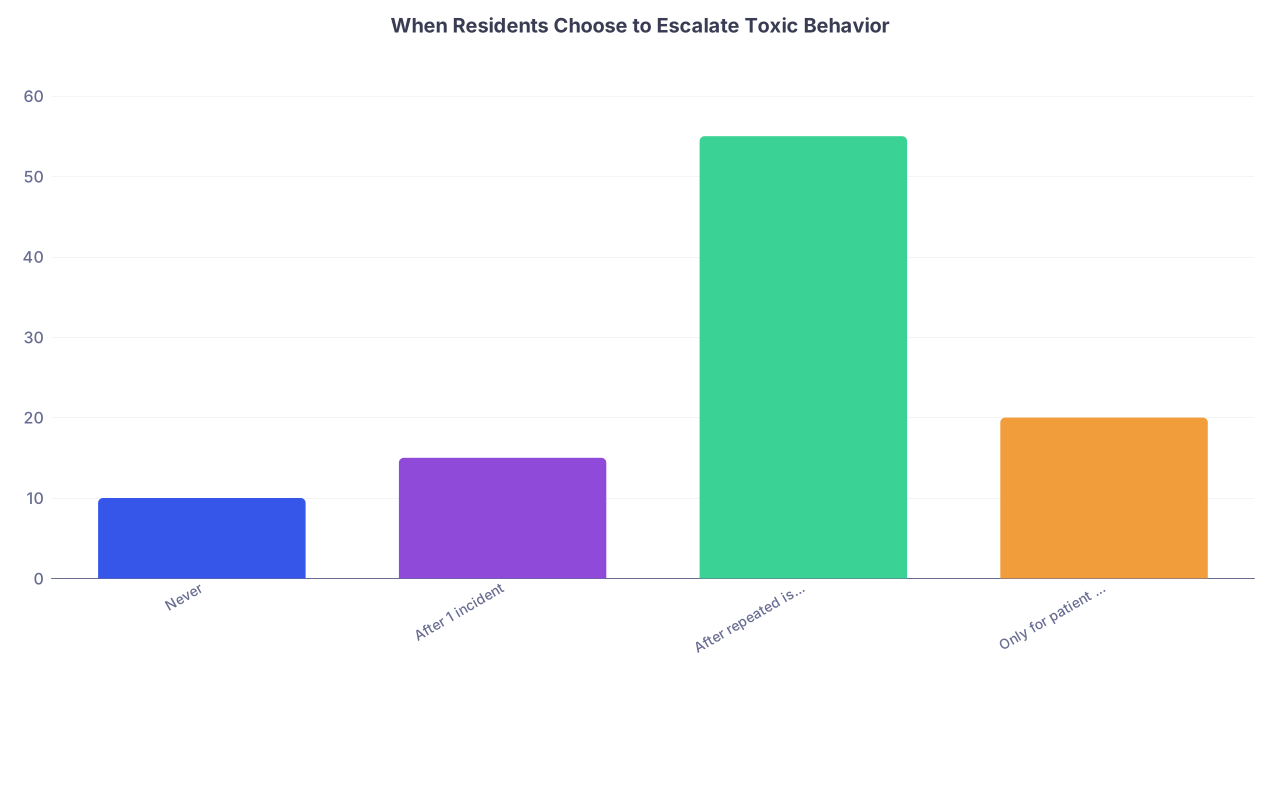
| Category | Value |
|---|---|
| Never | 10 |
| After 1 incident | 15 |
| After repeated issues | 55 |
| Only for patient safety | 20 |
Here’s the order I usually recommend:
Trusted senior or chief resident
Find the one who actually handles problems (you know who that is).- “I’m having an ongoing issue with [Name]. I want to make sure I’m seeing this clearly and handling it professionally. Can I run a few examples by you?”
You want:
- Sanity check: Are you overreacting?
- Strategy: How is this person perceived? Has this come up before?
Faculty mentor or APD you trust
Use your documented examples. Stay factual.- “Over the last month, I’ve had repeated issues with [Name] that are affecting team function and at times patient care. I’ve tried to address it directly once. Here are a few specific examples. I’m looking for guidance on next steps and how to protect patient safety without damaging my own standing.”
You are not asking them to “fix” your feelings. You’re asking for help with a professionalism issue.
Program Director – when patterns are serious or patient safety is at risk
By this point, you should have:- A brief written timeline.
- At least one attempt at direct communication (if safe).
- A chief or mentor who knows something about it.
In the PD meeting:
- Stay calm. No crying if you can help it (you’re allowed, but it shifts the frame).
- Use your timeline. “On X date, Y happened. Impact: Z.”
- State your goal: “I want to work effectively on teams and protect patient care. I also do not want retaliation.”
Ask directly:
“Is there a way to structure schedules or teams to minimize repeated pairing?”
“Is this behavior something the program is already aware of?”
If they are a decent PD, they’ll read between the lines.
Step 8: Guard Your Mental Health Like It’s a Patient in the ICU
You can be doing all the right “professional” things and still be wrecked by this.
Signs it’s taking too much from you:
- You’re dreading shifts solely because of this person.
- You replay their comments in your head after work.
- You start to believe you’re incompetent, despite no objective feedback supporting that.
- Your sleep, appetite, or basic functioning tanks.
At that point, this isn’t “just a rough rotation.” You need support.
Concrete moves:
One non-medical person who knows the basic story
Not every detail. Just: “I’m working with someone who is consistently undermining me and it’s grinding me down.”
Gives you reality checks and reminds you who you are outside the hospital.Consider occupational or mental health
Many hospitals have confidential counselling. Use it.
You do not lead with “this person sucks.” You lead with:
“I’m feeling demoralized and anxious on shifts, and I’m not sure how much is me versus a really difficult colleague.”Protect off-days aggressively
When you’re off, you’re off.
No stalking their progress on social media. No rehashing every interaction.
Force yourself into at least one non-medical activity that burns off cortisol: gym, long walk, trash TV, whatever.Short, nightly decompression
5–10 minutes after a shift:- Write down 2 things you did well that day. Not perfect. Just competent.
- One thing you’ll do differently tomorrow (on your own performance).
You’re fighting the narrative in your head that they’re trying to write for you.
Step 9: Adjust Expectations – You’re Not Here to Fix Them
Toxic co-residents rarely have an epiphany because of your feedback. They’re often:
- Chronically insecure.
- Used to getting away with this behavior.
- Very good at looking competent upward while punching downward.
So be clear on your actual goals:
Not realistic:
- “I will make them like me.”
- “I will prove my worth and they will respect me.”
- “I’ll fix their communication style.”
Realistic:
- “I will protect patients.”
- “I will protect my reputation.”
- “I will get through this rotation without burning out or compromising my values.”
- “I will leave a paper trail if they try to blame me for something.”
You’re training to be the attending who does not tolerate this. That’s the long game.
Step 10: What If You Are Also Doing Some of This?
Uncomfortable point, but I’ve seen it: sometimes someone reading this realizes, “Some of this sounds like… me.”
Good. That’s salvageable.
Quick self-audit:
- Do people seem tense when you walk into the workroom?
- Do interns avoid asking you questions?
- Have you ever framed someone else’s idea as your own in front of an attending?
- Do you use sarcasm as your default teaching “style”?
If you suspect you’re part of the problem:
Ask for honest feedback from one person you trust
“I’m worried my style sometimes comes off harsher than I intend. Have you noticed that?”
Then shut up and listen. No defending.Pick one behavior to change immediately
Examples:- No more negative comments about colleagues in front of nurses or students.
- Always acknowledge who did the work when presenting.
- Replace eye rolls with, “Let’s walk through it together.”
Own it if appropriate
A simple, “Hey, I realized I’ve been a bit sharp on rounds. I’m working on that,” can reset a lot.
Better to fix it now as a resident than be the attending everyone dreads.
A Quick Visual: Surviving a Month with a Toxic Co-Resident

| Step | Description |
|---|---|
| Step 1 | Notice Pattern |
| Step 2 | Document Examples |
| Step 3 | Contain and Set Boundaries |
| Step 4 | Consult Chief or Mentor |
| Step 5 | Maintain Boundaries |
| Step 6 | Meet with PD if Needed |
| Step 7 | Adjust Schedule or Monitoring |
| Step 8 | Support Mental Health |
| Step 9 | Mild or Severe |
| Step 10 | Improvement? |
Final Thoughts: What Actually Matters Here
You’re in a tough spot, but you’re not powerless. Three points to keep in your head:
- Separate feelings from facts. Your feelings are valid, but what protects you is clear behavior, documentation, and consistent professionalism on your side.
- You’re responsible for patient safety and your own integrity—not for fixing a broken colleague. Draw boundaries, escalate when necessary, and then let the system do its job (or fail visibly trying).
- This rotation ends. Your career goes on. How you handle this—calmly, with receipts, without becoming like them—will matter more for your growth than anything they say about you.