title: "Months Out vs Interview Week: Timing Your Professionality Answer" description: "Residency applicants: learn how to time your professionalism answer. Build stories months out, refine them late, and execute with poise on interview week."
The Countdown Begins: Why Timing Matters for the Professionalism Answer
Every residency interview includes some version of the professionalism question. "Tell me about a time you made a mistake." "Describe a conflict with a colleague." "When have you witnessed unprofessional behavior, and what did you do?" The prompt changes, but the target stays the same: can this person reflect honestly, act with integrity, and grow from the experience?
Most applicants treat the professionalism answer as a single task, something to figure out the night before. That's wrong. The months-out preparation and the interview-week execution are two completely different skills. Building the content requires slow, deliberate reflection. Delivering it requires poise and restraint. If you collapse those phases into one frantic week, you'll either sound rehearsed or sound lost.
I want you to think in terms of a chronological zone. The right prep timeline reduces anxiety and increases authenticity. You build a library early, refine it under pressure in the middle phase, polish it late, and then, critically, you stop. Interview week isn't for generating material. It's for trusting what you already have.
Here's the month-by-month, week-by-week, day-by-day plan.
Six to Three Months Out: Build Your Library of Professionalism Stories
At this point, you should inventory your experiences. Sit down with a blank document and recall three to five situations where you demonstrated professionalism. Not five situations where you were a hero. Five situations where you were a human being who handled something hard the right way, or the wrong way first, then corrected.
Good sources: a medication or documentation error you caught or made, a disagreement with a resident or attending, a difficult patient encounter, a moment you witnessed a colleague cross a line and had to decide whether to speak up.
Use the STAR-L method
For each story, write out:
- Situation, One or two sentences setting the scene. Clinical context, who was involved, what was at stake.
- Task, What were you responsible for in that moment?
- Action, What did you specifically do? Not the team. You.
- Result, What happened, concretely?
- Lesson Learned, What did this teach you about professionalism? This is the part most applicants skip, and it's the part interviewers actually care about.
Categorize your stories
Sort them into rough buckets:
- Conflict with a team member
- Patient safety or clinical error
- Admitting a mistake
- Managing a difficult or hostile patient
- Witnessing unprofessional behavior
You don't need one story per category. But you want coverage across at least three buckets. A single story about a medication error won't help you when the prompt asks about interprofessional conflict.
Write drafts, and then walk away
At this point, you should write each story as a rough draft. A paragraph or two. Don't edit for length yet. Don't memorize. Don't rehearse aloud. Just get the content out of your head and onto the page.
If you struggle with timeline gaps in your answers, see our guide on why timeline gaps trip up your behavioral answers and how to close them.
Then set it aside. Seriously. Close the document. Come back in two weeks with fresh eyes. The stories will have settled, and you'll see which ones actually have a lesson worth telling and which ones are filler.
The biggest mistake I see at this stage? Applicants pick the story that makes them look best instead of the story that taught them the most. Interviewers can tell the difference. Choose the learning, not the brag.
Three to One Month Out: Refine and Stress-Test Your Narratives
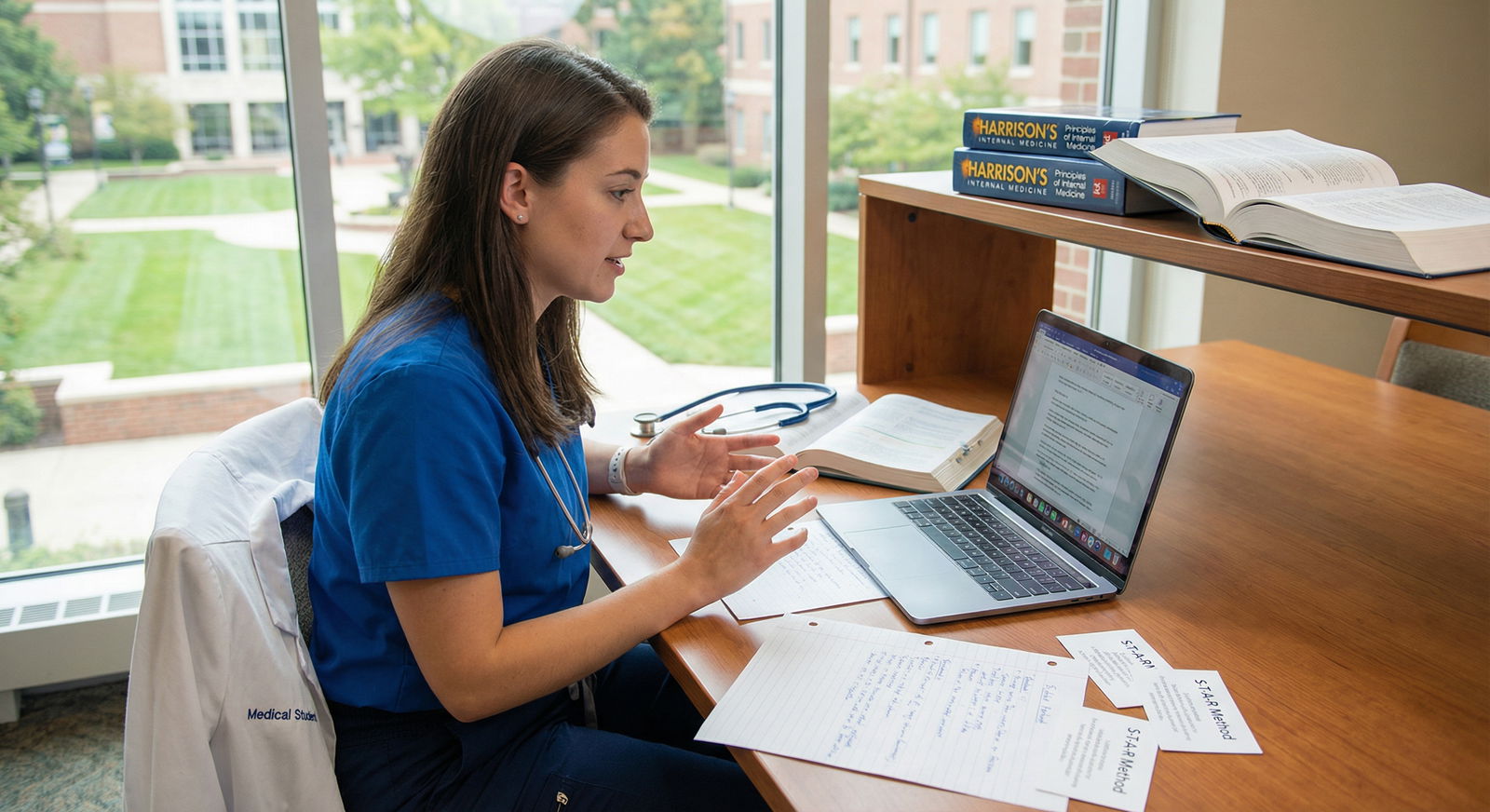
At this point, you should practice aloud with a timer. Your target is 90 seconds per answer. That's not a guess, it's the sweet spot where you give enough detail to be credible without rambling into territory the interviewer can't follow. Under 60 seconds feels thin. Over two minutes feels like you lost the thread.
Record yourself
Use your phone. Record video, not just audio, you need to see your face and hands. Then watch it. I know it's uncomfortable. Do it anyway.
Listen for three things:
- Clarity: Is the sequence of events obvious? Can someone who wasn't there follow it?
- Conciseness: Are you repeating yourself? Padding with "essentially," "basically," "needless to say"?
- Emotional tone: Do you sound calm and reflective? Or defensive, justificatory, performative?
If you sound like you're arguing your case to a jury, you've chosen the wrong story or the wrong frame. Professionalism answers should sound like someone thinking out loud about something they learned, not someone defending their honor.
For more on avoiding over-rehearsed responses, check out what if all my behavioral answers sound too perfect or fake.
Get outside feedback
At this point, you should run your stories past a peer or mentor. Ask them a specific question: "Does this sound like a genuine learning moment, or a rehearsed script?"
That question matters. A rehearsed script sounds smooth but hollow. A genuine learning moment has small imperfections, a pause, a moment of self-correction, a phrase like "what I didn't realize at the time was..."
Pick your top two
From your library of three to five, identify the two stories that are most versatile. These are the ones that can bend to different prompts. A good medication-error story can answer a question about mistakes, a question about patient safety, or a question about honesty. A good conflict story can answer a question about teamwork, communication, or difficult colleagues.
You're not discarding the others. You're prioritizing. In the final month, you want two stories you know cold, not five stories you kind of remember.
Two Weeks to One Week Out: The Final Polish, No New Stories
At this point, you should stop inventing new stories. I mean it. The temptation will be strong. You'll hear a prompt and think, "Oh, I should have a story about that." No. You don't need a new story. You need to polish the two you have.
Create a one-sentence headline for each story
Distill each story into a single sentence. Think of it as the title of a case report.
- "I admitted a medication error to my attending and helped implement a double-check system on our service."
- "I disagreed with a co-resident about a discharge plan and negotiated a compromise that kept the patient an extra day for observation."
That headline is your anchor. If you remember nothing else in the interview, you remember the headline, and you can rebuild the story around it.
Practice transitions
At this point, you should rehearse the opening line. Not the whole story, just the first sentence. The transition from the interviewer's question to your answer.
- "A time I demonstrated professionalism was when I..."
- "That reminds me of a situation during my sub-I where..."
- "I faced something similar last year when..."
Smooth openings buy you time. They let your brain catch up to your mouth.
Do two full mock interviews
Not quick practice runs. Full mock interviews, with someone asking you the professionalism question buried among other questions, the way it actually happens. You need to practice switching gears, moving from a clinical question to a behavioral question without losing your footing.
After each mock, ask your partner: "Did the professionalism answer feel like it belonged to the same person as the rest of the interview?" If the answer is no, your story is over-rehearsed. Dial it back.
Interview Week: Execute with Authenticity and Poise

At this point, your preparation is complete. Do not cram new material. I've watched applicants try to memorize a new story the morning of the interview. It always shows, they sound stiff, they lose their place, they panic mid-sentence. Trust the work you've done.
Morning of the interview
Review your two story headlines only. The one-sentence versions. No full text. No bullet points. You're not refreshing your memory, you're reminding yourself that you have the memory. That's enough.
During the interview
Listen carefully to the prompt. If it asks for "a time you faced a challenge," that doesn't automatically mean your conflict story. It might fit your medication-error story better. Adapt. You have two versatile stories, let the prompt tell you which one to use.
Use pauses. Silence is not your enemy. A two-second pause before you answer looks thoughtful, not unprepared. Speaking at a measured pace signals confidence. Rushing signals anxiety.
End with reflection. Every professionalism answer should close with what you learned, about yourself, about the profession, about the kind of resident you want to be. That's the lesson from your STAR-L. It's the reason the story exists.
After the answer
Stay calm. The interviewer may probe deeper. "What do you think you could have done differently?" or "How would you handle that now?" These aren't attacks. They're invitations to show depth.
Be ready to add one specific detail you didn't include the first time. Not a new story, a new layer. A thought you had in the moment. A follow-up action you took a week later. Something that proves the story is real and not a rehearsed monologue.
Then stop talking. Don't ramble. Let the interviewer move on.
Action Steps
- Six months out: Write 3-5 professionalism stories using STAR-L. Set them aside for two weeks.
- Three months out: Record yourself telling each story in 90 seconds. Watch the video. Cringe. Improve.
- One month out: Pick your two best, most versatile stories. Create a one-sentence headline for each.
- Two weeks out: Do two full mock interviews. Practice transitions. Stop adding new material.
- Interview week: Review headlines only. Trust your preparation. Speak slowly. Pause. Reflect.
The applicants who nail the professionalism question aren't the ones with the most dramatic stories. They're the ones who planned early, refined deliberately, and trusted themselves when it counted. Start now. The clock is already running.