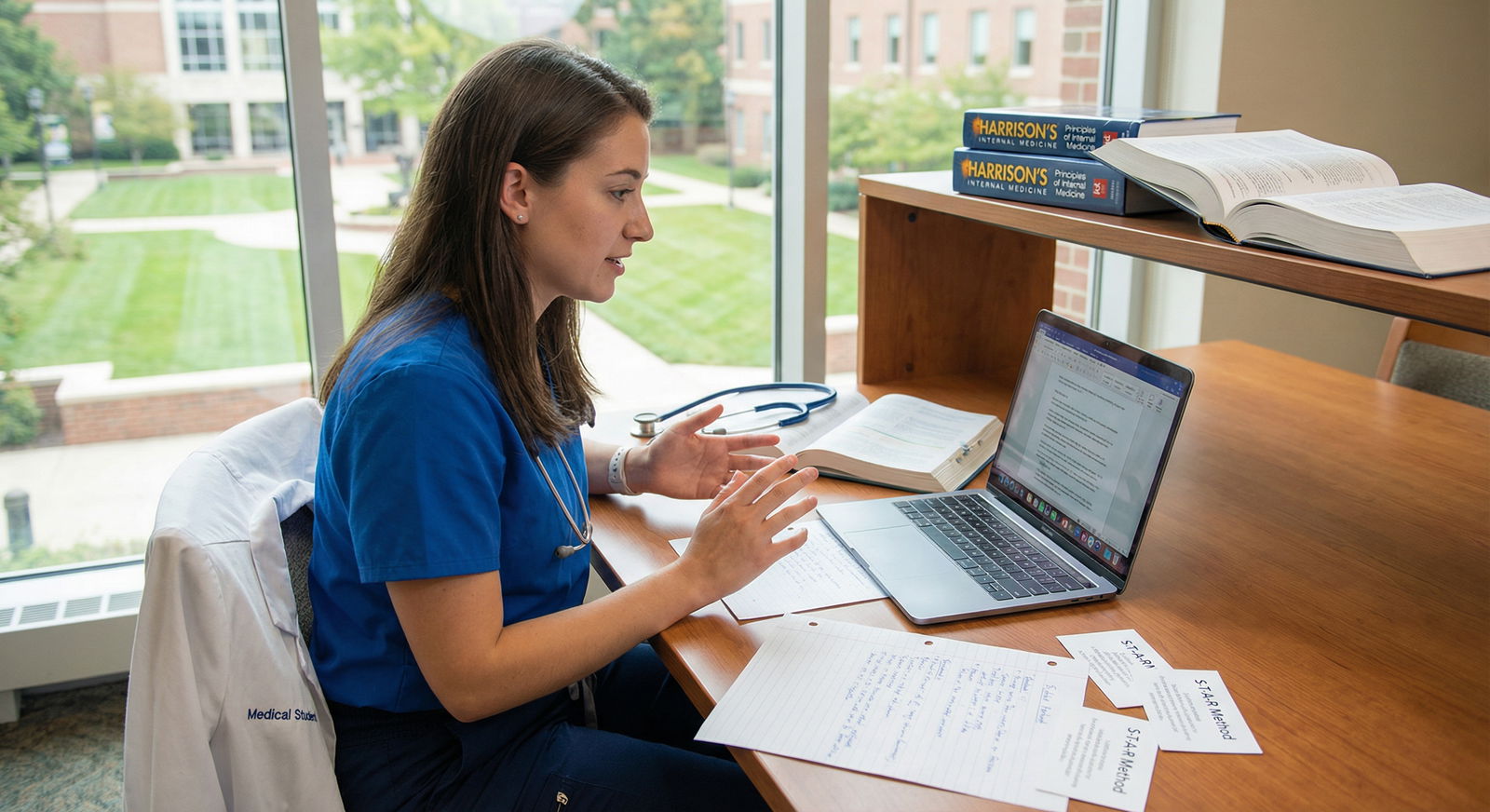
Why Behavioral Interviews Matter in Healthcare Careers
Residency programs and healthcare employers increasingly rely on Behavioral Interviews to distinguish between applicants who look similar on paper. Strong board scores and clinical evaluations may get you to the interview, but your ability to communicate, reflect, and work effectively with others is what often determines who matches or gets hired.
Behavioral interview questions are designed to reveal:
- How you think under pressure
- How you function on a team
- How you respond to conflict, mistakes, and feedback
- How you prioritize patient safety and professionalism
For residency and other healthcare careers, this is critical. Program directors want to know: If I put this person on my team at 3 a.m. with a crashing patient, what will they be like to work with?
This guide will help you:
- Understand what behavioral interviews are really testing
- Use the STAR Method to structure powerful, memorable answers
- Adapt real-life clinical experiences into polished responses
- Avoid common pitfalls that sink otherwise strong candidates
- Practice with healthcare-specific examples that map directly to residency and job interviews
What Are Behavioral Interview Questions?
Behavioral interview questions ask you to describe specific past situations rather than hypothetical ones. Instead of “What would you do if a patient was angry?” you’ll be asked, “Tell me about a time you dealt with an angry patient.”
The core assumption is: past behavior predicts future behavior. Your interviewer wants concrete evidence that you’ve:
- Practiced good judgment
- Demonstrated professionalism
- Managed complex or emotionally charged situations
- Taken responsibility and learned from experience
Common Behavioral Interview Question Themes in Healthcare
Most questions fall into a few key competency areas that are highly valued in residency and healthcare roles:
- Teamwork and collaboration
- Communication with patients and colleagues
- Leadership and initiative
- Ethical decision-making and professionalism
- Adaptability and resilience
- Conflict resolution
- Time management and prioritization
- Quality improvement and patient safety
Sample Behavioral Interview Questions
Here are examples you’re likely to see in residency and healthcare job interviews:
- “Can you give me an example of a time you had to overcome a significant challenge in clinical training?”
- “Describe a situation where you worked as part of a team to achieve a goal in patient care.”
- “Tell me about a time you made a mistake. How did you handle it?”
- “Describe a conflict with a coworker or team member and how you resolved it.”
- “Tell me about a time you advocated for a patient.”
- “Describe a situation where you had to adapt quickly to an unexpected change.”
To answer these effectively, you need a clear, structured approach. That’s where the STAR Method comes in.
Mastering the STAR Method for Behavioral Interviews
The STAR Method is one of the most effective Interview Tips for structuring behavioral answers. It keeps you focused, concise, and impactful.
STAR stands for:
- Situation – Set the stage with brief context
- Task – Explain your specific role or responsibility
- Action – Describe what you did, step by step
- Result – Share the outcome, including what you learned
How to Use STAR Effectively
- Keep the Situation and Task concise (2–3 sentences each)
- Spend most of your time on the Action (what you did, not what “we” did)
- End strongly with the Result, including impact on patient care, team function, or your growth
- When possible, quantify results (e.g., “reduced wait times by 30 minutes,” “improved adherence by 25%”)
Example 1: Overcoming a Significant Challenge
Typical Question:
“Can you describe a time when you faced a significant challenge at work or during clinical training?”
This question assesses your resilience, problem-solving, and adaptability—critical traits for successful residents and healthcare professionals.
Strong STAR Response
Situation:
“During my internal medicine rotation, our clinic experienced an unexpected surge in patients at the peak of flu season. We were short-staffed due to illness, and our usual scheduling system couldn’t keep up, resulting in long wait times and frustrated patients.”Task:
“As the senior student on the team that day, I was asked to help manage patient flow and support both the nursing staff and residents to keep the clinic running safely and efficiently.”Action:
“I quickly reviewed the schedule and worked with the charge nurse to categorize patients by urgency and complexity. I suggested converting some routine follow-ups to brief telehealth check-ins for stable patients, with attending approval. I also created a visible whiteboard system to track which patients were waiting for labs, imaging, or provider evaluation, which helped us avoid duplicate work and unnecessary delays. Additionally, I took on extra responsibilities such as gathering vitals and counseling stable patients about flu prevention to free up the residents for more complex cases.”Result:
“By reorganizing our workflow, we reduced average wait times by about 30 minutes compared to the previous day and were able to see all scheduled patients without needing to reschedule anyone. Several patients commented that they felt informed and cared for despite how busy the clinic was, and the attending later incorporated elements of the whiteboard tracking system into our standard process.”
Why This Works
- Demonstrates initiative (did more than was required)
- Shows systems thinking and patient-centered care
- Quantifies improvement (wait times, patient experience)
- Highlights collaboration with nurses and physicians

Example 2: Team Collaboration in Healthcare Settings
Typical Question:
“Tell me about a time when you collaborated with a team to achieve a goal.”
Residency and clinical practice are fundamentally team-based. Interviewers want to see that you can work across disciplines, respect different roles, and keep the team focused on patient outcomes.
Strong STAR Response
Situation:
“During my clinical year, I was part of a multidisciplinary team at a community hospital working on a quality improvement project to reduce readmissions for patients with poorly controlled diabetes.”Task:
“I was asked to coordinate patient education efforts and ensure that our written and verbal communication about diabetes management was clear, consistent, and understandable across the team.”Action:
“I started by meeting with nurses, dietitians, pharmacists, and physicians to understand what each discipline was already teaching patients and where inconsistencies existed. I then compiled this information and developed a unified, patient-friendly education booklet at a sixth-grade reading level, with clear visuals and step-by-step instructions on medication use, diet, and blood glucose monitoring. To improve team collaboration, I organized brief weekly huddles where we could review any patient feedback or readmission data and adjust our teaching materials accordingly. I also piloted a structured ‘teach-back’ method, training team members to ask patients to explain the plan in their own words before discharge.”Result:
“Over the following three months, our readmission rate for patients with diabetes decreased by approximately 15%. Patient satisfaction scores related to discharge instructions improved, and several patients specifically mentioned that the new booklet and teach-back conversations made them feel more confident managing their condition at home. The hospital’s QI committee later adopted the teach-back training session for other high-risk conditions.”
Why This Works
- Clearly shows interprofessional collaboration
- Demonstrates leadership without formal authority
- Connects actions to measurable quality and safety outcomes
- Uses language relevant to Healthcare Careers and residency programs
Example 3: Conflict Resolution with Colleagues
Typical Question:
“Describe a situation where you had a conflict with a coworker or peer and how you dealt with it.”
In high-pressure environments, disagreements are inevitable. Interviewers want to see emotional maturity, professional communication, and a clear focus on patient care.
Strong STAR Response
Situation:
“During my sub-internship, I worked with another student who had a very different style of presenting on rounds—very detailed and lengthy. Our attending frequently commented on how long rounds were taking, and tensions started to rise within the team.”Task:
“As the other student and I were splitting patients, I realized our different styles were contributing to inefficiency and frustration. I felt responsible for helping improve the situation without damaging our working relationship.”Action:
“I approached my colleague privately after rounds and started by acknowledging their strengths in gathering thorough information. I then shared my observation that our attending seemed concerned about time and asked if we could work together on a more streamlined format that still included key data. We agreed to practice a concise template for presentations and to give each other feedback after rounds. I also asked our senior resident for input on what they considered ‘high-yield’ information so we aligned with their expectations.”Result:
“Within a few days, our presentation times decreased noticeably, and rounds flowed more efficiently. The attending commented that our presentations had improved and felt more focused. My relationship with the other student also improved; they later told me they appreciated that I brought up the issue in a respectful, collaborative way. The experience reinforced for me the value of addressing conflict early, directly, and with a shared goal in mind.”
Why This Works
- Shows self-awareness and humility
- Focuses on problem-solving, not blame
- Demonstrates ability to give and receive feedback
- Emphasizes shared goals and respect
Advanced Techniques to Elevate Your Behavioral Interview Answers
Beyond basic STAR, there are several strategies that can significantly strengthen your performance in Behavioral Interviews, especially in competitive residency and healthcare hiring processes.
1. Build a “Behavioral Bank” of Versatile Stories
Create a story bank of 10–15 experiences you can adapt to different questions. Aim to cover:
- A time you led a project or team
- A challenging patient interaction
- A mistake or near-miss and what you learned
- A conflict with a peer or supervisor
- A time you went above and beyond for a patient or colleague
- A major obstacle or setback and how you responded
- An example of quality improvement or system-level thinking
Write brief STAR outlines for each. You can reuse and tailor these stories for many questions, which reduces stress and keeps your answers consistent and polished.
2. Align Stories with the Role and Program
For strong Job Preparation, review the program’s or employer’s:
- Mission and values
- Patient population
- Clinical strengths (e.g., trauma center, community-based, research-heavy)
Then choose stories that highlight the competencies they explicitly value. For example:
- Applying to EM? Emphasize calm under pressure, prioritization, and rapid decision-making.
- Applying to pediatrics? Highlight family communication, empathy, and patient education.
- Applying to surgery? Include examples of ownership, resilience, and teamwork in the OR or acute care settings.
3. Use “I” Statements and Own Your Role
Many candidates fall into the trap of saying “we” throughout their answers. While medicine is team-based, your interviewer needs to know:
- What you noticed
- What you decided
- What you did
Use “we” to set context, but shift to “I” for actions and reflections.
4. Incorporate Reflection and Growth
Program directors consistently value teachability and insight. After the Result, briefly add:
- “This experience taught me…”
- “Since then, I’ve changed my practice by…”
This shows you learn from experience—critical for success in any stage of healthcare careers.
Common Behavioral Interview Pitfalls (and How to Avoid Them)
Even strong candidates often stumble in predictable ways. Being aware of these common errors can dramatically improve your performance.
1. Being Too Vague or Hypothetical
Avoid answers like, “I usually handle stress by staying calm and organizing my work.” Instead, give a specific, concrete example and walk through it using STAR.
2. Over-Focusing on Medical Details
Your interviewer does not need every lab value or medication dose. Focus on:
- Situation context (briefly)
- Your decision-making process
- Your communication and teamwork
- Patient safety and professionalism
3. Choosing Stories Without a Clear Positive Outcome
You can absolutely talk about challenging situations or mistakes—but you must demonstrate:
- Responsibility (no blaming)
- Corrective action
- Learning and growth
If a situation didn’t end perfectly, emphasize what you changed afterward.
4. Rambling or Losing Structure
Without STAR, answers can become long and unfocused. Practice staying within 2–3 minutes per answer, with a clear beginning (S/T), middle (A), and end (R).
5. Using Only Non-Clinical Examples When Clinical Ones Are Available
Non-medical examples (from volunteer roles, sports, or prior jobs) can be excellent, especially early in training. However, for residency and advanced healthcare roles, try to include at least some clinical or healthcare-related examples to show readiness for the environment you’re entering.
Practical Job Preparation Tips for Behavioral Interviews
Deliberate preparation will make your answers more confident and authentic—not scripted.
1. Analyze the Job or Program Description
Highlight key qualities mentioned, such as:
- “Team-oriented,” “collaborative”
- “Adaptable,” “handles high-acuity patients”
- “Strong communication skills”
- “Commitment to underserved populations”
Then map your story bank to these themes.
2. Practice Out Loud, Not Just in Your Head
- Record yourself answering common questions using STAR
- Practice with a mentor, advisor, or friend
- Consider participating in a mock interview with your medical school or institution’s career office
Focus on:
- Clarity and conciseness
- Minimizing filler words (“um,” “like,” “you know”)
- Confident, conversational tone
3. Prepare for Variations of the Same Question
Different programs may phrase similar themes in different ways. For example:
- “Tell me about a challenging patient.”
- “Describe a time you had to deliver bad news.”
- “Share an example of a difficult communication situation.”
All can be answered using one or two well-crafted stories from your behavioral bank, tailored to the exact wording.
4. Plan Your “Closing” Questions
Almost every interview ends with, “Do you have any questions for us?” Thoughtful questions can reinforce your fit and interest. Consider asking about:
- Team dynamics and teaching culture
- How feedback is given and residents are supported
- Opportunities for QI, leadership, or specific clinical interests
This subtly reinforces that you value growth, collaboration, and patient-centered care—the same themes reflected in your behavioral responses.

FAQs: Behavioral Interviews for Residency and Healthcare Jobs
1. What are the most common behavioral interview questions in residency and healthcare interviews?
Common behavioral questions you’re likely to encounter include:
- “Describe a time when you had to deal with a challenging or non-adherent patient.”
- “Can you give an example of how you showed leadership on a clinical team?”
- “Tell me about a time you made a mistake in clinical care or training. What did you do?”
- “Describe a conflict with a teammate or supervisor and how it was resolved.”
- “Tell me about a time you felt overwhelmed. How did you handle it?”
Most of these can be answered by drawing from a well-prepared set of clinical and academic experiences using the STAR Method.
2. How should I prepare for a behavioral interview as a medical student or resident?
Effective Job Preparation for behavioral interviews includes:
- Reviewing the program or job description and noting key competencies
- Building a “behavioral story bank” of 10–15 experiences
- Writing brief STAR outlines for each story
- Practicing responses out loud with peers, mentors, or through mock interviews
- Reflecting on what you learned from each experience and how it shaped your approach to patient care and teamwork
The goal is not to memorize a script, but to be so familiar with your stories that you can adapt them naturally to different questions.
3. What should I do if I’m asked a question I didn’t prepare for?
It’s completely acceptable to pause briefly and think. You can say:
- “Let me think of a specific example.”
- “That’s a great question—one moment while I recall a relevant situation.”
Then:
- Choose the closest related story from your behavioral bank.
- Use STAR to structure a concise response.
- If you genuinely don’t have a direct experience, you can be honest, then pivot to a related experience and what you would do in the future based on your training and values.
Avoid panicking or rambling—taking a short pause to organize your thoughts actually projects maturity.
4. Is it necessary to use the STAR Method for every behavioral question?
You don’t need to announce, “I’m using STAR,” but you should use the structure in almost all behavioral answers. STAR ensures your response:
- Has clear context (S/T)
- Highlights your actions (A)
- Ends with a meaningful outcome or lesson (R)
For very short or follow-up questions, you might use a compressed version (e.g., one sentence for Situation/Task, a few for Action, one for Result), but the underlying structure still helps keep you on track.
5. Can I use non-medical experiences in behavioral answers?
Yes—especially earlier in training, experiences from:
- Volunteering
- Leadership in student organizations
- Coaching or tutoring
- Prior non-healthcare jobs
can all effectively demonstrate leadership, communication, conflict resolution, and resilience. For residency interviews, try to balance these with clinical or hospital-based examples to show you can apply these skills in a healthcare environment.
By combining thoughtful reflection, strategic Job Preparation, and consistent use of the STAR Method, you can turn your real-life experiences into compelling stories that resonate with residency programs and healthcare employers. Behavioral Interviews are not just hurdles to clear—they’re opportunities to demonstrate who you are as a colleague, caregiver, and future physician.