
What if they think I’m lying because my behavioral answers sound too polished?
That’s the thought, right? You’re rehearsing for your residency interview, you run through a “Tell me about a time you had a conflict with a teammate” answer, and suddenly it hits you:
“This sounds… scripted. Too good. They’re going to know I practiced. They’re going to think I’m fake. I’m going to tank this interview.”
Let me just say this up front: you’re not the first person to spiral about this. I’ve watched people walk out of interviews convinced they “came off as fake” because they sounded prepared. I’ve also seen interviewers complain about the opposite: applicants rambling, vague, can’t give a concrete example to save their life.
So you’re afraid of one thing:
That your answers sound “too perfect,” so they’ll think you’re insincere.
Let’s pull that apart before your brain convinces you you’re doomed.
What “too perfect” actually looks like to an interviewer (and what it doesn’t)
You’re imagining that if your answer is clear, structured, and you don’t stumble over every other word, they’ll mark you as inauthentic.
Reality is dumber and more boring than that.
Interviewers like when you:
- Answer the question directly
- Use a structured format (STAR, SBAR, whatever)
- Give a specific example instead of a vague “I always do X”
They don’t like when you:
- Sound like ChatGPT wrote your answer
- Make yourself the flawless hero of every story
- Avoid any sign of struggle, doubt, or imperfection
- Use generic “teamwork/leadership” clichés with zero specifics
Let me be blunt:
Your answer isn’t “too perfect” because it’s organized.
It’s “too perfect” when it doesn’t feel human.
I’ve heard answers like:
“I encountered a multidisciplinary challenge and took immediate initiative to demonstrate leadership, ensuring effective communication amongst all team members to optimize patient-centered outcomes…”
Looks great on paper. Sounds horrible from a human. Nobody talks like that at 3am on nights.
Whereas:
“On my medicine rotation at [Hospital], we had this one patient who kept bouncing back with DKA. Nurses were frustrated, the resident was burned out, and honestly I was annoyed too. I realized we were all giving different messages to the patient, so I asked if we could do a quick huddle before rounds to get on the same page…”
That’s polished. Clear. And still believable.
Your goal is not to sound messy and chaotic so they know you’re “real.”
Your goal is to sound prepared and like a normal human who’s been through real situations.
The red flags that actually make you sound fake
You’re probably panicking about the wrong things. It’s usually not:
- “I practiced this story before.”
- “I used STAR structure.”
- “I didn’t ramble.”
The real “fake” triggers are more like:
1. Zero vulnerability or struggle
If every story is:
- “I identified the problem right away.”
- “I knew exactly what to do.”
- “Everyone agreed I handled it perfectly.”
You sound like a superhero. And nobody believes superheroes. Not in residency.
Programs want residents who:
- Get overwhelmed sometimes
- Have missteps
- Need help
- Learn from feedback
If your “conflict” story ends with:
“In the end, there was really no conflict because I communicated so effectively.”
Yeah… no. That’s where you lose them.
2. Implausible outcomes
You’re telling a story as an MS4, and it suddenly sounds like you single-handedly changed hospital policy, saved the system millions of dollars, and fixed the EMR.
You probably didn’t. And that’s okay. You don’t need a Marvel origin story.
Saying:
“I brought it up to my resident, and we tried changing how we presented the dispo plan for a week. It did help with fewer last-minute family blowups, and that was a good lesson for me about setting expectations early.”
That’s small. But legit. And believable.
3. Over-rehearsed language
You know that thing where you suddenly start talking like a leadership textbook?
Phrases like:
- “Optimized interdisciplinary collaboration”
- “Maximized patient-centered care outcomes”
- “Leveraged my communication strengths to de-escalate the situation”
You can say those words. But string too many of them together and you sound like a LinkedIn post, not a person you’d want to be on nights with.
Most interviewers want: “I talked to the nurse and realized we weren’t on the same page, so I…”
4. No concrete details
This is huge. The faker the story, the vaguer it is.
Compare:
“On a rotation, I once had a conflict with a nurse. I listened, clarified expectations, and we resolved it through communication.”
Versus:
“On my surgery rotation at County, a night shift nurse was really frustrated that I’d written for Q2h vitals on an already over-monitored patient. She told me at the nurses’ station, ‘You’re writing orders like you’ve never been on nights.’ She wasn’t wrong. I’d copied forward from a previous patient…”
Specifics = believable.
Vague + “perfect” = suspicious.
How to fix “too perfect” answers without tanking your confidence
You don’t need to blow up everything you practiced. You just need to roughen the edges so they sound lived, not scripted.
Here’s what you can do.
1. Add one moment of doubt or mistake to each story
You should not be flawless in every answer. That’s what actually reads as fake.
Take this classic “too perfect” answer:
“I noticed a miscommunication between the nurse and resident about discharge plans. I stepped in, clarified the plan, and the patient was discharged safely and on time.”
Add humanity:
“I almost didn’t say anything because I was just the med student, and I didn’t want to sound like I was questioning the team. But the patient’s daughter had already rearranged work twice, and I knew if this got pushed again, it would really upset them. So I asked the resident after rounds, ‘Can I just clarify something about Mr. X’s dispo timing?’”
See the difference? Same story. But you admit you hesitated. That’s real.
2. Use your actual words, not your “applicant persona” words
Read your answer out loud. If you’d never say that sentence to a friend, it’s probably too polished.
You probably wouldn’t say:
“I utilized my leadership skills to ensure alignment among stakeholders.”
You might actually say:
“I pulled everyone together for five minutes to make sure we were all on the same page.”
Same idea. One sounds lived. One sounds… fake.

| Step | Description |
|---|---|
| Step 1 | Draft answer |
| Step 2 | Too vague or too heroic? |
| Step 3 | Add specific details: rotation, role, what you said |
| Step 4 | Add doubt, mistake, or need for help |
| Step 5 | Read out loud |
| Step 6 | Remove buzzwords you wouldnt say |
| Step 7 | Keep structure, keep humanity |
3. Anchor every story in time, place, and role
If you want your answer to feel real, tie it to something concrete:
- “On my third-year medicine rotation at [Hospital]…”
- “On nights in the MICU as a sub-I last August…”
- “During my psych rotation, when I was still figuring out how to present efficiently…”
Then name your role honestly:
- “I was the med student, so my job was mostly to… but I still…”
- “I wasn’t the team leader, but I did…”
Interviewers know what med students can and can’t do. If your story magically gives you intern-level authority, you lose credibility.
The irony: your anxiety about sounding fake usually means you’re not
The people who actually sound fake?
They’re not worried about it. They’re focused on sounding impressive.
You’re sitting here over-analyzing whether it’s okay to admit you prepared answers. You’re hyper-aware of not wanting to embellish. That’s exactly the mindset of someone who cares about being honest.
If anything, your risk is the opposite:
You might undersell yourself so much you sound bland.
I’ve watched this happen:
Interviewer: “Tell me about a time you dealt with conflict on the team.”
Applicant: “Umm… I mean, there was a time a nurse was frustrated with me. But it really wasn’t a big deal. I just apologized and it was fine.”
Then you talk to them afterward, and they tell you the full story and it’s actually a solid example of insight, communication, and growth. They just downplayed it to avoid sounding fake or dramatic.
Push back on that instinct a bit. You’re allowed to frame your experiences in a clear, strong way without lying.

Quick sanity check: Are your answers actually “too perfect” or just prepared?
Do this brutally honest check on a few of your stories.
Ask yourself:
Is there at least one moment in the story where I:
- Didn’t know what to do?
- Felt uncomfortable or unsure?
- Needed help or guidance?
- Realized I’d done something suboptimal?
Do I name at least a few specific details?
- Rotation or setting
- Who was involved (nurse, resident, attending, patient family)
- Roughly what was said
Do I talk like myself?
- If you’d never use the phrase in real life, cut it or translate it
Is the outcome reasonable for my role?
- Did I magically fix the hospital? Probably not.
- Or did I do something small but meaningful that showed growth?
If you can say yes to most of that, you’re probably fine. You don’t sound fake. You sound like someone who practiced and cares.
| Question Type | Too Perfect / Fake-Sounding | Believable Alternative |
|---|---|---|
| Conflict with nurse | “I resolved the conflict through excellent communication.” | “I realized I’d written an order that made her night harder. I asked what I could change to make it workable.” |
| Weakness | “I care too much and work too hard.” | “I can get flustered when I’m behind on notes. I’ve started…” |
| Leadership | “I led the team to a highly successful outcome.” | “I was the one who sent the message nobody wanted to send and organized a quick huddle.” |
| Mistake | “I’ve never made a serious mistake, but I’m always careful.” | “I once missed a critical lab in my pre-rounding. I caught it later, but I changed my system after that.” |
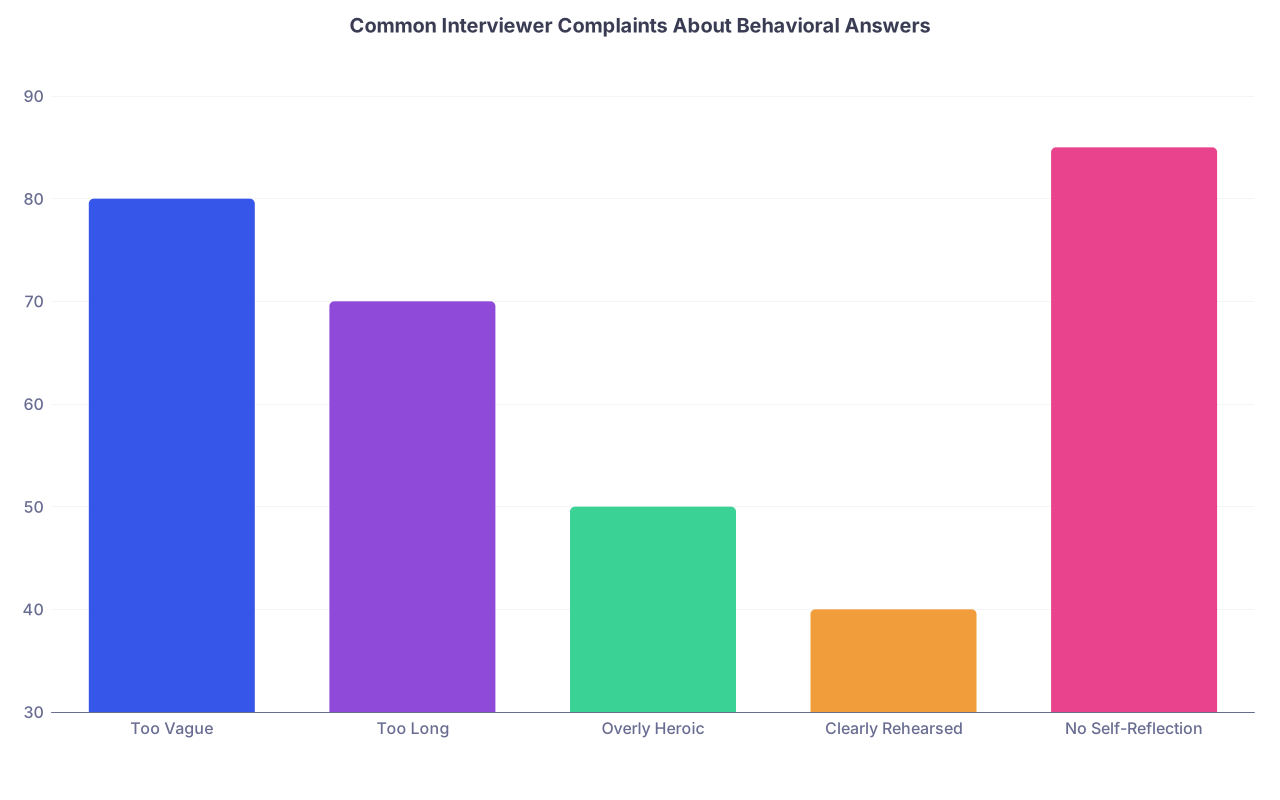
| Category | Value |
|---|---|
| Too Vague | 80 |
| Too Long | 70 |
| Overly Heroic | 50 |
| Clearly Rehearsed | 40 |
| No Self-Reflection | 85 |
Practicing without turning into a robot
You’re not wrong to practice. It’s normal. Almost every strong applicant does.
The key is how you practice.
If you script full paragraphs and try to memorize them word-for-word, you’re almost guaranteed to sound stilted and “too perfect.” Your brain will be half-focused on remembering the next sentence, not actually connecting with the question.
Instead, try this:
- For each common behavioral question, just outline:
- The situation in 1–2 sentences
- Your main action(s)
- What you learned or changed afterward
Then practice telling the story like you’re talking to a junior med student asking, “Hey, how do you handle it when a nurse is mad at you?”
You’ll hit the same beats each time, but the wording will shift. That’s good. That’s how humans talk.
Record yourself once or twice. Cringe at yourself. Then fix the worst parts. Don’t strive for “perfect.” Strive for “clear and human.”

The thing interviewers are actually judging you on
They’re not sitting there with a fake-o-meter going, “This answer is too organized. Automatic rejection.”
They’re asking themselves:
- Can I trust this person to tell me when they’re struggling?
- Do they have enough self-awareness to own mistakes?
- Would I feel okay leaving them alone with a patient at 3am (eventually)?
- Do they sound like they actually lived what they’re describing?
You don’t get there by being messy and unprepared.
You get there by being honest, specific, and willing to show where you’re not perfect.
You’re anxious because you care about not lying. That’s a good sign. Just give your stories some texture. Some doubt. Some imperfection.
Then stop tearing yourself apart. At some point, “I prepared and I’m doing my best” has to be enough.
Key takeaways
- “Too perfect” isn’t about structure or preparation; it’s about stories with no flaws, no doubt, and no real details.
- Add one moment of struggle, one concrete detail, and your real speaking voice to each answer—that’s what makes you sound human, not fake.
- If you’re this worried about sounding insincere, you’re already miles away from the people interviewers actually think are fake.