
You do not need fifty behavioral stories. That myth has wrecked more residency interviews than bad Wi-Fi ever did. Applicants hoard anecdotes like doomsday preppers stockpiling canned beans, convinced every possible question needs its own dedicated tale. Wrong. Completely wrong. The interview is not a scavenger hunt for obscure life events. It is a test of whether you can map a handful of strong experiences onto the competencies programs actually care about.
I have watched candidates freeze mid-answer because they were mentally flipping through a mental Rolodex of thirty-seven half-baked stories. Cognitive load theory is not abstract here. Your working memory collapses under that volume. You ramble. You lose the thread. The interviewer checks their watch. Meanwhile, the applicant who walked in with five to eight sharp, versatile narratives looks calm, structured, and deliberate. That is the reality. Quality plus strategy beats quantity every single time.
One story can pull double or triple duty. Call it Core Competency Mapping. Your conflict-with-a-difficult-team-member narrative can also demonstrate leadership, adaptability, and empathy depending on which angle you emphasize. You are not collecting stamps. You are building a small, flexible toolkit.
The Premise: Why 'More' Is Not Always 'Better'
The 50-story myth comes from well-meaning advisors who treat behavioral interviews like a multiple-choice exam with infinite variants. "What if they ask about a time you disagreed with a superior while also managing a dying patient and a broken printer?" Stop. Programs are not writing gotcha questions from a secret bank of 200 prompts. They recycle the same core themes: leadership, teamwork, conflict, failure, resilience, ethics, and communication.
Here is the baseline that actually works. Five to eight high-quality, well-practiced narratives cover nearly everything. I have seen applicants match with four airtight stories and one solid backup. I have also seen people with twenty-five mediocre ones crash because they could not retrieve the right details under pressure.
Cognitive load is the silent killer. When you try to memorize dozens of scripts, two things happen. First, you spend interview prep time on rote recall instead of reflection. Second, during the actual conversation your brain starts sorting instead of storytelling. The result is filler language, lost eye contact, and answers that sprawl past two minutes. Interviewers notice. They always notice.
Core Competency Mapping flips the script. Take one experience, say, coordinating a free clinic schedule during a staffing shortage. Framed one way, it is leadership. Framed another, it is conflict resolution with volunteers who wanted different hours. Framed a third, it is adaptability when the electronic system crashed. Same raw material. Multiple competencies. That is efficient. That is smart.
At this point you should reject the hoarding instinct. More stories do not equal more safety. They equal more noise.
Week 1: The Audit, Identifying Your Top Narrative Buckets
Week 1 is pure inventory. No polishing. No practicing delivery. Just ruthless sorting.
Day 1-2: Brain dump everything. Open a spreadsheet. Columns: Experience, Setting (research, clinical, volunteering, work, personal), Year, One-sentence summary, Initial gut reaction (strong/medium/weak). List research projects, shadowing moments, volunteer gigs, jobs, even family crises if they taught you something transferable. Do not censor yet. I have seen gold come from a summer job as a line cook when the applicant later reframed the chaos of a dinner rush as crisis management under pressure.
Day 3-4: Group by the four pillars that dominate residency behavioral questions:
- Leadership
- Teamwork / Empathy
- Conflict / Challenge
- Failure / Resilience
Some experiences will sit in two columns. That is fine, flag them. Those multi-use stories are your highest-value assets.
Day 5-7: Select the top candidate for each pillar. If one pillar looks thin, go hunting. Reframe an existing experience before inventing a new one. A research setback can become a failure/resilience story if you own the mistake and show the correction. A volunteering disagreement can become conflict if you highlight the resolution steps you drove.
Actionable checklist for the end of Week 1:
- Complete a Story Inventory Grid with 5-8 experiences
- Map each to at least two competencies
- Mark any gaps and schedule a targeted reflection session to fill them
- Delete or archive everything else for now, clutter is the enemy
Look at the curve. Coverage jumps fast from one to eight stories, then flatlines. Diminishing returns hit hard after that. You are not gaining safety. You are adding drag.
At this point you should have a clean shortlist. If you are still clinging to fifteen "maybe" stories, cut five more. Be brutal.
Week 2: The Frameworks, Structuring for Impact
Raw stories are useless until they have bones. At this point you should lock in structure before you worry about pretty language.
Two frameworks dominate for a reason. STAR (Situation, Task, Action, Result) is the classic. CARL (Context, Action, Result, Learning) adds the explicit reflection residency programs love. Either works. Pick one and stick to it across all stories so your delivery muscle memory stays consistent.
Critical rule: the Action portion must own roughly 70% of the spoken time. Most applicants invert this. They spend 40-50 seconds setting the scene, "It was a busy Tuesday in the ED, the attending was late, the nurse was new...", then rush the actual decisions they made. Interviewers do not care about the weather. They care what you did.
Draft skeletons only this week. For each of your 5-8 stories write four short bullets:
- Situation/Context in one tight sentence
- Task or challenge in one sentence
- Three to five concrete actions you took (verbs first: "I convened...", "I reassigned...", "I stayed late to...")
- Result plus one sentence of learning
Do not polish the script yet. A disorganized good story is worse than an organized mediocre one. Logical flow first. Cause and effect must be obvious. If the interviewer cannot follow why your action produced the result, the story dies.
I have coached people who wrote beautiful prose but lost the plot halfway through. Skeleton first. Always.
At this point you should be able to glance at any of your five-to-eight skeletons and instantly see the spine. If any story still feels mushy, rewrite the Action bullets until they are sharp.
Week 3 & Beyond: Iteration and Cross-Application
Now the real leverage begins. You have structured skeletons. Time to make them multi-purpose.
Take your strongest Conflict story. Ask: Does this also show Adaptability? Leadership? Empathy? Write a one-line "pivot note" for each alternate angle. Example: "If they ask about teamwork, emphasize how I brought the quiet med student into the plan." Same facts. Different spotlight. This is how five stories cover fifteen question variants without new material.
Practice aloud. Timer on. Sixty to ninety seconds is the sweet spot unless they specifically ask for more depth. Record yourself. You will hate the first three takes. Good. That discomfort is the point. Cut every sentence that does not advance the Action or the Learning.
Seek feedback early. Mentors, peers, even a non-medical friend. Ask two questions only: "Were you bored?" and "Did you understand what I actually did and what changed because of it?" If either answer is weak, slash the fluff. I have seen a single mentor session turn a rambling two-minute mess into a crisp seventy-second weapon.
By the end of Week 4 you should hit a simple benchmark: hear a prompt keyword ("Tell me about a time you failed," "Describe a conflict," "Leadership example") and surface the matching core story in under ten seconds. Not the full monologue, just the title and the first Action verb. Retrieval speed under mild stress is the difference between sounding prepared and sounding scripted.
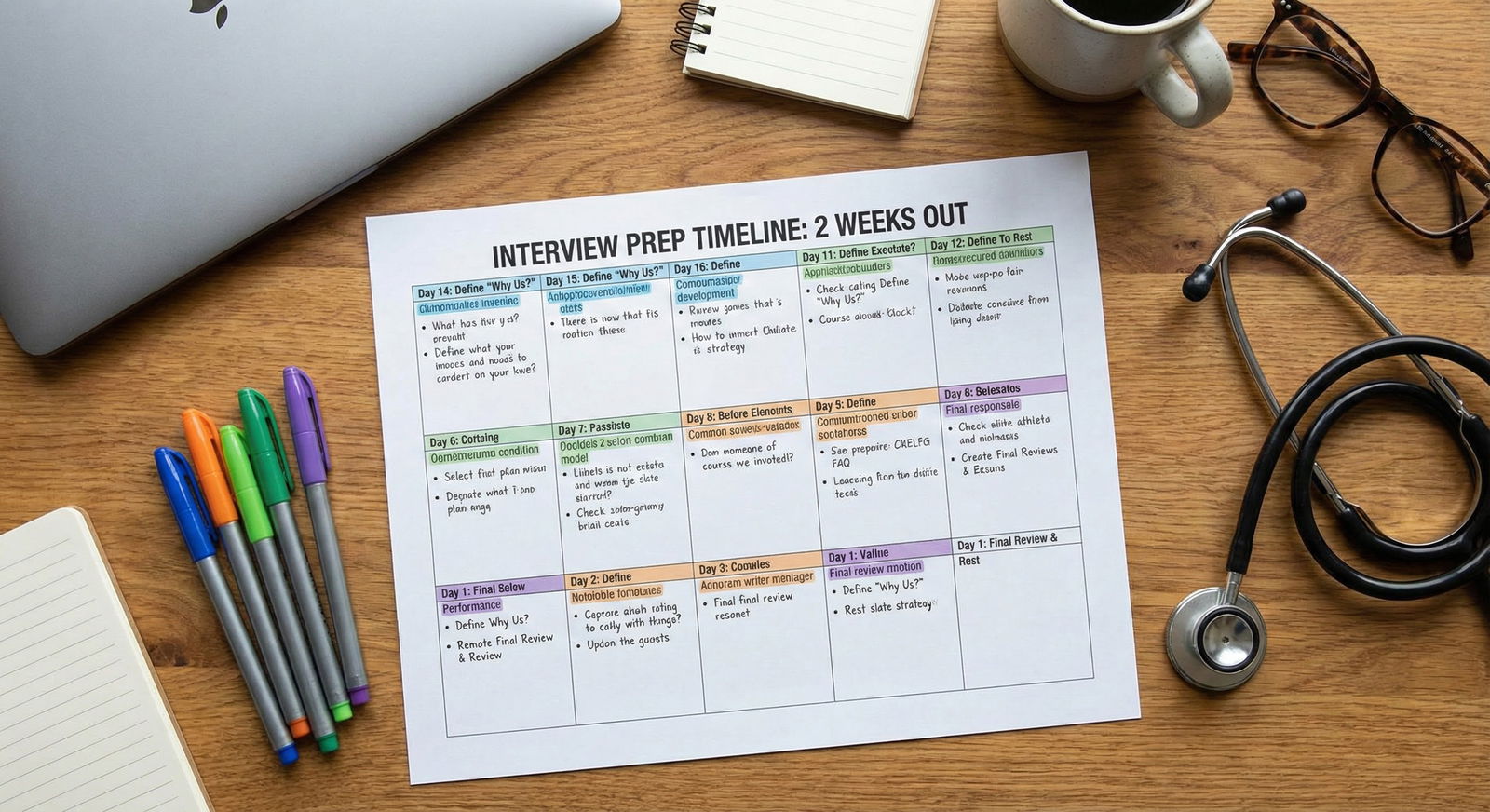
Keep iterating. One week before interviews, do a full mock with a timer and a slightly hostile questioner who interrupts. That pressure reveals which stories still wobble.
Summary
You do not need dozens of stories. You need five to eight versatile, well-structured narratives mapped tightly to core competencies. Focus the bulk of every answer, roughly 70%, on the Action so the interviewer sees your agency, not just the scenery. Week 1 auditing prevents the panic cram later; quality of reflection always beats quantity of experiences. Cross-application is the force multiplier that lets one story answer multiple prompts and conserves the mental energy you will desperately want on interview day.
Stop collecting. Start refining. The applicants who match are rarely the ones with the longest lists. They are the ones who can deploy a small set of sharp stories with speed and precision. That is the entire game.