
Yes, you can reuse the same story for different behavioral questions — but not the way most applicants do it.
If you walk into residency interviews with three to five strong stories and reuse them intelligently, you’ll sound consistent, prepared, and reflective. If you repeat the same story word-for-word for every question, you’ll sound canned and uninsightful. Programs can tell the difference in under 30 seconds.
Let me break down exactly how to reuse stories the right way for behavioral residency questions, and where people screw this up.
The Core Answer: Yes, Reuse Stories — With Rules
Here’s the straight answer:
You should reuse your best stories across different behavioral questions if:
- The story clearly fits the question being asked
- You answer from a different angle or with a different emphasis
- You show new insight or learning each time
You should not reuse stories if:
- You’re giving almost the exact same answer you already gave earlier
- You have zero other examples for professionalism, conflict, or feedback
- The story doesn’t really fit, and you’re forcing it just because you practiced it
Interviewers do not sit there tallying: “Ah, that’s the third time they mentioned that patient.” They’re asking: “Does this person have judgment, insight, maturity, and self-awareness?” If repeating a story still answers that question well, it is not a problem.
Where you get in trouble is when you sound like you memorized a monologue and are just hitting play again.
Why Reusing Stories Actually Makes You Stronger
Most residents and students dramatically overestimate how many stories they need. They show up with 20 half-baked examples instead of 5 solid, high-yield ones.
For behavioral residency questions, you can realistically cover 80–90% of what programs ask with a core story bank of 5–8 experiences:
- 2–3 clinical stories (hard, complex, or emotionally charged cases)
- 1–2 conflict/communication stories (within team, with consultant, with nurse, etc.)
- 1 story of failure or mistake
- 1 story of leadership / initiative
- 1 story of feedback or growth
Those same stories can be angled to answer:
- “Tell me about a time you had a conflict on the team.”
- “Tell me about a time you received difficult feedback.”
- “Describe a situation where you went above and beyond for a patient.”
- “Tell me about a time you disagreed with a supervisor.”
- “Tell me about a time something did not go as planned.”
Same story. Different lens. Different lesson.
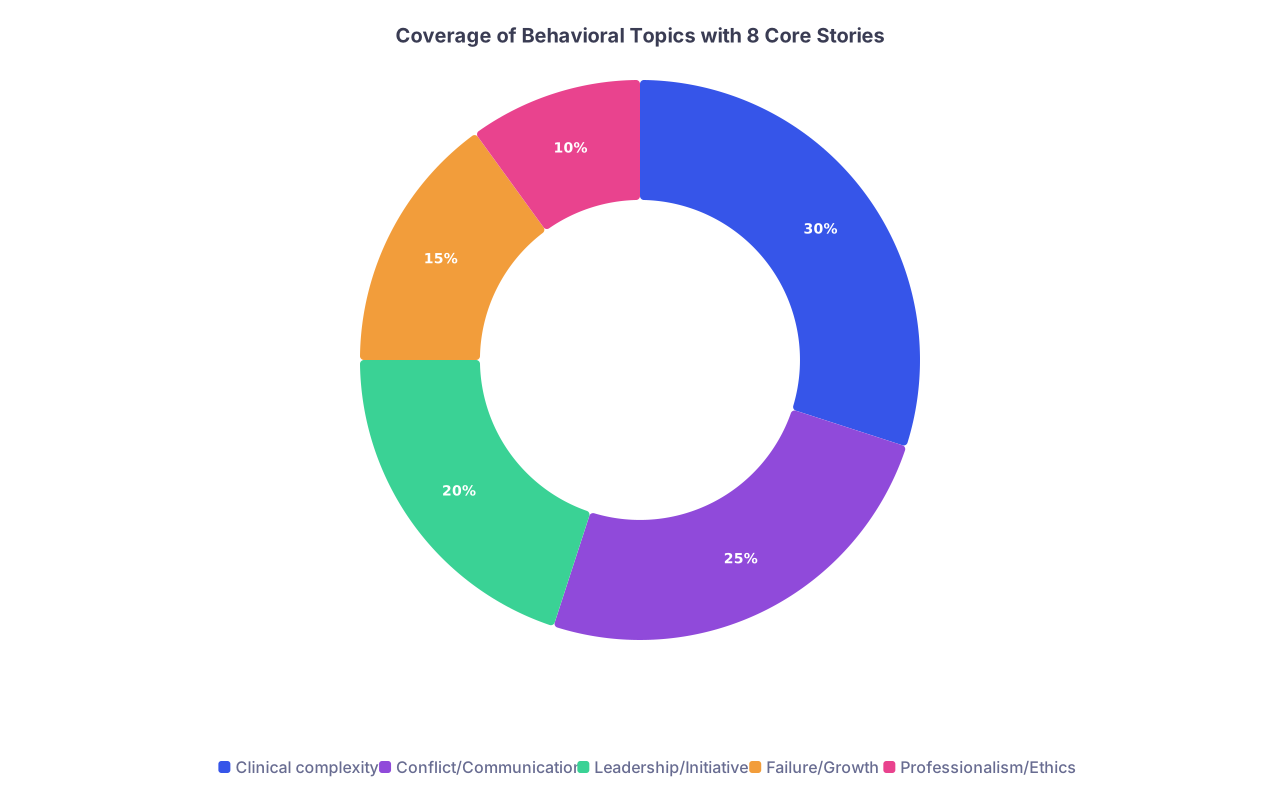
| Category | Value |
|---|---|
| Clinical complexity | 30 |
| Conflict/Communication | 25 |
| Leadership/Initiative | 20 |
| Failure/Growth | 15 |
| Professionalism/Ethics | 10 |
If you try to invent a brand new story for every question, you’ll ramble, lose the point, and end up sounding less reflective. I’ve watched applicants do this in mock interviews — the “new” stories are almost always worse.
How to Reuse a Story Without Sounding Repetitive
The trick is not the story. The trick is what you highlight.
Use one case, but answer from a different angle each time.
Example: One Story, Three Questions
Story: On your sub-I, you were taking care of a complex septic patient. There was miscommunication about antibiotics, the patient decompensated, and you had to escalate concerns and coordinate the team quickly.
You could use that same story for:
“Tell me about a time you handled a conflict on a team.”
Focus on:- Miscommunication between services
- How you clarified roles and expectations
- How you approached the senior or attending respectfully
“Tell me about a time something did not go as planned.”
Focus on:- The error or near-miss
- What you learned about checking orders, closed-loop communication
- How you changed your practice afterward
“Describe a time you had to advocate for a patient.”
Focus on:- Recognizing the patient was worse than the numbers suggested
- Calling for help despite hesitancy or hierarchy
- How you balanced being a student vs stepping up
Same facts. Different theme, different reflection, different takeaways.
What you do not do is this:
You: “Sure, I’ll tell you about a time I handled conflict on a team…”
[tell septic case story]
Next question: “Tell me about a time you advocated for a patient.”
You: “Sure, I’ll tell you about a time I advocated for a patient…”
[tell the exact same septic case, in the same way, with the same ending and same lesson]
That’s when interviewers think: “Do they seriously only have one story?”
The Only Hard Limit: Don’t Repeat Back-to-Back
The real red flag is not reusing a story somewhere in the interview. It’s reusing it immediately.
If your last question used Story A and the next question could use Story A again, force yourself to switch:
- “Tell me about a time you failed.” → Story A
- Next: “Tell me about a time you received feedback.” → Do not go back to Story A right away
You want some variety in a short time window. If you have a 20–30 minute interview and you mention the same story three times, that’s too much.
A simple personal rule that works:
- Do not use the same story for two consecutive questions
- Try to keep each story to once per interviewer
If you have multiple interviews in a day (which you will), it is completely fine to use the same story with different interviewers. They do not compare transcripts line by line.
When Reusing a Story Is a Bad Idea
There are clear situations where you should not go back to an old story:
The question is clearly about something else.
Example: “Tell me about a time you worked with someone from a different background or perspective.”
Using the same ICU septic case that had nothing to do with diversity or perspective? That’s lazy.The story already painted you in a slightly risky light.
If you used a story about a big mistake for a “time you failed” question, don’t recycle that same story for “time you had a conflict with an attending.” It starts to sound like you are accident-prone or chronically at odds with supervisors.You have a better, more direct example and you’re ignoring it.
Program directors can tell when the story is a stretch. Don’t force it.
How to Build a Reusable “Story Bank”
You’ll re-use stories best if you prepare them like a toolkit, not like memorized monologues.
Here is a simple structure that works extremely well for residency behavioral answers:
- Context (1–2 sentences): Where you were, what your role was
- Challenge: What was hard / tense / at risk
- Actions: What you did, step by step, focused on your thinking and communication
- Outcome: What happened and how things ended
- Reflection: What you learned / what you’d do differently
Do this for 5–8 stories and you’re already ahead of most applicants.
Now, for each story, identify which themes it can cover:
| Story # | Short Label | Usable For |
|---|---|---|
| 1 | Septic ICU patient | Conflict, advocacy, failure, prioritization |
| 2 | Difficult family meeting | Communication, empathy, breaking bad news |
| 3 | Mistaken lab order | Failure, attention to detail, systems thinking |
| 4 | Leading student project | Leadership, initiative, time management |
| 5 | Feedback from attending | Feedback, growth, professionalism |
Print this, or have it in a notebook when you practice. You’re training yourself to see how one story can answer multiple questions with different angles.

| Step | Description |
|---|---|
| Step 1 | Core Clinical Story |
| Step 2 | Conflict Question |
| Step 3 | Failure Question |
| Step 4 | Advocacy Question |
| Step 5 | Prioritization Question |
How to Pivot If You Have Used a Story Already
Sometimes your best story for the question is one you already used earlier in the interview. Use it again, but be transparent and shift the emphasis.
For example:
“Sure. I’ll go back to the same ICU case I mentioned earlier, but focus on the conflict side of it this time. In that situation…”
Then:
- Shorten the background; they’ve heard it
- Emphasize what’s new: your thought process, communication strategy, emotions, and learning specific to this question
- End with a different reflection
This shows self-awareness, not laziness. Interviewers appreciate it because you are not pretending they forgot what you just said.
Red Flags Interviewers Notice (That You Can Avoid)
Here’s what makes programs worry during behavioral questions:
- Every story is vague: “I was working on a team and there was this patient…” No service, no role, no specifics
- Every story is from undergrad, none from clinical years
- You never once admit to a mistake, misstep, or conflict
- You use the same “perfect” story three times with identical phrasing
- Your answers are so rehearsed they feel like reading from a script
Reusing stories is not the problem. Shallow reflection is the problem.
If you can clearly state:
- What was at stake
- What you actually did and said
- What you’d do the same or differently now
You’re doing better than most.

Quick Decision Framework: Should I Reuse This Story Right Now?
If you’re in the interview and debating reusing a story, run this 5-second mental check:
- Does this story actually answer the question directly?
- Have I used it with this same interviewer already?
- Did I just use it in the last question?
- Can I add a new lesson or angle this time?
- Do I truly have a better example?
If:
- It fits the question
- You have not used it in the last answer
- You can highlight a different lesson
Then reuse it. Cleanly. Confidently. No apology.
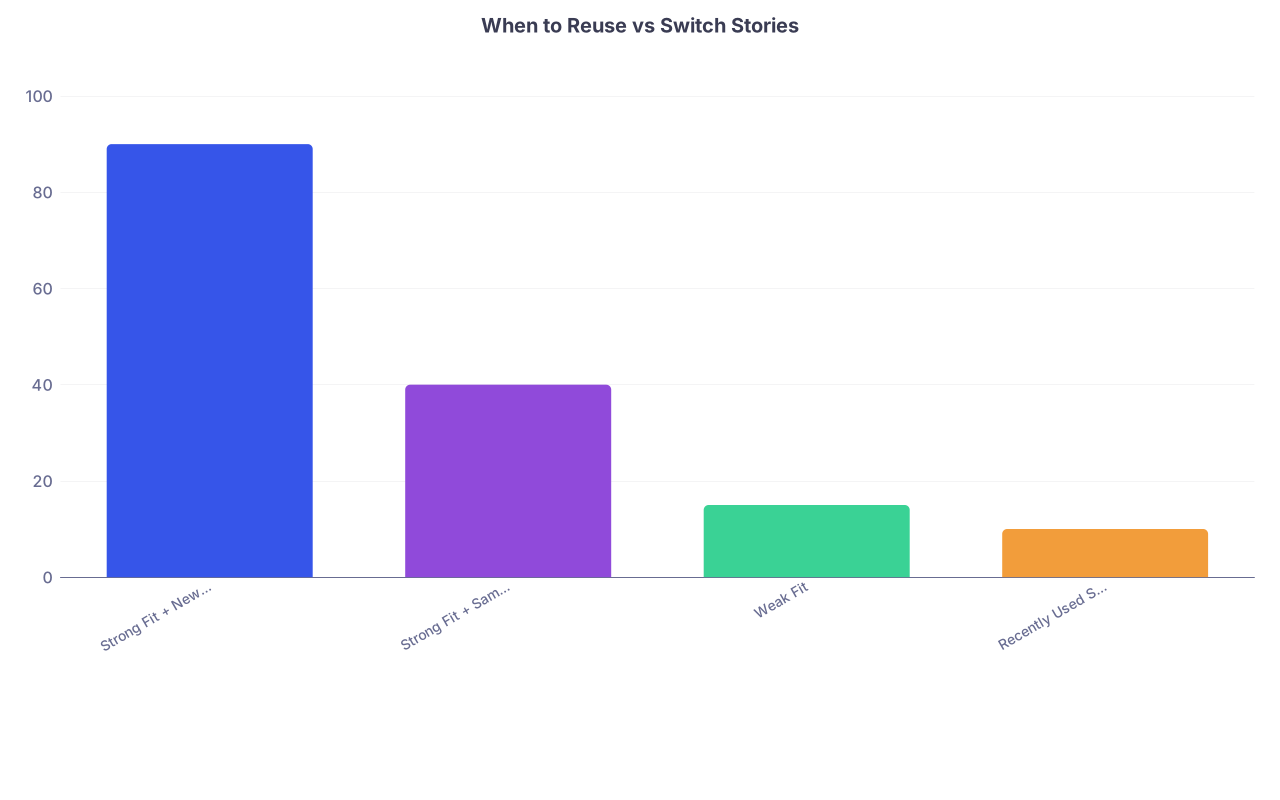
| Category | Value |
|---|---|
| Strong Fit + New Angle | 90 |
| Strong Fit + Same Angle | 40 |
| Weak Fit | 15 |
| Recently Used Story | 10 |
(Think of the values as “how comfortable I am recommending it.” Strong fit + new angle is almost always fine.)
What Programs Actually Care About
Residency programs are not scoring you on “number of distinct stories told.” They’re looking for:
- How you think under pressure
- How you handle conflict and feedback
- Whether you take responsibility without dramatizing
- Whether you learn from experiences and change your behavior
If reusing a story helps you show that more clearly, it’s not just “okay.” It’s smart.
So stop panicking about coming up with 20 different stories. Spend that energy actually deepening your understanding of the 5–8 that show who you are as a clinician and teammate.

FAQ: Reusing Stories for Behavioral Residency Questions
1. How many times can I reuse the same story during one interview day?
Across the whole day with multiple interviewers, you can reuse a strong story several times (3–5) without any problem. Within one individual interview, try to keep any single story to once, maybe twice if you take a very different angle and are transparent about it. The main thing is not to use it for back-to-back questions with the same person.
2. What if my best story fits almost every behavioral question they ask?
That usually means it’s a rich, high-yield story. Good. But force yourself to rotate in at least 2–3 other stories so you do not look one-dimensional. You can always fall back on your “super story” when you’re stuck, but don’t make it your reflex answer for everything.
3. Is it bad if multiple stories come from the same rotation or specialty?
Not inherently. Many applicants’ best stories come from their sub-I or favorite clerkship. Just be sure you:
- Show different types of situations (conflict, failure, leadership, etc.)
- Avoid painting one rotation as a constant disaster zone
- Make clear what you did, not just what the team did
Programs care more about variety of behavior than variety of rotations.
4. Can I reuse the same stories from my personal statement in my interviews?
Yes, and you probably should. Those are often your strongest, most meaningful experiences. Just do not recite the personal statement paragraph. Use the same story, tell it more conversationally, and expand on parts that show decision-making, communication, and growth. If they mention your personal statement story directly, that’s an invitation to deepen, not repeat.
5. How many stories should I have prepared before interview season?
Aim for 5–8 well-developed stories. If you can clearly answer: conflict, failure, feedback, leadership, going above and beyond, and a difficult clinical situation using that story bank, you are ready. Do not chase a huge number. Instead, practice telling each story from multiple angles so you can confidently reuse them when behavioral questions overlap.
Open a blank page right now and list your top 5 clinical or professional experiences — then, for each one, write down three different behavioral questions it could answer. That’s how you turn “reusing stories” from a crutch into your biggest interview strength.