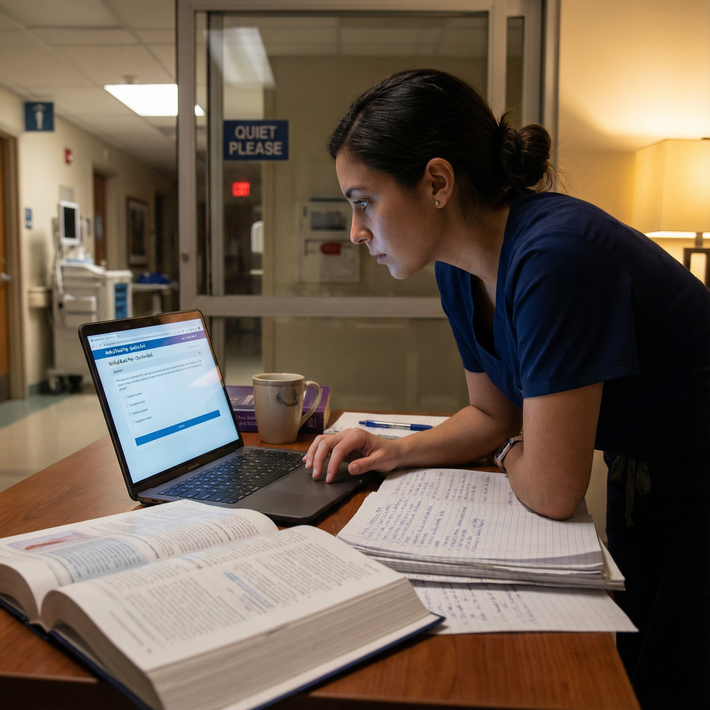
Opening Scenario: Two Resources, One Deadline
It is six weeks before your specialty boards. You are staring at your screen after a grueling twelve-hour shift. On one browser tab, you have the specialty-society question bank. On the other tab, you have the registration page for a full-length mock exam. You only have the time and cognitive bandwidth to execute one of them properly this weekend. Which do you choose?
This is the exact dilemma I see residents face every single spring. The panic sets in. You feel behind. You want to do both, but your clinical schedule laughs at that idea. You end up doing a few random questions, taking a half-finished practice test, and going to bed feeling worse than when you started.
Let me break this down specifically. These two resources do not do the same job. They answer entirely different questions about your readiness. The right priority depends entirely on your test timing, your baseline knowledge, and your ultimate score goals. Treating them as interchangeable is a fundamental error in board preparation.
In this breakdown, we will solve this exact problem. I will detail exactly when to use each resource, how many of each you actually need, and what your performance data should force you to change. No fluff. Just the mechanics of high-yield board preparation.
What Specialty-Society Qbanks Actually Build
Specialty-society question banks are the gold standard for content mastery. They are typically written, reviewed, and updated by the very experts who shape the board examinations. When you use these resources, you are getting targeted content review layered with specialty-specific nuance, recent guideline updates, and the exact favorite board-style traps the examiners love to deploy.
Let us look at what question banks train best. They build pattern recognition. They expose content gaps. They force mini-retrieval practice on a micro-level. They also build topic-level stamina, allowing you to drill fifty cardiology or pulmonology questions in a row until the algorithms become second nature.
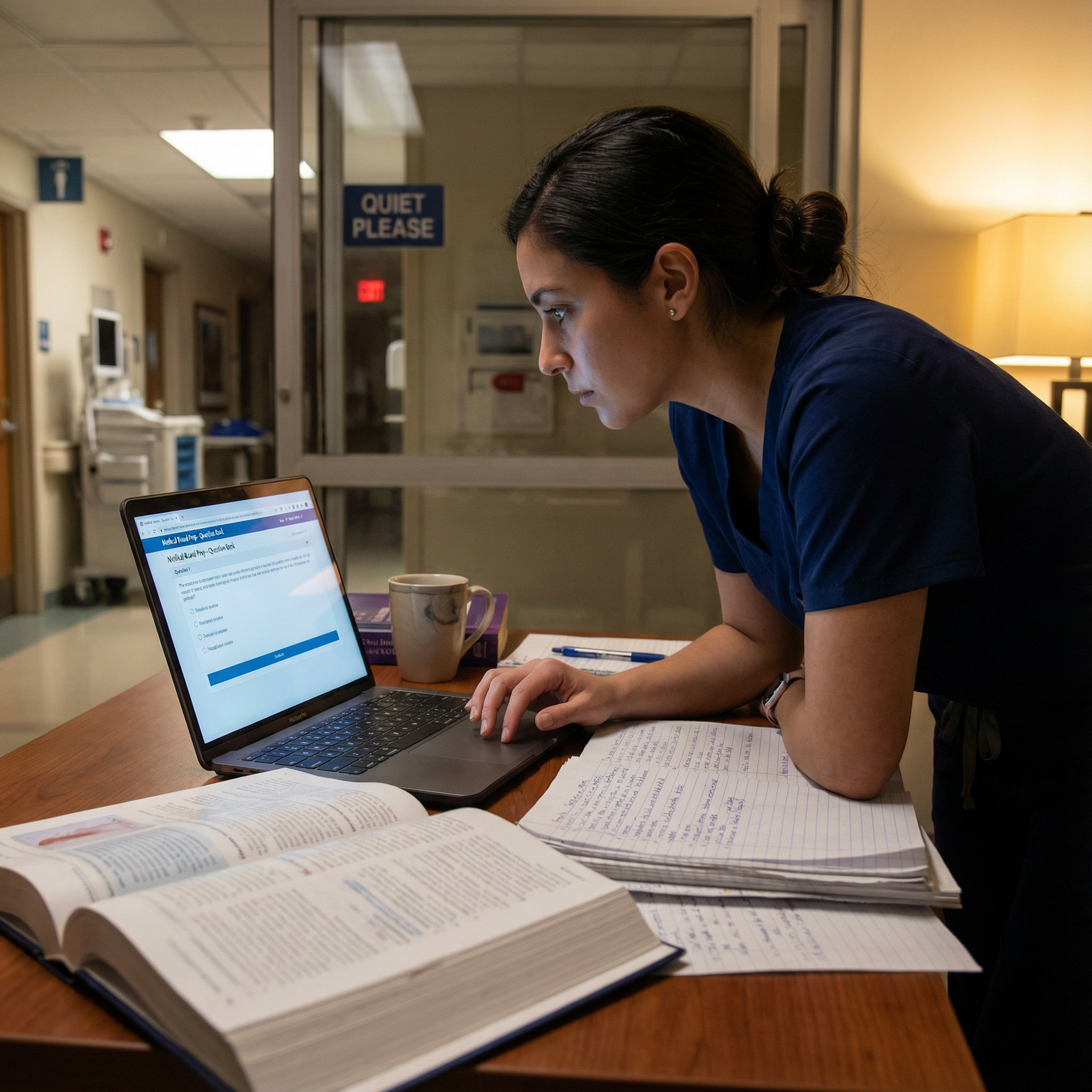
More importantly, these platforms clarify common exam patterns. You will quickly recognize repeated stem styles, such as the classic "most appropriate next step in management" phrasing. You will memorize high-yield contraindications. You will learn to spot guideline exceptions that examiners use to separate the top percentile from the rest.
However, you must distinguish strong uses from weak uses. Question banks are exceptional for remediation and reinforcement. They are terrible for simulating test-day endurance or pacing. Doing ten questions on heart failure during your lunch break does absolutely nothing to prepare you for the cognitive fatigue of block seven on the actual exam. If you rely solely on a question bank, you will build a massive database of medical knowledge but lack the structural framework to deploy it under extreme time pressure.
What Full-Length Mock Exams Measure That Qbanks Cannot
Full-length mock exams test the machine, not just the database. They measure endurance, pacing, question transition speed, cognitive fatigue, and test-day decision-making under strict time pressure. A question bank tells you if you know the material. A mock exam tells you if you can actually use it when you are exhausted.
These exams expose structural weaknesses that remain entirely hidden during casual study. I frequently see residents who score in the eightieth percentile on untimed question banks, only to crash during a mock exam due to poor timing, inconsistent attention span, or content drift. Mocks reveal if you overthink easy questions. They expose score volatility across blocks, showing you exactly when your brain stops processing information efficiently.
This data is critical for strategy calibration. A full-length mock forces you to define your guessing thresholds. It helps you establish skipping rules for questions that are taking too long. It allows you to practice break timing, caffeine planning, and your overall order-of-attack behavior. You need to know exactly how much coffee you can drink before you get jittery, and exactly how long you can stare at a screen before your reading comprehension degrades.
Finally, do not underestimate the psychological value. Taking full-length exams reduces novelty on exam day. The real board test should feel procedurally familiar. You want to sit down at the testing center and feel like you are just doing another mock exam. That procedural boredom is the ultimate defense against test-day anxiety.
How to Prioritize Based on Your Timeline and Baseline
To make the right choice, you need a decision framework based on your time remaining. The allocation of your study hours must shift as the exam approaches.
If you have more than six weeks, your priority should be heavily question-bank focused. At this stage, you need to build the knowledge ceiling. If you have three to six weeks, you should balance both resources equally, using mocks to diagnose and question banks to treat. If you are in the last two weeks, mock exams and targeted review should dominate your schedule.
Which learners should lean question-bank heavy? Those with obvious content gaps. If your baseline performance is low, or if you have specific specialty-specific weak areas that you avoided during residency, you need the question bank. You cannot test your way out of a fundamental knowledge deficit.
Conversely, which learners should prioritize mock exams? Those who are already near their target score. If you are content-complete but struggling with timing and stamina, taking another thousand question bank items is a waste of time. You need to sit in a chair for eight hours and practice executing your knowledge.
Here is the simple rule I give every resident I advise: use question banks to raise your knowledge ceiling, and use mock exams to confirm your readiness and expose test-day risk. Do not confuse the two objectives.
The Best Hybrid Strategy: How to Use Both Without Wasting Time
The highest-yield approach is a deliberate hybrid strategy. You must use both resources in a specific, practical sequence to avoid wasting time.
Start with a diagnostic or first full-length mock exam. Take it under strict testing conditions. Once it is graded, review your weak areas meticulously. Convert every missed or guessed question into a reasoned explanation. Do not just look at the correct answer and move on. Ask yourself why you missed it. Was it a knowledge gap? Did you misread the stem? Were you fatigued? Once you have identified the gaps, complete targeted question bank blocks specifically focused on those weak systems. Then, repeat the cycle with another full-length mock exam to measure your improvement.
You need an efficient weekly rhythm to make this work. Use untimed or lightly timed question blocks for pure learning and content absorption. Use one strictly timed set of questions per week to practice pacing. Finally, use a periodic full-length assessment for overall calibration.
I must warn you against the most common mistakes I see in board preparation. The first is doing question banks passively. Reading the explanation before attempting the question ruins the retrieval practice. The second mistake is taking too many mock exams too early in your study period. This leads to burnout and false despair when your scores are predictably low. The third mistake is using your scores as ego feedback. Your mock exam score is not a reflection of your self-worth or your clinical competence. It is a planning tool. Treat it like a laboratory result. Use the data to adjust your treatment plan.
When One Resource Should Clearly Win
There are specific scenarios where one resource should clearly dominate your study plan.
Question banks should win when you have major content deficits. If this is your first pass through a specialty, or if you have poor performance on specific systems like biostatistics or pediatric emergencies, you need the granular repetition of a question bank.
Mock exams should win during the final month of preparation. If you have a stable knowledge base but suffer from repeated timing failures, or if your test anxiety is driven by unfamiliarity with the testing interface, you need full-length simulations.
Consider the special cases. Retakers almost always need to prioritize mock exams, as their failure is rarely due to a lack of medical knowledge and almost always due to flawed test-day execution. Residents with heavy clinical schedules often need to rely on high-yield question banks in short, twenty-minute bursts because they simply cannot find four uninterrupted hours for a mock exam. Learners from lower-yield training environments must use question banks aggressively to fill the clinical exposure gaps left by their specific residency programs.
Make your decision today. Look at your calendar, assess your baseline, and commit to the resource that addresses your most critical vulnerability.
Key Takeaways
Specialty-society question banks and full-length mock exams do entirely different jobs. One builds content mastery, while the other tests readiness under real exam conditions.
If your medical knowledge is shaky, prioritize question banks to build your foundation. If your knowledge is stable but your pacing, endurance, or stamina is weak, prioritize full-length mock exams to fix your execution.
The highest-yield plan for most board candidates is a structured hybrid approach. Diagnose your weaknesses with a mock exam, patch your knowledge gaps with targeted question banks, and then re-test your readiness with another full-length mock.