The last 8 weeks before your boards will make or break your score. Not because of magic resources. Because of how ruthlessly you structure your time.
You’re not a preclinical student with empty afternoons. You’re a resident. You’re post-call, exhausted, getting paged while trying to do UWorld. So the usual “just do 80 questions a day” advice is garbage for you.
Here’s a real, resident‑grade, week‑by‑week intensification plan. At each point I’ll tell you exactly: “this week, you should be doing X, Y, Z” — and what you must stop doing.
Big Picture: Your 8‑Week Curve
Before we go week by week, you need the macro structure in your head.
- Weeks 8–6: Foundation & diagnostics
- Weeks 5–4: Volume & pattern recognition
- Weeks 3–2: Exam simulation & refinement
- Week 1: Sharpen, don’t sabotage
, Week 7, Week 6, Week 5, Week 4, Week 3, Week 2, Week 1](https://cdn.residencyadvisor.com/images/articles_svg/chart-weekly-question-volume-target-qbank-nbmes--7283.svg "Weekly Question Volume Target (Qbank + NBMEs)")
| Category | Value |
|---|---|
| [Week 8](https://residencyadvisor.com/resources/board-exams-residency/emergency-4-week-countdown-schedule-for-underprepared-residents) | 280 |
| Week 7 | 320 |
| Week 6 | 360 |
| Week 5 | 420 |
| Week 4 | 450 |
| Week 3 | 420 |
| Week 2 | 360 |
| Week 1 | 220 |
That’s the curve: controlled ramp up, peak in the middle, slight taper with higher yield work, then a sharper taper in the final week.
Now let’s walk it, week by week.
Week 8: Establish Reality and Lock the System
This is your “no more fantasy” week. At this point you should:
Take a full self‑assessment early in the week.
- NBME or your exam’s official self-assessment. Timed. Single sitting.
- Don’t “save” them; you need a baseline.
- Same time of day as your real exam if possible.
Audit your resources. Then cut.
- You get:
- 1 primary Qbank (e.g., UWorld for IM, TrueLearn, Rosh, etc.)
- 1 main review source (Boards & Beyond/OnlineMedEd/Anki deck/your specialty’s gold standard text).
- If you’re juggling 5 resources, you’re actually procrastinating.
- You get:
Design your weekly template around your rotation.
- On a “normal” non‑call weekday:
- 1 block of questions before work (even 10–15 questions if that’s all you can do).
- 1–2 blocks after work.
- On call:
- Smaller micro‑sessions (review flashcards or skim explanations).
- Post‑call:
- Sleep first. Then one lighter study block.
- On a “normal” non‑call weekday:
| Day Type | Morning | Post‑Work | Night |
|---|---|---|---|
| Floor Day | 10–20 timed Qs | 20–40 timed Qs + review | 30–45 min targeted content |
| ICU Day | 0–10 Qs (if possible) | 20 Qs untimed + light review | Stop. Sleep. |
| Clinic Day | 20 timed Qs | 40 timed Qs + review | 20–30 min flashcards |
Targets for Week 8
- Questions: ~250–300 total
- Dedicated review: ~10–12 focused hours
- Self‑assessment: 1 full-length
End of Week 8, you should:
- Have a clear baseline score.
- Know your bottom 3 weak systems/topics.
- Have a fixed daily structure that actually fits your rotation.
If you end Week 8 “planning to plan more,” you’re already losing ground.
Week 7: Build Routines, Attack Weaknesses
Now you know where you stand. This week is about locking habits and attacking your worst areas systematically.
At this point you should:
Schedule your remaining practice exams.
- Put them on the calendar now:
- 1 full exam roughly every 1.5–2 weeks.
- Never the day after a 28‑hour call.
- Protect these days like OR time. You would not cancel a case for Netflix.
- Put them on the calendar now:
-
- Minimum daily:
- 20–40 Qbank questions (timed, random or by system depending on goals).
- 20–30 minutes of flashcards/rapid review (Anki, notes, audio).
- Minimum daily:
Run one “weakness mini‑bootcamp.”
- Pick your single worst domain from Week 8:
- Example: For IM boards, maybe rheumatology or heme/onc.
- For 3 consecutive days:
- 15–20 questions focused on that topic.
- 1–2 hours of focused review (guideline‑level detail, algorithms).
- Pick your single worst domain from Week 8:
Start building your “must‑know list.”
- Not pretty notes. A brutal, ugly list:
- “Afib anticoag thresholds”
- “Vent settings for ARDS”
- “Hyponatremia correction rules”
- This list becomes gold in Weeks 3–1.
- Not pretty notes. A brutal, ugly list:
Targets for Week 7
- Questions: 300–320
- Focused weak‑area review: 6–8 hours
- “Must‑know” list started: aim for 30–50 items
By the end of Week 7, you should feel tired but in control. If you’re totally fresh and relaxed, you’re under‑training.
Week 6: Volume Push and Realistic Conditions
This is where you stop studying like a casual learner and start training like a test athlete.
At this point you should:
Increase question volume modestly.
- Aim: 50–60 questions on most non‑call days.
- Still protecting sleep. More questions are useless if you’re a zombie.
Shift more blocks to “random, timed, mixed.”
- At least one block per day should be:
- Timed
- Mixed topics (unless your exam is strictly modular)
- The exam will not politely group all your cardio questions together.
- At least one block per day should be:
Take another self‑assessment end of week.
- Same conditions as Week 8.
- Compare to baseline:
- If your score dropped slightly but explanations are making more sense, that’s fine.
- If you’re scattered and fatigued, you’re probably skimming explanations or undersleeping.
Refine your error‑review process.
- Stop reading explanations passively.
- For each missed/guessed question:
- Write 1–2 sentence summary of the concept.
- If it’s algorithmic (e.g., sepsis management), sketch out the steps.
- If it’s pure recall (e.g., side effect), toss it into flashcards.

Targets for Week 6
- Questions: ~340–360
- Self‑assessment: 1 full exam
- Error review: 1–2 hours on most days
End of Week 6, you should:
- See at least modest movement toward or above your target score.
- Have fewer “WTF I’ve never seen this” questions and more “I knew this but blanked/was sloppy.”
Week 5: Peak Learning, Not Peak Panic
This week is where most residents begin to freak out. Don’t. This is exactly when your curve should crest.
At this point you should:
Hit your highest question volume.
- Target: 60–70 questions on full‑energy days.
- Combine:
- 1 long timed block (advanced conditioning).
- 1 shorter block (20–30 Qs) with slow, deep review.
Rotate through systems in a 3–4 day cycle.
- Example for IM:
- Day 1: Cardio/Pulm heavy.
- Day 2: Renal/Endo.
- Day 3: Heme/ID.
- Day 4: Neuro/MSK/odds & ends.
- But your questions are still mostly mixed; you’re just biasing your review/explanations to that day’s theme.
- Example for IM:
Run your second “weakness mini‑bootcamp.”
- Pick a new bottom domain based on Week 6 assessment.
- 2–3 days of focused questions + targeted review.
Start tactical memorization.
- Short daily blocks (15–20 minutes) for:
- Classic triads.
- Must‑know drug side effects.
- Cutoffs and numbers (sodium correction rates, BP goals, time windows for thrombolysis, etc.).
- Short daily blocks (15–20 minutes) for:
Targets for Week 5
- Questions: 400–420
- Themed review: 6–8 hours across the week
- Memorization mini‑blocks: 15–20 min/day
End of Week 5, you should:
- Feel mentally stretched but noticeably sharper.
- Be faster at reading stems.
- Miss more questions from fine‑detail nuance rather than total ignorance.
Week 4: Full Simulations and Ruthless Trimming
This is your last “big push” week. From here, the overall load will slowly taper.
At this point you should:
Do a full, exam‑length simulation.
- Timed, all sections, single long sitting with brief breaks.
- Same wake‑up time, same breakfast, same hydration/caffeine.
- Treat this like a dress rehearsal.
Analyze your simulation like an attending reading a bad note.
- Not just percent correct.
- Look for:
- Blocks where your performance dropped (fatigue patterns).
- Question types that consistently trip you (long multi-step, image‑heavy, calculation‑heavy).
- Recurrent content themes.
Trim any remaining “nice but not necessary” resources.
- No new video series.
- No switching qbanks.
- No trying to “squeeze in” an entire textbook.
- At this point, changing your tools is self‑sabotage.
Strengthen test‑day logistics.
- If you have a choice:
- Confirm exact test center and drive time.
- Decide transportation and backup plans.
- Start a simple “test‑day bag” list:
- ID, snacks, water, jacket, earplugs (if allowed), meds.
- If you have a choice:
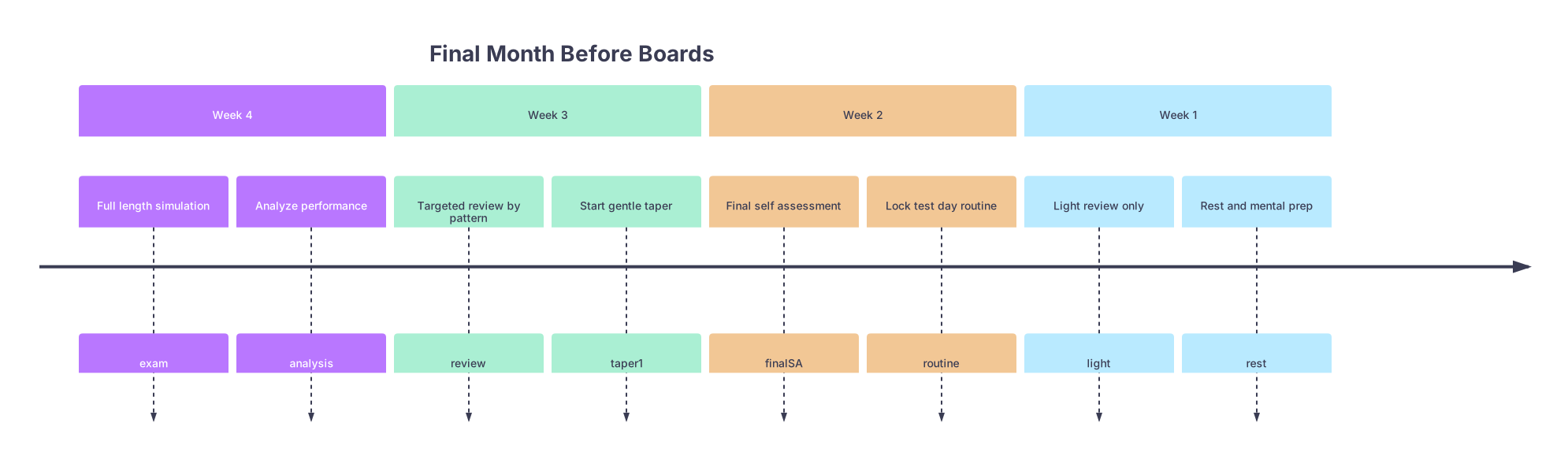
| Period | Event |
|---|---|
| Week 4 - Full length simulation | exam |
| Week 4 - Analyze performance | analysis |
| Week 3 - Targeted review by pattern | review |
| Week 3 - Start gentle taper | taper1 |
| Week 2 - Final self assessment | finalSA |
| Week 2 - Lock test day routine | routine |
| Week 1 - Light review only | light |
| Week 1 - Rest and mental prep | rest |
Targets for Week 4
- Questions: 430–450 (including full exam)
- 1 full simulated exam
- 1–2 focused evenings cleaning up persistent weak spots
End of Week 4, you should:
- Have a very realistic sense of your scoring range.
- Know your energy curve across a long exam day.
- Stop worrying about resources you “didn’t get to.” That list will never hit zero.
Week 3: Refinement and Pattern Mastery
Now we shift from “learn everything” to “own the patterns you’ll see 100 times.”
At this point you should:
Lower volume slightly, increase precision.
- Questions: ~350–420 this week, not 450+.
- You’re preserving brain cells for quality review.
Create pattern lists from your last 2–3 weeks of questions.
- Examples:
- “Typical vs atypical presentations of ACS, PE, aortic dissection.”
- “Steroid indications and taper patterns.”
- “Common traps/decoy answer patterns in your qbank.”
- For each pattern, write:
- How it usually appears.
- The 1–2 key discriminators.
- Your “if I see X, do Y” rule.
- Examples:
Run your final major self‑assessment in the first half of the week.
- Not later than ~10–12 days before the actual exam.
- This is to confirm trajectory, not disrupt your last week with a bad score.
Start stress‑testing your test‑day rhythm.
- Pick 2–3 days this week:
- Wake at test‑day time.
- Eat your planned breakfast.
- Do at least 2 back‑to‑back blocks of timed questions.
- Pay attention:
- When does your focus sag?
- Do you need a caffeine micro‑dose between blocks?
- Pick 2–3 days this week:
Targets for Week 3
- Questions: 350–420
- 1 self‑assessment (early in the week)
- Daily 30–45 minutes on pattern lists + must‑know items
By the end of Week 3, you should:
- Be within striking distance of your goal score.
- Have a clear, written “test‑day game plan” (sleep, food, pacing, break use).
Week 2: Lock It In, Don’t Blow It Up
This is the danger window. People panic, change resources, try to relearn all of nephrology from scratch. Bad move.
At this point you should:
Taper question volume to maintain sharpness.
- Questions: ~300–360 for the week.
- Max of 2 full blocks in a day, sometimes just 1 plus review.
- Keep them timed and mostly mixed.
Stop taking full‑length exams after mid‑week.
- Last full simulation or long self‑assessment should be:
- 7–10 days before your exam, not 2–3.
- Late‑stage bad score = panic, not progress.
- Last full simulation or long self‑assessment should be:
Do targeted, time‑capped content review.
- Look at your must‑know list and pattern lists.
- For each item:
- Give yourself 3–5 minutes to clarify or reinforce.
- If it’s still foggy after that, accept you’ll probably miss similar questions. Move on.
Run at least one full “half‑day drill.”
- Example:
- Two or three back‑to‑back 40‑question timed blocks with official length breaks.
- Focus:
- Pacing (not rushing first 10 and dying later).
- Quick triage: mark and move vs. getting bogged down.
- Example:
Targets for Week 2
- Questions: 300–360
- Zero new resources started
- Daily review centered on:
- Must‑know list
- Pattern list
- Your personal “trap list” (concepts you chronically overthink)
By the end of Week 2, you should:
- Have no major knowledge blindspots left, just normal uncertainty.
- Be tired, but not burnt to ash.
Week 1: Sharpen, Then Get Out of Your Own Way
The final week is not for heroic comebacks. It’s for not ruining the work you already did.
At this point you should:
Cut total volume by ~40–50%.
- Early in the week:
- 1 block per day of 20–40 mixed, timed questions.
- Last 2 days before exam:
- Max 10–20 questions, or zero if you are too anxious.
- Absolutely no full exams.
- Early in the week:
Shift to light, confidence‑building review.
- High‑yield, rapid review topics:
- Common emergencies and algorithms.
- Can’t‑miss diagnoses and red flags.
- Easy points (vaccines, screening guidelines, classic presentations).
- If something makes you anxious every time you see it and you still don’t get it? Skim, don’t dive.
- High‑yield, rapid review topics:
Dial in your body clock.
- Sleep:
- Go to bed and wake up as you will on test day starting at least 4–5 days out.
- No “studying until 2 a.m.” nonsense.
- Caffeine:
- Match your test‑day plan. Don’t suddenly double your intake.
- Sleep:
Handle logistics like a professional.
- 2–3 days before:
- Confirm test center location and check timing / parking.
- Day before:
- Pack your bag (ID, snacks, jacket).
- Lay out clothes.
- Decide what you’ll do if you cannot sleep well (hint: that does not mean cancel the exam).
- 2–3 days before:
Day before the exam: protect your brain.
- Light review only:
- Skim your must‑know list.
- Browse a few favorite “easy win” resources.
- Non‑negotiables:
- Normal meals.
- No intense new exercise that will leave you sore.
- Screens off at least 30–60 minutes before bed.
- Light review only:
Test day: execute, don’t evaluate.
- You’re not there to “feel good” about your performance.
- You’re there to:
- Stick to your pace.
- Use elimination and pattern recognition.
- Move on when stuck instead of spiraling.
Daily Micro‑Structure: What a Good Day Actually Looks Like
Let’s ground this in a concrete example. You’re on a standard ward month, non‑call day, 8 days before your boards.
At this point in the timeline (Week 2), your day might look like:
- 05:45–06:15 – Wake up, coffee, 10–15 quick flashcards or 5–10 easy questions.
- 07:00–17:00 – Work. Maybe 5–10 questions at lunch if the day is gentler.
- 18:00–19:30 – 1 timed, mixed block (30–40 questions).
- 19:30–20:15 – Dinner and decompress.
- 20:15–21:00 – Review that block’s explanations + patch weak spots.
- 21:00–21:30 – Light skim of must‑know list or one high‑yield topic.
- 22:00 – In bed. Phone away.
Not glamorous. But it works. I’ve watched more residents inch into passing and competitive scores with this kind of boring consistency than with any fancy new app.
One More Thing: When You’re Behind at Week 8
If you read all this and thought, “I’m not remotely at Week 8 starting line yet” — fine. You still follow the same blueprint. You just:
- Lower question targets by 10–20% to avoid injury.
- Cut even more resources.
- Accept a more realistic score target and optimize pass probability before chasing a vanity number.
Take one concrete step now: open your calendar and block off your full‑length practice exam days for Weeks 6 and 4. Protect those dates like they’re OR cases, then build the rest of your 8‑week intensification plan around them.