The biggest lie residents believe is that “I’ll get serious about boards next year.” That is how people end up in PGY-3 with a red-flag in‑training exam and a program director quietly panicking.
If you treat board prep as a 3‑year project—not a 3‑month cram—you will walk into your specialty boards annoyed, not scared. That is the goal.
Below is a year‑by‑year, then quarter‑by‑quarter, then month‑level roadmap from PGY‑1 to PGY‑3 focused on one thing: being truly board ready on graduation day.
Big Picture: Three-Year Board Strategy
At this point you should stop thinking “exam” and start thinking “system.”
- PGY‑1: Build habits, foundations, and question bank consistency
- PGY‑2: Aggressive content consolidation and in‑training exam leverage
- PGY‑3: Targeted remediation, high-yield drilling, and exam logistics
Here is the rough distribution of board‑focused effort over residency:
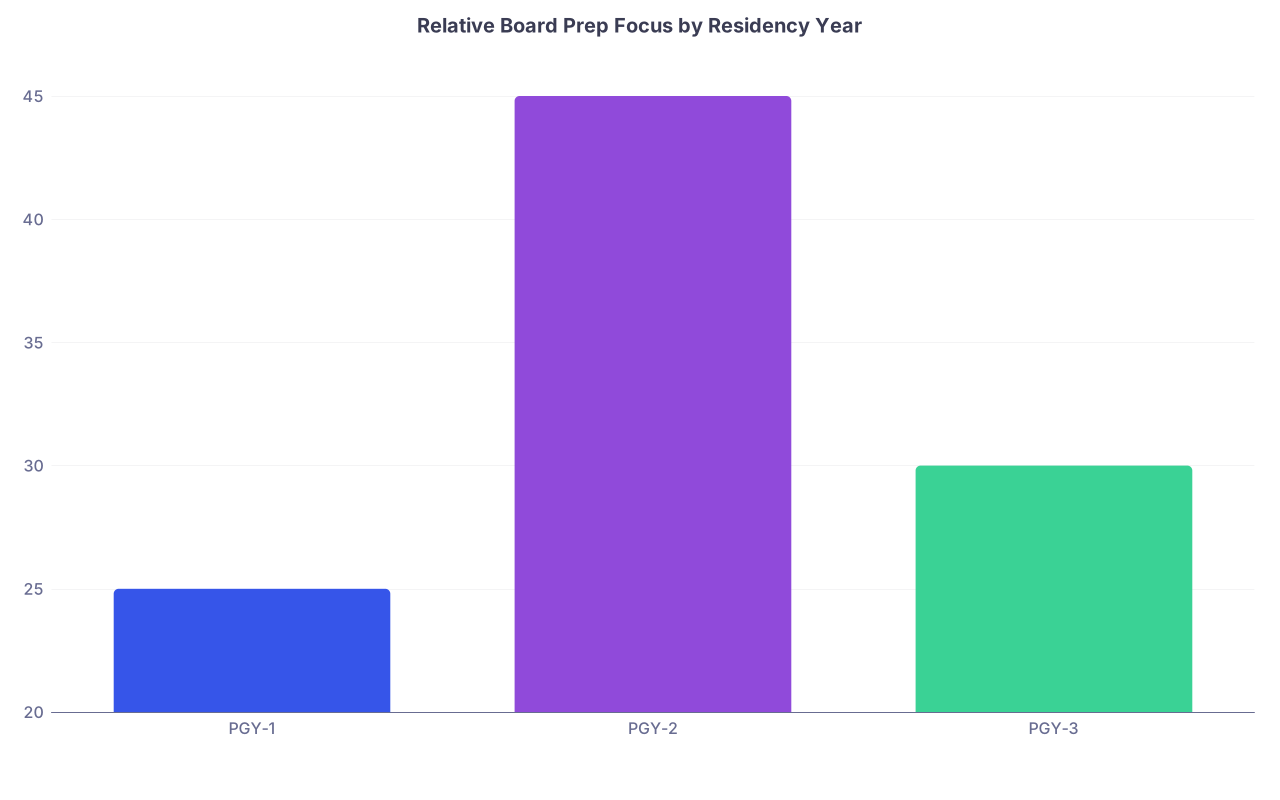
| Category | Value |
|---|---|
| PGY-1 | 25 |
| PGY-2 | 45 |
| PGY-3 | 30 |
Your actual calendar will look different by specialty (surgery vs psych vs IM), but the structure is the same. You anchor everything around:
- Annual in‑training exam (ITE) date
- Specialty board exam window
- Heavy rotations (ICU, nights, consults, wards) vs lighter blocks (clinic, electives, research)
We will walk straight through PGY‑1 to PGY‑3 with “at this point you should…” clarity.
PGY‑1: Build the Machine, Not the Myth
PGY‑1 is not about “crushing boards.” It is about never letting yourself become the PGY‑3 who is starting from zero.
PGY‑1, Quarter 1 (July–September): Survival + Tiny Habits
You are learning how to write notes, not kill patients, and find the cafeteria. Fine. But even here:
At this point you should:
Pick one primary resource for boards
- Internal medicine: MKSAP, UWorld IM, or equivalent
- Surgery: SCORE, TrueLearn, ACS SESAP
- Peds: PREP, MedStudy
- Psych: PRITE-style Qbanks, board review texts
The actual choice matters less than sticking to one main path your program director respects.
Set a bare-minimum question habit
- Week 1–4: 5 questions per day, 5 days per week
- After that: 10 questions per day, 5 days per week
Do them after sign-out, before bed, or during your post-call recovery. But do them.
Create a dead-simple tracking system
- One spreadsheet or note with:
- Daily question count
- Topics missed repeatedly
- “Red list” concepts to review (e.g., hyponatremia, anticoagulation reversal, ventilator basics)
- One spreadsheet or note with:
At this stage, consistency beats volume. A tired intern doing 10 focused questions a day wins over a heroic 150-question weekend that dies after two weeks.
PGY‑1, Quarter 2 (October–December): Build Understanding
Now you are not drowning quite as much. This is when most interns either build momentum or drift.
At this point you should:
Increase to 10–15 questions/day on most non-call days
Link questions to real patients
- Missed a question on DKA? Review it on your actual DKA admission that week.
- Write 1–2 teaching points in the chart for yourself (even if you never show anyone).
Start a micro‑review system
- Once a week (e.g., Sunday evening), spend 30–45 minutes:
- Skimming notes on your “red list” concepts
- Re‑doing 5–10 questions you got wrong that week
- Once a week (e.g., Sunday evening), spend 30–45 minutes:
This is your foundation for long‑term retention. Not glamorous, but it sticks.
PGY‑1, Quarter 3 (January–March): First In‑Training Exam Prep
This is where most programs start talking about your specialty in‑training exam.
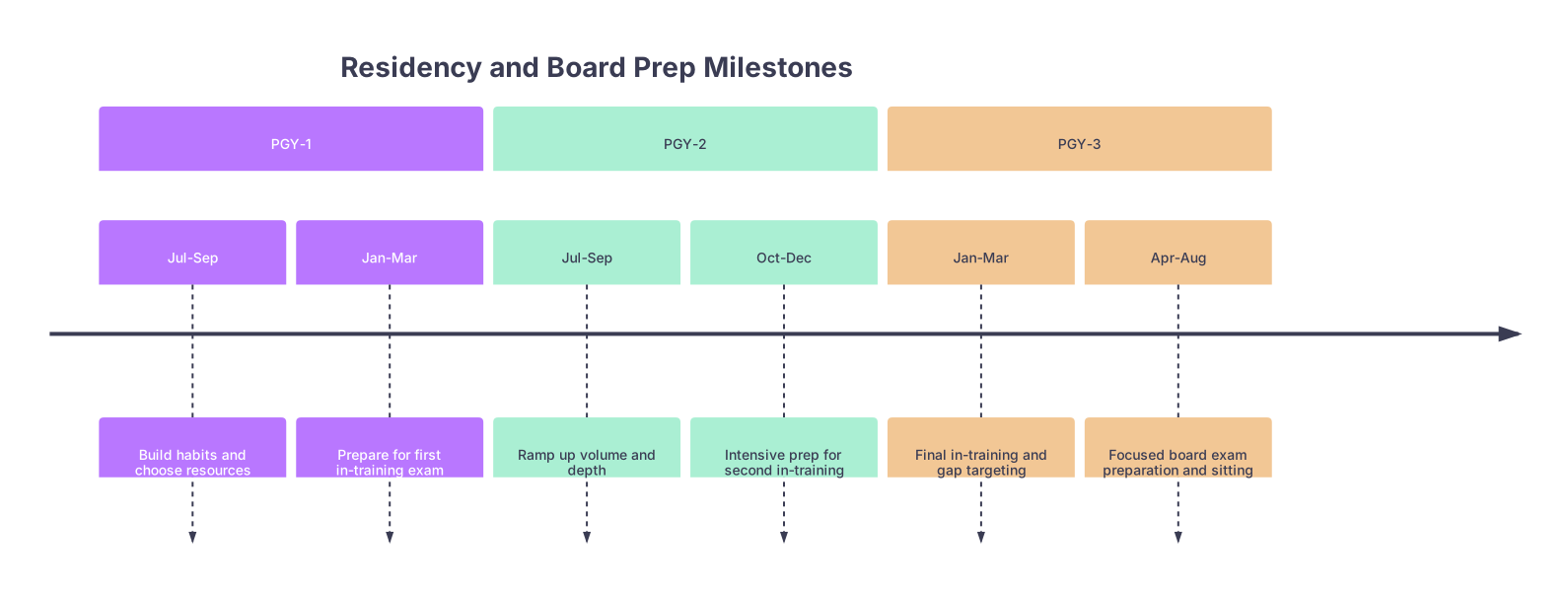
| Period | Event |
|---|---|
| PGY-1 - Jul-Sep | Build habits and choose resources |
| PGY-1 - Jan-Mar | Prepare for first in-training exam |
| PGY-2 - Jul-Sep | Ramp up volume and depth |
| PGY-2 - Oct-Dec | Intensive prep for second in-training |
| PGY-3 - Jan-Mar | Final in-training and gap targeting |
| PGY-3 - Apr-Aug | Focused board exam preparation and sitting |
At this point you should:
Know the ITE date. Put it on your calendar.
Back up 6 weeks. That is your “ITE ramp period.”During the 6 weeks pre‑ITE:
- Aim for 20–25 questions/day, 5 days per week, focused on your weaker systems
- One 40–60 question timed block per week to practice test stamina
- Review explanations thoroughly; do not chase more volume at the expense of review.
Do one brief pass through a rapid review resource
- Example: reading high-yield chapter summaries or flashcards for:
- Cardiology
- Pulm
- ID
Pick your top 3 most common inpatient systems to keep it realistic.
- Example: reading high-yield chapter summaries or flashcards for:
If you are crushed with nights/ICU during this period, scale the numbers but keep the structure. The ramp matters more than the exact total count.
PGY‑1, Quarter 4 (April–June): Post-ITE Debrief and Adjustment
When ITE scores landed in my inbox, the smartest interns did something simple that most skipped: they booked a 15‑minute meeting with their program director or APD.
At this point you should:
- Get your ITE breakdown (by system, topic, or domain)
- Identify your bottom 2–3 areas (e.g., endocrine, rheum, psychiatry)
- Design a 3‑month “repair plan”:
- One focused topic per week from your weak areas
- 20–30 questions/week specifically from those sections
- Quick read of 1–2 key review chapters for each weak system over the quarter
Your PGY‑1 year closes not with “I survived,” but with a clear map of where you are weak and what you will attack in PGY‑2.
PGY‑2: Depth, Volume, and Serious In‑Training Strategy
PGY‑2 is the engine year. You are no longer just trying to not get yelled at on rounds. This is when board prep becomes deliberate.

PGY‑2, Quarter 1 (July–September): Scale Up
At this point you should:
Commit to a real weekly question volume
- Target: 150–200 questions/week
- Structure:
- 3–4 days of 20–30 questions (untimed, learning mode)
- 1–2 days of 40–60 questions (timed blocks)
Begin your first full pass of a major Qbank
- Internal medicine example: full UWorld IM pass this year
- Track completion: aim for ~25–30% done by end of September
Integrate learning into work
- Pick 1 patient each day and tie them to a question block that night
- If you admitted GI bleed, your questions that evening hit GI bleeding, transfusion thresholds, anticoagulation.
PGY‑2, Quarter 2 (October–December): Structured Content Review
This is where many residents stall. Do not.
At this point you should:
Set up a 12‑week system‑based plan
Example for IM (adjust to your specialty):- Week 1–2: Cardiology
- Week 3–4: Pulmonary
- Week 5: Nephrology
- Week 6: GI
- Week 7: Endocrine
- Week 8: Rheum/MSK
- Week 9: Heme/Onc
- Week 10: ID
- Week 11: Neuro
- Week 12: Misc / catch‑up
For each week:
- Read high-yield summaries or core review chapters (2–3 evenings)
- Do 60–100 questions focused on that system
- Write 5–10 “must remember” pearls in your notebook or digital notes
This gives you your first true content sweep of residency.
PGY‑2, Quarter 3 (January–March): Second In‑Training – This One Counts
This ITE drives a lot of PD anxiety. It is closer to your boards and seen as a predictor.
At this point you should (8 weeks before ITE):
Increase to 250–300 questions/week
- At least two 60-question timed blocks per week
- One of those in “random mixed” mode to simulate exam conditions
Finish your first major Qbank pass
- If you are not on track, accelerate:
- 40–60 questions per day on lighter rotations
- Use post-call mornings for review (not for new blocks).
- If you are not on track, accelerate:
Use practice exams if your specialty offers them
- Internal medicine: NBME-style practice exams or vendor “mock” boards
- Surgery: SCORE exams, SESAP practice sets
Take one 4–6 weeks pre‑ITE, one 1–2 weeks pre‑ITE.
After the ITE:
- Compare PGY‑1 → PGY‑2 scores
- If your percentile dropped or stayed low:
- You are now on a structured remediation track. Good. That is better than denial.
PGY‑2, Quarter 4 (April–June): Second Pass and Weakness Targeting
This is where you begin your second pass through questions and high-yield concepts.
At this point you should:
Identify bottom 3–4 domains from your ITE report
Set a 3‑month weakness boot camp:
- For each weak area:
- Re‑do all missed questions from that topic
- Add 40–60 new questions from a second Qbank or unused sections
- Review 1–2 focused chapters or guidelines (e.g., 2017 ACC/AHA HTN guideline)
- For each weak area:
Begin a “spaced recall” habit
- One evening per week:
- Rapidly scan your notes from prior months (10–15 minutes per topic)
- Close notes and force yourself to recite key facts / algorithms from memory
- One evening per week:
By the end of PGY‑2, you should not just know that you are weak in, say, rheumatology. You should have already attacked it once and know precisely which subtopics (e.g., vasculitis, SLE criteria, inflammatory myopathies) still give you trouble.
PGY‑3: Board Alignment and Execution
PGY‑3 is not the time to “start” board prep. It is the time to convert your prep into a passing board performance.
| Quarter | Primary Focus | Weekly Question Target |
|---|---|---|
| Q1 (Jul–Sep) | Second-pass Qbank, integrate with work | 200–250 |
| Q2 (Oct–Dec) | Third-pass on weak areas, practice exams | 250–300 |
| Q3 (Jan–Mar) | Final ITE, refine gaps | 200–250 |
| Q4 (Apr–Jun/Jul–Aug)* | Board-specific boot camp | 150–250 |
*Exact Q4 timing depends on your specialty board exam window.
PGY‑3, Quarter 1 (July–September): Controlled Aggression
At this point you should:
Begin (or continue) your second full Qbank pass
- Now in random, mixed, timed mode most of the time
- 200–250 questions/week is a solid target if rotations allow
Lean into pattern recognition
- While reviewing, explicitly ask:
- “What are they really testing here?”
- “What is the single key word or lab that gave away the answer?”
- While reviewing, explicitly ask:
Start building a one‑document “Boards Playbook”
- 10–20 pages max
- Sections: Cardio, Pulm, Renal, etc.
- Only ultra high-yield:
- Diagnostic criteria
- First‑line vs second‑line therapies
- Classic “board‑style” presentations
By the end of September, you want a concise, personal reference that you trust more than random PDFs people email around.
PGY‑3, Quarter 2 (October–December): Serious Simulations
If your board exam is spring/summer after graduation, this is the last true “build” phase before you enter execution mode.
At this point you should:
Schedule 2–3 full practice exams
- One early in the quarter
- One mid‑quarter
- One near end of quarter or early next
Simulate test day: same length, timed, no interruptions beyond what the real exam allows.
Analyze practice exam performance ruthlessly
- For each exam:
- List top 3 weakest systems
- List top 3 types of errors:
- Rushing, misreading
- Getting tricked by distractors
- Knowledge gaps in core pathophysiology
- For each exam:
Tighten time‑management
- Practice keeping a steady pace (e.g., 1–1.2 minutes per question)
- If you are habitually finishing with <10 minutes left, you are probably rushing and making avoidable mistakes.
This quarter is about making the exam feel boringly familiar.
PGY‑3, Quarter 3 (January–March): Final In‑Training + Micro-Targeting
Your last ITE is a free board practice test with consequences but no immediate license on the line. Use it aggressively.
At this point you should (6–8 weeks pre‑ITE):
Hold 200–250 questions/week steady
- Mixed-mode blocks, heavy focus on speed + accuracy
Do at least one full‑length simulation under strict exam conditions
Polish your Boards Playbook
- Fill gaps exposed by practice tests
- Trim clutter—this is not a textbook.
After the ITE:
- Compare your performance trajectory PGY‑1 → PGY‑2 → PGY‑3
- If you are above your board pass threshold and trending up: maintain and refine
- If your score is borderline:
- Schedule a meeting with PD/faculty now
- Arrange lighter rotations or elective time ahead of the board window if possible
- Consider formal remediation: extra review course, tutor, or structured faculty mentoring
PGY‑3, Quarter 4 (April–Board Exam): Final Four to Eight Weeks
This is the sprint. Not the entire race.
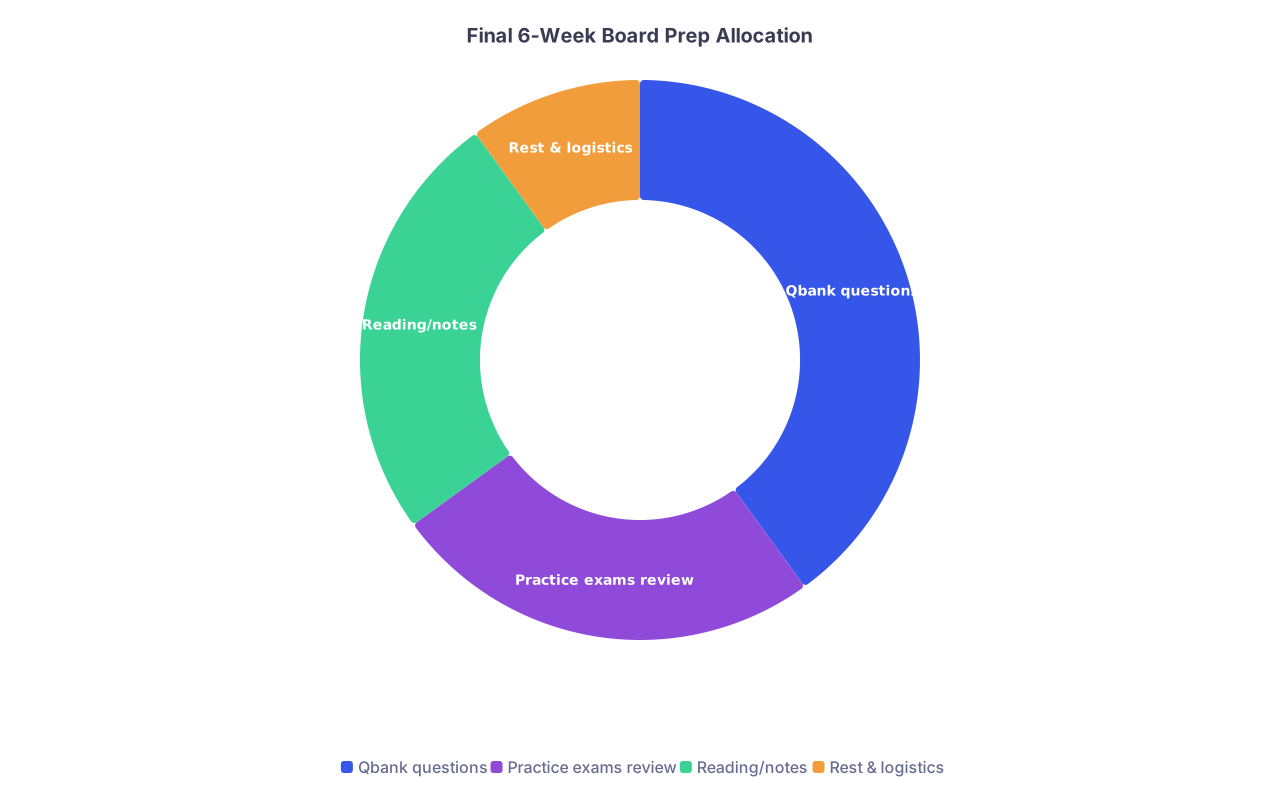
| Category | Value |
|---|---|
| Qbank questions | 40 |
| Practice exams review | 25 |
| Reading/notes | 25 |
| Rest & logistics | 10 |
Assuming a June/July exam, here is how to structure the last ~6 weeks.
At this point you should:
Set realistic weekly goals (example for IM):
- 150–200 questions/week
- 1 full or half‑length practice exam every 1–2 weeks
- 5–7 hours/week dedicated to reading your Boards Playbook and key chapters
Shift from “learning new” to “sealing known”
- Prioritize:
- Frequently tested bread‑and‑butter (CHF, COPD, DM, sepsis, AFib)
- Common management algorithms and guidelines
- De‑prioritize:
- Ultra‑rare zebras you have seen once in 3 years
- Prioritize:
Lock down exam‑day logistics at least 2 weeks ahead:
- Confirm:
- Test site location and parking
- Start time
- Required IDs and confirmation emails
- Plan:
- How you will get there
- What you will eat before and during breaks
- Sleep schedule in the 3–4 nights prior
- Confirm:
Final 7–10 days:
- No massive new Qbank binge
- Focused review of:
- Your Boards Playbook
- All the questions you repeatedly missed (flagged list)
- Short daily timed blocks (10–20 questions) just to keep the engine warm
-
- Light reading only
- No full exams. No staying up late.
- Maybe 10–15 easy questions just to keep confidence intact.
Red Flags and Course Corrections by Year
You will not follow this perfectly. Nobody does. Here is when you absolutely must course-correct:
PGY‑1 ITE < 20th percentile
- Response: Early conversation with PD, increase structured study by 30–50%, possibly pair with a senior mentor.
PGY‑2 ITE not improved from PGY‑1 or still borderline
- Response: You are now in a “board risk” category. You need:
- Formal plan
- Scheduled weekly study blocks protected as much as possible
- Possibly a review course during PGY‑3.
- Response: You are now in a “board risk” category. You need:
PGY‑3 practice exams consistently below passing (within 6 months of real boards)
- Response: This is not a “wait and hope” situation.
- Aggressive 6–8 week remediation
- Re‑distribution of rotation intensity if your program can accommodate it
- Maybe delay boards if your specialty allows and PD agrees (rare, but better than a fail on record in some cases).
- Response: This is not a “wait and hope” situation.
You do not need to study like a full‑time student throughout residency. You do need to treat board prep like a long, controlled campaign instead of a last‑minute rescue.
Here is your concrete next step:
Open your calendar for the next four weeks and block three specific 30–45 minute study sessions per week. Label each with the exact task (e.g., “20 cardio questions,” “review endocrine notes”). If you cannot defend those three tiny blocks from chaos now, you will not magically defend six weeks of board prep later.