The biggest lie residents tell themselves is, “I’ll study when my rotation slows down.” It will not. You either build a daily 30–45 minute board routine on service, or you show up to the exam underprepared and annoyed at yourself.
You can get real board prep done in brutal rotations. But it has to be engineered almost minute-by-minute.
Below is your Timeline Guide: how to use 30–45 minutes a day for board prep while on service. Hour by hour, then week by week, then across a full block.
First, Define the Daily Target (Before the Month Starts)
Before the rotation even begins, you set the rules. Not the hospital. You.
By this point (pre-rotation planning, usually 3–5 days before day 1), you should:
-
- Medicine: UWorld, MKSAP, or Amboss.
- Surgery: TrueLearn / SCORE / UWorld surgery.
- Peds/OB/Anesthesia, etc.: The core Qbank for your board exam.
- Commit to one main Qbank for timed, exam-style questions.
Decide your daily quantitative goal
- If you have 30 minutes:
- 10–15 questions + rapid review of explanations
- If you have 45 minutes:
- 15–20 questions + slightly deeper review
- Non-negotiable: questions every single study day. Passive reading is a luxury, not the default.
- If you have 30 minutes:
Set a realistic weekly minimum
- For busy inpatient months:
- Aim: 60–100 questions per week during heavy ward / ICU.
- For lighter or clinic months:
- Aim: 120–150+ questions per week.
- For busy inpatient months:
| Rotation Type | Daily Time | Daily Questions | Weekly Minimum |
|---|---|---|---|
| Heavy wards/ICU | 30 min | 10–15 | 60–80 |
| Typical inpatient | 30–45 min | 15 | 75–105 |
| Outpatient/“light” | 45+ min | 20–25 | 120–150 |
- Create a default daily slot
Pick one of these and treat it like a standing meeting:
- 20–30 minutes before sign-out (protected, headphones in).
- 20–30 minutes after sign-out before you leave (if you are a night owl).
- 2 x 15-minute micro-sessions: early morning and post-lunch.
If you do not assign the time now, the hospital will eat it.
The Daily Blueprint: How to Use 30–45 Minutes on a Typical Service Day
Think of your day in segments. At each point, you should know exactly what your board work looks like.
1. Pre‑Shift (5–10 Minutes at Home)
You are not “studying” yet. You are priming.
At this point (before leaving home) you should:
- Open your Qbank app or notes app and:
- Look at yesterday’s wrong answers (2–3 key ones).
- Glance at 1–2 high‑yield flashcards (Anki or your own).
- Set the day’s micro-goal:
- “15 UWorld cards on AKI/CKD before sign-out”
- Or, “20 OB questions between 3–5 pm, no explanations until later.”
Keep it under 10 minutes. This is psychological: you start the day already “touching” board content.
2. Early Pre‑Rounds / Lull Time (5–10 Minutes, Opportunistic)
You are loading labs, waiting for your attending, or stuck on hold. This is not your main study block. This is scrap time.
At this point (micro-gaps during the morning) you should:
- Do rapid-fire recall, not full questions:
- 5–10 Anki flashcards.
- Or review your “Top 10 Misses of the Week” note.
- Or scan a one‑page summary that matches a patient:
- New GI bleed? Quickly skim a concise upper GI bleed algorithm.
- COPD exacerbation? Quick look at GOLD treatment steps.
You are linking clinical cases to board patterns. But you are not deep-diving yet.
3. Core Study Block #1 – Midday or Pre‑Sign‑Out (20–30 Minutes)
This is the backbone. Protect this block like you protect meal breaks.
If you have 30 minutes
At this point (once your main work is done but before you completely crash) you should:
- Set a tight timer: 25 minutes work + 5 minutes buffer.
- Do 10–12 timed questions in your Qbank:
- Mixed or rotation‑relevant blocks.
- Timed mode, not tutor. You need to keep exam pacing alive.
- Review in “triage mode”:
- For each question, spend:
- 10–15 seconds: Why did I miss / get it right?
- 20–30 seconds: Scan explanation for the one key sentence.
- Mark only:
- Major conceptual gap
- Repeated pattern you keep missing
- Guideline update you did not know
- For each question, spend:
You are aiming for high-volume repetition, not perfection.
If you have 45 minutes
At this point you should:
- Aim for 15–18 questions:
- 25–30 minutes for questions.
- 15–20 minutes for focused review.
- For key wrongs, pause and:
- Write a 1–2 line distilled takeaway in a note or Anki:
- “ARDS – low tidal volume (6 mL/kg IBW), permissive hypercapnia, high PEEP if refractory hypoxemia.”
- “Iron deficiency vs anemia of chronic disease by ferritin and TIBC.”
- Write a 1–2 line distilled takeaway in a note or Anki:
This is your “deep work” window. Once a day is enough if you keep it consistent.
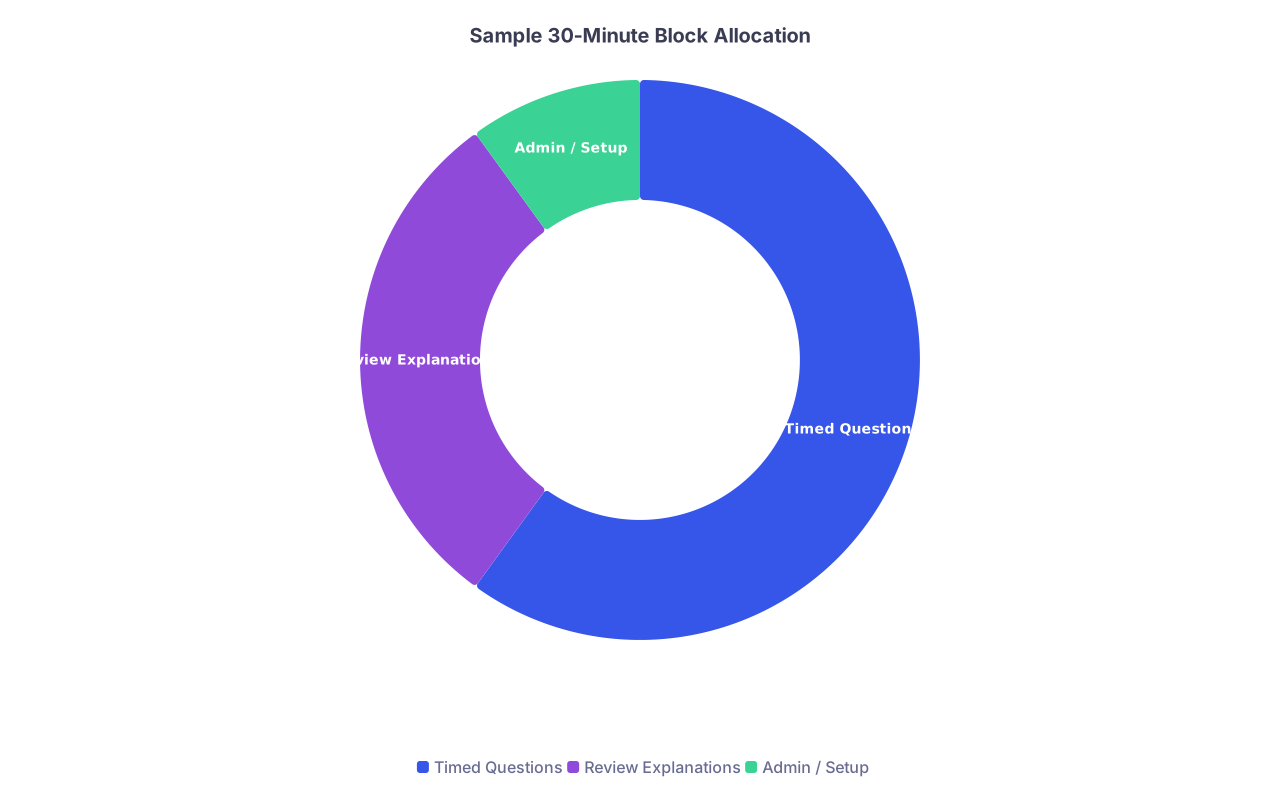
| Category | Value |
|---|---|
| Timed Questions | 60 |
| Review Explanations | 30 |
| Admin / Setup | 10 |
4. Core Study Block #2 – Bedtime (Optional 10–15 Minutes)
If you are wiped out, skip this. Sleep is board prep too. But if you have a little left in the tank:
At this point (lying on the couch / in bed) you should:
- Do light, low-friction work:
- 10–15 Anki cards of today’s new facts only.
- Or re-read your “today’s misses” summary.
- Do not open a full Qbank block. You will either fall asleep or waste time.
Think of this as “setting up tomorrow’s recall.” Short. Simple. Done.
Weekly Structure: How 30–45 Minutes Builds Over a Rotation
Now zoom out. Daily blocks are only useful if they add up across weeks.
Week 1 of a New Rotation: Calibration Week
Your only job in Week 1 is to get realistic.
At this point in the rotation (Days 1–7) you should:
Test your actual energy and time
- Try your planned study slot on Days 1–3:
- Can you really do 15–20 questions? Or do you die at 10?
- Adjust:
- If you crash at 10: commit to 10 a day, 6 days/week. That is fine.
- If 15 feels easy: go to 15–20, 5 days/week.
- Try your planned study slot on Days 1–3:
Align Qbank topics with your service
- On medicine wards:
- Front-load: sepsis, electrolyte disorders, respiratory failure, chest pain, AKI.
- On nights:
- Focus: emergent management, toxicology, arrhythmias, rapid decompensation patterns.
- On medicine wards:
Build your “rotational anchor habits”
- Example anchors:
- “I start my pre‑sign‑out questions as soon as I finish my last note.”
- “I always open my Qbank before I open social media at night.”
- Do not rely on motivation. Build triggers.
- Example anchors:
By the end of Week 1, you should know:
- Average daily question count you can sustain.
- Best time block that actually works with your team and patient load.
Weeks 2–3: Volume and Pattern Recognition
This is where the gains actually happen. The novelty of the rotation is over. You are just grinding now.
At this point in the month (Days 8–21) you should:
Standardize your daily blueprint
- 5–10 minutes: micro-review or flashcards (morning or bedtime).
- 20–30 minutes: 10–20 Qbank questions.
- 5–10 minutes: quick consolidation (mistake log / Anki).
Track, very briefly, each study day Make a tiny log (in Notes, Notion, or a notebook):
- Date
- Number of questions
- % correct (rough)
- 1–3 themes you struggled with
Example row: “7/3 – 15 qs, 60% – AFib rate vs rhythm control, DOAC in CKD, diuretic ototoxicity.”
Identify repeat offenders At the end of each week, scroll your log and:
- Circle topics that show up >2 times.
- Spend one 30–45 minute session that week doing:
- 5–10 targeted questions in that topic, plus
- 5–10 minutes reading a short review (Amboss article / guideline summary).
Use your in-hospital cases as flashcards When a patient matches a board pattern:
- Write a one-line board question about them in your head.
- Or literally in your notes app:
- “72-year-old with painless jaundice, elevated direct bili, weight loss – next best test?”
- Check yourself later with a resource if you are unsure.
This is how board vignettes stop feeling abstract. They turn into people you actually rounded on.
Week 4 (or Final Week of the Block): Consolidation and Adjustment
At this point (tail end of the rotation) you should stop pretending next month will magically be easier. It rarely is.
Review your weekly question totals
- Add up the last 3 weeks:
- Did you hit roughly your weekly minimum (60–150 per week depending on block)?
- If yes:
- Great. Stay the course.
- If no:
- Identify:
- Which days collapsed?
- Why? Post‑call? Terrible attending? Night float?
- Identify:
- Add up the last 3 weeks:
Build a “Top 20 Misses of the Month” list In one 30–45 minute session:
- Skim your log and flagged questions.
- Pick 20 concepts you keep screwing up.
- For each, write:
- 1‑line summary.
- 1 key number / drug / decision rule.
Example:
- “SIADH – serum osmo low, urine osmo high; treat with fluid restriction, salt tabs, consider vaptan if severe.”
- “Hypertrophic cardiomyopathy – young athlete syncope, systolic murmur ↑ with Valsalva; treat with beta‑blockers, avoid dehydration and vasodilators.”
This list becomes your bridge into the next rotation’s studying.
- Preview next month’s needs
- If next month is ICU:
- Start sprinkling in ARDS, shock, ventilator management questions.
- If it is clinic:
- Start doing more chronic disease management, screening, and preventive care.
- If next month is ICU:
Your studying should anticipate the rotation, not lag behind it.
A Sample Day: 30–45 Minute Board Prep on a Busy Ward Shift
Let me spell out a realistic call‑like day.
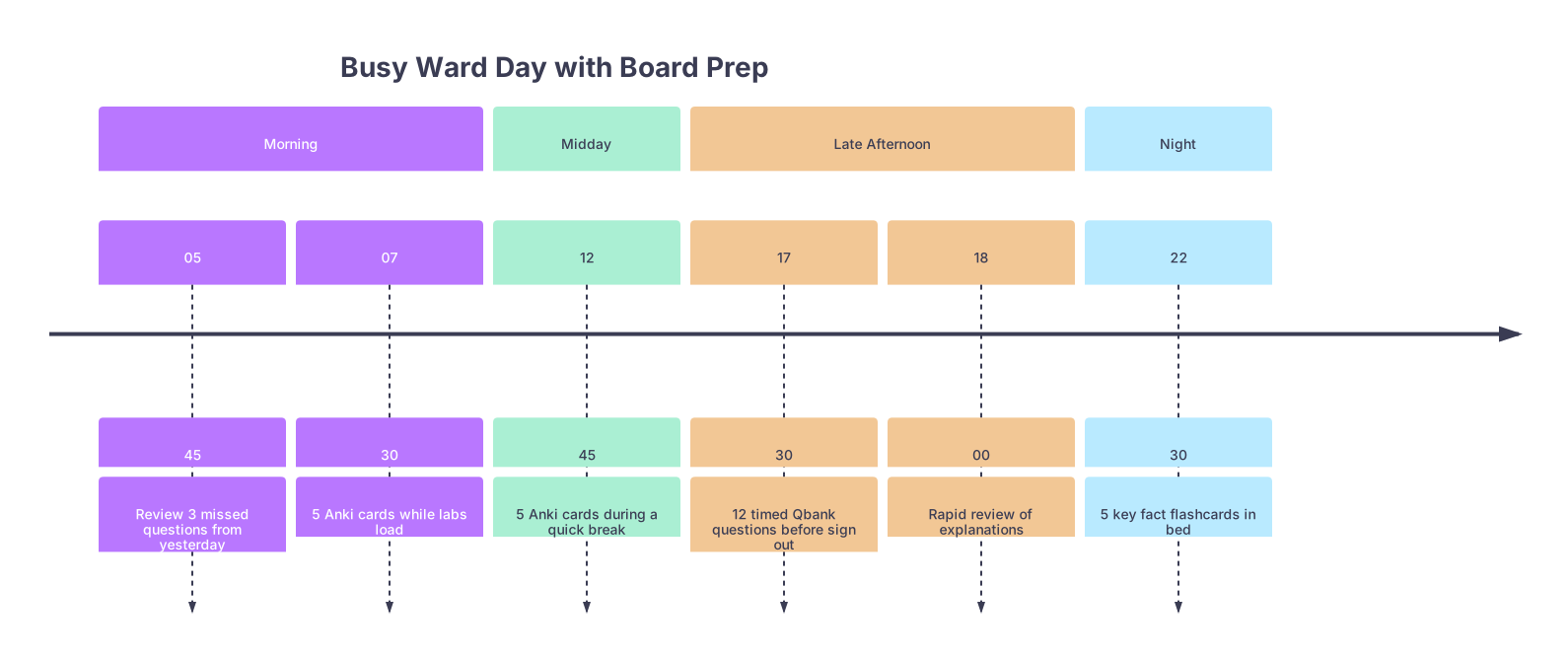
| Period | Event |
|---|---|
| Morning - 05 | 45 |
| Morning - 07 | 30 |
| Midday - 12 | 45 |
| Late Afternoon - 17 | 30 |
| Late Afternoon - 18 | 00 |
| Night - 22 | 30 |
Timeline Breakdown
05:45–05:55 (Home, coffee brewing) – 10 minutes
- Open your mistake log.
- Re-read 3 questions you got wrong yesterday.
- Do 5–10 quick Anki cards if you use them.
07:20–07:30 (Pre‑rounds lull) – 5–10 minutes
- While EMR is loading or labs are populating:
- 5 more Anki cards, especially on what matches today’s sickest patient.
12:40–12:50 (Between notes / food) – 10 minutes
- Eat something.
- While eating:
- 5–10 flashcards or 1–2 very short question stems in tutor mode.
- Nothing that requires deep concentration.
17:25–17:55 (Pre‑sign‑out study block) – 30 minutes
- Put on headphones, tell your senior you are finishing notes if that keeps them off your back (honestly, you usually are).
- 20–25 minutes:
- 12 timed questions on your Qbank (mixed internal medicine, or block-relevant).
- 5–10 minutes:
- Rapid review of explanations.
- Mark 2–3 for deeper follow-up.
22:25–22:35 (In bed) – 10 minutes (optional)
- Re‑open flagged questions on your phone.
- Capture 2 concepts into your “Top Misses” note.
- Close the phone. Lights out.
Total:
- 12 full questions + ~15–20 flashcards.
- 30–40 minutes of focused prep, distributed across the day.
This is what a truly busy, but not impossible, day can look like.
Adjusting for Different Rotations
Not all months are equal. Your blueprint shifts slightly.

ICU / Night Float
You are exhausted and your circadian rhythm is wrecked. Fine. The rules change:
At this point on ICU / nights you should:
- Drop your daily study minimum:
- 5–10 questions, 5 days/week is acceptable.
- Tie questions to real cases:
- Had a septic shock patient? Run a 5-question mini-block on sepsis in the lull between admissions.
- Never do heavy study right before sleep on nights. Your brain is already trashed.
Clinic / Electives
This is when you push volume.
At this point on lighter months you should:
- Raise daily target to 20–25 questions most days.
- Use lunchtime consistently:
- 15 questions + 10 minutes review.
- Use evenings for:
- Reviewing guidelines (ACC/AHA, ADA, etc.).
- Converting high-yield guidelines into flashcards.
Tools and Micro‑Systems That Actually Help
You do not need a fancy productivity system. You need 3–4 simple tools that fit into your day without friction.

At this point in your training, you should strongly consider:
A single main Qbank app
- Log in once. Stay logged in. Use it on phone and laptop.
- Favor apps with:
- Good offline mode.
- Short stems option if your attention is fragmented.
A “Mistake Log – Lite”
- One note file where you:
- Paste or summarize your worst misses.
- Keep your “Top 20 Misses of the Month.”
- 1–3 bullet points per concept. No essays.
- One note file where you:
A simple tracker
- Could be:
- A spreadsheet.
- A checklist in your notes app.
- Columns:
- Date, questions completed, % correct, brief comment.
- Could be:
Alarms / calendar events
- Set a recurring alarm labeled:
- “Qbank before sign-out – 20 min.”
- Or a calendar block named:
- “Boards: 15 questions.”
- Set a recurring alarm labeled:
The point: external memory. Your brain is already juggling patients, pages, and passwords.
Measuring Progress Without Obsessing
Data matters. But residents do not have time to live in dashboards.
At this point, your progress checks should be:
- Weekly:
- Total questions done.
- Rough trend in % correct (stable, up, or down).
- Monthly:
- One self-imposed mini-assessment:
- 20–40 questions under exam-like conditions.
- Track % correct.
- One self-imposed mini-assessment:
- Use these numbers to:
- Adjust daily volume (too low? bump by 5 questions).
- Adjust topic selection (holes in cardiology, neuro, OB?).
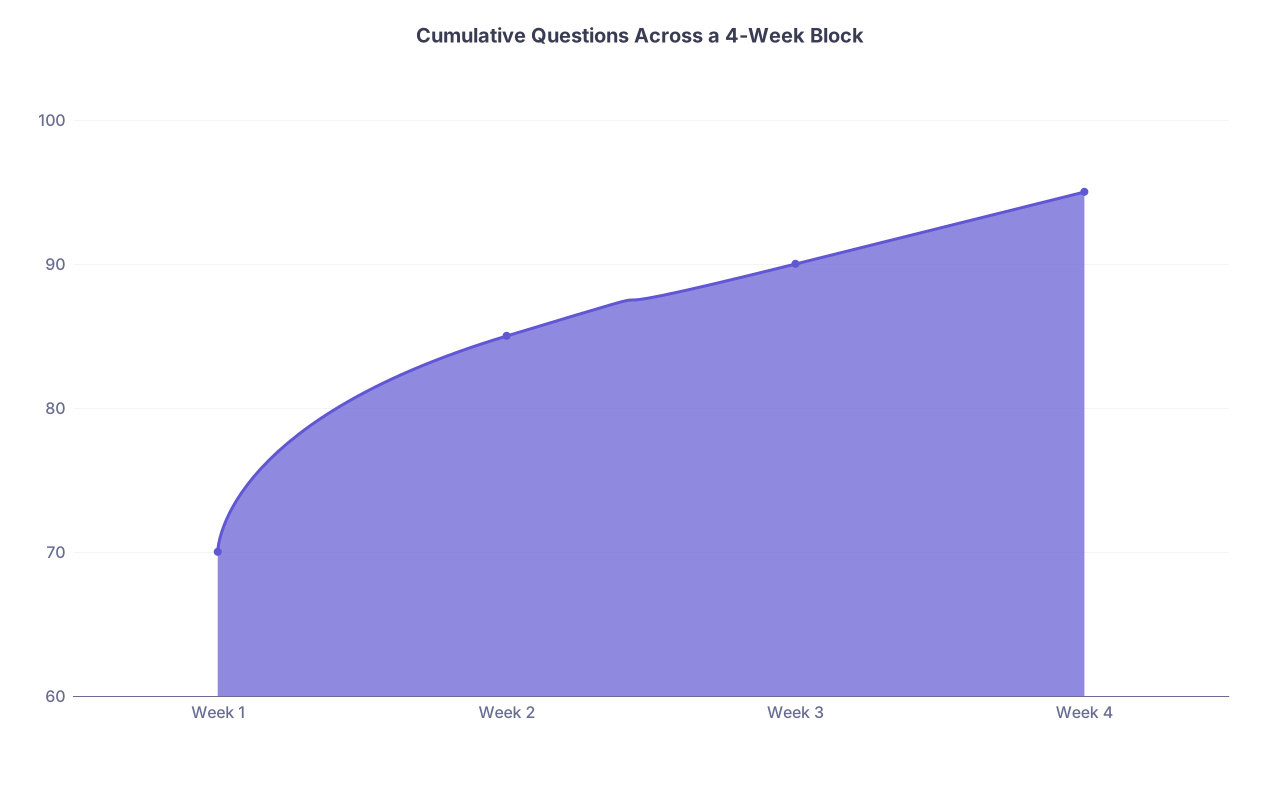
| Category | Value |
|---|---|
| Week 1 | 70 |
| Week 2 | 85 |
| Week 3 | 90 |
| Week 4 | 95 |
When You Miss Days (Because You Will)
You will have days where everything catches fire. Code blue, new admissions, angry families, punitive attendings. Studying will not happen.
At that point, your rule is simple:
- Do not compensate by doubling the next day.
- Resume your normal daily target as soon as possible.
- If you miss:
- 1–2 days per week: ignore, keep going.
- 3–4 days in a row: lower your daily target temporarily and rebuild the habit.
The only real failure is quitting for a month and pretending you will “restart next rotation.”
The Bottom Line
Three points to walk away with:
- 30–45 minutes is enough for serious board prep in residency—if it is structured as daily question blocks plus fast review, not random reading.
- Anchor a specific time of day for your core Qbank session, protect it like it is part of your job, and supplement with micro-moments of recall (flashcards, quick reviews).
- Track lightly and adjust weekly so you are honest about volume and weak areas, instead of guessing three months before your exam and trying to cram.
Build this now, in the chaos of service. Boards will feel like an extension of your normal day, not a separate crisis.