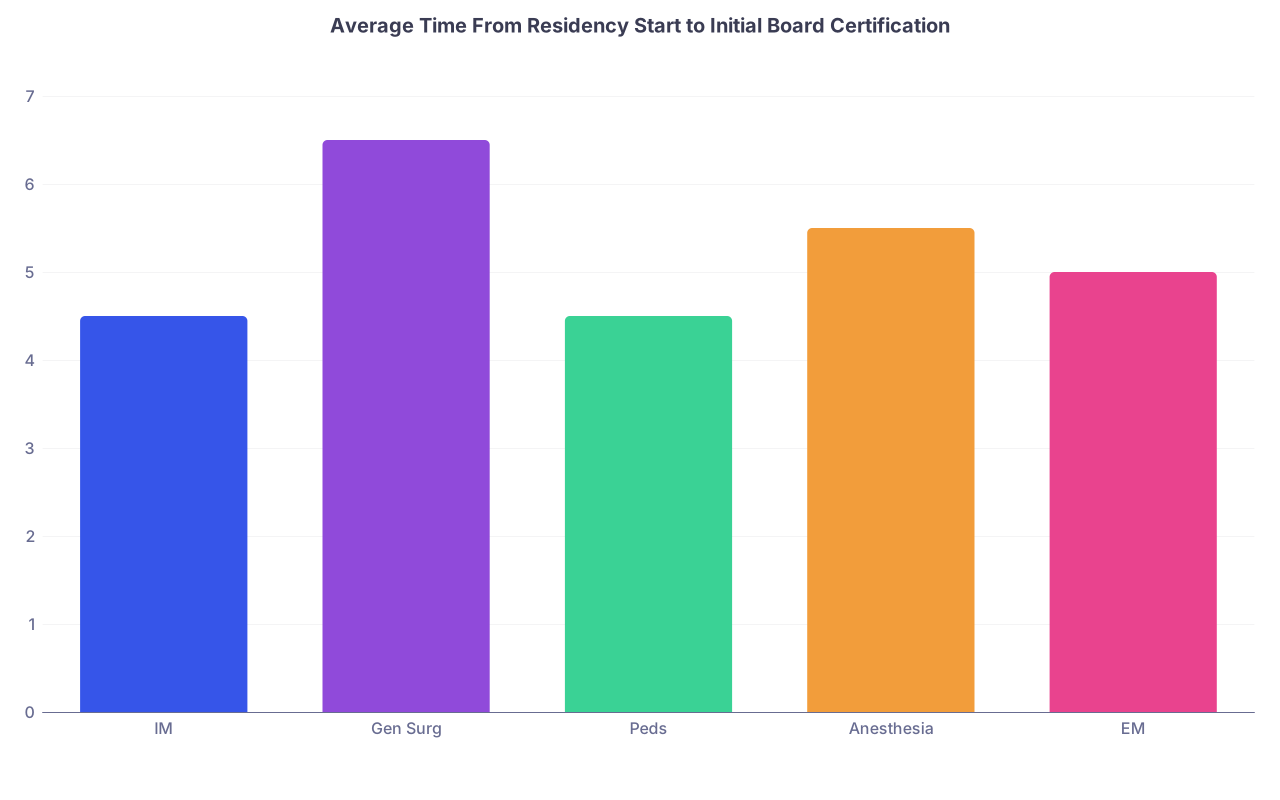
The way most residents react to their PGY‑2 in‑training exam is lazy and wasteful. They glance at the score, complain in the workroom, and then go right back to doing random questions “when they have time.” That’s how you walk into boards underprepared.
You’re PGY‑2 now. The in‑training exam (ITE) is no longer a practice quiz. It’s your early warning system. At this point you should be weaponizing that feedback into a concrete board prep timeline that runs through the rest of the year.
Here’s how to do it, step by step, month by month.
Big Picture: Your PGY‑2 Board Prep Timeline
Let me anchor your year first. I’ll assume:
- Standard residency calendar: July–June
- Boards after PGY‑3 (for IM/EM/Peds/Anesthesia/OB etc.)
- ITE usually in the fall (Oct–Nov) or winter (Jan–Feb) depending on specialty
So you have three phases as a PGY‑2:
- Pre‑ITE (July–Exam Month) – Build baseline habits & data.
- Immediate Post‑ITE (0–4 weeks after score release) – Deep dive, set targets, adjust plan.
- Long Game (3–9 months after ITE) – Systematic remediation plus exam‑style conditioning.
At each point, you should know:
- What you’re focusing on
- How you’re measuring it
- How it fits into PGY‑3 board prep
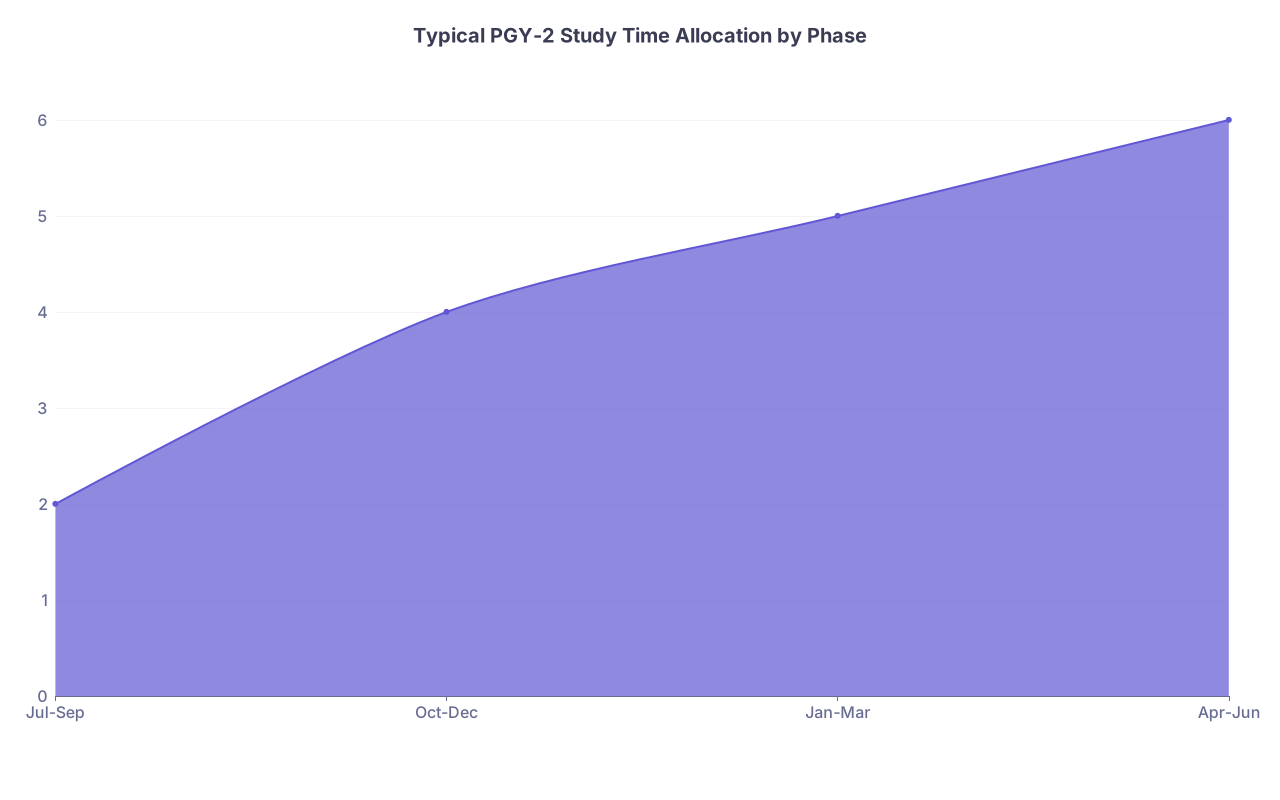
| Category | Value |
|---|---|
| Jul-Sep | 2 |
| Oct-Dec | 4 |
| Jan-Mar | 5 |
| Apr-Jun | 6 |
(Values are average hours/week of true board prep, not “I read UpToDate once.”)
Phase 1: July to ITE – Set Up The Data You’ll Need Later
If your ITE is in the fall, this is July–October. If it’s winter, shift everything a few months. The logic stays the same.
July: Stabilize Your Life + Pick Your Tools
At this point you should:
- Accept that your schedule is not going to “get easier later.” It won’t.
- Decide on one primary Qbank and one secondary resource. Not five.
Pick something like:
- Internal Medicine: UWorld + MKSAP
- EM: Rosh/EM:RAP questions + EM Board Review text
- Peds: PREP + one smaller review book
Do not spend three months “researching which qbank is best” while doing no questions.
Your July checklist:
- Buy/activate your main Qbank (full year or 2‑year access if PGY‑2 early).
- Set a modest baseline target: 20–30 questions/week.
- Choose a way to track: spreadsheet, Notion, or Qbank’s built‑in tracker.
- Block two protected 30–45 minute slots per week on your calendar.
By the end of July you should have:
- 80–100 questions completed
- A feel for your weak systems/subjects, even if it’s blurry
August: Build Consistency, Not Heroics
At this point you should focus on habit, not volume.
Targets:
- 40–60 questions/week, in blocks of 10–20
- Timed, mixed when possible (mimics ITE/boards)
After each block:
- Tag questions into 3 buckets in your notes:
- “Didn’t know the concept at all”
- “Knew but misapplied”
- “Careless / misread / time issue”
Why? Because post‑ITE, you need to know if your problem is knowledge, reasoning, or discipline.
August micro‑routine:
- One weekday post‑call: 10–15 questions, untimed, heavy review.
- One weekend block: 20 questions timed, simulate test conditions a bit.
By the end of August you should:
- Know your recurring weak areas (e.g., nephrology, OB emergencies, endocrine).
- Have some baseline Qbank percentages to compare to after the ITE.
September: Start Thinking Like the Exam
At this point you should be:
- Doing mostly timed blocks
- Mixing topics rather than only “I’m on GI month so I’ll only do GI”
You also start small data hygiene:
- Track average block score (e.g., 55–60% early on is common and fine)
- Note which domains are consistently <50% (e.g., infectious disease, heme/onc)
If your ITE is in October/November, September is where you:
- Ramp to 80–100 questions/week if your schedule allows
- Do at least one “half ITE” (60–75 questions in one sitting) on a day off
Phase 2: ITE Month + First 4 Weeks After Results
This is where most residents blow it. They use the ITE as a judgment, not as a roadmap.
ITE Week: Treat It Like a Dress Rehearsal
The week of the exam:
- Sleep. Seriously. The best “prep” in 7 days is not cramming; it’s clear thinking.
- Two or three 20–30 question timed blocks just to get in rhythm.
Day before:
- Shut it down. Maybe glance at your own summary notes or high‑yield topics. No 6‑hour cram.
- Pay attention to how you feel in:
- First 20 questions (rusty or fine?)
- Middle of exam (mental fatigue?)
- Last 10 (rushing, re‑reading stems?)
You’re collecting process data, not just content gaps.
Week 0–1 After Score Release: Cold, Ruthless Assessment
The day you get your ITE results, do not just stare at the percentile.
You need a 60–90 minute debrief session.
At this point you should:
Print or save the full breakdown.
- Performance by subspecialty/system
- Performance by topic domain (diagnosis, management, basic science, etc.)
- Percentiles against PGY‑2 peers
Sort your results into three buckets:
- Red (Critical Weak) – <25th percentile or clearly dangerous gaps
- Yellow (Needs Work) – 25th–50th percentile
- Green (Stable) – >50th percentile, especially >70th
Create a one‑page “ITE to Board Prep Map.” Literally one page:
- Top: Your total percentile and goal for boards
- Middle: 3–4 Red areas, 3–4 Yellow areas
- Bottom: A single sentence: “If I keep this trajectory, I am [on track / borderline / in trouble] for boards.”
| Domain | ITE Percentile | Color | Priority |
|---|---|---|---|
| Cardiology | 40th | Yellow | Medium |
| Nephrology | 15th | Red | High |
| Infectious Dz | 60th | Green | Low |
| Endocrine | 20th | Red | High |
| Rheumatology | 30th | Yellow | Medium |
If your reaction is just “ugh I did worse than I wanted,” you’ve wasted the exam.
Week 1–2 After Results: Translate Feedback Into a 3‑Month Plan
This is where you integrate, not just complain.
At this point you should:
Align ITE results with Qbank analytics.
- Are your Red areas also low in Qbank performance?
- Any discrepancies? (Strong in Qbank but weak on ITE = test‑taking issue.)
Define specific targets for the next 3 months:
Example:
- “Raise nephrology from 15th → at least 40th percentile by next ITE/assessment.”
- “Close endocrine knowledge gaps to the point where I score ≥65% on Qbank endocrine blocks.”
Build a focused block schedule:
- Weeks 1–4 post‑ITE: 70% of questions from Red areas, 30% mixed
- Weeks 5–8: 50% Red, 30% Yellow, 20% mixed
- Weeks 9–12: 30% Red, 40% Yellow, 30% mixed timed blocks
Book a 15–20 minute meeting with a program director or mentor.
- Bring your one‑page map.
- Ask two questions:
- “Given these results, would you be concerned about my boards?”
- “If you were me, which 2–3 areas would you attack first?”
You’ll get more honesty if you show you’ve already analyzed your own data.
Phase 3: Month‑by‑Month After ITE – Turning Weaknesses Into Strengths
Now we stretch out. Think of this as a 3‑part arc.
Months 1–3 After ITE: Intensive Remediation Cycle
At this point you should still feel a little uncomfortable. That’s good. You’re in the “fix it” window.
Monthly goals:
- 100–150 questions/month specifically in your Red zones.
- 150–200 questions/month mixed/timed.
For each Red area (say nephrology):
Week 1 of focus:
- 3 blocks of 10–15 nephro questions (untimed), heavy review.
- Short, 1‑page summary for each key topic you repeatedly miss.
Week 2:
- 2–3 mixed blocks with at least 30% nephro questions.
- Check your performance delta. Aim for +10–15% from initial Qbank baseline.
Week 3:
- One half‑test (40–60 mixed questions) with no filtering.
- Verify you can apply nephro concepts when they’re interleaved, not isolated.
Week 4:
- Quick re‑review of your 1‑page topic notes.
- Add any remaining “I still don’t get this” bullet points.
You then move to the next Red area (e.g., endocrine) and repeat the same 4‑week structure, with overlap.
By the end of Month 3 post‑ITE you should:
- Have 2–3 previously Red domains upgraded to at least “Yellow/average.”
- Notice fewer “I have literally no idea” questions and more “I can at least eliminate 2 options” scenarios.
Months 4–6 After ITE: Build Board‑Level Stamina and Refinement
You’re now probably entering late PGY‑2 or early PGY‑3.
At this point you should shift from pure remediation to exam conditioning.
Targets:
2 full 60–80 question blocks/month under true exam conditions:
- Timed
- No phone, no interruptions
- Breaks only like on real boards
Maintain 150–200 questions/month with a mix:
- 40–50% from remaining Yellow areas
- 50–60% fully mixed, random
You also start to:
- Track not only accuracy, but error type:
- Rushing
- Misread question
- Changed from right to wrong
- Did not know concept
- Aim to shrink the “avoidable mistake” category each month.
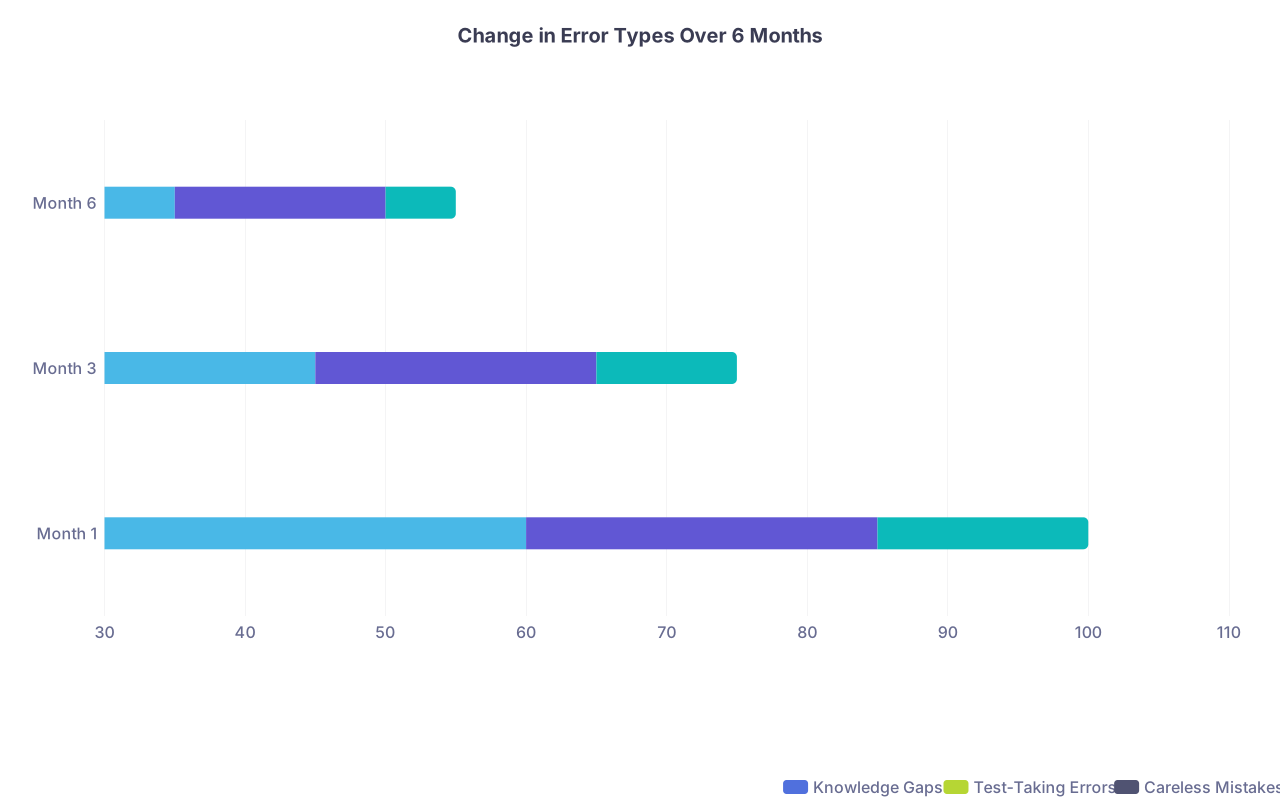
| Category | Knowledge Gaps | Test-Taking Errors | Careless Mistakes |
|---|---|---|---|
| Month 1 | 60 | 25 | 15 |
| Month 3 | 45 | 20 | 10 |
| Month 6 | 35 | 15 | 5 |
If that careless bar isn’t shrinking, your issue isn’t knowledge. It’s discipline.
Months 7–9 After ITE: Pre‑Board PGY‑3 Alignment
By now you’re brushing up against PGY‑3. At this point you should use your PGY‑2 ITE data as a benchmark, not a current snapshot.
Here’s the move:
Re‑take a self‑assessment (NBME, in‑house exam, or Qbank self‑assessment).
Compare domain performance to your PGY‑2 ITE map:
- Did your old Red areas improve?
- Did any new weak spots emerge?
Update your map with three labels per domain:
- “Resolved” – now consistently strong or at least average
- “Residual” – still below where you want it, but improved
- “New problem” – emerged despite no big signal on PGY‑2 ITE
From here, your PGY‑3 board prep plan should not be generic. It should be built off this trajectory:
- Residual and new problem domains get 60–70% of focused studying.
- Previously strong domains just get maintenance (occasional blocks, quick review).
Weekly and Daily: What This Actually Looks Like On a Schedule
Let’s get concrete. How does this integrate with a brutal PGY‑2 schedule, nights, ICU, and everything else?
I’ll give you two templates.
On a “Normal” Ward Month
Assume 6‑day weeks, one golden weekend maybe.
Weekly PGY‑2 Board Prep Template:
Monday (post‑call or lighter):
- 10–15 untimed questions from a Red/YT (Yellow/Target) area, heavy review.
- 20–30 minutes of reading linked to missed questions.
Wednesday:
- 20 questions timed, mixed.
- Review explanations for all incorrect and all guessed‑correct items.
Saturday (or your lightest day):
- 20–30 question timed block from focused area (e.g., endocrine).
- Quick 10‑minute reflection: any pattern this week?
That’s 50–65 questions/week. If you protect those three blocks, you’ll outpace most of your co‑residents.
On a Brutal ICU / Night Float Month
ICU month is not where you pretend you’re doing 200 questions/week. That’s fantasy.
At this point you should shift to maintenance mode with micro‑sessions:
- 3 days/week
- 5–10 questions/day, often on your phone during a real break (not while admitting a crashing patient)
- Focused on a single Red area to keep concepts fresh
Your only non‑negotiable:
- Do not let the habit break for more than 7–10 days straight.
- After the rotation, schedule one “reset” half‑test (40–60 mixed questions) on your first off weekend.
How To Actually Use the ITE Feedback Page (Step‑By‑Step)
Most of you get a dense PDF or online breakdown. Here’s what you do in the first 60 minutes with it.
Ignore the raw score for a moment.
Go straight to:- Percentile vs. PGY‑2 peers
- Performance by content area
Circle the bottom 3–5 content areas by percentile.
- If everything is equally mediocre, that’s a different problem (global under‑preparation).
Match each weak area to a practical trigger on the wards.
Example:- Nephrology weakness → every AKI/CKD patient becomes a study opportunity.
- Endocrine weakness → you own all DKA, thyroid storm, adrenal cases on your team.
Write one “must‑learn list” per weak area.
For nephrology, that might be:- Indications for dialysis
- Workup of hematuria/proteinuria
- Approach to hyponatremia
- Acid‑base interpretation patterns
Plan 2–3 concrete actions for each list in the next month.
- Listen to 1–2 targeted podcast episodes
- Read 1 core chapter or review section
- Do 30–40 Qbank questions just on that domain
You now have a direct line from a cold PDF to a living plan.
Visual Roadmap of Your PGY‑2 Year
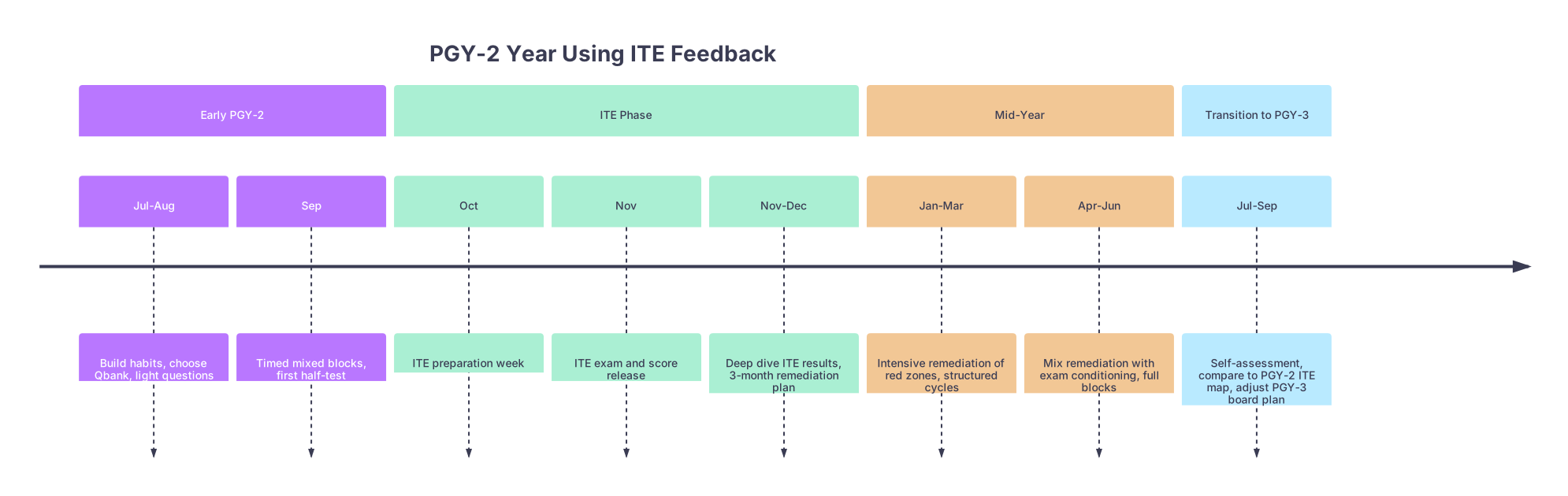
| Period | Event |
|---|---|
| Early PGY-2 - Jul-Aug | Build habits, choose Qbank, light questions |
| Early PGY-2 - Sep | Timed mixed blocks, first half-test |
| ITE Phase - Oct | ITE preparation week |
| ITE Phase - Nov | ITE exam and score release |
| ITE Phase - Nov-Dec | Deep dive ITE results, 3-month remediation plan |
| Mid-Year - Jan-Mar | Intensive remediation of red zones, structured cycles |
| Mid-Year - Apr-Jun | Mix remediation with exam conditioning, full blocks |
| Transition to PGY-3 - Jul-Sep | Self-assessment, compare to PGY-2 ITE map, adjust PGY-3 board plan |
Common Mistakes PGY‑2s Make (And When They Happen)
Quick reality check. I see the same patterns over and over.
July–September:
- “I’ll start once my schedule calms down.” It never does.
- Hoarding resources instead of doing questions.
ITE Month:
- Treating the exam like a one‑day event instead of a diagnostic tool.
- Panicking from one bad section instead of mapping a plan.
First 3 Months Post‑ITE:
- Doing generic mixed questions with no focus on Red areas.
- Ignoring ITE because “boards are still a year away.”
6–9 Months Post‑ITE:
- Forgetting what the ITE showed and starting PGY‑3 prep “from scratch.”
- Not using a self‑assessment to confirm improvement.
Do not repeat these. They are how solid residents end up sweating bullets the month before boards.
How To Know If Your Plan Is Working
You don’t wait until boards to find out.
Signs month‑to‑month that your ITE‑driven prep is on track:
- Your weakest domains in Qbank are creeping up by 5–10 percentage points over 2–3 months.
- When a patient on rounds triggers a weak content area, you now have a framework instead of a blank stare.
- On full timed blocks, your fatigue point moves later (you’re making fewer stupid mistakes at question 40+).
- You can explain a previously weak concept to an intern or student without peeking at UpToDate every sentence.
If none of that is happening by 3–4 months after ITE, your “plan” is probably just random questions when you’re bored. Fix it.
Final Snapshot: What You Should Be Doing When
- Before the ITE: Build consistent question habits and baseline data; don’t chase perfection.
- First 4 weeks after ITE results: Turn the score report into a one‑page map, pick 3–5 weak domains, and design a 3‑month remediation cycle.
- Following 3–9 months: Systematically attack red/yellow areas, increase timed blocks, and use new assessments to verify that PGY‑2 ITE weaknesses are truly resolved before you walk into boards.