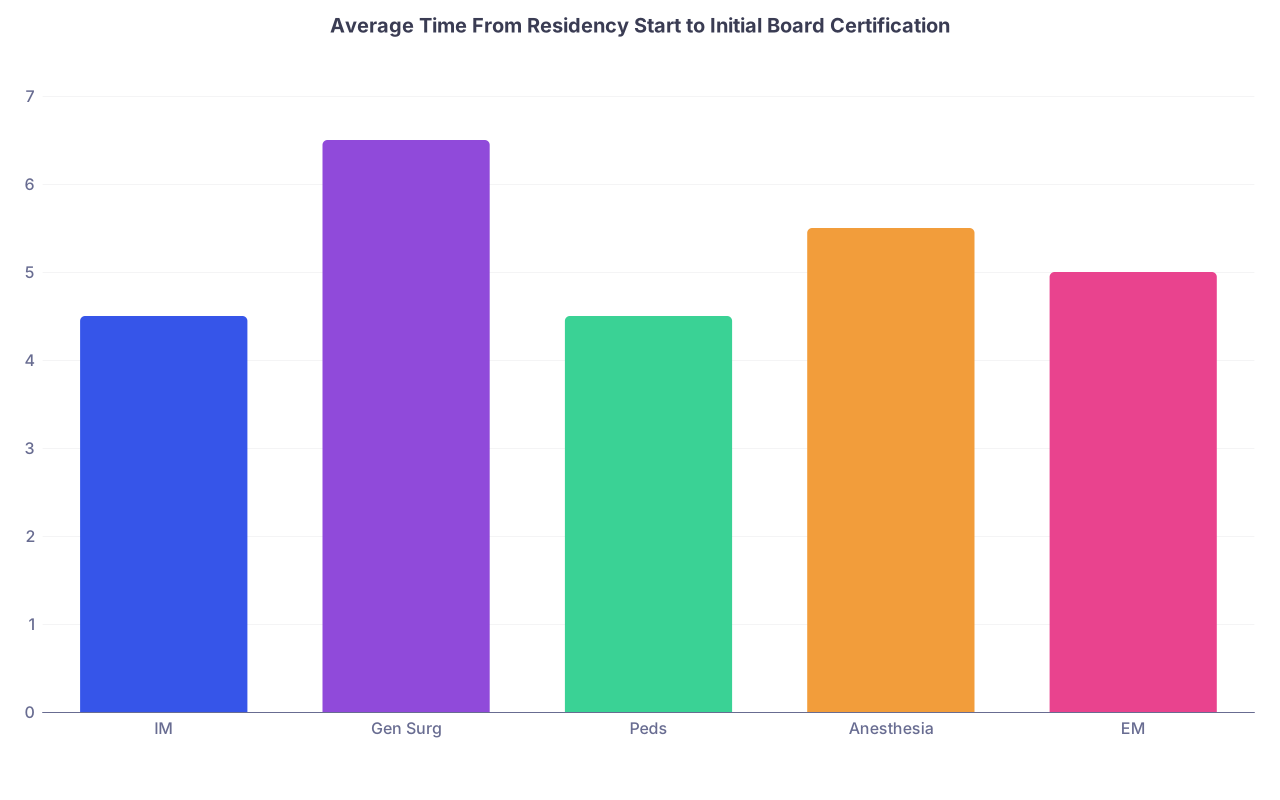
You’re a PGY-2 heading into PGY-3. You’ve got an in-training exam score email sitting in your inbox, a co-resident just matched into a competitive fellowship, and your program director casually reminded you, “Don’t forget, boards are right after graduation.”
You’re thinking: I have to be a good resident, crush my boards, and apply to fellowship. In the same year. On the same tired brain.
Here’s how you do it without lighting yourself on fire.
Big Picture: Parallel Tracks, Not Competing Priorities
You’re running two timelines:
- Certification board exam (e.g., ABIM, ABS, ABP) after residency
- Fellowship application + interviews usually starting 9–12 months before that exam
They are not separate projects. They feed each other. Strong board-level knowledge makes you better in interviews; a disciplined application year helps you not panic-cram for boards six weeks before the test.
Think in three phases:
- Foundation (PGY-1 to early PGY-2) – Set habits, fix weaknesses, align rotations.
- Application Year (late PGY-2 through PGY-3) – Heavy lift: fellowship apps + early board prep.
- Final Push (last 4–6 months of residency) – Lock in board content once applications calm down.
Here’s the timeline, concretely.
PGY-1: Quiet Setup That Pays Off Later
You’re not applying to fellowship yet. But future-you will either thank you or swear at you based on what you do now.
Months 1–3 of PGY-1: Just Survive, But Capture Data
At this point you should:
Figure out which exam and format you’ll face
- Internal med: ABIM – mostly multiple choice, heavy on bread-and-butter medicine
- Surgery: ABS QE – more operative decision-making
- Pediatrics: ABP – similar style to ABIM but pediatric-focused
Log what repeatedly embarrasses you on rounds.
- Start a simple note on your phone or a Google Doc:
- “ICU: vasopressors – confused about when to switch”
- “Renal: glomerulonephritis patterns”
- “Cards: anticoagulation around procedures”
- Start a simple note on your phone or a Google Doc:
Do very light QBank exposure (seriously light):
- 5–10 questions a day, 3–4 days a week. Untimed, learning mode.
- Just to get used to board-style thinking, not to “study for the boards.”
You’re building awareness, not mastery.
Months 4–6 of PGY-1: Establish an Actual Study Habit
At this point you should:
Choose your primary question bank for boards:
- IM: UWorld (non-negotiable), consider a secondary bank (AMBOSS, MKSAP questions).
- Surg: TrueLearn + SCORE.
- Peds: MedStudy or PREP.
Create a micro-habit schedule:
- 15–20 questions per weekday.
- One 1–2 hour “learning block” on a lighter weekend day to review missed questions.
Align your habit with your reality:
- On wards: 10 questions pre-call, 10 post-call the next day = done.
- On lighter rotations (clinic/elective): 20–30/day.
If you can’t consistently do 10–20 questions as a PGY-1, you’re not going to magically do 60/day as a PGY-3 applying to fellowship.
Months 7–12 of PGY-1: Turn ITE into a GPS
You’ll usually have an In-Training Exam (ITE) near the end of PGY-1.
At this point you should:
Treat the ITE as your baseline board score:
- Don’t freak out about percentile; look at domain breakdown.
- “Weak: nephrology, rheumatology, heme-onc.” Good. That’s your map.
Implement targeted blocks:
- 60–70% of questions from weak areas.
- 30–40% from mixed or strong areas to maintain breadth.
Start building a personal “board notes” system:
- One consolidated place: Notion, OneNote, Google Doc, or a physical notebook.
- Only write down:
- Repeatedly missed concepts
- Mnemonics or decision trees
- High-yield algorithms (e.g., AFib anticoagulation, sepsis management steps)
You’re not doing “hardcore board prep” yet. You’re building infrastructure so PGY-3 doesn’t feel like starting from zero.
PGY-2: Decide Fellowship, Align Training, Ramp Up
This is where the board timeline and fellowship timeline start overlapping.
Early PGY-2 (Months 1–3 of the Year): Decide Your Route
At this point you should:
Make a real decision about fellowship:
- Yes/No and which field (Cards, GI, Heme/Onc, Pulm/CCM, etc.).
- If you’re unsure by mid-PGY-2, you’re already behind for niche, super-competitive fields.
Talk to:
- A recent grad who matched in your chosen fellowship.
- A faculty mentor in that subspecialty.
- Your PD or APD about rotation planning.
Align your rotations:
- Front-load your future fellowship’s rotations in late PGY-2 / early PGY-3.
- Example: future cardiology fellow → aim for CCU, consults, and echo during PGY-2–PGY-3 early so your letters can mention concrete work.
This directly affects your board prep: the more subspecialty content you see on the wards now, the less you’ll have to brute-force later.
Mid PGY-2 (Months 4–6): Build a Two-Track Study Plan
Now board prep and fellowship prep start to share a brain.
At this point you should:
Increase board-related questions:
- 25–35 questions per day on average.
- Try one timed block (10–15 questions) per week.
Start fellowship-specific reading layered on top:
- Want GI? Skim ASGE guidelines and basic hepatology decision trees.
- Want Cards? ACC/AHA guidelines for CHF, AFib, ACS.
Aim for overlap: a hemodynamics concept you learn for your future fellowship goes straight into your board foundation.
- Build a single reading pipeline:
- For each rotation, choose:
- 1 board review resource (e.g., MKSAP section, MedStudy videos)
- 1–2 key guidelines/landmark review articles related to your intended fellowship.
- For each rotation, choose:
You are not doing separate “board time” and “fellowship time” for basic concepts. Core medicine should count for both.
Late PGY-2 (Months 7–12): ITE #2 and Early Fellowship Prep
Now the timeline tightens. ERAS (or SF Match for some fellowships) is on the horizon.
At this point you should:
Take ITE seriously as your board predictor:
- Aim to be safely above the “at risk” zone.
- If you’re below average or borderline:
- You need an actual remediation plan now, not in PGY-3.
- Consider: dedicated weekly study group, faculty tutor, or a structured board course.
Start early fellowship application prep:
- Update CV with:
- Presentations
- QI projects
- Any poster you half-finished—finish it.
- Identify letter writers:
- Two from your desired subspecialty
- One from a core rotation who can vouch for your overall competence
- Update CV with:
Integrate fellowship topics into board prep:
- If applying for Heme/Onc, don’t ignore oncology chapters “for later.”
- You want to walk into interviews already sounding like someone with board-solid general knowledge and a focused subspecialty interest.
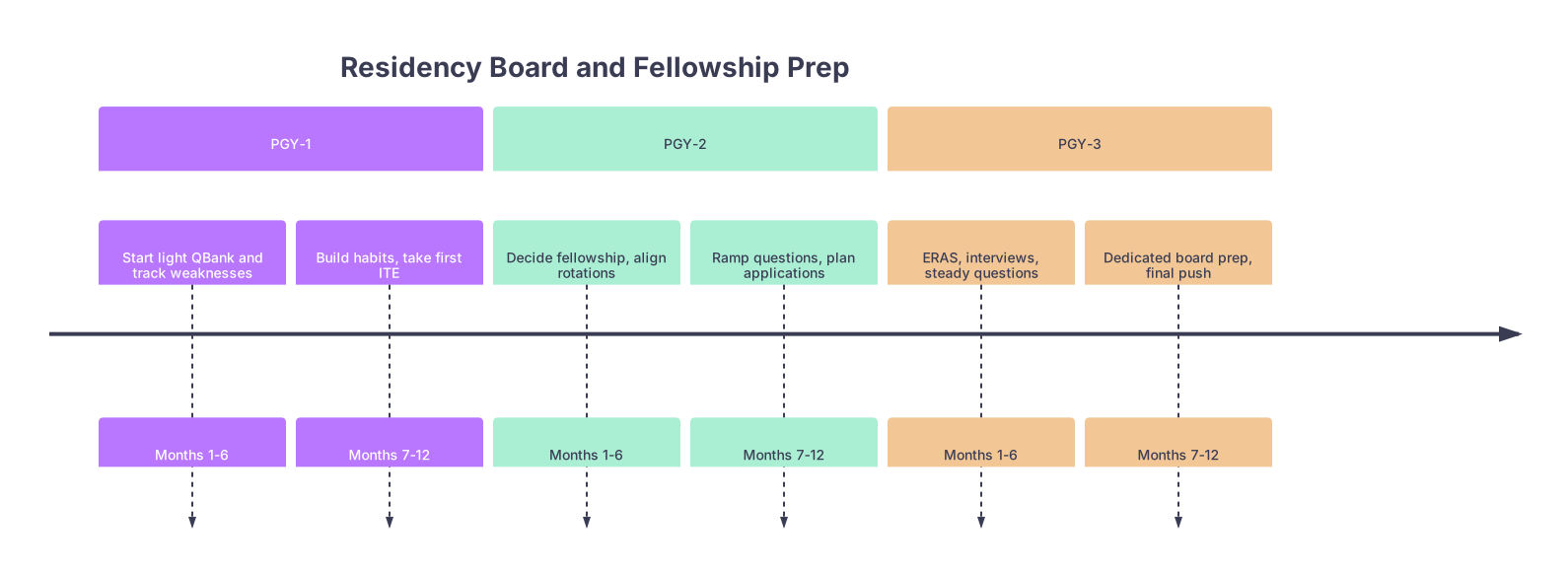
| Period | Event |
|---|---|
| PGY-1 - Start light QBank and track weaknesses | Months 1-6 |
| PGY-1 - Build habits, take first ITE | Months 7-12 |
| PGY-2 - Decide fellowship, align rotations | Months 1-6 |
| PGY-2 - Ramp questions, plan applications | Months 7-12 |
| PGY-3 - ERAS, interviews, steady questions | Months 1-6 |
| PGY-3 - Dedicated board prep, final push | Months 7-12 |
PGY-3 (or Final Year): The Tightrope Year
This is the year that breaks people who didn’t plan. You’ll have:
- ERAS submission
- Fellowship interviews (often bunched into brutal weeks)
- Senior responsibilities on service
- Last ITE
- Board exam date creeping closer
PGY-3 Months 1–3: ERAS + Maintain Your Baseline
ERAS for most internal medicine-based fellowships opens in June with submissions soon after; other specialties vary slightly, but the chaos is similar.
At this point you should:
Finish 90–100% of your primary QBank at least once:
- If you haven’t, you’re behind. Prioritize high-yield areas now.
- Shift to timed blocks for most of your sessions.
ERAS / application tasks:
- Personal statement drafted and edited.
- LoRs requested with clear deadlines.
- Program list made (reach/realistic/safe).
Protect a minimum floor of board study:
- Even during application madness:
- 10–15 questions per day, non-negotiable.
- That’s your “heartbeat.” You stop that for two months, you will feel it later.
- Even during application madness:
PGY-3 Months 4–6: Interview Season + Board Insurance
This is the danger window. Travel, virtual interviews, late nights, extra calls to cover co-residents on interviews.
At this point you should:
Run efficient, portable board prep:
- QBank app on your phone/tablet.
- 10–20 questions between interviews, on planes, at the hotel.
- Short review of your “worst systems” each week (one-hour block).
Use interview prep to secretly help boards:
- Every “Tell me about a case…” → you review pathophys and management.
- When you prep for fellowship journal clubs or case presentations, you’re reinforcing board-level knowledge. Treat it that way.
Keep track of your cumulative question counts:
- Residents love to lie to themselves about how much they’ve done.
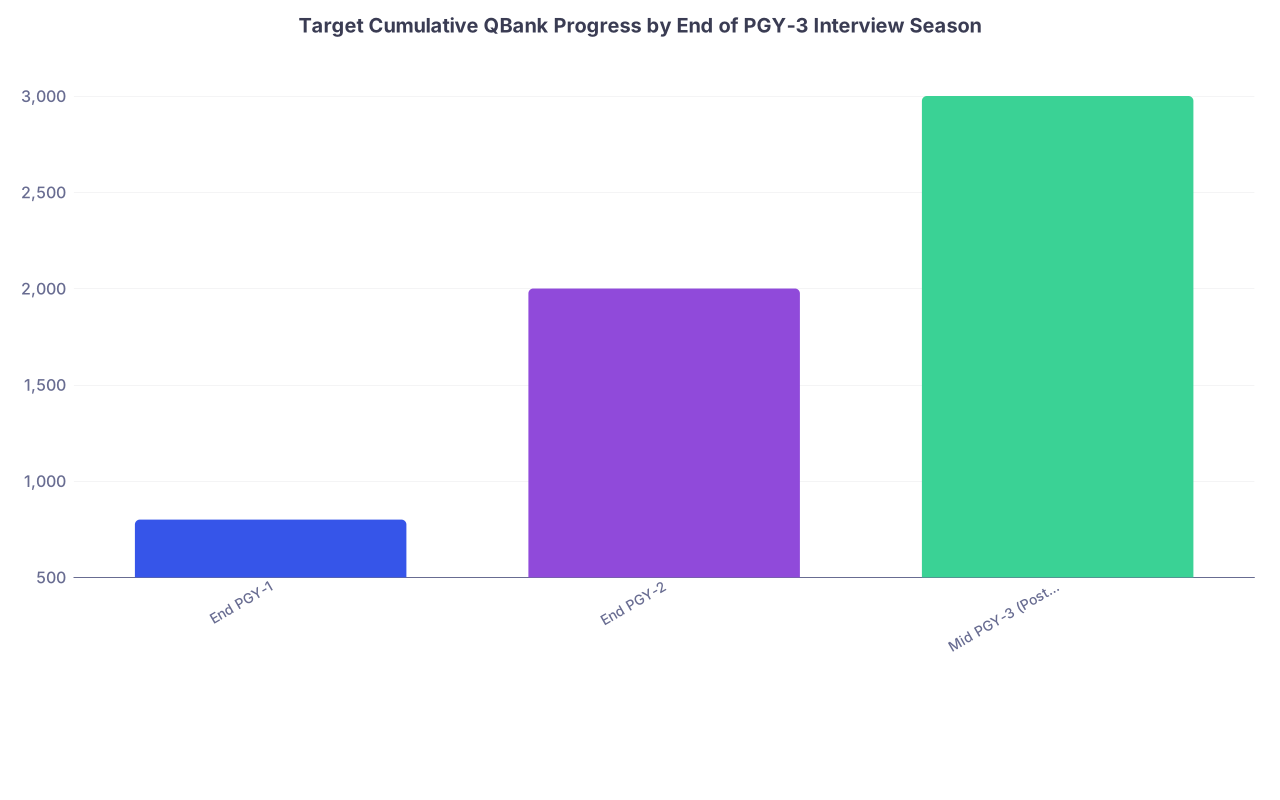
| Category | Value |
|---|---|
| End PGY-1 | 800 |
| End PGY-2 | 2000 |
| Mid PGY-3 (Post-Interviews) | 3000 |
If you’re nowhere near those numbers and your ITE is weak, you need to make some hard choices: fewer moonlighting shifts, less elective fluff, more textbook + QBank time.
6 Months Before Boards: Shift From Survival to Attack
Now we’re in the real “board prep” period. Fellowship apps are mostly done, maybe you’ve already matched. Use that relief wisely.
6 Months Out: Structured, Exam-Focused Plan
At this point you should:
Lay out a content plan by month:
- Month 1–2: Systems you’re weaker in + high-yield bread-and-butter (cards, pulm, ID).
- Month 3–4: Remaining systems + mixed question blocks.
- Month 5: Full-length practice exams + review of misses.
- Month 6: Polish, review notes, lighter volume.
Do 40–60 questions most days:
- Mix of:
- Timed blocks (20–30 questions)
- Smaller “topic review” blocks for weak areas.
- Mix of:
Add a secondary resource if it fits:
- Board review videos during commutes.
- Condensed review books (MKSAP Board Basics, MedStudy “Core” books, etc.).
This is where your PGY-1 and PGY-2 habits either make this sustainable or miserable.
3–4 Months Out: Simulate and Correct
At this point you should:
Take a full-length or near full-length practice exam:
- Schedule it like the real thing: quiet space, minimal breaks, similar timing.
- Example: multiple 60–70-question blocks in one day.
Do a brutal, honest review:
- Categorize misses:
- Knowledge gap
- Didn’t read question carefully
- Changed right answer to wrong
- If your score is bad in multiple major domains, this is your red alert.
- Categorize misses:
Adjust based on results:
- If you’re weak across the board:
- Consider a short, intensive board review course.
- If you have 2–3 weak systems:
- Rebuild them aggressively with focused reading + questions.
- If you’re weak across the board:

2 Months Before Boards: Fellowship Match + Final Push
Most fellowship matches occur in this window or slightly before. Emotionally volatile month.
At this point you should:
Expect 1 week of productivity dip around Match:
- Match week is noisy—emails, congratulating co-residents, processing your own result.
- Plan for that. Do not schedule your most intense study block that same week.
Narrow your focus:
- Go from “learn all of medicine” to:
- High-yield patterns
- Algorithms
- Classic board traps
- Go from “learn all of medicine” to:
Revisit every “persistent miss” topic from your notes:
- If it’s been on your wrong-answer list for 6 months and you still don’t get it, fix it now.
- Or accept you’ll miss a couple of those and not obsess if they’re low-yield.
This is also the time to shut down anything non-essential:
- Say no to new QI projects
- Say no to “fun but optional” teaching extras
- Guard sleep ruthlessly
Final 2–4 Weeks: Taper Smart, Don’t Panic
You’re almost done. Do not do the classic resident move of trying to do 150 questions/day and then walking into boards half-delirious.
At this point you should:
Run exam simulations:
- One more full-length practice if timing allows.
- Several days of:
- 2–3 timed blocks
- Focused review of rationales, not just your score.
Switch gradually to review mode:
- Re-read your consolidated notes.
- Hit the highest-yield topics daily:
- For IM: CHF, AFib, COPD/asthma, pneumonia, sepsis, diabetes, CKD, GI bleeds, etc.
- For Surg: trauma, acute abdomen, periop management, postop complications.
- For Peds: vaccine schedules, congenital heart disease patterns, asthma, seizures.
-
- Drop total question volume slightly.
- Increase review, decrease new content.
- Fix your sleep schedule to match exam day.
Day before:
- Half day of light review max.
- No new topics. No all-nighters. You’re not a med student cramming for pharmacology anymore.

Sample Weekly Structure During Final 3 Months
To make this less abstract, here’s what a good PGY-3 late-year week looks like when you’re on a moderate rotation (not ICU, not nights):
| Day | Questions | Other Study | Notes |
|---|---|---|---|
| Monday | 40–50 | 30 min notes review | Post-call? Adjust volume. |
| Tuesday | 50–60 | 1 video/lecture | Timed blocks. |
| Wednesday | 40–50 | None | Busy clinic day. |
| Thursday | 50–60 | 30–45 min focused topic | Weak system. |
| Friday | 40–50 | Review missed questions | Lighter day. |
| Saturday | 60–80 | 1–2 hours reading | Longer block. |
| Sunday | 20–30 | High-yield skim | “Maintenance” day. |
Adjust for ICU/nights by dropping question volume 30–40% but preserving some daily work.
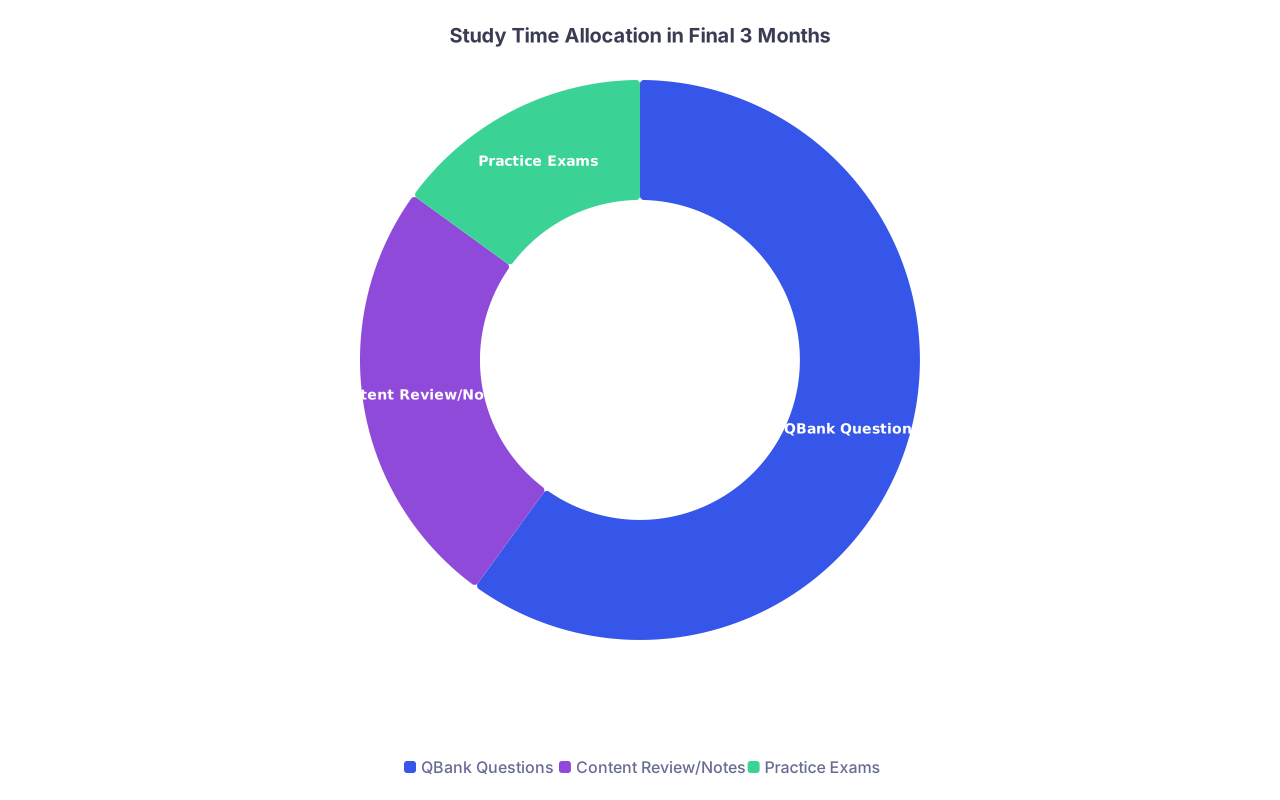
| Category | Value |
|---|---|
| QBank Questions | 60 |
| Content Review/Notes | 25 |
| Practice Exams | 15 |
Common Mistakes Residents Make (And What To Do Instead)
You’re not special; I’ve seen the same three screwups for years.

Treating fellowship and boards as totally separate worlds
- Wrong: “I’ll do boards after I match.”
- Better: Every rotation, every guideline, every case → ask, “How would this be tested?”
Ignoring ITEs
- Wrong: “I didn’t study but still passed, so I’m fine.”
- Better: Use each ITE as a compass. Adjust within weeks, not years.
All-or-nothing study patterns
- Wrong: 0 questions for three weeks, then 300 questions on a random Sunday.
- Better: 20–40 questions most days. Small, boring, consistent.
Final 3 Takeaways
- Start early, small, and consistent in PGY-1 and PGY-2 so PGY-3 isn’t a disaster.
- Make fellowship prep and board prep feed each other, not compete with each other.
- In the last 6 months, treat board prep like a scheduled rotation: daily work, clear plan, no magical thinking.