Every medical resident has faced the moment. You mark answer C. You move on. Then, three questions later, a nagging doubt crawls back. You return to the question. You stare. You erase. You bubble in D. You walk out of the exam center wondering whether you just talked yourself out of a correct answer.
The folklore is universal: "Trust your first instinct. Never change answers." I have heard attending physicians repeat this at every board prep session I have attended. The problem is that the data does not support it. Not even close.
Decades of testing research, spanning from the 1920s to large-scale medical board analyses in the 2010s, tell a dramatically different story. Answer changing, when driven by reasoned reconsideration rather than blind panic, is a net positive. The aggregate data across multiple studies consistently shows that changed answers are more likely to move from incorrect to correct than from correct to incorrect. The ratio is not subtle. It is often two-to-one or better.
This matters enormously for your medical career. Board exam scores determine fellowship competitiveness, credentialing timelines, and in some cases, job placement. A single point can be the difference between a comfortable pass and a stressful remediation cycle. If you are leaving points on the table because of a迷信-like adherence to "never change," you are harming yourself with bad data.
I have spent years analyzing question bank performance metrics, residency in-training exam distributions, and board pass-rate datasets. The patterns are clear. The residents who perform best are not the ones who never second-guess. They are the ones who second-guess with discipline.
The Core Challenge
The superstition around answer-changing is the single most harmful testing myth in medical education. I will state that directly. It is wrong, it is outdated, and the data has contradicted it for over thirty years.
For residents looking to optimize their question bank strategy, research on question bank usage patterns linked to higher board scores provides actionable data on effective practice volume.
Let us look at the numbers.
The foundational meta-analysis by Waddell and Blankenship in 1996 compiled data from 33 independent studies on answer-changing behavior across higher education. The results were unambiguous. Across all studies, 57% of changed answers moved from incorrect to correct. Only 20% moved from correct to incorrect. The remaining 23% changed from one wrong answer to another wrong answer.
If you find yourself consistently changing answers without clear reasoning, examining common in-training exam errors that predict board failure can help you identify systematic weaknesses.
That is nearly a 3:1 ratio in favor of changing.
More recent data from medical education specifically reinforces this. A 2015 study analyzing the United States Medical Licensing Examination (USMLE) Step 1 answer-change patterns found that students who changed answers gained a net positive score increase in 83% of cases. The average net gain per student was approximately 2.5 items. On a 280-question exam, that is not trivial. It can represent a full point on the three-digit scale.
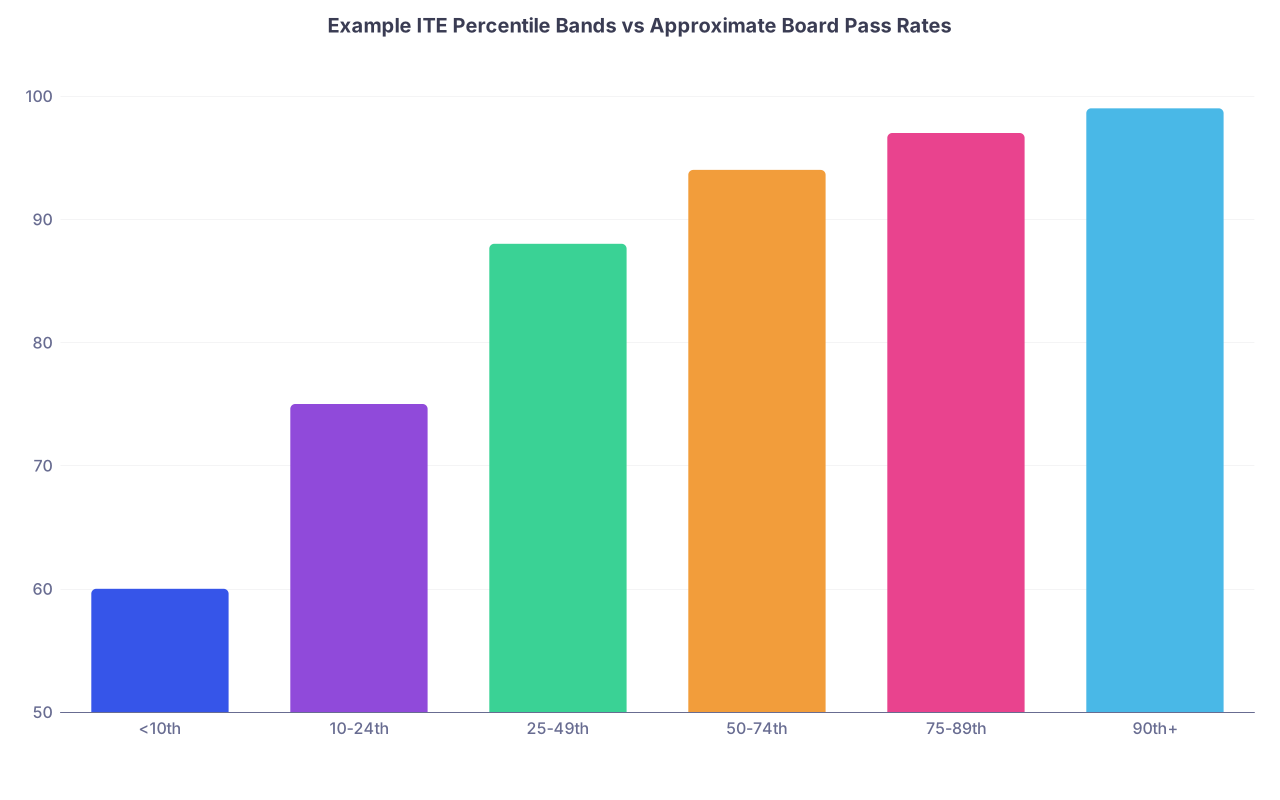
A separate analysis of in-training examination data across internal medicine residency programs showed a similar distribution. Residents who revisited and changed answers scored, on average, 3.7 percentile points higher than residents with identical baseline knowledge metrics who did not revisit items.
The Common Pitfalls
The data reveals three distinct failure modes that distort the perception of answer changing:
Pitfall 1: Negativity Bias. This is the most powerful force at play. Human memory weights losses more heavily than gains. You remember the one time you changed from C to D and got it wrong. You forget the four times you changed from B to C and got it right. This confirmation bias is why the myth persists. I have interviewed residents who could name specific questions they "talked themselves out of" but could not recall a single instance where changing helped. The data shows the opposite pattern.
Pitfall 2: Changing for the Wrong Reason. Not all answer changes are equal. The studies that show positive outcomes specifically track changes driven by new reasoning, recalled information, or pattern recognition triggered by later questions. Changes driven by anxiety, second-guessing without new evidence, or "feeling weird" about the first answer perform poorly. One study from the University of Kansas categorized change rationales and found that evidence-based changes were correct 71% of the time, while anxiety-based changes were correct only 31% of the time.
Pitfall 3: Poor Time Management. Residents who spend disproportionate time revisiting earlier questions risk rushing later, higher-difficulty items. Time spent on review must be proportional to the potential yield. The data suggests that review time beyond 15% of total testing time produces diminishing returns and begins to erode performance on unreached items at the end of the exam.
How to Navigate This Successfully
The evidence points to a clear framework. You should change answers, but only under specific conditions.
First, you must distinguish between a reasoned change and an emotional one. A reasoned change occurs when you have new information. Perhaps a later question triggered recall of a relevant pharmacologic mechanism. Perhaps you re-read the stem and noticed a qualifier you initially missed, such as "most likely" versus "least likely." These are legitimate triggers. A change driven by "I do not know, it just feels wrong" is not legitimate.
Second, you must track your own answer-change behavior during practice question blocks. Most major question banks, including UWorld and AMBOSS, log whether you changed an answer before submitting. I instruct every resident I work with to pull these reports monthly. The data is personal. Aggregate studies tell you the population trend. Your own change-correctness ratio tells you whether your specific changing behavior is productive.
Third, you must allocate review time strategically. The first pass of the exam should be steady and methodical. Flag items where you have genuine uncertainty. Do not flag everything. Reserve review time for items where a second look with fresh eyes might trigger new reasoning. Items where you were confident should be left alone. The data shows that revisiting confident items produces a higher rate of harmful changes than revisiting uncertain items.
The framework is simple. But simple does not mean easy. The pressure of a board exam environment, the fatigue of a seven-hour testing session, and the weight of career consequences all conspire to push you toward emotional decisions. The data is your anchor. When the instinct screams "do not change," the numbers say otherwise.
Actionable Next Steps

Here is the step-by-step plan I recommend to every resident preparing for board exams. This is built from the data, not from intuition.
Step 1: Establish Your Baseline Change Ratio
Before you can improve, you must measure. Pull the last 500 questions you have completed in your primary question bank. Export the data if the platform allows it. Most platforms track whether an answer was changed between selection and submission. Count the total changes. Then count how many of those changes moved from wrong to right, right to wrong, or wrong to wrong.
If your wrong-to-right ratio is above 1.5, your changing behavior is productive. Keep doing what you are doing. If it is below 1.0, you are actively losing points by changing. You need to change your changing behavior. If you have no changes recorded at all, you are leaving points on the table. You should be flagging and reviewing.
Step 2: Categorize Your Changes
For the next 200 questions, after each change, write a one-line note on why you changed. Use three categories:
- Evidence-based: New reasoning, recalled fact, or stem re-reading changed your analysis.
- Pattern-triggered: A later question or answer choice on another item reminded you of something relevant.
- Anxiety-based: No new information. Just doubt.
After 200 questions, tally the correctness rate by category. The data from the studies I cited earlier suggests you will see evidence-based changes performing best, pattern-triggered changes performing moderately, and anxiety-based changes performing worst. But your personal data may differ. That is why you measure.
Step 3: Set Review Time Budgets
Based on the timing data, allocate no more than 12-15% of your total exam time for review. For a standard board exam with approximately 280 items and a seven-hour window, that translates to roughly 50 minutes of review time. Distribute this across flagged items only.
Practice this timing during your full-length mock exams. If you find yourself running out of review time before reaching all flagged items, you are flagging too many. Tighten your flagging criteria. Flag only items where you narrowed to two choices and genuinely could not decide.
Step 4: Build the Habit of Reasoned Review
During practice blocks, force yourself to articulate, internally, the specific reason for any change before you make it. If you cannot articulate a reason beyond "I am not sure," do not change. This habit transfers to the actual exam. It takes approximately three to four weeks of deliberate practice to internalize this discipline.
Resources to Use
- UWorld Analytics Dashboard: Provides change-tracking data and performance by category. The most robust dataset available for most residents.
- AMBOSS Performance Analysis: Offers detailed item-level analytics including time per question and change frequency. Useful for cross-referencing.
- NBME Self-Assessment Feedback Forms: While they do not track changes directly, they provide performance benchmarks that you can correlate with your change behavior from practice blocks.
- Personal Tracking Spreadsheet: I have a template I share with residents. Columns for question number, original answer, changed answer, rationale category, and outcome. Simple. Effective. The act of tracking itself changes behavior.
Key Takeaways
- Be prepared. The data is clear that answer changing is beneficial when done with reasoning. Preparation means practicing the change discipline, not avoiding changes entirely.
- Focus on high-yield areas. Your review time is limited. Direct your answer-review attention toward flagged items in content areas where your baseline performance is weakest. This maximizes the marginal utility of each minute spent on review.
The residents who score highest on board exams are not the most confident. They are the most data-driven. They know their own change ratios. They know which rationale categories produce correct changes for them personally. They approach the exam with the same analytical rigor they apply to patient care.
The myth of "never change your answer" is not just wrong. It is measurably harmful. It costs residents points. It costs them percentile rankings. In some cases, it costs them a passing score. The data has been telling us this for thirty years. It is time medical education listened.
Looking ahead, the next frontier in this space is adaptive testing analytics. As question banks and board exams move toward computerized adaptive testing models, the opportunity to receive real-time feedback on answer-change patterns will expand. Residents who build data-driven review habits now will be positioned to leverage these tools effectively as they arrive. Those who continue to rely on folklore will not. The numbers do not care about tradition. They care about outcomes. Your board exam score should reflect what the data supports, not what the hallway rumors suggest.