
Educational disclaimer: this article is for medical education purposes only. It discusses residency training resources and may briefly reference institutional investment, funding priorities, contracts, compensation, taxes, or personal financial planning in the context of choosing a program. It is not financial, legal, or tax advice. For decisions involving employment agreements, compensation, taxes, institutional policies, or financial planning, consult qualified professionals.
Yes. But only partly.
A strong simulation curriculum is a real positive signal in a surgical residency. I take it seriously. Programs that build serious simulation usually care about education, structure, feedback, and resident development. That matters. A lot.
But here is the mistake applicants make every year: they walk into a gleaming sim center, see a robot console, a row of box trainers, maybe a cadaver lab brochure, and assume the residency must be excellent. Wrong. That is lazy reasoning.
Simulation can predict certain things well. It can tell you a program probably values deliberate practice. It can suggest there is faculty time set aside for teaching. It often tracks with organized assessment, onboarding, and technical skill development. If I see a residency that has PGY-specific simulation milestones, protected sessions, faculty debriefing, and required participation, I immediately assume the educational leadership is more serious than average.
What it cannot tell you is just as important. It does not reliably predict operative autonomy. It does not tell you whether chiefs are actually running cases. It does not tell you whether junior residents are retracted into oblivion for three years. It does not tell you whether trauma nights are educational or just exhausting. It does not tell you whether the ward culture is malignant, whether fellows soak up index cases, or whether residents leave training confident in independent operative judgment.
That distinction matters. A lot.
The core question is not, "Does this program have simulation?" Nearly everyone claims they do. The better question is: Does this program use simulation as part of a real training system, or as interview-day decor?
I have seen both versions. One program had a stunning simulation suite that residents barely touched outside intern boot camp. Another had a smaller, less glamorous setup where residents drilled laparoscopic suturing every month, tracked performance times, reviewed video with faculty, and used simulation before real OR transitions. Guess which one impressed me more. Not the shiny one. The serious one.
So my direct answer is this: a strong simulation curriculum is a meaningful proxy for educational investment and training structure, but it is not a standalone predictor of better surgical residency training. It is one signal. Useful. Sometimes powerful. Never enough by itself.
This article is for educational purposes only. It is not financial advice, not legal advice, and not tax advice. Figures vary by individual circumstances, consult a qualified professional before acting.
What Makes a Simulation Curriculum Truly Strong?
A strong simulation curriculum is not a room full of expensive toys. It is a system. Structured, repeated, supervised, measured.
That distinction is everything.
The weakest programs say, "We have access to the sim center." That means almost nothing. Access is not curriculum. Optional open lab time is not curriculum. A couple of intern orientation sessions are not curriculum. If nobody checks whether residents improve, it is just expensive furniture.
A genuinely strong simulation curriculum has six features.
1. Frequency
Residents must use it regularly. Not once a year. Not only before interviews. Real curricula show up on the calendar again and again. Monthly laparoscopic tasks. Quarterly crisis scenarios. Recurrent endoscopy training. PGY-specific skills blocks. Repetition is where improvement happens.
2. Progression
The tasks should become harder as training advances. Interns might start with knot tying, camera navigation, peg transfer, basic tissue handling, central line placement, and emergency airway drills. Mid-level residents should move into intracorporeal suturing, stapling judgment, endoscopic maneuvers, robotic docking workflows, and procedural troubleshooting. Seniors should be rehearsing complex decision-making, operative sequencing, team leadership, and crisis management. A flat curriculum for five years is bad design.
3. Deliberate practice
This is the heart of the whole thing. Residents should repeat targeted tasks with a clear performance goal. Faster is not enough. Cleaner motion. Better economy. Fewer errors. Better bimanual control. More precise needle angles. Short practice with feedback beats vague exposure every time.
4. Objective feedback
The good programs score performance. Time to completion. Error count. Motion efficiency. Standardized global rating scales. Video review. Faculty checklists. If assessment is purely "looked good to me," the educational value drops fast.
5. Debriefing
This is where faculty matter. After a crisis simulation or OR team rehearsal, the debrief is often more important than the scenario itself. What did you miss? Why did communication break down? Why were you task-fixed on the anastomosis while the patient was decompensating? Good debriefing changes behavior. Weak debriefing turns simulation into theater.
6. Accountability
Required beats voluntary. Every time.
If a program tells you, "Residents can use the sim center whenever they want," I immediately get suspicious. Busy surgical residents do not magically create extra hours after call to practice in an optional lab. If simulation matters, the program protects time and expects attendance.
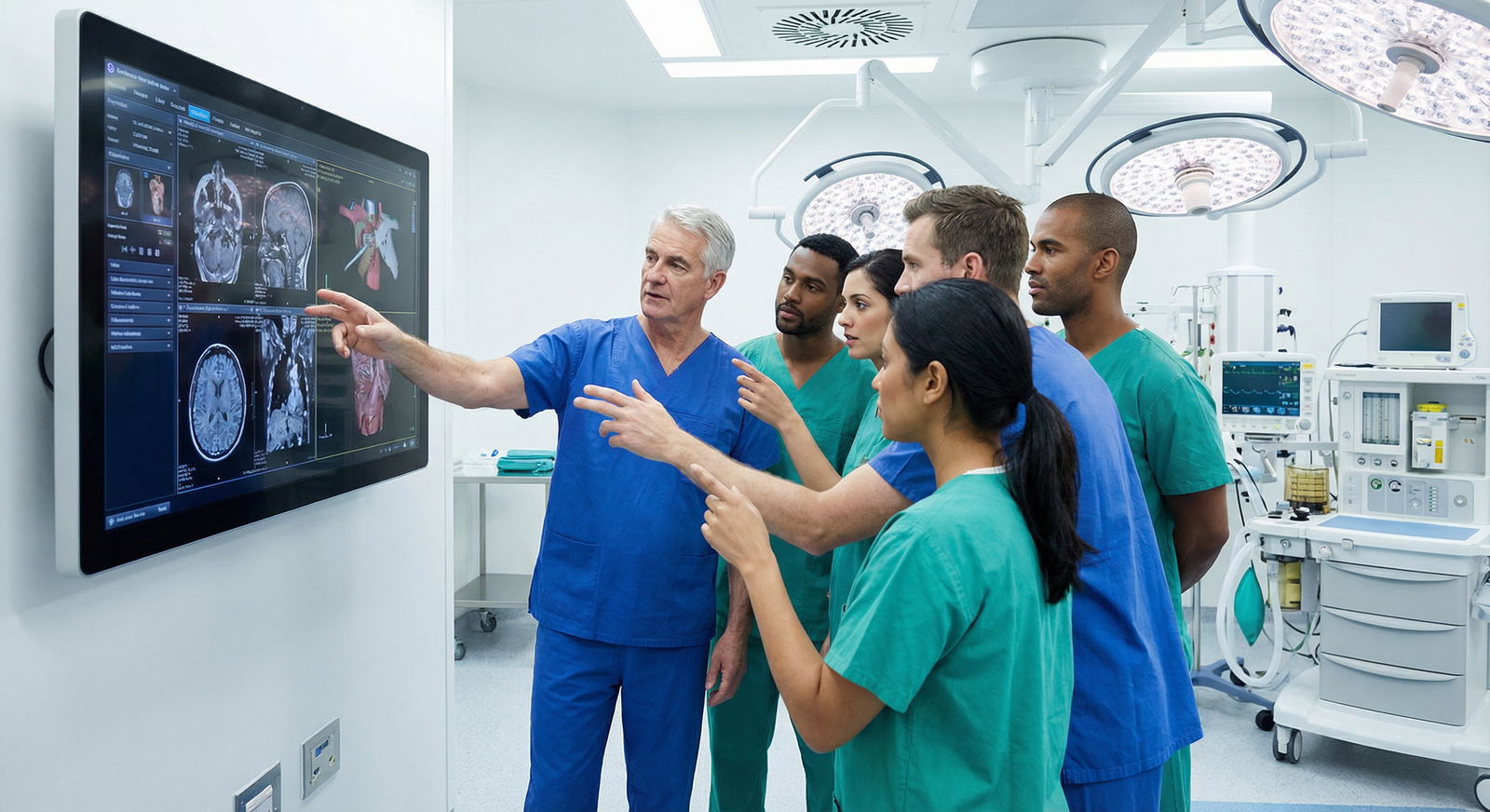
The best modalities are not mysterious. They are the ones that map onto real training needs:
- Laparoscopic box trainers for camera control, depth perception, ambidexterity, suturing
- Virtual reality laparoscopic simulators for metric-based repetition
- Robotic simulators for console familiarity, clutching, camera control, wristed motion
- Cadaver labs for anatomy, exposure, procedural sequencing, tissue planes
- Endoscopy task trainers for scope handling and orientation
- Airway and trauma simulations for acute perioperative management
- Crisis resource management scenarios for communication, leadership, escalation
- Team-based OR rehearsals for workflow and interprofessional coordination
And then there is the question applicants often forget to ask: Who teaches it?
A faculty-run curriculum is different from a resident-run one. I value resident teaching, but faculty engagement signals legitimacy. If attendings show up, watch performance, and coach residents longitudinally, that is a real investment. If simulation is dumped onto one enthusiastic chief every year, the program is coasting.
Does Simulation Quality Correlate With Residency Quality?
Usually, yes. Directly, no.
Let me break that down specifically.
Strong simulation programs often travel with other good things: protected didactic time, educational leadership, skill assessment, onboarding structure, and a culture that does not treat teaching as an afterthought. Those are meaningful correlations. A department willing to fund simulation, schedule it, staff it, and evaluate it is usually more organized than one that does not.
The cynical side is also true. Simulation can reflect institutional resources more than training quality. A wealthy academic center can build a beautiful lab and still produce residents with mediocre autonomy. I have seen exactly that. The residents were polished, articulate, and technically rehearsed. They were not actually operating independently enough.
That is why simulation is a marker. Not a verdict.
Where simulation helps most is in the transition from novice technical exposure to safer OR participation. Interns who have practiced camera navigation, intracorporeal knot tying, and instrument handling before stepping into a laparoscopic case are simply less lost. Residents who have done repeated vascular or bowel anastomosis drills often enter the OR with better motor planning. Teams that rehearse crises communicate better under pressure. None of that is theoretical. It shows up.
Simulation also matters for remediation. Good programs use it to identify and help struggling residents early. That is a quiet advantage applicants rarely appreciate. If someone is slow with tissue handling, loses orientation endoscopically, freezes during acute scenarios, or has poor economy of motion, simulation gives the program a place to intervene before the OR becomes the proving ground. That is smart training.
It also boosts confidence, which is not trivial. The resident who has already practiced the mechanics of chest tube placement, robotic docking, or laparoscopic suturing ten times walks into the real case with less cognitive overload. Confidence alone is not competence, but confidence built on repeated practice is useful.
Still, there are hard limits.
Simulation does not recreate the full mess of live surgery. Tissue quality changes. Bleeding changes everything. Attendings vary. Case flow gets disrupted. Staffing gets weird. Equipment fails. The patient is not a model, and the stress is not the same. More importantly, residency quality depends on things simulation barely touches:
- actual case numbers
- breadth of pathology
- continuity with patients
- overnight decision-making
- autonomy in operative steps
- ICU responsibility
- ward management
- attending temperament
- fellow competition
- program morale
A residency can have a good sim curriculum and still have a weak operative culture. That matters more than applicants want to admit because it is harder to measure on interview day.
What Applicants Should Actually Look For Beyond the Simulation Lab
If you are choosing a surgical residency, the simulation center should never be the main event. It is supporting evidence.
Here is what matters more.
1. Case volume
You need reps. Real reps. Ask how many major cases residents log, but do not stop there. Ask who gets those cases. A high-volume hospital means little if fellows, attendings, or senior residents absorb the best operative opportunities.
For a broader framework on evaluating programs, compare what you hear about simulation with the same program's approach to operative exposure, call structure, and teaching culture in your residency interview prep, how to rank residency programs, questions to ask surgical residents, and surgical residency program red flags resources.
2. Progressive autonomy
This is the big one. Bigger than simulation. Bigger than prestige in many cases.
Do juniors get to do real portions of cases? Do seniors run operations with supervision or just perform isolated steps after perfect exposure is handed to them? Are chiefs making intraoperative decisions, or are they forever "assisting plus"?
Programs are often slippery here. Residents usually tell the truth if you ask carefully. It can also help to compare their answers with guidance on surgical autonomy in residency, how operative independence develops, and what chief year should look like.
3. Case complexity and diversity
A technically polished curriculum means less if your operative experience is narrow. Breadth matters. Breadth by service, pathology, acuity, and approach. Community bread-and-butter cases, tertiary referrals, emergencies, minimally invasive work, open surgery, ICU exposure. You need all of it.
If you are weighing specialties with heavy MIS or robotic exposure, it also helps to review minimally invasive surgery training pathways, robotic surgery training in residency, and general surgery residency curriculum and how that field's expected case mix evolves from intern year through chief year.
4. Call burden and service design
Brutal service work can hollow out education. So can overprotected training that leaves residents underexposed to responsibility. Ask what overnight calls actually feel like. Ask whether interns are learning or merely drowning. Ask who manages floor crises, consults, trauma activations, and ICU transitions.
To put those answers in context, applicants should also compare them with guidance on surgical call schedules, resident duty hours, and night float in residency.
5. Mentorship and faculty investment
You can feel this fast. Do attendings know residents well? Is feedback routine or random? Are faculty willing to teach slowly, or do they grab the case back the moment things become inconvenient? A gorgeous simulation center cannot compensate for indifferent faculty.
This is also where speaking with current residents and recent graduates can be more useful than any formal tour or presentation. Cross-check those conversations with articles on resident mentorship, surgical residency culture, resident wellness, and faculty feedback in residency if you are comparing several programs at once.
6. Resident morale
Not fake interview-day morale. Real morale. Tired but proud is fine. Flat, guarded, and vaguely miserable is not.
If morale seems off, it is worth reviewing related signs in resident burnout, malignant residency culture, and how to evaluate residency fit.
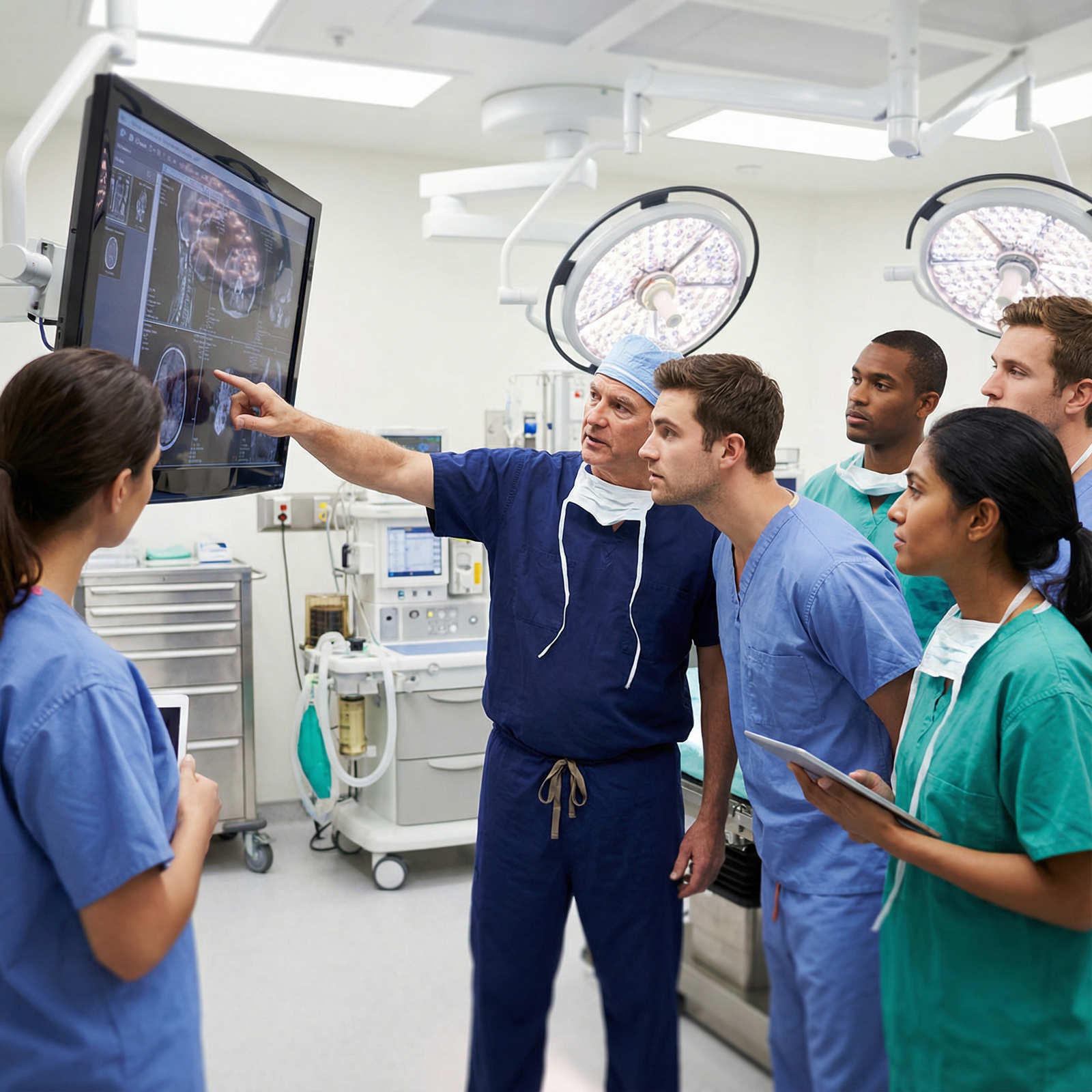
Now let me give you the sharper interview questions. These are better than "Do you have simulation?"
Ask this instead:
- How often is simulation required for each PGY year?
- Is participation protected, or is it something residents squeeze in on their own?
- Who teaches the sessions: core faculty, fellows, senior residents, sim staff?
- Are there specific technical milestones residents are expected to hit?
- How is performance measured?
- Is simulation linked to laparoscopic, endoscopic, robotic, trauma, or ICU training?
- Do residents use simulation before starting robotic cases or new procedural rotations?
- How is simulation used for remediation?
- Are team-based crises rehearsed with anesthesia and nursing, or is it siloed?
- Can residents actually access the equipment outside formal sessions?
- Has the curriculum changed based on resident feedback or outcomes?
These questions expose whether the program has substance.
And there are red flags. Very common ones.
Red flag #1: The interview tour revolves around equipment, not curriculum
If the program spends ten minutes naming devices and zero minutes explaining resident progression, they are selling the showroom.
Red flag #2: Residents say they "could use it more"
That usually means they do not use it much at all.
Red flag #3: Simulation is concentrated in intern boot camp only
Useful? Yes. Enough? Not even close.
Red flag #4: No one can explain assessment
If there are no metrics, no milestones, and no consequences, the curriculum is probably superficial.
Red flag #5: Simulation is disconnected from real OR advancement
This one is fatal. If residents simulate endlessly but still do not get graduated autonomy in live cases, the educational return is limited.
Then compare simulation against harder endpoints:
- board pass rates
- ABSITE performance trends
- fellowship placement
- chief confidence
- alumni readiness
- attrition
- resident wellness and morale
- operative logs
- faculty stability
That is the grown-up way to evaluate a program. Not by being dazzled on the tour.
How to Interpret Simulation as a Predictor: A Practical Framework for Applicants
You need a rubric. Not a vibe.
Step 1: Ask whether the simulation effort is longitudinal
One-off orientation sessions do not count for much. A curriculum that follows residents across all years carries real weight.
Step 2: Ask whether it is mandatory and protected
Required participation means the department truly values it. Optional attendance usually means it will be crowded out by service demands.
Step 3: Ask who teaches and debriefs
Core surgical faculty involvement raises the signal strength. If faculty are present, coaching, and reviewing performance, simulation is probably embedded in the culture rather than parked on the margins.
Step 4: Ask how residents are assessed
No metrics, no serious curriculum. You want benchmarks, milestone progression, and some mechanism linking performance to coaching.
Step 5: Ask whether simulation changes what happens in the OR
This is the most important final test. Does the program use simulation to prepare interns for lines, scopes, laparoscopy, trauma, robotics, or crisis management before live patient exposure? Do residents actually feel more ready? Do faculty trust them sooner? If yes, simulation has practical value. If not, it may just be educational theater.
So when should simulation be a major ranking factor?
It should matter more if:
- you are entering a technically demanding field with significant minimally invasive or robotic work
- you value structured coaching
- you learn best through repetition and feedback
- you want a program with strong onboarding and remediation systems
- you are deciding between otherwise similar programs
It should matter less if:
- the curriculum is optional and poorly defined
- the program has weak operative autonomy
- case volume is thin
- fellow competition is severe
- residents seem overworked and undercoached
- the sim center exists mostly for branding
My position is straightforward: treat simulation as a high-quality secondary signal, not a primary determinant. If two programs have similar volume, morale, autonomy, mentorship, and outcomes, the stronger simulation curriculum can absolutely be a tiebreaker. A good one may even tilt the scale meaningfully. But if a flashy sim center is trying to distract you from weak resident autonomy or poor service design, do not fall for it.
That trick is old.
Action steps for applicants
Use this checklist on interview day and while building your rank list:
Score simulation structure, not appearance. Give points for required participation, faculty involvement, assessment, progression, and OR integration.
Ask residents whether simulation changes real case readiness. If they hesitate, the answer is probably no.
Prioritize autonomy and case experience over facility glamour. You are training to operate on patients, not on expensive plastic.
Look for educational consistency. Strong simulation plus strong operative teaching plus good mentorship is the combination you want.
Watch for mismatch. A polished curriculum sitting inside a chaotic, low-autonomy residency is a warning sign.
Use a multi-factor rubric. Include case volume, autonomy, complexity, culture, fellowship competition, mentorship, board outcomes, and simulation.
The bottom line is simple. A strong simulation curriculum is a real asset and a meaningful positive signal. But the best predictor is not the presence of simulation equipment. It is whether simulation is embedded in a structured, faculty-led, competency-based training system that clearly feeds into live operative performance.
That is the difference between education and marketing. And yes, you should judge programs by it.