What if most of what you think matters for choosing a surgical residency… actually doesn’t?
Let’s go straight at the sacred cows. Surgery applicants trade myths like currency: “You must do research.” “You’ll never see your family.” “Only top-10 programs match into competitive fellowships.” I hear these every single cycle, and they’re mostly wrong—or at least badly distorted.
Here’s what the data, program outcomes, and real-world training patterns actually show.
Myth #1: “The most prestigious program is always the best choice.”
This is the classic trap: equating name recognition with good training.
Yes, reputation matters. But it doesn’t always correlate with what you care about: operative experience, mentorship, fellowship placement in your interest, or actually being treated like a human.
Here’s the problem: “Prestige” in surgery often reflects:
- Old research clout
- Historical names on the letterhead
- NIH funding numbers
Not necessarily case logs, autonomy, or resident outcomes.
Look at ABS case logs and fellowship match lists and you’ll see something uncomfortable: mid-tier, non-brand-name programs quietly producing technically excellent surgeons who match into top fellowships every year.
| Factor | Big-Name Program | Solid Regional Program |
|---|---|---|
| NIH Funding | Very High | Low–Moderate |
| Reputation (USNWR) | Top 10 | Unranked / Lower tier |
| Complex Case Exposure | Often High | Varies but can be strong |
| Fellowship Matches | Nationally competitive | Nationally competitive |
I’ve seen residents from “no-name” state programs match:
- Surgical oncology at MD Anderson
- MIS/foregut at major academic institutions
- CT at big quaternary centers
Because they had strong letters from surgeons who knew them well, solid case numbers, and active mentorship—not because their badge logo glowed.
If you choose prestige over fit, you can absolutely end up at a big-name place where:
- You compete with fellows for every good case
- You’re one of 30 categorical residents, semi-anonymous
- The culture is malignant but “that’s how we’ve always done it”
You can’t flex prestige at 2 a.m. on trauma call. You need support, systems that work, and attendings who’ll back you when things get messy.
What actually matters more than prestige:
- Case volume and diversity (trauma, onc, emergent, elective)
- Resident autonomy and graduated responsibility
- Fellowship match in your specific interests
- Culture: how they handle complications, feedback, wellness
- How current residents talk when the PD is not in the room
Myth #2: “You have to be in a big city academic center to get top-tier training.”
This one survives because applicants rarely look beyond the coasts and major metros.
Academic does not automatically mean:
- Better teaching
- Better operative experience
- Better fellowship opportunities
Some of the most surgically competent grads I’ve seen came from “regional workhorses” or hybrid programs: not ivory-tower research machines, but busy clinical centers with:
- High-volume trauma
- Bread-and-butter general surgery
- Plenty of emergency cases at 2 a.m. when fellows are not around
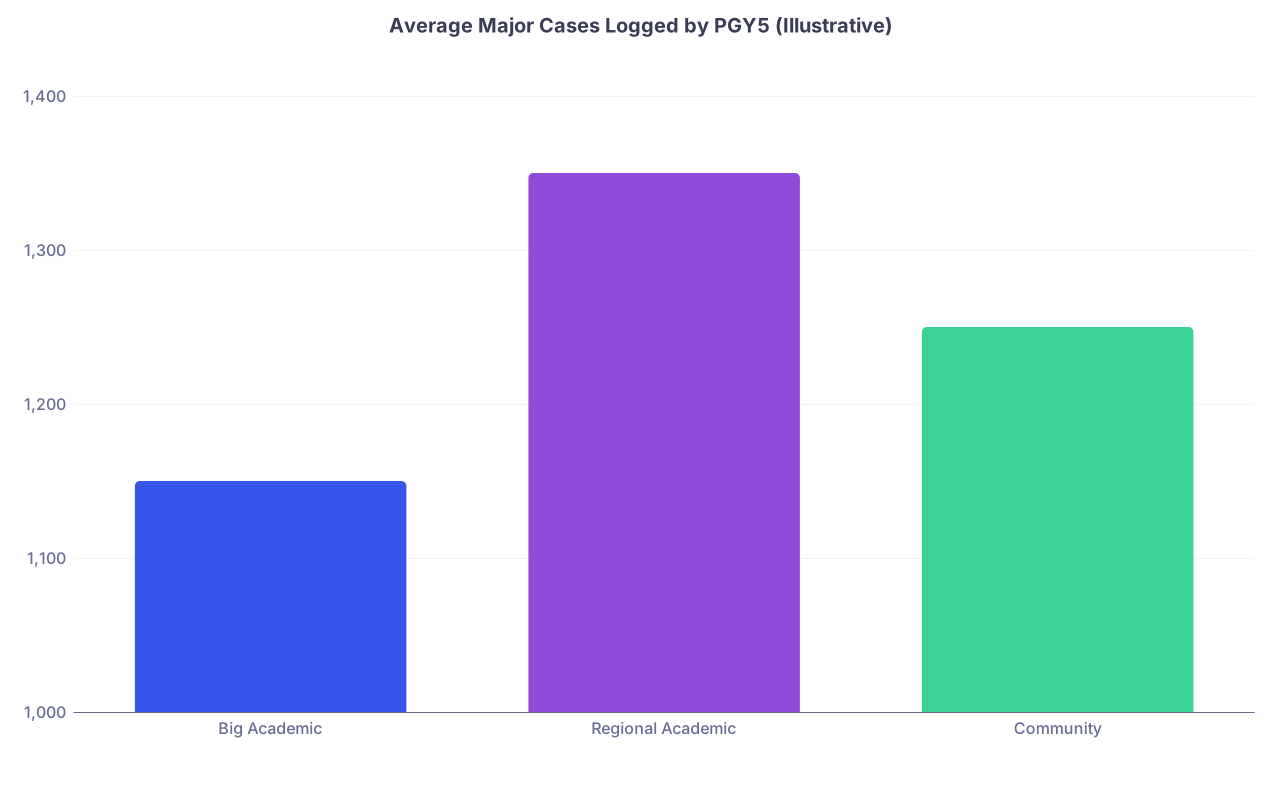
| Category | Value |
|---|---|
| Big Academic | 1150 |
| Regional Academic | 1350 |
| Community | 1250 |
These numbers are illustrative, but they track with what you often see when you actually compare logs: busy non-elite programs can exceed some famous departments on raw operative volume and autonomy.
Where big academic centers often win:
- Niche complex cases (HIPEC, transplant, complex onc)
- Built-in research infrastructure
- Name recognition for very academic fellowships
Where smaller or regional centers often win:
- Earlier and more consistent primary surgeon time
- Less competition from armies of subspecialty fellows
- More “real world” general surgery experience
If your end goal is community general surgery, a massive ultra-subspecialized quaternary center can actually be a mismatch.
Myth #3: “More research automatically equals a better surgical residency.”
Applicants love tallying PubMed hits like Pokémon cards. Programs love to brag about total publications.
But there’s a difference between:
- A research requirement that’s supported, mentored, protected
- A research burden that’s dumped on you with no real guidance
High research output programs often have big-name PIs, T32 grants, mandatory research years. That’s good if you want to be:
- Academic surgeon-scientist
- Future division chief/program director
- Deeply involved in trials or outcomes research
It is not automatically good for everyone.
An “R1” heavy program that forces everyone into two full years of research can be painful if you:
- Hate research
- Just want to be a high-volume clinician
- Lose operative momentum and have a rough re-entry to the OR
The flip side: programs with some research expectation, integrated into residency, with reasonable QI or outcomes projects and decent mentorship, often get you enough scholarly activity for competitive fellowships without consuming two extra years of your life.
What you should ask on interviews:
- How many residents actually publish?
- How many have to leave for 1–2 years vs. integrated time?
- Who mentors projects—real faculty or “figure it out yourself”?
- Are projects resident-driven, or just data grunt work for someone else’s name?
More research is not inherently better. Targeted, mentored, and aligned with your goals is better.
Myth #4: “Community programs are for people who couldn’t match academically.”
This one’s wrong and a bit insulting.
There are three types of “community” in conversation:
- True community programs with no med school or academic affiliation.
- Community-based programs with academic ties and fellowships.
- Hybrid programs that call themselves “community” but function like regional academic hubs.
Category 2 and 3 often:
- Have robust fellowship matches (MIS, breast, vascular, critical care)
- Send people into academic careers
- Provide earlier operative autonomy because there are fewer fellows blocking cases
I’ve seen residents from so-called “community” programs:
- Become chairs of academic departments
- Match into surgical oncology, HPB, CT
- Go into QI leadership roles at large systems
What matters: graduates’ careers, not the label. Look at the last 5–10 years of alumni outcomes. Not the marketing slide.
Myth #5: “I’ll have no life in a surgical residency. It’s basically signing away my 20s.”
This myth survives because there are programs that chew residents up. But it’s not universally true anymore, and pretending it is just signals you haven’t looked at actual duty-hour and schedule data.
Yes, general surgery is demanding. You will miss holidays. You’ll be tired. Random Tuesday plans will die regularly.
But we also have:
- 80-hour work week rules (imperfectly followed, but far better than pre-2003)
- Required days off
- Increasing attention to burnout, depression, and attrition
- Real program citations if they abuse residents consistently
The spread is big. Some programs are at 60–70 hours most weeks, others riding the edge of 80 constantly. You need to ask blunt questions:
- “What does a bad week look like? A normal week?”
- “How often are you actually logging 80?”
- “How many residents have left in the last 5 years, and why?”
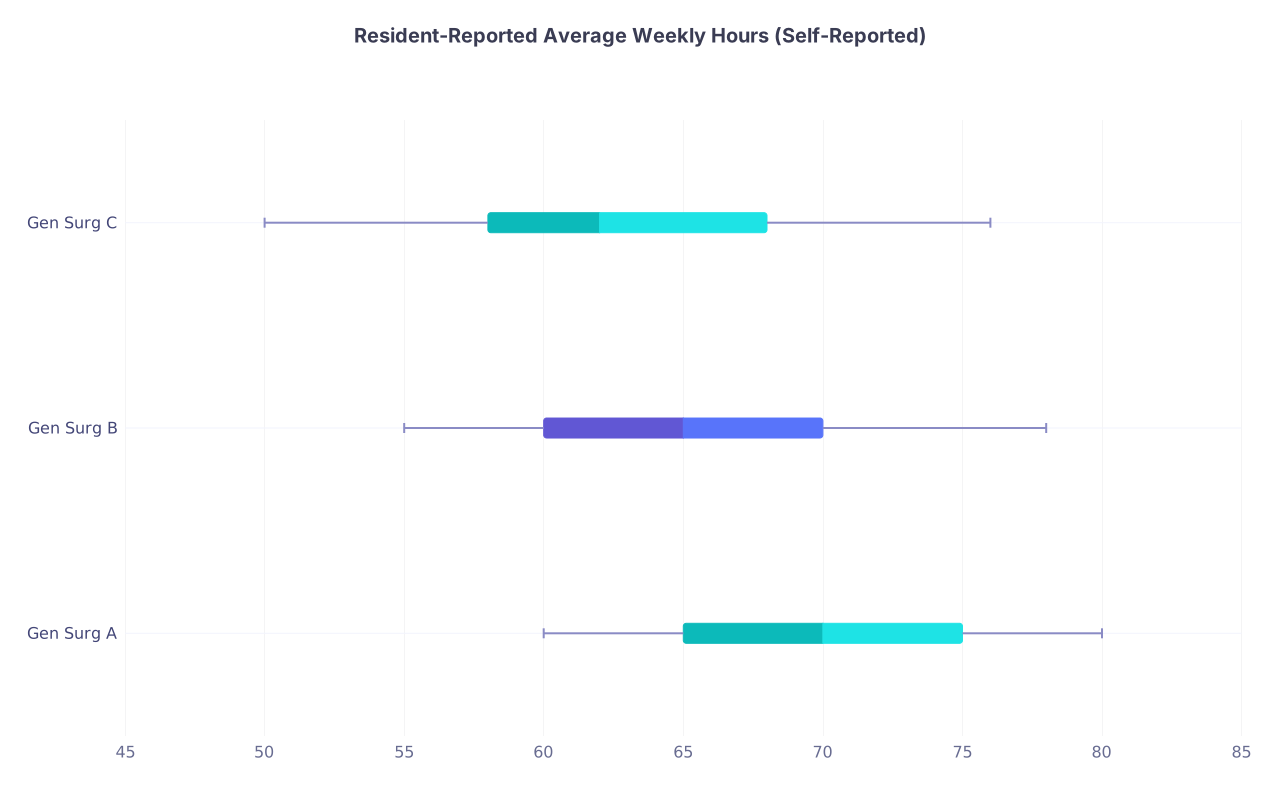
| Category | Min | Q1 | Median | Q3 | Max |
|---|---|---|---|---|---|
| Gen Surg A | 60 | 65 | 70 | 75 | 80 |
| Gen Surg B | 55 | 60 | 65 | 70 | 78 |
| Gen Surg C | 50 | 58 | 62 | 68 | 76 |
The idea that “you have zero life” is lazy. The better statement is: “You must be intentional and protective of your non-work life.” People do:
- Get married
- Have kids
- Train for marathons
- Maintain hobbies
But they choose programs where that’s actually possible, and they learn to say no.
Myth #6: “High case volume is all that matters.”
Applicants love hearing “we are the busiest trauma center in the region” or “our residents graduate with 1400+ cases.”
Volume does matter. You can’t become a good surgeon if you rarely operate.
But above a certain threshold, raw numbers have diminishing returns. Ten appys look different from one hundred liver resections. The mix and level of responsibility matter more than brag-worthy totals.
High volume can also hide problems:
- You’re retracting in 80% of cases while fellows operate.
- You’re double- or triple-scrubbed constantly, never primary.
- You log the case but weren’t meaningfully operating.
Look for:
- Resident role in complex cases by PGY level
- Ownership of cases on chief year (especially bread-and-butter)
- Balanced exposure: colorectal, HPB, breast, endocrine, foregut, hernia, trauma, ICU
Case logs plus narrative from residents is where the truth lives. Numbers alone lie easily.
Myth #7: “You must match a ‘top’ program to get a competitive fellowship.”
Fellowship match anxiety is probably the most recurrent nonsense I hear.
Reality: fellowship directors care about:
- Letters from people they trust
- Your operative skill and judgment
- Your work ethic and reputation
- Some pattern of academic productivity (varies by subspecialty)
Where you trained matters, but not only at the “elite” level. Being the top or near-top resident at a strong but unglamorous program can beat being middle-of-the-pack at a powerhouse where nobody really knows you.
I’ve watched GI/MIS, surg onc, and CT programs rank high on residents who:
- Were clearly technically excellent (backed by their attendings’ letters)
- Showed longitudinal interest in the subspecialty (electives, projects)
- Had strong interviews and realistic career plans
Not just who had “Harvard” on their CV.
If you want a niche micro-specialty in an ultra-academic setting, yes, name-brand helps. For the majority of fellowships, being a standout in a solid program is enough.
Myth #8: “Program culture is just soft stuff; I’ll adapt.”
This is how people end up miserable.
Culture is not soft. It drives:
- How complications are handled (teaching vs. shaming)
- Whether you can admit fatigue or struggle without being labeled weak
- How much support you get when life blows up (illness, death in family, pregnancy)
Toxic surgical culture still exists in pockets: yelling in the OR, punishment paging, “you’re lucky to be here” attitudes. Some places hide this on interview day. Residents will hint at it if you pay attention.
Red flags:
- Residents unable to freely talk with you without staff hovering
- Lots of nervous laughter, “we work hard but we’re like a family” with no details
- High attrition rates or vague answers when you ask about it
You will adapt, sure. Or you will burn out, numb out, or leave.
If two programs are similar on paper, pick the one where PGY-2s and PGY-3s look tired but not dead inside.
Myth #9: “If I’m not 100% sure I love surgery, I shouldn’t rank it.”
This one pushes people into analysis paralysis.
No, you don’t need 100% certainty. You need:
- Enough exposure to know you don’t hate the OR
- Some tolerance for bodily fluids, chaos, and night work
- Actual enjoyment of solving problems with your hands, not just the idea of it
Every year, I hear some version of: “Everyone else seems so sure; maybe I’m not cut out for surgery.” Then I meet residents who were 70% sure, took the plunge, and grew into genuinely excellent and happy surgeons.
On the flip side, I’ve seen gung-ho “I was born for surgery” types crash and burn when the real lifestyle and stress hit.
You’re choosing a trajectory, not a forever prison sentence. People:
- Switch into surgical subspecialties
- Switch out to anesthesia, radiology, EM, even psych
- Finish surgery and practice part-time or in niche roles
Be brutally honest about what parts of surgery you actually like: the anatomy? Team dynamic? Procedures? The ego? Then pick programs where the day-to-day aligns with that, not with your Instagram image of being a surgeon.
Myth #10: “Once I match, the hard part is over.”
No. Matching is just the entry ticket.
The hard parts change:
- Going from being a polished MS4 to an intern who knows nothing
- Being constantly evaluated by staff, nurses, co-residents
- Owning complications that keep you up at night for months
But here’s the flip: the hard parts become more meaningful.
Most residents, by PGY-3 or so, will say some version of, “I’m exhausted, but I can’t imagine doing anything else.” They’re actually helping people in concrete ways. They can walk into a crashing patient’s room and do something.
Your job now—before you rank—is not to find the program that makes life easy. It’s to find the program where the hard parts are:
- Sustainable
- Supported
- Aligned with the kind of surgeon you want to become
Quick Comparison: What Applicants Overvalue vs What Actually Matters
| Applicants Overvalue | Underappreciated But Critical |
|---|---|
| Name recognition / prestige | Resident autonomy and trust |
| NIH dollars and publications | Culture around complications and errors |
| “Busiest trauma center” claims | Actual chief case mix and responsibility |
| Fancy new hospital buildings | OR efficiency and staff relationships |
| Mandatory research years | Quality of mentorship and feedback |
FAQs
1. Should I avoid any program that has fellows?
No. Fellows are not automatically your enemy. They can be fantastic teachers and advocates. The problem is unbalanced services where fellows take every meaningful case and residents just retract. Ask residents specific questions: “On HPB cases, who usually operates? By PGY-4, how often are you primary on major cases?” The answers matter more than whether the program has fellowships on the brochure.
2. Is it a bad sign if a program has had residents leave or be dismissed?
Not automatically. Zero attrition over a decade can actually be suspicious or just a sign of low expectations. What you want to know is why people left and how the program responded. If multiple residents left for the same reason (malignant culture, constant 90+ hour weeks) and nothing changed, that’s a red flag. One or two departures over years for personal or honest performance issues is normal.
3. How many programs should I rank for general surgery to be “safe”?
Data from NRMP shows that for US MD seniors, ranking ~10–12 categorical programs gives a very high match probability; DO and IMG applicants usually need more. But “safe” is the wrong frame. You should rank every program where you’d be willing to train for 5+ years and realistically be happy enough to grow. Padding your list with programs you’d secretly hate is how you end up both matched and miserable.
Key points to walk away with:
- Prestige, research volume, and “busiest center” claims are wildly overrated compared with culture, autonomy, and fellowship outcomes in your area of interest.
- There are excellent surgeons coming out of non-name, regional, and community-based programs every single year; don’t confuse branding with training.
- Your job is not to chase the shiniest name—it’s to pick the place where you can become a competent, supported, and sustainable surgeon, not just a burned-out one with a fancy hospital badge.