The wrong way to choose between orthopedic surgery and general surgery is to ask, “Which is better?” The only useful question is: “Which one is better for the life I actually want 10–20 years from now?”
Let me give you a straight answer up front:
- If your long‑term goals center on procedural intensity, MSK-focused practice, higher average compensation, and a more predictable, elective-heavy lifestyle in private practice, orthopedic surgery usually wins.
- If your long‑term goals center on clinical breadth, leadership in hospital systems, flexibility to pivot into subspecialties (surgical oncology, trauma, critical care, colorectal, transplant, HPB), global surgery, or academic roles that are not narrowly MSK, general surgery usually wins.
Everything else is details. So let’s get into those details.
1. Start With Your 15‑Year Vision, Not Your Step Score
You’re probably tempted to ask: which is more competitive, which pays more, which has a better lifestyle? Those matter, but they’re secondary. First, force yourself to answer some brutally specific questions about your future:
Where do you picture yourself at 45?
- Running a high-volume elective practice doing joint replacements or sports procedures, clinic four days a week, OR two to three days, minimal nights?
- Or being the “surgeon of surgeons” at a tertiary center, handling complex abdomens, oncologic resections, emergencies, leading an ICU or an ACS service?
What kind of patients and pathology actually fascinate you?
- Bones, joints, tendons, hardware, biomechanics? Watching patients go from crutches to running again?
- Or the whole abdominal cavity, thoracic inlet to pelvis, GI tract, biliary system, endocrine, soft tissue tumors, breast, trauma?
How much do you want to subspecialize?
- Orthopedics is inherently specialized: everything is MSK. You’ll then further subspecialize (sports, adult recon, spine, hand, foot/ankle, trauma, pediatrics, oncology).
- General surgery can stay broad or become highly subspecialized (HPB, MIS/bariatrics, colorectal, breast, transplant, CT via integrated or fellowship, trauma/critical care).
Finally: how do you handle chaos vs control?
- If you crave controlled elective cases, clear anatomy, reproducible techniques, and can tolerate some heavy trauma rotations early on, ortho leans your way.
- If you actually like the adrenaline of “what rolls through the door,” the Swiss-army-knife feel of being able to operate head-to-toe (within reason), and you do not mind messy abdomens at 3 a.m., general is your arena.
If you do not have at least rough answers to those, you’re not ready to decide. But let me help you sharpen the comparison.
2. Training Pathway and Competitiveness
Here’s the simple reality: orthopedic surgery is generally more competitive to match into than categorical general surgery, especially at strong academic programs.
| Factor | Orthopedic Surgery | General Surgery |
|---|---|---|
| Residency Length | 5 years | 5 years (often 6 with research) |
| Competitiveness | Higher | Moderate-High |
| Board Focus | MSK only | Abdomen, breast, soft tissue, etc. |
| Fellowship Rate | Very high | Very high |
Most orthopedics residents now do fellowships. Most general surgeons also do fellowships. So the “I’ll be done in 5 years and work as a generalist” fantasy is fading in both fields.
If your long‑term goal is being done with training as fast as humanly possible, neither is truly short. You’re realistically looking at 6–7 years minimum in both tracks if you factor in common fellowships:
- Ortho: 5-year residency + 1-year fellowship (sports, joints, trauma, hand, etc.)
- General: 5-year residency + 1–2-year fellowship (MIS, colorectal, HPB, surgical oncology, trauma/critical care, breast, transplant, etc.)
So do not pick one thinking you’re “saving years.” That difference is negligible. Focus instead on what you will actually be operating on for 30 years.
3. What Your Day‑to‑Day Career Actually Looks Like
This is where the specialties really diverge.
Orthopedic surgery: narrow but deep
In practice, orthopedic surgeons:
- See a lot of degenerative joint disease, fractures, sports injuries, tendon/ligament problems.
- Operate in relatively clean fields, mostly on bones, joints, and soft tissue around them.
- Do a mix of clinic and OR that’s fairly predictable in many private settings.
- Often have a significant elective case load (joints, sports) plus some trauma depending on their call responsibilities.
They tend to build procedure-heavy, high-RVU practices. Lots of mechanical problem → mechanical solution. You fix it, patients see a tangible gain.
If your long-term goal is:
- High-volume elective practice
- Clear, “fixable” problems
- Patients who are often otherwise healthy aside from their MSK issue
- A business-friendly environment (ASC ownership, partnerships, etc.)
Then orthopedics maps well to that picture.
General surgery: broad, systemic, often sicker
General surgeons:
- Manage the GI tract, abdominal wall, biliary, some endocrine, breast, soft tissue masses, some vascular exposure, trauma.
- See more systemically ill patients: sepsis, bowel ischemia, perforations, complex oncologic disease.
- Work more hand-in-hand with intensivists, hospitalists, GI, oncology, radiology.
- Face more unplanned/emergent cases: appendicitis, cholecystitis, perforation, SBO, hernia with strangulation, etc.
If your long-term goal is:
- Being clinically broad and indispensable at a community or regional center
- Doing meaningful oncology work (HPB, colorectal, surgical oncology)
- Having the option to lead trauma/ACS/ICU services
- Being heavily involved with multidisciplinary decision making
Then general surgery fits better.
4. Lifestyle, Call, and Burnout Trajectories
Let’s be blunt. Residency for both is rough. The difference is not intern year; the difference shows up 10 years out.
Training years
In residency:
- Both ortho and general surgery have long hours, heavy call, and serious physical/mental fatigue.
- Ortho has more physically demanding OR days (lead, large retractors, long joint or spine cases).
- General has more night float, emergent belly cases, and ICU time.
During training, lifestyle is bad enough in both that it shouldn’t be your deciding factor. Look at the attending life.
Attending practice
In broad strokes:
- Ortho attendings in private practice with elective-heavy subspecialties (sports, joints, hand) often achieve a relatively predictable schedule: full clinic days, scheduled blocks, fewer middle-of-the-night cases outside of trauma call.
- General surgery attendings in many settings shoulder more unplanned emergency call. Nighttime bowel obstructions, perforations, septic cholecystitis—this stuff does not book itself at 9 a.m.
But there’s nuance:
- An orthopedic trauma surgeon at a Level I center may have a more chaotic lifestyle than a general surgeon who does mostly elective hernias and gallbladders in a community hospital.
- A general surgeon focusing on breast or elective MIS/hernia can design a very civilized schedule, especially in private practice.
The average trajectory, though, looks like this:
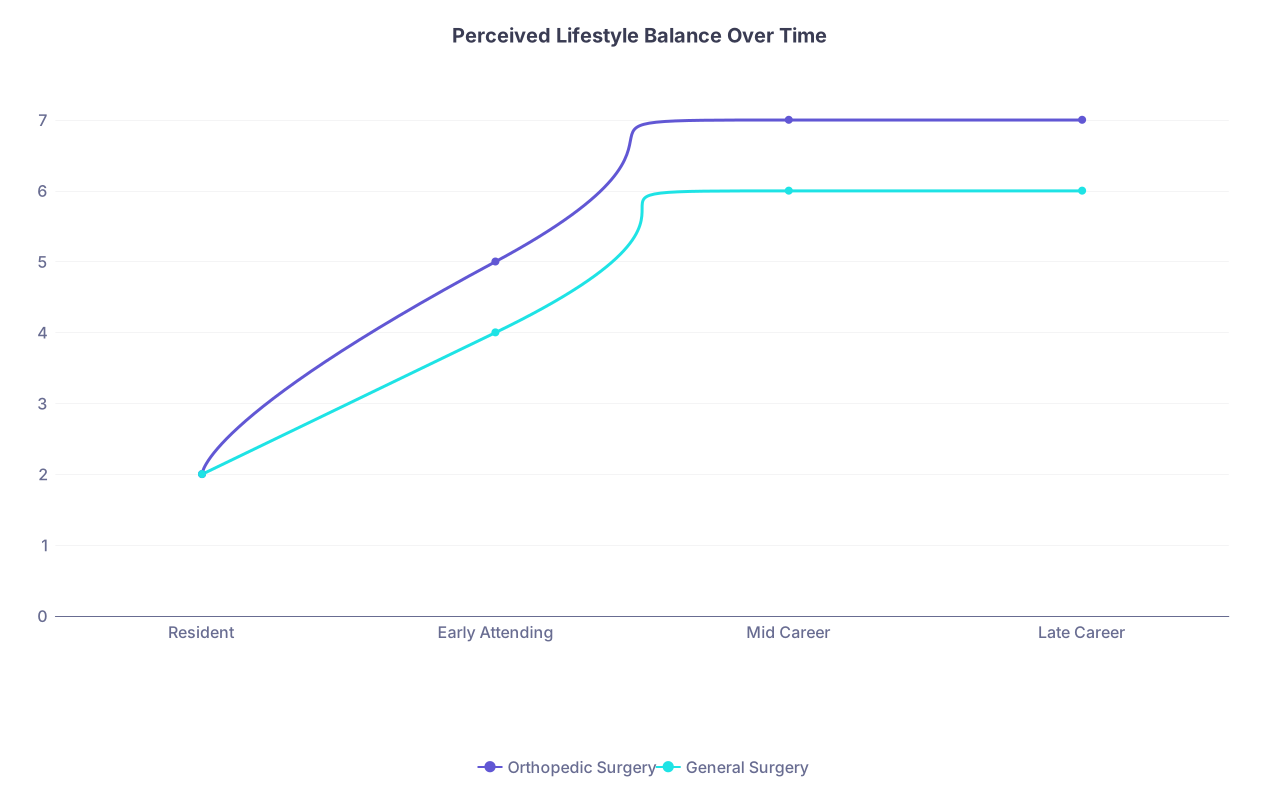
| Category | Orthopedic Surgery | General Surgery |
|---|---|---|
| Resident | 2 | 2 |
| Early Attending | 5 | 4 |
| Mid Career | 7 | 6 |
| Late Career | 7 | 6 |
(Scale 1–10, higher = better lifestyle. This is illustrative, but it matches what many surgeons report anecdotally.)
If your long-term goal is to protect evenings and weekends as much as possible, and you’re willing to aim for an elective-heavy subspecialty, orthopedics is usually the better bet.
5. Money, Job Market, and Practice Models
Ignore anyone who says compensation shouldn’t factor in. It absolutely does. You’re trading a decade of your life in training.
Compensation
On average, orthopedics is one of the top-paying specialties in medicine. General surgery is well compensated but not in the same league, unless you carve out very high-demand niches.
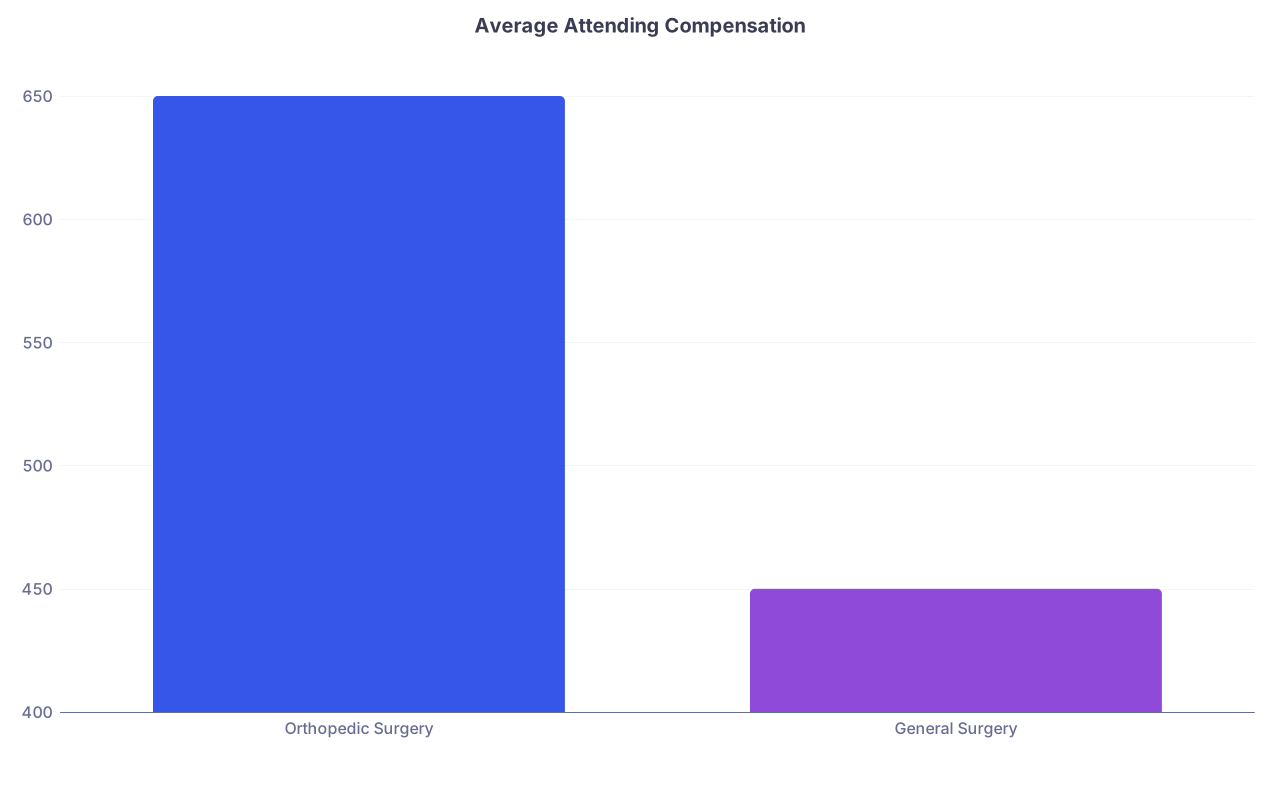
| Category | Value |
|---|---|
| Orthopedic Surgery | 650 |
| General Surgery | 450 |
(Approximate U.S. averages in thousands; your mileage will vary by region, setting, subspecialty.)
If long-term financial goals—early mortgage payoff, significant investment capacity, kids’ college funds—are a major priority, orthopedics offers more raw potential.
Job market and flexibility
Orthopedics:
- Strong demand, especially in community and suburban markets.
- Many options for working in large private groups, hospital-employed roles, and ASCs.
- You are more locked into MSK-only work. Great if you love it, problematic if you ever burn out on joints and fractures.
General surgery:
- Extremely flexible in where you can work: rural, global, academic, community. Almost every hospital needs general surgeons.
- You can reinvent your practice through fellowship or focus: acute care only, elective MIS, breast, colorectal, HPB, bariatrics, etc.
- You can more easily pivot into administrative and leadership roles in hospitals and health systems, because your scope touches so many services.
From a job security and flexibility standpoint, general surgery arguably wins. You may not hit peak orthopedic salaries, but you’ll rarely be unemployable if you’re competent and not difficult to work with.
6. Personality Fit and What You Actually Enjoy in the OR
Here’s where people make their worst mistakes: they ignore what they actually like doing on rotation because they’re dazzled by salary charts.
Think about concrete moments:
- On your ortho rotation, did you genuinely enjoy reaming canals, placing screws, aligning fractures under fluoro, watching someone walk better after a total knee? Or were you just tolerating it because “ortho is competitive and prestigious”?
- On general surgery, did you like the complexity of an open colectomy, the decision-making of whether to resect or divert, the satisfaction of running a busy general/trauma service?
Orthopedic surgery tends to attract:
- People who like mechanical problem-solving, sports, MSK anatomy, and highly reproducible procedures.
- Those who don’t mind repetitive but high-skill work (e.g., many joints that are similar but technically demanding).
- People comfortable in a somewhat “bro‑y” culture at some programs (not universal, but common enough that you should be honest with yourself about fit).
General surgery tends to attract:
- People who like complex physiology, ICU-level decision-making, and a wide range of pathologies.
- Those who enjoy running big services, leading teams, and don’t mind messy, unpredictable cases.
- People who can tolerate high acuity and sicker patients, not just focused elective cases.
If your long-term goal includes never dreading the OR, pay close attention to which cases make you lose track of time in a good way.
7. Decision Framework: Which One Aligns With Your Long-Term Goals?
Let’s put this into a simple decision flow. If you answer “yes” to most in a column, that field is probably closer to your long-term goals.

| Step | Description |
|---|---|
| Step 1 | Start |
| Step 2 | Lean Orthopedic Surgery |
| Step 3 | Reevaluate surgical careers |
| Step 4 | Lean General Surgery |
| Step 5 | Love MSK and biomechanics? |
| Step 6 | Prefer elective, reproducible procedures? |
| Step 7 | Enjoy broad abdominal and soft tissue cases? |
| Step 8 | Interested in ICU, trauma, oncology? |
To sharpen it further, ask yourself:
Orthopedic surgery may be better for your long-term goals if you:
- Light up around MSK medicine, sports injuries, fractures, joint disease.
- Want high earning potential and are okay with being very specialized.
- Prefer mostly elective work in the long run, with some trauma.
- Do not need to manage broad critical care or abdominal catastrophes for your whole career.
General surgery may be better for your long-term goals if you:
- Enjoy thinking through complex abdominal and systemic disease.
- Want the option to do surgical oncology, HPB, colorectal, trauma/ICU, MIS, bariatrics, or breast.
- Value flexibility—being employable and able to pivot practice focus over decades.
- Are okay with a career that likely includes more emergency work and sicker patients.
8. Concrete Next Steps to Decide
Do not decide between orthopedics and general surgery from behind a laptop. You will get it wrong. Here’s a practical short list.

| Category | Value |
|---|---|
| Formal rotations | 8 |
| Shadowing days | 4 |
| Informational interviews | 4 |
| Self-reflection sessions | 4 |
These are weeks or discrete half-days, not years. You can do this.
Here’s what to actually do:
Re-review your clerkship notes and memories.
Which days left you tired but satisfied? Which cases did you talk about on the phone with friends afterward?Book at least one more focused experience in each field.
An away rotation, a sub‑I, or an extra elective week. But be deliberate: one in a high-volume community general surgery service, one in a busy ortho service (ideally with both trauma and elective).Have 3 brutally honest conversations in each specialty.
Talk to:- One resident.
- One early-career attending (< 5 years out).
- One mid/late-career attending (10+ years out).
Ask the same questions: - “If you were starting over, would you choose this again?”
- “What sucks about your job that students don’t see?”
- “What do you like more now than you expected?”
Map your values explicitly.
Write down your top 5 long-term priorities: e.g., “high income,” “academic leadership,” “elective OR days,” “oncology work,” “rural/global flexibility,” “less night call after 45,” etc. Rank them. Then score each specialty 1–10 on each value.It might look like this:
Sample Personal Values Scoring Value / Priority Orthopedic Surgery (1–10) General Surgery (1–10) High long-term income 9 7 Broad clinical scope 3 9 Elective case dominance 8 5 Oncology opportunities 2 9 Flexibility to pivot 4 9 Your numbers will differ. The exercise is what matters.
Be honest about competitiveness.
If you are sitting on a marginal application for orthopedics (low Step, few ortho letters, minimal research), ask yourself: are you willing to do a research year or prelim spot to chase it? If not, that’s data. Do not pick a field you’re not willing to struggle for.
9. So, Which Is “Better” For Long-Term Goals?
Here’s my unapologetic take.
If your long-term goals are primarily:
- High, stable compensation
- Procedural work that is highly technical, fairly reproducible
- Patients mainly with localized mechanical problems
- A realistic shot at carving out a lifestyle with more control and elective work
Then orthopedic surgery is usually the better fit—if you genuinely enjoy MSK and are competitive for it.
If your long-term goals are primarily:
- Broad clinical and operative scope
- Intellectual engagement with complex, system-wide disease processes
- Multiple, very different fellowship options
- Flexibility to work anywhere and pivot over time
- Impact in trauma, oncology, critical care, and hospital leadership
Then general surgery is usually the better fit—if you can accept more chronic exposure to emergencies and sicker patients.
The trap is choosing orthopedics for the money or the brand while secretly loving belly cases… or choosing general surgery because “ortho is too bro-y,” while actually getting bored on non-MSK services.
Your next move is simple: schedule one concrete ortho experience and one general surgery experience in the next 30 days—clinic or OR, not just conferences. Then sit down that night and write one page comparing how each day made you feel.
Do that twice, and the “Is ortho or general better for my long-term goals?” question will get a lot less abstract and a lot more obvious.