
The wrong time to decide your surgical future is at 3 a.m. after a malignant call night. Or right after a sexy HPB case with the rock-star attending. Yet that’s when most interns feel like deciding.
You need a timeline, not a mood swing.
Here’s how your entire PGY-1 year in general surgery should look if you’re trying to answer two big questions:
- Do I want a surgical fellowship (and which one)?
- Do I stay in surgery at all, or switch fields?
We’re going month by month, then tightening down to specific weeks and critical decision points.
Big Picture: The PGY-1 Decision Arc
By the end of PGY-1 you should have:
- A clear lean: stick with general surgery, aim for a specific fellowship, or plan to switch fields.
- A realistic CV plan: research, mentors, and steps needed for competitive fellowships.
- An exit strategy, if needed: timing, contacts, and a narrative that doesn’t burn bridges.
Here’s the high-level timeline you’re actually living:
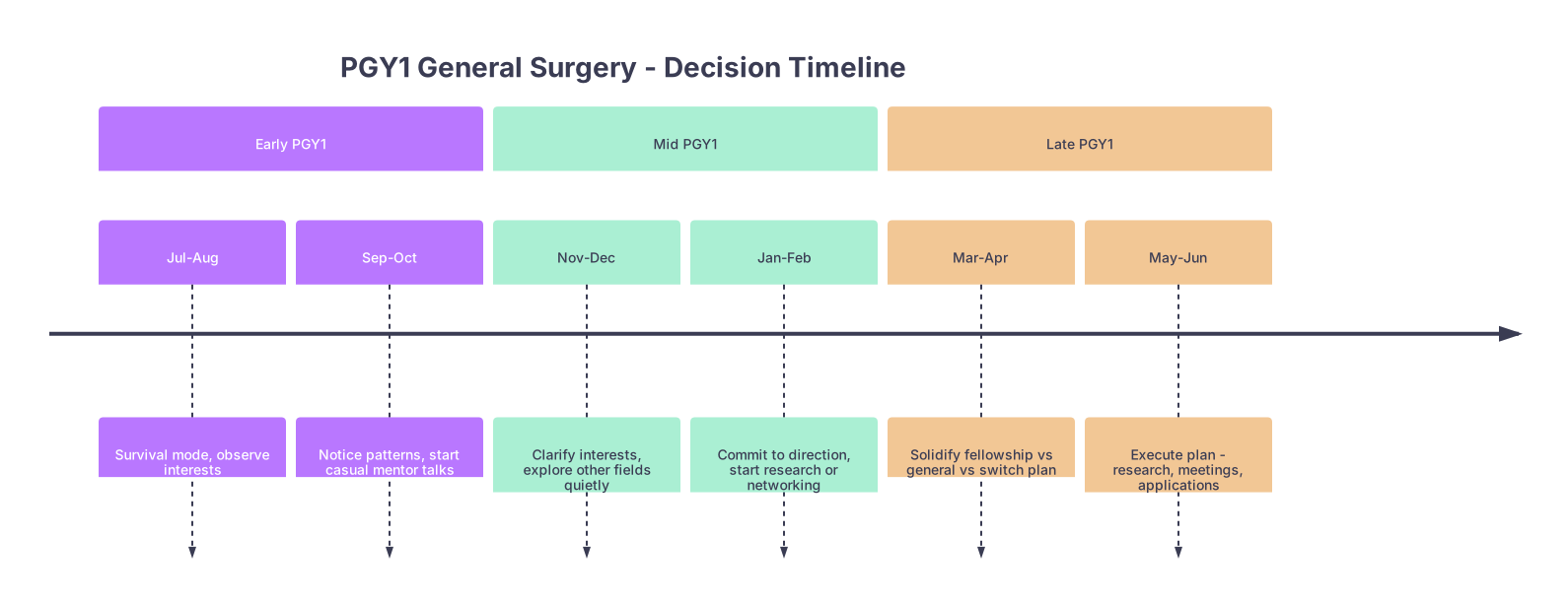
| Period | Event |
|---|---|
| Early PGY1 - Jul-Aug | Survival mode, observe interests |
| Early PGY1 - Sep-Oct | Notice patterns, start casual mentor talks |
| Mid PGY1 - Nov-Dec | Clarify interests, explore other fields quietly |
| Mid PGY1 - Jan-Feb | Commit to direction, start research or networking |
| Late PGY1 - Mar-Apr | Solidify fellowship vs general vs switch plan |
| Late PGY1 - May-Jun | Execute plan - research, meetings, applications |
Keep that mental map. Now let’s walk it properly.
July–August: Survival Mode, Not Decision Mode
At this point you should not be deciding on a fellowship or switching. You’re just trying to not drown.
Your goals in months 1–2
Learn what your days really feel like
- Track a simple log for 2–3 weeks:
- What time you leave
- How exhausted you are (1–10)
- How much of your day is:
- Floor work / scut
- OR
- ICU / ED consults
- You’re looking for one thing: do you hate the feel of surgical days or just the steep learning curve?
- Track a simple log for 2–3 weeks:
Start a quiet pattern-recognition exercise
When cases come up, notice your internal reaction:
- Vascular: “Cool bypass, love the anatomy” vs “Please no more 4-hour leg cases”
- Trauma: Are you excited when the pager explodes, or does your stomach sink?
- Colorectal / HPB / MIS / Bariatric: Who do you enjoy being in the room with? Which cases make 4 hours feel like 1?
Do not label anything yet. Just notice.
Take mentor notes, not mentor meetings yet
- Note which senior residents and attendings:
- Teach well
- Have careers you might want
- Seem sane and not destroyed by their job
- You’ll use this list later. Right now, you’re still the barely-functioning new intern.
- Note which senior residents and attendings:
At this point you should: Focus on competence, not career decisions. Write down patterns; don’t act on them yet.
September–October: First Reality Check, First Conversations
By early fall your brain stops being on fire all the time. This is the first safe window to start thinking.
Month 3–4: Clarify what you’re actually reacting to
Ask yourself bluntly:
- Do I hate surgery, or do I hate being incompetent?
- Do I hate nights and call, or do I hate the culture on this one service?
- Do I feel dread on OR days, clinic days, or floor days?
Specifics matter. “I hate everything” at 4 a.m. is meaningless.
Start low-stakes conversations
At this point you should schedule 2–3 quick chats:
- One senior resident who seems happy
- One recently graduated chief (if available)
- One attending whose job you might want
What to ask (keep it short, 15–20 minutes):
- “When did you know you wanted [their field]?”
- “Did you ever think about switching out of surgery?”
- “If someone’s on the fence, when is it too late to change?”
You’re gathering timing intel, not announcing big decisions.
November–December: Exploring Fellowship Interests vs. Exit Thoughts
This is where most people make their first serious mental pivot.
If you’re leaning toward surgery long-term
At this point you should:
Roughly rank what interests you
Do not overthink; just write a quick ranking and gut reasons:
- Trauma / SCC
- Vascular
- Colorectal
- Surgical oncology / HPB
- MIS / Bariatrics
- Transplant
- Breast
- CT (not always via general, but many consider it here)
Identify where competitiveness actually matters
Some fields are brutal; others are wide open if you’re solid.
| Fellowship | Competitiveness* | Research Heavy? | Lifestyle After Training |
|---|---|---|---|
| Surg Onc / HPB | High | Yes | Moderate to heavy call |
| CT Surgery | Very high | Yes | Heavy, variable |
| Vascular | High | Preferred | Heavy call early |
| MIS / Bariatric | Moderate | Helpful | Often better lifestyle |
| Breast | Moderate | Helpful | Generally favorable |
*Competitiveness varies by country and year, but the pattern holds.
This matters because the earlier you think about surg onc or CT, the better. They eat CVs for breakfast.
- Start sniffing around for research
No, you’re not ready to run a trial. But you can:
- Email 1–2 faculty in areas you might like:
- “I’m a PGY1 interested in learning more about [field]. Do you have any ongoing projects where I could help with data collection or chart review?”
- Ask your seniors:
- “Who in [field] actually gets residents on papers?”
You’re not marrying anyone yet. You’re just opening doors.
If you’re seriously thinking about switching fields
By late fall, if you’re waking up most days thinking, “I cannot do this for 5 more years,” you need to treat that seriously.
At this point you should:
Differentiate burnout vs. wrong specialty
You’re more likely burned out than uniquely defective.
But strong red flags to respect:
- You dread the OR itself, not just being slow.
- You like thinking through cases but hate the procedural part.
- You’re jealous (not curious—jealous) of medicine, EM, radiology, anesthesia residents.
Quietly gather intel about other fields
- Talk to 1–2 trusted seniors or chiefs:
- “Off the record, what have you seen people do who left surgery?”
- Identify realistic alternatives:
- EM, anesthesia, radiology, IM, PM&R, sometimes pathology.
- Talk to 1–2 trusted seniors or chiefs:
Learn the timing reality
You are up against application cycles. If you’re U.S.-based:
- ERAS for many specialties opens around September each year.
- To jump for next year, you generally need to:
- Decide by January–March of PGY1
- Prep applications, letters, and maybe do an away rotation or elective
We’ll hit this again in the mid-year section.
January–February: Mid-Year Audit & First Commitments
This is the pivot point of PGY-1. You’re no longer “just the intern.” People start to see your trajectory.
Mid-Year Self-Assessment (be brutal)
At this point you should sit down one day off and write three one-page answers:
- Do I see myself as a surgeon at 40?
- If I stay in surgery, what 2–3 fellowships or job types sound least miserable?
- If I left surgery, what 2–3 fields would I chase?
Do not show this to anyone. But keep it. You’ll look back in June and see whether your story is consistent or just emotional whiplash.
If you’re leaning toward fellowship within surgery
By mid-year, you should:
Pick 1–2 likely directions to explore more seriously
You’re not committing forever. You’re choosing where to be visible.
For example:
- “Probable: MIS vs Surg Onc”
- “Maybe: Vascular vs Trauma/SCC”
Formalize at least one mentoring relationship
You should have one attending in your area of interest who:
- Knows your name and face
- Has seen you work, even briefly
- Understands you’re curious about their field
Your script:
“I’m a PGY1 on [service]. I’ve really enjoyed these cases and I’m thinking about [field] as a possible direction. I’m early and not committed, but I’d love to hear how people in my position can set themselves up well, whether this ends up being my path or not.”
Attach yourself to at least one project
Low-hanging fruit:
- Retrospective chart reviews
- Case series
- Database work with a research fellow
Your minimum goal by end of PGY-1:
- 1 poster or abstract submitted, not just “in progress”
Why? Because if you end up gunning for a competitive fellowship, late-start research is a nightmare. Starting now gives you options.
March–April: Decision Windows Tighten
This is where you move from “I’m thinking” to “I’m planning.”
For those planning to STAY in surgery, maybe with fellowship
At this point you should:
Clarify your likely post-residency path
Answer this in one sentence each:
- “If I had to pick today, I’d likely aim for [fellowship type] because [specific reasons].”
- “If fellowship didn’t work out, I’d be okay doing [type of general surgery practice].”
Even a rough answer guides which rotations, research, and relationships you prioritize.
Line up PGY-2 and PGY-3 with your future self
You don’t always control schedule, but you can influence:
- Elective choices
- ICU vs floor vs trauma time
- External rotations at big-name centers
Talk to your program leadership or chief resident who does scheduling:
- “If possible, I’d love more exposure to [field] in PGY-2 or PGY-3. Is there any flexibility with electives or outside rotations?”
Double down on one or two serious mentors
You need:
- A “career mentor” (often program leadership or a big-name attending)
- A “day-to-day mentor” (often a senior resident or young faculty)
They do different jobs:
- Career mentor: letters, connections, honest feedback (“You’re competitive for X, not Y”)
- Day-to-day mentor: how to survive and improve now
For those considering SWITCHING fields
Here is where timing becomes unforgiving.
At this point you should:
Decide if you are really out of surgery
Ask yourself:
- “If I left and never did another laparotomy, would I feel relieved or regretful?”
- “Do I enjoy the identity of being ‘a surgeon’ or does it feel like a costume?”
If the honest answer is: “I’d feel relieved,” stop dragging this out.
Talk to your program director – intentionally and prepared
Do not bomb their office with “I think I hate surgery.” Come in with:
- A written outline:
- Why surgery may not be the right field for you
- What alternatives you’re considering
- How you plan to finish the year strong and not abandon your team
- Openness to their feedback
Many PDs have seen this before. The mature approach is:
“I’m grateful for the training so far. I’m recognizing that long-term, I may be better suited for [field or 2–3 options]. I want to make this transition in a way that’s fair to the program and in line with timing for applications. I’d appreciate your help understanding what’s realistic.”
- A written outline:
Learn your realistic application timeline
Depending on where you are:
If you’re aiming to apply in the fall of your PGY-2 year:
- You need to:
- Line up letters this spring/summer
- Secure a home in another department (IM, EM, etc.)
- Possibly do a short rotation there as a PGY-1 or early PGY-2
- You need to:
Some paths:
- Direct transfer into an open PGY-2 spot in another specialty
- Re-apply as a PGY-1 to start over in a new field
Not all programs will keep paying you indefinitely while you sort your life out. The earlier you’re honest, the more they can help.
May–June: Locking In and Executing
By the end of PGY-1 you should not be in vague limbo. You won’t have every detail figured out, but your direction should be clear.
If you’re STAYING in surgery (general or fellowship-bound)
At this point you should:
Have a short written “career story”
Something like:
“I’m a categorical general surgery resident with growing interest in [field]. I’ve started working on [type of research/project] and am aiming to get more exposure on [specific rotations] over PGY-2 and PGY-3. I’m open to general surgery practice but leaning toward [fellowship] if my performance and opportunities align.”
This becomes:
- How you introduce yourself to new faculty
- The spine of your future personal statement
- A sanity check for your choices
Have 1–2 concrete academic steps accomplished or in motion
Minimum realistic PGY-1 outputs:
- Attached to at least one research project
- Ideally one of:
- Abstract submitted
- Poster accepted
- IRB application underway
These are small now but compound later.
Know your fellowship competitiveness reality
Your mentors should be able to answer:
- “If my performance continues at this level, what fellowships would I be realistically competitive for?”
- “What would I need to change to aim for something more competitive?”
You want this feedback now, not as a PGY-4 when doors are closed.
If you’re PLANNING TO SWITCH
By the end of PGY-1, your switch plan should be more than a fantasy.
You should have:
- A documented conversation with your PD
- Some sense of:
- Whether you’ll stay for PGY-2 or leave after PGY-1
- Whether another department at your institution is interested
- Whether you’ll apply through ERAS for a new PGY-1 or PGY-2 spot
At this point you should:
Protect your professionalism
Finish PGY-1 strong:
- Show up
- Do the work
- Don’t poison the well by trashing surgery publicly
People talk. Future PDs call your current PD.
Start laying groundwork in the new field
That means:
- Meetings with the target department (IM, EM, anesthesia, etc.)
- At least one faculty in that field ready to say:
- “I’ve met them, I’ve seen them, I’d take them”
Own your story
You’ll need a clean narrative, not a therapy session:
- “I realized I’m more interested in longitudinal patient care and complex decision-making than in operating itself.”
- “I learned I enjoy acute resuscitation and ED flow more than the OR, which is why I’m pursuing EM.”
- “My favorite parts of surgical training were the physiology and ICU aspects, which led me toward anesthesia/critical care.”
Short. Coherent. Not blaming.
One-Week Micro-Timeline Before PGY-1 Ends
Last 7–10 days of intern year, here’s what you should actually do:
- 30 minutes – Update CV with:
- Presentations
- Projects
- Committees/leadership
- 1–2 hours – Write a one-page “career trajectory” summary for yourself:
- Where you started mentally in July
- Where you are now
- What changed your mind
- 2–3 short meetings:
- Career mentor: “Here’s my current plan. What am I underestimating?”
- One senior resident: “What would you do differently if you were me aiming for [X]?”
- If switching: PD or new specialty contact for timeline and expectations
Keep it tight. This is not the time to start new massive initiatives. It’s the time to align what you’ve already done with where you’re going.
Quick Recap: The Three Things That Actually Matter
- Timing beats emotion. Do not make career decisions on call; make them around mid-year and spring when you understand the work and the application cycles.
- Direction beats certainty. By the end of PGY-1, you don’t need a locked-in fellowship, but you do need a clear direction and mentors who know it.
- Honesty beats drift. If surgery is wrong for you, face it early, talk to your PD like an adult, and build a real exit plan instead of quietly rotting for three years.