

The worst way to choose a surgical specialty is to “just see what feels right” during MS3. You need a plan, not vibes.
Your surgery clerkship is your one built-in, fully sanctioned chance to test-drive almost every operative field you are vaguely considering. If you drift through it, you will enter fourth year guessing. If you structure it month by month, you will enter fourth year with a short list and a clear direction.
I am going to walk you through that structure.
Big Picture: How Your Surgery Clerkship Becomes a Specialty Lab
Most schools run surgery as a 6–12 week block, usually split between:
- General surgery (often 4–6 weeks)
- One or more subspecialty weeks (trauma, vascular, colorectal, surg onc, etc.)
- Possibly a short elective block (ENT, ortho, urology, neurosurgery, plastics) if your school is sane
You cannot control everything. But you can absolutely control how you use each month.
Here is the chronological arc you are aiming for:
- Month 0 (4–6 weeks before): Clarify interests, set targets, arrange subspecialty exposure.
- Month 1 (Weeks 1–4): Learn how to be useful on general surgery. Start systematic specialty “sampling.”
- Month 2 (Weeks 5–8+): Target deeper exposure to 2–3 realistic specialties. Lock in mentors. Start positioning for away rotations and sub‑Is.
Your goal is not to “pick ortho vs gen surg” by the end. Your goal is to:
- Narrow from “maybe 6–7 fields” to “2–3 serious contenders.”
- Have at least one surgeon in each contender field who knows you.
- Know what fourth-year schedule you will need if you choose any of those contenders.
Let us walk through the calendar.
Month 0: Four–Six Weeks Before the Clerkship Starts
At this point you should stop thinking like a generic MS3 and start acting like someone running a controlled experiment.
Step 1: Make a brutally honest interest list
Sit down and rank your current surgical interests from 1–10:
- General surgery
- Orthopedic surgery
- Neurosurgery
- Plastic surgery
- ENT
- Urology
- Vascular
- Trauma / SCC
- OB/Gyn (yes, it is operative)
- Ophthalmology (if your school treats it separately, still list it)
You are not marrying anything. You are just labeling:
- 8–10: “High interest, would seriously consider”
- 5–7: “Neutral / curious”
- 1–4: “Probably not unless something shocks me”
Keep at least 2–3 “high interest” options on the board.
Step 2: Map your clerkship structure
Pull your school’s surgery syllabus. Actually read the structure:
- How many total weeks?
- Which sites?
- Is there a built‑in “selective” or “specialty” week?
- Any rule about OR versus clinic days?
- Evaluation weight: shelf vs clinical vs OSCE?
Now, decide which “high interest” field you will push hardest to see. You usually cannot see everything, so you prioritize.
| Week | Primary Service | Focus Type |
|---|---|---|
| 1-4 | General Surgery A | Core skills |
| 5 | Trauma/ICU | Acute care |
| 6 | Vascular Surgery | Subspecialty 1 |
| 7 | Surgical Oncology | Subspecialty 2 |
| 8 | Elective (student) | High-interest |
Step 3: Send two short emails right now
You want to plant flags before the clerkship chaos begins.
To the clerkship coordinator:
- Ask which weeks are most flexible for subspecialty days.
- Ask if students can request 1–2 days with ENT/ortho/urology/etc. during the block.
To at least one specialty contact per high-interest field:
Example:
“I am a rising MS3 starting surgery on [date]. I am very interested in [specialty] and would like to spend 1–2 days in the OR or clinic during my rotation if possible. Is there a preferred way to arrange this?”
Names come from: student rumor mill, your school’s website, or any resident you already know.
Step 4: Set concrete “experiment outcomes”
By the end of the surgery clerkship, you should plan to answer:
- “Can I realistically see myself on general surgery call q3–q4 as a resident?”
- “Does ortho/ENT/urology/plastics/neurosurgery still appeal after watching a full day?”
- “Which fields have attendings and residents whose lives and personalities look like something I want?”
Write these down. Tape them inside your white coat. You will forget during week 3 post‑call haze.
Month 1, Week 1: Survival Mode + Data Collection Framework
At this point you should focus on not flailing while quietly setting your evaluation system in place.
Day 1–3: Learn the basic game
You are learning:
- Rounds structure: order, expectations, pre‑round timing
- OR flow: where to stand, how not to contaminate, how to ask to scrub
- Notes and presentations: one template that your team likes
You are not deciding your life path yet. You are building competence so attendings will actually let you see interesting cases.
Day 3–7: Start your “specialty scorecard”
Do not trust vibes at 5 a.m. after you forgot breakfast. Use a simple, repeatable system.
Create a one‑page note or spreadsheet with these columns:
- Service / specialty
- Day length (actual hours)
- OR vs clinic balance (percentage)
- Case type (big / small / repetitive / varied)
- Team vibe (1–10)
- Resident happiness (1–10, your judgment only)
- Your energy at 4 p.m. (1–10)
- Desire to come back (Y/N/maybe)
- Notes (“PGY3 said they barely see clinic”, “attending loves teaching”, etc.)
You fill this out for every different service and subspecialty experience.
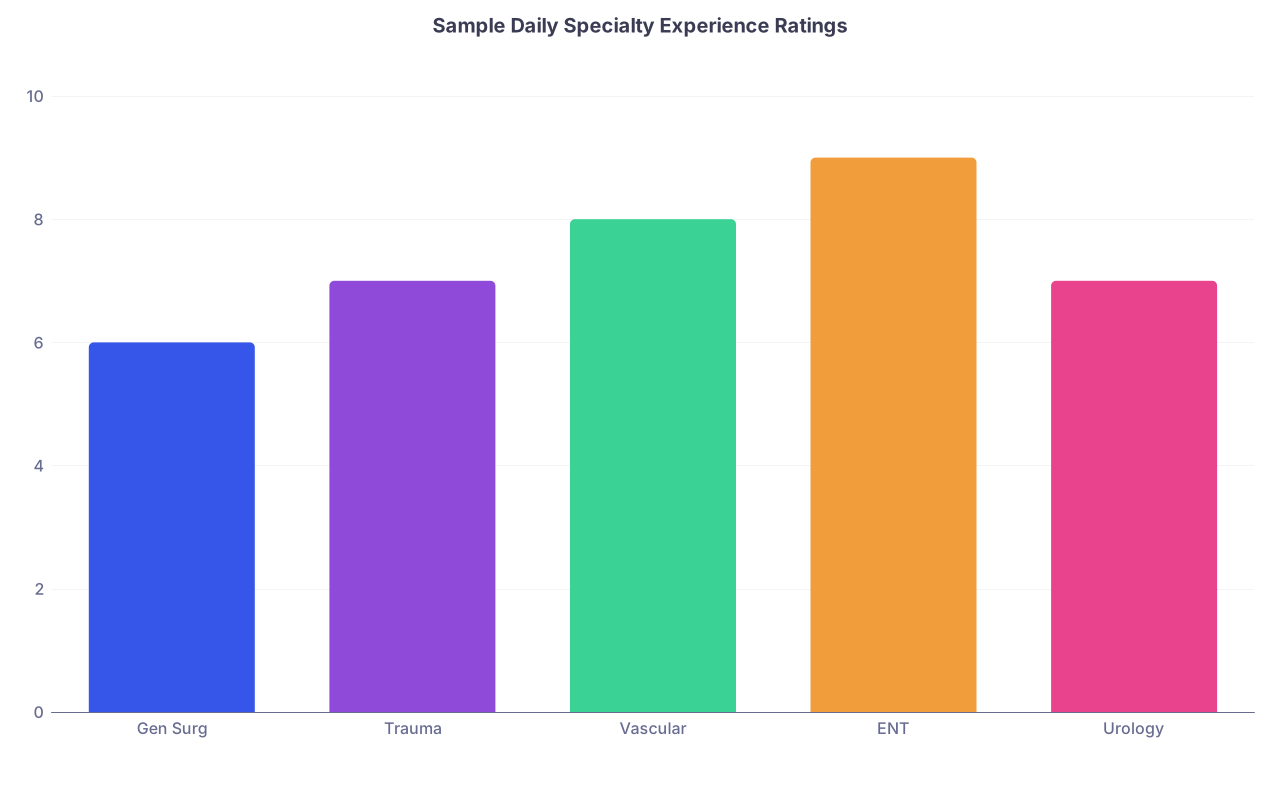
| Category | Value |
|---|---|
| Gen Surg | 6 |
| Trauma | 7 |
| Vascular | 8 |
| ENT | 9 |
| Urology | 7 |
End of Week 1: Mini‑checklist
By the end of the first week:
- You should:
- Know when your team rounds and where pre‑round labs live.
- Have scrubbed at least a few cases.
- Have started your specialty scorecard.
- You should not:
- Panic about loving or hating anything yet.
- Promise anyone you are “definitely going into” their field.
Your only real goal: Become just competent enough that people want you in their OR.
Month 1, Weeks 2–4: Systematic Sampling While You Level Up
At this point you should be useful on your core general surgery team and start deliberately sampling other services.
Week 2: Clean technique, clean data
Operationally, you are:
- Closing skin without being chased out of the room.
- Anticipating basic next steps (foley, positioning, stapler, suction).
- Presenting on rounds without rambling.
Specialty‑wise, you start your first two test drives.
You want at least two half‑days this week on non‑gen surg services. Use your pre‑month emails or ask your chief:
“I am very interested in [ENT/urology/ortho]. If there is a lighter day this week, would it be OK for me to spend a half day in their OR?”
Most chiefs will say yes as long as you are not abandoning your work.
When you go:
- Arrive early and introduce yourself to the chief / senior.
- Tell them plainly: “I am on general surgery but considering [specialty]. I want to see what your day is really like.”
- Fill out your scorecard that same day. No rose‑colored memory.
Week 3: First serious filter
By now you will have:
- A feel for general surgery days.
- A couple of focused experiences (maybe trauma ICU, maybe ENT or ortho).
At this point you should do a first hard filter:
- Anything you absolutely dread when you see it on the board? Drop it to “low interest.”
- Any day where you found yourself energized at 4 p.m., not just surviving? Flag that field.
You are not making a final choice. You are shrinking your list. Aim to go from 5–6 possibilities down to 3–4.
Also during Week 3:
- Ask residents blunt questions:
- “What surprised you the most about this specialty?”
- “Who on your team is actually happy?”
- “If you had not matched here, what was your backup?”
You are collecting real‑world outcomes, not brochure copy.
Week 4: First mentor ping
At this point you should have a sense of what you might want more of, especially among:
- General surgery vs trauma/acute care
- “Big field” specialties: ortho, neurosurg, plastics, ENT, urology
Pick one attending or senior resident from each remaining high-interest option and send a short, respectful email:
- Thank them for letting you work with them / watch their cases.
- Tell them you are strongly considering their field.
- Ask if they would be willing to chat briefly about:
- What they look for in applicants.
- Which 4th‑year rotations matter most.
- Whether research is essentially required in that field.
You are not asking for a letter. You are signaling interest early and collecting planning data.
Month 2, Weeks 5–8: Deep Dives and Decision Pressure‑Testing
If your clerkship is 8 weeks, Month 2 is where the choices get sharper. If it is shorter, compress this logic into your remaining time.
At this point you should stop trying to see everything and start building depth in 2–3 realistic options.
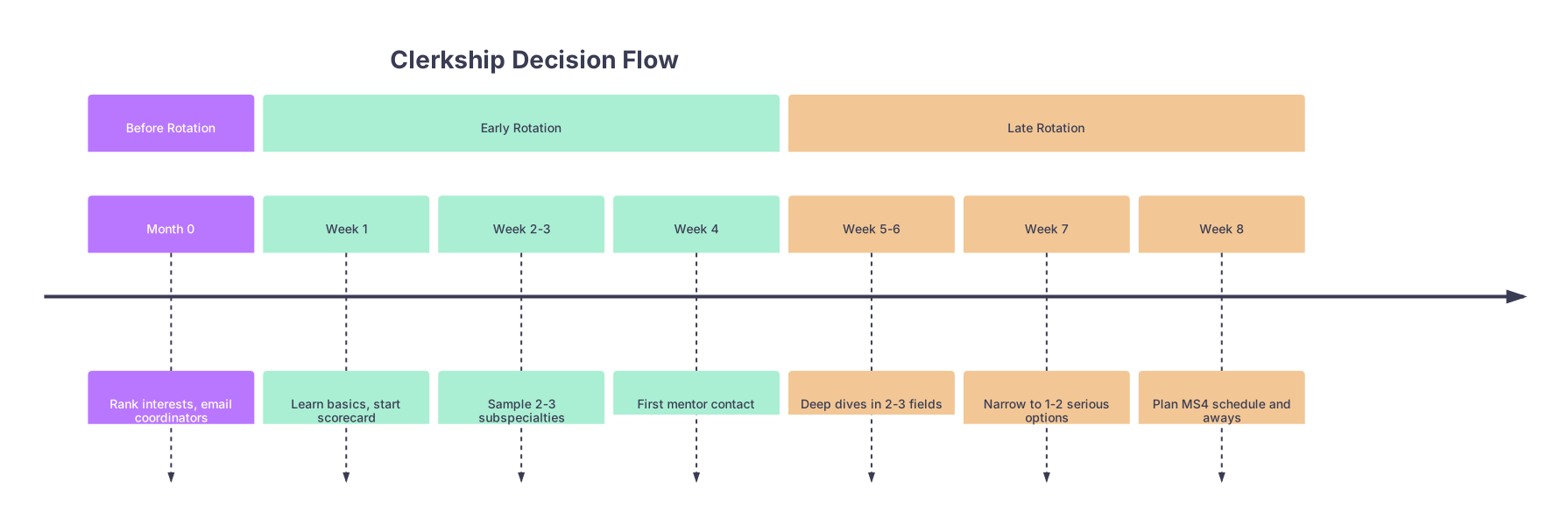
| Period | Event |
|---|---|
| Before Rotation - Month 0 | Rank interests, email coordinators |
| Early Rotation - Week 1 | Learn basics, start scorecard |
| Early Rotation - Week 2-3 | Sample 2-3 subspecialties |
| Early Rotation - Week 4 | First mentor contact |
| Late Rotation - Week 5-6 | Deep dives in 2-3 fields |
| Late Rotation - Week 7 | Narrow to 1-2 serious options |
| Late Rotation - Week 8 | Plan MS4 schedule and aways |
Week 5: Pick your top three
Based on your scorecards and gut:
- Circle three fields:
- Example: general surgery, ENT, urology.
- Force yourself to justify each in writing:
- “Gen surg: love acute abdomen cases, like SICU, team culture decent.”
- “ENT: clinic + OR mix, microskills, cases feel satisfying.”
- “Urology: laparoscopic/robotic focus, patients seem grateful, residents not miserable.”
Then decide: which two get priority for more time?
Your rule: by the end of surgery clerkship, you need to have at least one extended day or multi‑day exposure in each true contender.
Week 5–6: Plan and execute deep dives
A “deep dive” is not one half‑day where you mostly watch. It is:
- A full clinic day + a full OR day if possible, or
- Two consecutive OR days, embedded with that team.
What you are looking for during deep dives:
- How much of the work is cognitive vs procedural.
- How much of the OR is attending‑driven vs resident‑driven.
- Resident dynamics: friendly vs toxic, collaborative vs siloed.
- How you feel when a case runs long and bumps your afternoon.
You should also ask during these days:
- “What are your typical call schedules?”
- “What do graduates of this program actually do—fellowships vs community jobs?”
- “What killed people in interviews for your last match cycle?”
This is where you separate “interesting OR to watch” from “life I want for 5–7 years.”
Week 6: Reality check on competitiveness and preparation
By Week 6, you should start getting real about whether your academic profile matches your target fields.
Create a quick reality grid for each serious option:
- Step/COMLEX scores (even pass/fail, programs still care about Step 2)
- Class rank / honors pattern
- Research in that area (or at least in surgery)
- Letters you could potentially get
| Specialty | Your Fit Level | Research Needed | Away Rotations |
|---|---|---|---|
| General | Strong | Helpful | 0–1 |
| ENT | Borderline | Strongly needed | 1–2 |
| Urology | Moderate | Preferred | 1–2 |
If an attending in a hyper‑competitive field (ENT, plastics, neurosurg) quietly tells you:
- “You will need a strong Step 2, at least one project, and one away at a big program”
Believe them. Use that information now, not in September of MS4.
End of Clerkship: Converting Experience into a Fourth-Year Plan
The last 1–2 weeks are where most students mentally check out. You cannot afford that. This is where you lock in your trajectory.
Final Week − 10 days: Narrow to 1–2 true contenders
At this point you should:
- Have clear data from your scorecards.
- Know which services you happily woke up early for.
- Know which residents looked like your future or your nightmare.
Force yourself to rank:
- Specialty A – “Most likely”
- Specialty B – “Strong backup / co‑favorite”
- Everything else – “Only reconsider if something drastic changes”
If you are completely split between A and B, that is fine. But you need to know what each path demands next year.
Final Week: Targeted mentor meetings
You need at least one real conversation (15–30 minutes) with a faculty member in each of your top 1–2 fields.
Your script:
- “I am finishing my surgery clerkship and strongly considering [specialty].”
- “My stats are roughly [X]. I liked [specific aspects] of this rotation.”
- “If I commit to this field, what do you recommend I do between now and ERAS?”
- Sub‑I timing and where.
- Research vs case reports vs QI.
- Away rotations:
- Are they essential or optional?
- Ideal months (July–October vs later).
Take notes immediately after. These meetings will blur together later.
Letters of recommendation: plant the seed now
You do not have to lock in every letter today. But if someone clearly likes you and is from a contender field:
- Say, “I learned a lot from working with you. Would it be reasonable to ask for a letter of recommendation later if I decide on [specialty]?”
- If they say yes, follow up:
- Ask what they need (CV, personal statement draft, case list).
- Ask how far in advance they want the request.
Future‑you will thank you when you are not cold‑emailing in August.
Shelf and evaluation: do not sabotage yourself
Even if you decide you want ENT or ortho, your core surgery grade still matters. At this point you should:
- Block out 3–4 solid shelf study days in the final 2 weeks.
- Make sure your evaluations reflect actual effort:
- Ask for mid‑rotation feedback earlier; correct anything glaring.
- Do not disappear to subspecialties in the final days. Be visible to the attendings filling out forms.
Residency programs notice patterns. A trash grade in core surgery does not scream “dedicated future surgeon,” even if your field is technically outside general.
After the Clerkship: The 4–8 Week Debrief Window
The rotation ends, you sleep, and then your memory starts editing out the bad days. Counter that.
In the first month after the clerkship:
Rewrite your specialty scorecards as short narratives
For each serious contender, write half a page:- “A typical resident day looked like…”
- “The worst part seemed to be…”
- “The best part was…”
- “I could/could not see myself tolerating the bad for the sake of the good.”
Revisit competitiveness with fresh honesty
Now that the adrenaline wears off, ask:- “If I went all‑in on this field, what is the realistic range of programs I could reach?”
- “Am I comfortable with that risk profile?”
Sketch a rough MS4 schedule for each path
Example:
- If you choose general surgery:
- Sub‑I in gen surg early MS4.
- Maybe one away, but not always required.
- If you choose ENT or plastics:
- Home specialty rotation ASAP.
- 1–2 away rotations in July–October.
- Research or at least a poster by MS4 fall.
- If you choose general surgery:
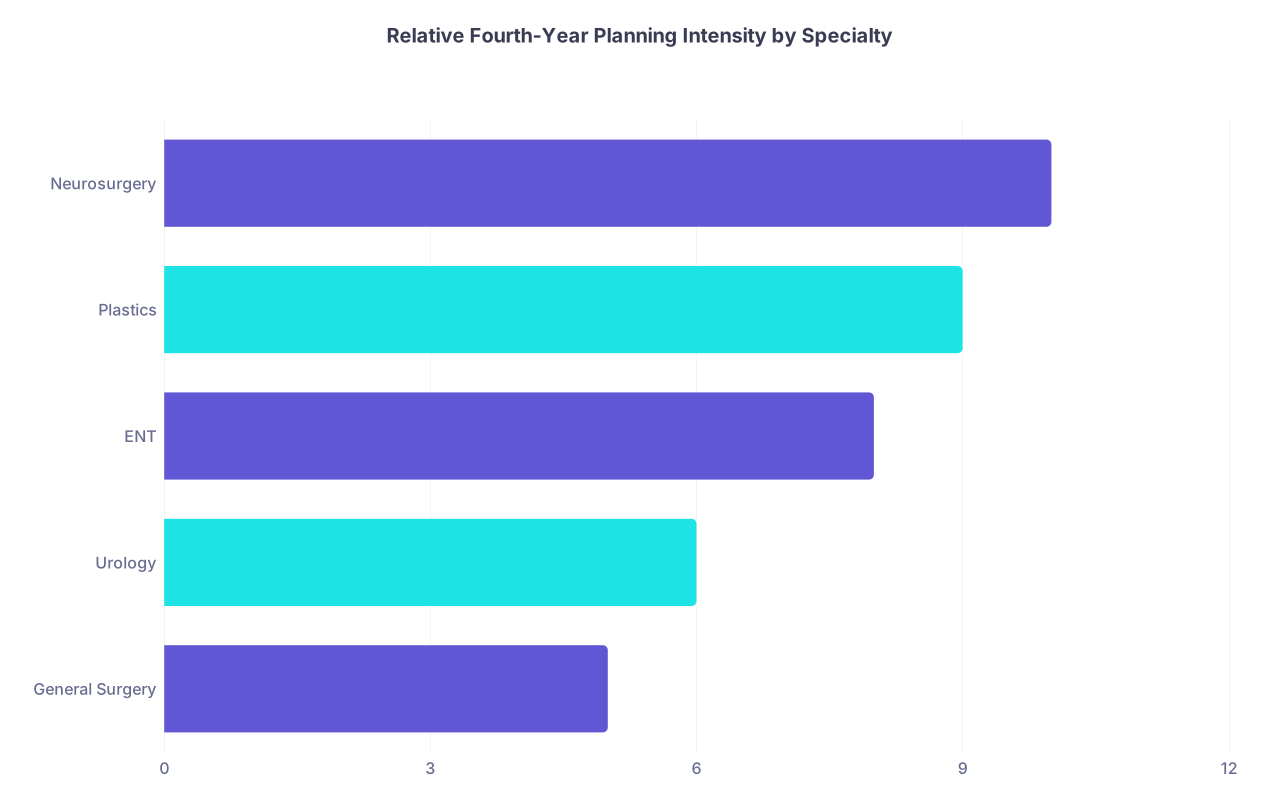
| Category | Value |
|---|---|
| General Surgery | 5 |
| Urology | 6 |
| ENT | 8 |
| Plastics | 9 |
| Neurosurgery | 10 |
You are not locking it in yet. You are clarifying the true cost of each route.
Three Things to Remember
- Your surgery clerkship is not just about the grade. It is your one guaranteed lab to test real surgical lives. Treat it like an experiment with a hypothesis and data collection, not like a sightseeing tour.
- Sampling without structure is useless. Use a simple scorecard, plan intentional deep dives, and narrow deliberately from many options to 1–2 contenders by the end.
- Mentors and logistics decide matches. By the time the clerkship ends, you should know who to email, what MS4 schedule you will need for each field, and whether your stats match your ambitions. Everything after that is execution.


