The best operative cases do not go to the “smartest” residents. They go to the ones who understand the politics of the OR.
Let me be blunt: case allocation in surgical residency is not fair, not objective, and not purely based on a rotation schedule. Every program pretends it is. The chiefs tell the interns, “It all evens out over time.” The PDs talk about “case minimums” and “educational equity.” On paper, sure.
In the real world, a small group of residents consistently ends up with the best cases, the most autonomy, and the trust of the surgeons who actually matter. Everyone else fights over appendectomies at 2 a.m. and wonders what they’re doing wrong.
You want to choose a surgical residency? You’d better understand how this game is actually played before you sign a contract.
The Dirty Secret: “Case Logs” Are Not the Full Story
Program directors love to hide behind numbers. They’ll show you aggregate case logs that look impressive. “Our graduating chiefs average 1,200+ major cases.” You nod and smile.
What they do not show you: how those cases are distributed within each class.
In every program I’ve been around—academic, community, hybrid—there’s usually:
- One or two residents who are essentially junior attendings by PGY-4/5
- A middle group who are competent, safe, but not particularly favored
- A bottom group who meet the ACGME minimums but never get real autonomy
Here’s the key: all three groups can graduate with “acceptable” numbers. The logs do not tell you who was holding the knife when things got complex, who converted the lap to open, who controlled the bleeder, who got to do the anastomosis, and who was just retracting.
When attendings talk about “Oh, that resident is a surgeon,” they are not talking about case counts. They’re talking about who they trusted when it mattered.
That trust is political capital.
The Hidden Power Brokers Who Decide Your Cases
You think case allocation is random or purely seniority-based? No. It’s controlled by a few key people you don’t fully appreciate as a medical student.
The Attending “Rainmakers”
In most general surgery programs, 5–10 attendings generate the majority of high-value operative experience:
- The hepatobiliary surgeon doing Whipples and liver resections
- The colorectal surgeon everyone sends their difficult pelvic cases to
- The bariatric/metabolic surgeon running a high-volume minimally invasive service
- The acute care surgeon who always seems to get the juiciest emergency cases
If you are on their good side, you get fed. Big, complex, career-defining cases.
If you’re invisible or irritating to them, you get crumbs.
Residents love to pretend it’s democratic—“we just rotate through.” But I’ve watched the same PGY-3 be called in at 2 a.m. to do a complex re-op bowel case because the attending trusted them over the scheduled resident. That is not an accident.
The Chief Residents
You will underestimate how much chiefs control your OR life until you’re already in the system. Chiefs decide:
- Who scrubs versus who runs the floor
- Who gets called for add-on cases
- Who gets “protected” from useless scut so they can be in the OR
- Who is “ready” for certain parts of cases versus who “needs more basic reps”
You can be the most technically gifted PGY-2 on the service; if the chief does not like you or trust you, you will not touch the good parts of the case.
I’ve heard this line more times than I can count:
“Yeah, I know you wanted that lap sigmoid, but I needed someone I didn’t have to babysit. We’ll get you the next one.”
You rarely get the next one.
The Coordinators and Schedulers
This one surprises people. The surgery scheduler and chief resident together can quietly make or break your month.
They know which attending is doing which case. They know who’s on call, who’s post-call, who’s scrubbed into a marathon case already. Subtle adjustments—“Oh, let’s add Dr. X’s favorite resident to that block,” or “We’ll send the PGY-2 instead of the intern”—change who’s in the room when the real learning happens.
You want to see how much power they have? Watch what happens to the schedule after a resident pisses off the wrong attending. Suddenly, they’re covering the floor. A lot.
Who Actually Gets the Best Cases (And Why)
Here’s the harsh truth: it’s not just about being “good.” Plenty of technically solid residents get mediocre case exposure because they misunderstand how attendings and chiefs think.
The residents who consistently get the best cases usually check several boxes.
1. They Are Calm, Not Just Smart
Attendings do not care if you can recite the steps of a pancreaticoduodenectomy if your hands shake when there’s a bleeder.
They care about:
- Can you stay composed when the ABG looks bad and anesthesia starts to panic?
- Do you shut down or freeze when you’re told, “Okay, your turn, take the artery”?
- Do you ask for help early, or do you flap around for 10 minutes pretending?
I’ve watched attendings consciously redirect cases away from residents who get visibly rattled under stress. “We’ll give them another month before they do that.” Translation: you just slid down the internal rank list.
The residents who project controlled, thoughtful confidence—who can say “I’m not sure; I’d like you to show me this part”—get trusted earlier and more.
2. They Do the Invisible Work Without Whining
Not glamorous. But real.
When attendings see that a resident:
- Has the consent done correctly
- Knows the imaging, the labs, and the story cold
- Has the equipment, special instruments, and positioning already arranged
- Anticipates what the attending likes without being asked
…they start thinking, “I want that resident on my cases.”
That’s when you start getting texts: “Add Smith to my lap colon this afternoon.” The rest of the residents never see that text. They just see Smith mysteriously scrubbed in for another big case.
3. They Protect Their Reputation Relentlessly
There is an internal narrative about every resident. It forms early. It is very hard to change.
Examples I’ve actually heard in workrooms:
- “He’s slow but safe.”
- “She’s very sharp, but kind of disorganized.”
- “Good surgically, but can be lazy.”
- “Solid. I’d let them take care of my family.”
That last one is nuclear. When several attendings and chiefs start describing you that way, you are going to get the best cases. Period.
Residents who blow off clinic, punt floor work to interns, or come unprepared to M&M get tagged as unreliable. You can be a technically gifted operator; if you are seen as unreliable, you will not be handed the challenging portions.
4. They’re Politically Smart With Nurses and Anesthesia
You think the attending is the only person deciding if they want you in the room? Wrong.
OR nurses and anesthesia talk. Constantly. In the core room. In pre-op. At 2 a.m. when you’re not there.
Residents who:
- Treat scrub techs with respect
- Do not argue with anesthesia every single induction
- Help turn over rooms when they can instead of vanishing
…get talked about in a very different way than the residents who only appear at incision and disappear at dressing.
There is nothing attendings hate more than walking into a room and sensing that the entire OR staff collectively rolls their eyes at the resident. That resident gets less autonomy. Less leeway. Fewer invites.
How This Plays Out Differently Across Programs
When you’re choosing a surgical residency, you’re not just choosing a geographic location and name brand. You’re choosing a political ecosystem. And some ecosystems are much more brutal than others.
| Program Type | Case Competition | Politics Intensity | Autonomy Variability |
|---|---|---|---|
| Big-name Academic | Very High | Very High | Huge by resident |
| Mid-tier Academic | High | High | Moderate–High |
| Hybrid (Univ/Comm) | Moderate | Moderate | Moderate |
| Large Community | Moderate | Low–Moderate | Often High |
| Small Community | Low–Moderate | Variable | Depends on volume |
Big-Name Academic Programs
At the marquee places—think MGH, UCSF, Duke, Hopkins—you get:
- Massive case volume
- Huge number of fellows
- Very stratified resident reputations
Politics there are vicious in a quiet, polite, “we’re all a family” way. A small subset of residents ends up getting tracked toward complex HPB, advanced MIS, or colorectal cases because attendings see them as future academic stars. Others end up doing endless bread-and-butter and trauma.
You might match at a big-name program and still graduate feeling undercooked in advanced cases if you never crack into that favored inner circle.
Mid-Tier Academic / Hybrid Programs
These places can be sweet spots—or minefields.
They often have:
- Fewer fellows, so more opportunity for residents
- A couple of high-volume attendings who essentially run the shop
- Strong personalities that dominate the culture
If you click with the key attendings and chiefs, you will eat. If you don’t, you’ll technically “meet requirements” but miss out on the complex stuff that builds true surgical confidence.
Community Programs
Residents love to sneer at community programs. Big mistake.
I’ve seen graduates of strong community programs (no fellows, high attending dependence on residents) come out far more comfortable operating than some brand-name academic grads who spent years retracting for fellows.
But the politics are still there—just more personal. Your relationship with 3–5 core attendings can define your whole experience. If you burn one bridge at a 5-attending program, that’s catastrophic. At a 40-attending academic shop, less so.
Red Flags on Interview Day That Nobody Explains to You
You can spot how bad the politics are during your interview day and away rotation—if you know what to look for.
Watch How Residents Talk About “Autonomy”
If residents say:
- “Autonomy is very attending-dependent,” and then glance at each other
- “It’s great once they trust you,” but can’t explain how that trust is built
- “It really evens out by chief year,” but PGY-5s look burned out and vague
…understand that autonomy is likely reserved for a chosen few. Others survive on scraps.
Pay Attention to the PGY-3s and PGY-4s
Med students always focus on interns and chiefs. Stop doing that.
Interns have no real frame of reference yet. Chiefs are trapped—they’re not going to trash the program in front of you. PGY-3s and 4s are where the truth leaks out.
Ask them directly:
- “If you magically started residency again, would you pick this program?”
- “Do you feel like you’re the surgeon when you operate, or an assistant to the attending?”
- “Do you feel the good cases are spread around, or a bit concentrated?”
Listen for hesitation. Watch their eyes more than their words.
Notice How They Treat the Medical Students
This is a tell.
Programs with toxic, cutthroat internal politics often let that leak onto students. If juniors are constantly shoved aside, never get to scrub, and the residents are bizarrely territorial about simple cases? That’s the same behavior they’re seeing from their seniors.
When a chief blocks a student from scrubbing a straightforward lap chole because “I need the numbers,” you’re seeing scarcity mindset. Programs with genuinely strong case distribution are more generous.
The Quiet Strategies Residents Use to Get Better Cases
You cannot control all the politics. But you are not powerless either. The high-opportunity residents are not just lucky; many of them play the game intentionally.
They Pick Their Battles With Brutal Discipline
Arguing with anesthesia over every minor thing? Complaining to the wrong attending about call schedules? Publicly criticizing another resident? All expensive politically.
The residents who rise tend to:
- Take their frustrations to the right person, in private
- Accept some unfairness without making it everyone’s problem
- Save their capital for the moments that really matter (like being wrongly blamed or blocked from core training)
Program leadership pays attention to which residents chronically stir drama. Those people do not get the benefit of the doubt when it’s time to reassign a big case.
They Go All-In on a Few Key Relationships
You are not going to get every attending to be your champion. That’s fantasy.
What I’ve seen work: residents identify 2–4 attendings whose practice aligns with their interests and who clearly invest in resident education. Then they:
- Show up early and stay late for that attending’s cases
- Read deeply on their typical procedures and preferences
- Take ownership of “their” service patients
- Ask for feedback and actually implement it
Those attendings become your advocates in the room where decisions are made—CCCs, rank list meetings, fellowship recommendations, who gets sent to visiting rotations. They say things like, “I want them on my block,” and that carries weight.
They Make Their Competence Loud in Subtle Ways
Nobody watches your every move. Attendings see fragments. Chiefs see snapshots. You have to make those snapshots count.
That means:
- Being visibly prepared on rounds, in the OR, and at M&M
- Presenting patients crisply, anticipating next steps without hand-holding
- Owning your complications at M&M without deflecting
Word spreads fast when a resident gives a rock-solid case presentation or handles a rough M&M with maturity. That changes who wants you in their OR.
What This Means When You’re Choosing a Program
Here’s the part most applicants get wrong: they pick programs based on prestige, geography, and vague “fit,” but they never ask, “How does this institution handle power?”
You should be asking yourself:
- Is this a culture where a small inner circle hoards opportunity?
- Do juniors talk about being developed or merely “surviving”?
- Are the chiefs respected as surgeons, or just as schedulers and scut managers?
You’re signing up for 5–7 years of apprenticeship. The name on the diploma matters. The letters after your name matter. But the politics of who gets the best cases will decide if you walk out feeling like a confident surgeon or a glorified assistant.
Two residents can graduate from the same program with the same case numbers and completely different operative realities. One has done 50 real colectomies skin-to-skin. The other has “done” 50 colectomies where they stapled the mesentery and closed the skin.
Which one do you want to be?
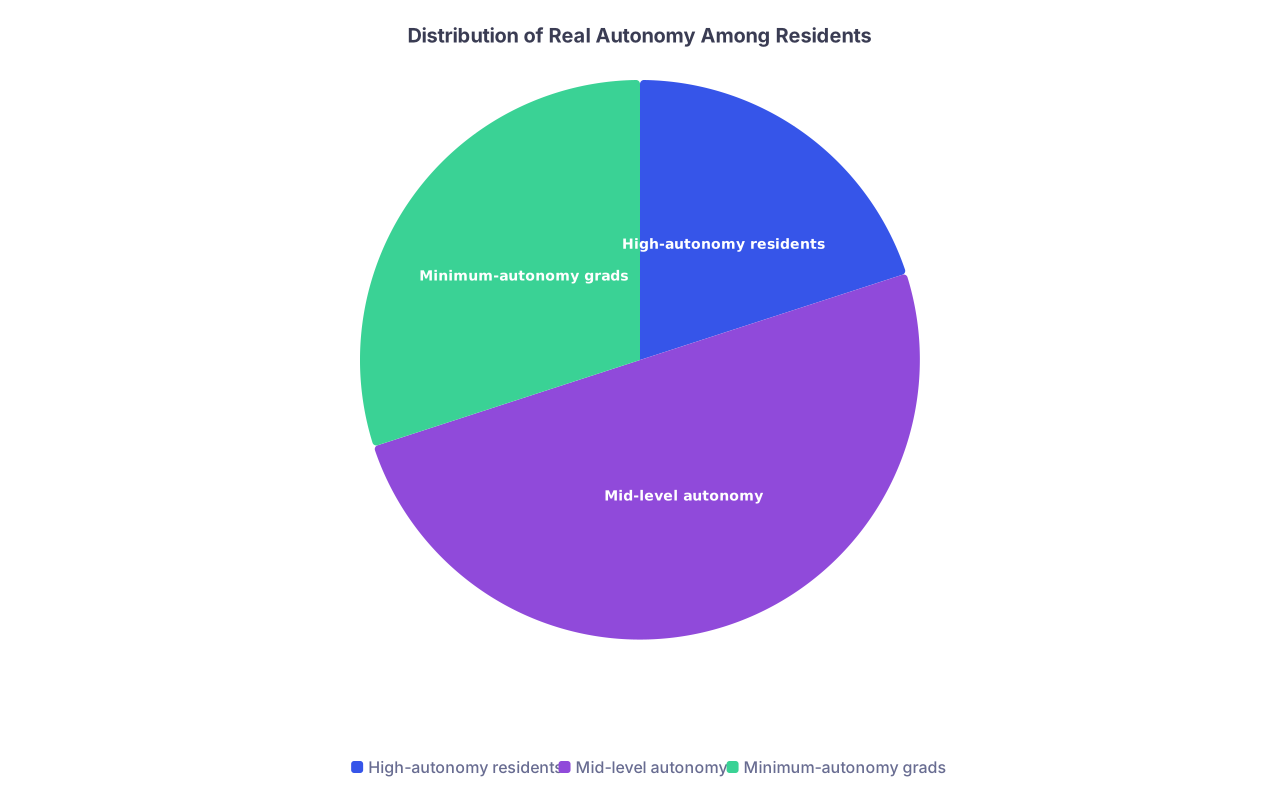
| Category | Value |
|---|---|
| High-autonomy residents | 20 |
| Mid-level autonomy | 50 |
| Minimum-autonomy grads | 30 |
How to Probe the Politics Without Sounding Naive
You cannot walk into an interview and say, “So who are the favorites?” But you can ask serious questions that reveal the power dynamics.
Here’s how smart applicants do it.
Ask About “Remediation” and “Support”
Not because you plan to fail. Because how a program talks about weak residents reveals how they really view their trainees.
Questions like:
- “Can you tell me about how the program supports residents who are struggling clinically or technically?”
- “Have residents ever graduated a year later than expected? What drove that?”
If the answers are vague, defensive, or blame-heavy—“We don’t really have that problem here”—you’re seeing a program that pushes out their out-group instead of developing them.
Ask For Concrete Autonomy Examples
You want specifics, not slogans.
Try:
- “Can you give me an example of a case a typical PGY-3 would do mostly independently in your program?”
- “What would a PGY-5 on your colorectal service be doing themselves versus the attending?”
If they can’t give you real examples, or if attendings talk like they are always the primary surgeon, be careful.

| Step | Description |
|---|---|
| Step 1 | PGY1 - Retract and Assist |
| Step 2 | PGY2 - Basic Laparoscopy |
| Step 3 | PGY3 - Lead Bread and Butter |
| Step 4 | PGY4 - Complex Portions |
| Step 5 | PGY5 - Surgeon with Backup |
Bottom Line: The Politics Are Real. You Either Learn Them or Get Ruled by Them.
You do not need to be fake. You do not need to kiss up. But you do need to understand that “fairness” is not the operative currency in surgical training. Trust is. Reputation is. Alliances are.
Some residents quietly learn that early and position themselves where the best cases naturally flow. Others pretend it’s all random and then feel blindsided when they graduate underprepared.
When you’re choosing a surgical residency, you’re not just choosing a training environment. You’re choosing a political landscape you will live in for the better part of a decade. Walk in with your eyes open.
FAQs
1. If I’m not naturally extroverted or “political,” am I doomed to bad cases?
No. You do not need to be a loud networker. Many of the best-case residents are actually quiet but very reliable. What matters more is that key people know you are prepared, calm, and respectful. You can build that reputation with consistent behavior rather than social charm. Show up early, know your patients and your cases cold, treat staff well, and follow through. That builds more capital than forced small talk ever will.
2. Is it safer to choose a community program if I’m worried about politics?
“Safer” is the wrong word. Community programs can have just as much politics; they’re just more concentrated because there are fewer players. The upside is that you often get more hands-on experience and less competition from fellows. The downside: one or two bad relationships can affect a huge portion of your training. You need to assess the specific program, not just the label “community” or “academic.”
3. How early in residency does your reputation really start to matter for case allocation?
Earlier than you think. By the end of your intern year, the chiefs and a handful of attendings have already formed a story about you—organized or scattered, hungry or complacent, safe or worrisome. That story colors who they call for extra cases, who they trust with add-ons, and who they keep on the floor. You can change that narrative later, but it’s uphill. Better to get it right from the start.
4. On away rotations, what single behavior makes attendings think, “I want this student as a resident”?
It’s not answering every pimp question. The behavior that stands out is ownership: the student who quietly knows the patients, helps close out tasks, shows up early to clinic and cases, and doesn’t disappear when things get busy. When an attending feels like you make their day run smoother—clinically and in the OR—they think, “If this is what they’re like as a student, they’ll be a monster as a resident.” Those are the people who end up with the best cases later.
Key points:
- The best operative cases go to the residents who build trust and political capital, not just those with seniority or good evaluations on paper.
- Program culture and hidden power structures matter as much as volume and prestige when you’re choosing where to train.
- Your reputation forms early; learn the politics, protect that reputation, and align yourself with the right mentors if you want to be the one holding the knife when it counts.