The fastest way to sink your shot at a surgical residency is to mishandle your away rotation.
You think it is a month to “check out the program.” They see it as a month-long interview. That mismatch is where people get burned.
I have watched strong students quietly remove themselves from consideration at great programs because of basic, avoidable errors on away rotations. Not bad people. Not bad test takers. Just people who did not understand how ruthlessly evaluative these months are.
Let me walk you through the 7 common mistakes that consistently damage applications — and how to avoid putting a target on your own back.
1. Treating the Away as a Vacation, Not a 4‑Week Interview
The worst mistake is subtle: acting like you are “visiting” instead of “auditioning.”
You see this when students:
- Show up right at start time instead of early
- Leave as soon as the day slows down
- Pass on cases because they are “not interested”
- Vanish for long coffee runs or “studying” in the library
From the resident side, it looks like this: “They are not hungry. Next.”
On a surgical away, your baseline assumption must be that every single day counts. People will absolutely judge you off a short sample size. One slow, checked-out week can undo three good ones.
Here is the reality no one likes to say out loud: away rotators are compared directly against each other. You are not in a vacuum.
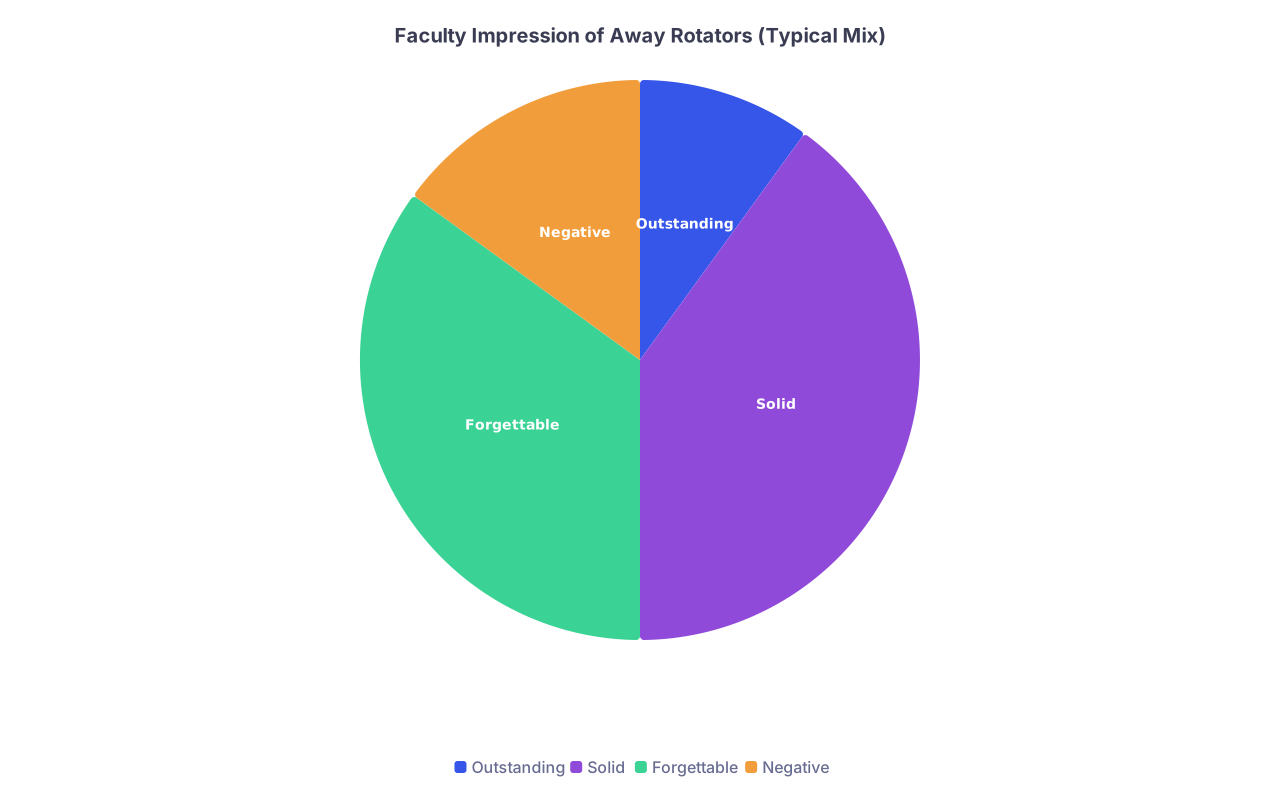
| Category | Value |
|---|---|
| Outstanding | 10 |
| Solid | 40 |
| Forgettable | 35 |
| Negative | 15 |
The “forgettable” and “negative” groups almost always include students who simply did not act like this was an interview.
Avoid this mistake by:
- Arriving 15–30 minutes before round start. Every day. No exceptions.
- Asking at the beginning of each day, “Is there anything extra I can help with this afternoon?”
- Staying engaged until you are explicitly told you can go. Do not self-dismiss.
- Saying yes to cases. You are not above a hernia repair or lap chole. That is the job.
You do not need to be theatrical or fake. You just need to show you actually want to be there. Complacency reads as disinterest, and disinterest is deadly in surgery.
2. Being a “Ghost” Student: Invisible on the Team
The second big error: you are technically present, but functionally invisible.
I have seen this pattern over and over:
Student stands in the back of the OR. Quiet. Hands folded. Nods a lot.
Shows up on rounds. Writes nothing. Asks for no tasks.
Disappears during downtime.
End of the month: “I think I did okay; I did not bother anyone.”
You did not bother anyone. You also did not help anyone. And that is the problem.
On a busy surgical service, no one has the energy to “figure out” what you can do. If you do not make yourself useful, you get mentally filed as background noise. When it comes time to rank students, background noise gets no comments, no advocates, no push.
At many programs, only a small fraction of away rotators end up highly recommended.
| Outcome | Rough Proportion |
|---|---|
| Strongly recommended | 10–20% |
| Recommended | 30–40% |
| Neutral / no impression | 30–40% |
| Not recommended | 5–10% |
“Neutral” is not safe in a competitive surgical match. It is wasted potential.
Avoid being a ghost by:
- Claiming tasks explicitly: “Can I pre-round on Ms. X and draft the note?”
- Offering simple help: “I can consent the next case, if that is okay.”
- Owning a few patients: know everything about them without being asked
- Standing where you can see and participate in the OR, not buried in the corner
You want at least 2–3 residents and 1–2 attendings who can say, unprompted, “Yes, I remember them. They were helpful.” If they struggle to recall you, you already lost.
3. Overstepping vs. Understepping: Getting the Autonomy Line Wrong
The third trap is mishandling autonomy. Students either:
- Overstep: act like a junior resident, make decisions independently, present plans as if final
- Understep: act like a shadow, never offer an assessment, never suggest plans
Both send red flags. One screams “unsafe,” the other screams “passive.”
Classic overstepping mistakes I have seen:
- Calling consults without clearing it with the resident
- Changing dressings or lines that were clearly resident-level decisions
- Presenting in rounds with firm plans you never discussed (“We will take him to the OR today…”)
- Telling a patient about imaging or surgical plans before the team has
Programs do not trust students who do not recognize limits. Surgery lives and dies on safe hierarchy.
On the flip side, understepping looks like this:
- “Vitals are stable, labs look okay. No changes.” Every day.
- When asked, “What do you want to do?” responding with “I am not sure” every time
- Never reading overnight events, notes, or imaging before rounds
- Not looking up simple questions you were asked the day before
That makes faculty think: “Do I really want to work with this person at 3 AM?” Often the answer is no.
How to stay in the safe zone:
On rounds:
Offer an assessment and plan, but label it clearly as your thought process.
“Overnight she had no fevers, pain is controlled, WBC is downtrending. I would continue current antibiotics, advance diet as tolerated, and consider removing the Foley if her urine output stays stable. What do you think?”
That is humble, thoughtful, and safe.
On orders and consults:
Never enter or change orders without asking. Never call another service without clearing it with your resident. Period.
With procedures:
Always ask about level of assistance.
“Would you be comfortable if I close the skin?”
Not “I will close.” Not silently picking up the needle driver and going rogue.
You want to show initiative inside a clearly defined boundary. The boundary is whatever your senior and attending decide. Not what you think is reasonable.
4. Mishandling OR Etiquette and Sterility
If you want a surgical resident to lose confidence in you in under 10 seconds, break sterility.
I have watched attendings write students off permanently after one careless contamination. Not because they are cruel. Because carelessness around sterility translates mentally to carelessness with patient safety.
Common OR mistakes that brand you as “not safe”:
- Touching the blue sterile field with your bare hands
- Leaning your non-sterile body or hair over the field
- Reaching into scrub nurse’s sterile area to “help”
- Turning your back and brushing your sterile gown against non-sterile surfaces
- Adjusting glasses or masks after scrubbing and then going straight to the field
You get one, maybe two small mistakes with a forgiving team. You do not get five.
And it is not just sterility. OR etiquette matters. Residents and attendings remember:
- The student who sits or slumps against the wall during a long case
- The student who checks their phone in view of the door or team
- The student who complains about case length or “boring” pathology
- The student who keeps asking, “When are we done?” or “Can I scrub out now?”
That last one is fatal.
Protect yourself by front-loading expectations:
Before your first day in the OR, find a resident or scrub nurse and say:
“I want to be really careful about sterility and OR flow. Are there specific things your team cares a lot about, or common pitfalls I should avoid?”
Then:
- Watch how others move around the field before you get close
- Keep your hands in the classic sterile position: above waist, below chest, in front
- If you think you contaminated something, say so. Immediately. Cover it. Re-scrub if needed. Programs respect honesty far more than cover-ups.
As for engagement: you do not need to talk nonstop. But you must be awake, attentive, and physically present in the case. If you are exhausted and might pass out, quietly tell a resident before you fall over, not after.
5. Being Socially Tone-Deaf With Residents and Staff
Another mistake that quietly kills evaluations: bad social judgment.
Away students sometimes think they are on equal footing with residents after a few good days. They start:
- Making edgy jokes in the call room
- Complaining about other programs, classmates, or their home institution
- Fishing for gossip about faculty or program politics
- Oversharing personal drama
- Flirting with residents or staff
Every one of those is a risk you cannot afford.
I once heard a chief say, “We were ready to rank her highly until she started openly trashing another program in front of us. If she talks like that about them, how will she talk about us?”
You are not just being evaluated on technical potential. You are being evaluated as a future colleague. Programs ask: “Do I want this person in my workroom at 2 AM for five years?”
Avoid the social landmines:
- Be friendly, not familiar. You do not need to “be one of the guys.”
- Never badmouth your home program, classmates, other away sites, or other applicants. Ever.
- Keep politics, religion, and controversial topics out of casual conversation. It adds zero value.
- If residents are venting about an attending, do not join in. Listen quietly or leave.
And a big one: do not play the “rank me, I will rank you” game. Telling a program they are your number one during the rotation locks you into a corner and can backfire if it is insincere or later contradicted.
Residents talk. Nurses talk. Scrub techs talk. The “weird vibe” or “bit unprofessional” comments travel faster than anything else.
6. Misreading the Culture and Acting Like You’re Somewhere Else
Students often make the mistake of running an away like their home institution. That is a good way to look tone-deaf.
Programs differ wildly in:
- How formal presentations are on rounds
- How aggressively they push autonomy
- How “chill” or hierarchical the OR feels
- How much they value research vs. workhorse clinical ability
You cannot bulldoze your home style onto a new program. I have seen students act like they are still at their home hospital — joking in the OR with residents, calling attendings by first name because “that is what we do at home,” leaving early because “students usually do that back home.”
It reads as disrespectful at best, arrogant at worst.
Your job in week 1 is simple: observe and adapt.
Watch:
- How do interns present? Bullet points or full sentences? Detailed plans or quick updates?
- Do people stand for attendings, or is it casual?
- Do residents pre-round alone, or do students join them?
- How do they address attendings: “Dr. Smith” or “John”?
- How late do most people actually stay? Not “officially,” but in reality.
Then calibrate yourself to match the more conservative end of the spectrum. Overformality is rarely punished. Overfamiliarity often is.
Second piece of misreading culture: trying to “fix” or critique the program.
You are there for four weeks, not four years. No one wants feedback from the visiting student about how they should change sign-out or modify their trauma workflow. Keep improvement ideas to yourself unless directly asked, and even then, tread lightly.
7. Failing to Close the Loop: No Advocates, No Follow‑Through
The final mistake is more strategic: students complete the away, disappear, and assume a decent performance “speaks for itself.”
It does not.
At most programs, there is no magical system that auto-boosts your name. People are busy. If you do not close the loop, you risk being “the good student from July… what was their name again?”
Common errors:
- Not asking anyone for a letter while you are still on service
- Not telling anyone clearly that you are very interested in the program
- Not following up with a brief thank you email and reminder of your interest
- Not keeping a single point person (often a PD, APD, or key faculty) updated
And yes, it is extremely common for equally strong students to be differentiated simply by who has a strong advocate in the rank meeting.

| Step | Description |
|---|---|
| Step 1 | Strong Performance |
| Step 2 | Identified by Residents |
| Step 3 | Faculty Notice |
| Step 4 | Advocate Speaks at Rank Meeting |
| Step 5 | Higher Rank Position |
| Step 6 | No Follow Through |
| Step 7 | No One Mentions Name |
| Step 8 | Neutral or Low Rank |
Avoid disappearing by:
Mid-rotation check-in
Around week 3, pick a faculty member who has seen you work and say:
“I really like this program and could see myself training here. Do you have any feedback for me on how I am doing, and anything I should improve before I leave?”
You get targeted feedback and you quietly signal real interest.
Ask for letters strategically
Near the end:
“Would you feel comfortable writing a strong letter of recommendation for my residency application?”
The word “strong” is intentional. If they hesitate, thank them and ask someone else.
Follow-up after you leave
Short email to 1–2 key people:
- Thank them for the opportunity
- Mention one concrete thing you appreciated
- Reiterate that you are applying and remain very interested
- Remind them of a distinctive detail (thesis topic, specific case you scrubbed, etc.)
No spamming. No weekly updates. Just one or two well-timed, respectful touches.
Quick Recap: The 7 Mistakes You Cannot Afford
- Treating the away like a visit, not a high-stakes interview.
- Being invisible — pleasant but forgettable, with no clear contributions.
- Mishandling autonomy — either overstepping into unsafe territory or never offering your own thinking.
- Breaking OR etiquette or sterility, or acting disengaged in the OR.
- Social missteps with residents and staff that raise professionalism concerns.
- Ignoring local culture and acting like you are still at your home institution.
- Leaving without advocates, letters, or follow-through, expecting “the system” to remember you.
Surgery is competitive. Programs are risk-averse. They will pass on a “maybe” and rank the student who was clearly safe, hungry, and easy to work with.