
It’s 1:37 a.m. You should be sleeping. Instead, you’re toggling between ENT, gen surg, ortho, plastics, neurosurg, and that random thought of IR that creeps in every two weeks. You read one more Reddit thread about someone who “switched from ortho to radiology and is finally happy,” and your heart just drops.
You keep thinking:
What if I pick wrong?
What if I get stuck?
What if I waste the best years of my life in a specialty that makes me miserable?
You’re not being dramatic. The commitment is huge. Surgery isn’t exactly a casual hobby.
Let me walk through the fears you’re actually having, not the sanitized version people politely ask about on interview day.
The Nightmare Loop in Your Head: “What If I Hate It Once I’m In?”
You’re probably replaying some version of this mental horror movie:
You match into, say, orthopedics. Everyone congratulates you. You post the cute Match Day photo. You buy the ortho-themed Patagonia. PGY-1 is exhausting but survivable. PGY-2 hits and you realize:
“I don’t actually care about bones.”
Or maybe it’s not the content. Maybe it’s the culture. You’re surrounded by people who live for the OR, cutting, drilling, hardware talk. Meanwhile, you find yourself actually enjoying clinic days or ICU time more, and you start thinking about anesthesia or EM. Then the panic comes: you feel trapped, guilty, and like a fraud.
Here’s the ugly truth most people won’t say out loud:
This happens. Not just rarely. I’ve seen it more than once at almost every big program I’ve been around.
People:
- Switch within surgery (e.g., from gen surg to ENT, from ortho prelim to neurosurg, from OB/GYN to gen surg).
- Switch out of surgery completely (to anesthesia, radiology, pathology, EM, FM).
- Or stay in their specialty but carve a very non‑traditional niche (research-heavy, outpatient-heavy, lifestyle-heavy).
Is it easy? No. Is it automatic? Absolutely not. Does it mean your life is over if your first pick isn’t perfect? Also no.
Your brain is acting like you’re signing an irreversible blood oath. It’s not that absolute.
How “Locked In” Are You Really?
Let’s be painfully concrete, because vague reassurance doesn’t quiet 3 a.m. thoughts.
| Path | Realistic Flexibility Level |
|---|---|
| Preliminary surgical year | High |
| Categorical gen surg | Moderate |
| Ortho/neurosurg/urology | Low–moderate |
| ENT/plastics | Low–moderate |
| Switching out of surgery | Moderate |
Here’s what I’ve actually seen happen:
Preliminary surgical year
This is the least “trapped” you’ll ever be once you start residency. People use prelim years to:- Reapply to a different surgical specialty
- Pivot out of surgery (anesthesia, EM, rads)
- Slide into a categorical gen surg or other program that got to know them
Categorical general surgery
Surprisingly, this has more doors than your brain is giving it credit for. People have:- Left after 1–2 years for anesthesia, EM, IM, rads
- Completed gen surg then done highly sub-specialized fellowships (surg onc, MIS, colorectal, breast, transplant) and ended up with practice patterns very different from a “typical” community general surgeon
- Transitioned later to non-op, admin, critical care, palliative, or hospital leadership roles
Highly specialized from day one (ortho, neurosurg, ENT, plastics, urology)
This is where your “oh God I’m stuck forever” fear gets loudest. The flexibility is narrower, but:- People do switch to other surgical specialties, often via prelim years or reapplying after stepping out
- Some complete residency and then shift to niche practice, academic/research-focused roles, or less intense settings
- A non-trivial number burn out, take time off, and then rebuild in a different space (not ideal, but not life-ending either)
Switching out of surgery
I’ve seen gen surg PGY-2s become:- Anesthesiologists
- Radiologists
- EM docs
- IM residents headed for cards/GI Many brought their procedural skills and trauma exposure as a selling point.
So yeah, there’s commitment. But the “one irreversible choice that seals your fate forever” thing? Mostly a story your anxiety is telling you.
The Real Question: Are You More Afraid of Regret or Reality?
There are two separate fears tangled together:
- “What if I actually hate the day-to-day of this field?”
- “What if there’s a better specialty out there and I never find it?”
The first is about misalignment. The second is about perfectionism.
Let’s hit them separately.
1. Misalignment: Signs You Actually Might Pick Wrong
These are the red flags I take seriously when a student says they’re “not sure” about a surgical specialty:
- You consistently dread that specialty’s OR days on your rotation
- You like the idea of the specialty more than the actual work you saw
- You didn’t like a single attending’s lifestyle or career path in that field
- You found yourself thinking, “I could tolerate this, I guess” instead of “I want to be better at this”
If you’ve rotated in, say, ortho twice and every day felt like you were acting a part, that’s not nerves. That’s data.
But if you had a mix of:
- Some days where you were exhausted but proud
- Some days where you were bored or irritated by culture
- Some days where you thought “this is actually cool”
That pattern is normal. That’s what early career anything feels like.
2. Perfectionism: The Myth of the “Soulmate Specialty”
Your brain wants a clean answer:
“There’s exactly one specialty I’m meant to do, and if I choose wrong I ruin my life.”
This is fantasy. People are often compatible with multiple fields. Plenty of surgeons could have been happy anesthesiologists or EM docs. Plenty of ENT people could have been plastics or gen surg. They picked, committed, and built meaning after the choice.
You’re overestimating the importance of picking the one “right” path. You’re underestimating:
- How much your enjoyment comes from people, mentors, and environment
- How your identity shifts during residency
- How much you can shape your job after training
No specialty feels like a soulmate every day, under every attending, on every rotation. Some days everything sucks. That’s not a sign you chose wrong. That’s just residency.
General Surgery vs. Early Subspecialization: Which Is “Safer” If You’re Scared?
This is the actual decision a lot of anxious applicants are staring at:
“Do I rank more gen surg because it’s broad and flexible, or go all-in on ENT/ortho/neurosurg/plastics because that’s what I think I want — and then risk being stuck?”
Let’s be blunt.
Pros of choosing general surgery when you’re unsure
- It keeps multiple fellowships open (trauma/CC, surg onc, MIS, colorectal, breast, transplant, HPB, etc.)
- It’s a natural launching pad to switch to other fields early if you realize, “nope”
- If you like the OR and critical care but not a very specific anatomic region, it matches that
Cons
- If you secretly know you’re obsessed with bones/brain/face/airway, gen surg might feel like a consolation prize
- You may end up doing a long path (5+2 or more) anyway to get where you want
- Some competitive fellowships can feel like their own mini-match stress
Pros of choosing a narrow field early (ortho, ENT, neurosurg, plastics, uro)
- You lean fully into what actually excites you right now
- You train with people who “speak your language” from day one
- Your residency years are directly aligned with the anatomy/pathology you love
Cons
- Switching once you’re in is hard; not impossible, but it’s extra emotional, logistical, and sometimes financially rough
- If you realize you like breadth more than depth, you’ll feel boxed in
- You’re very dependent on matching the right program culture, because the field is small
If your anxiety is absolutely paralyzing and you truly like multiple surgical areas, gen surg is often the “safer” bet. If, deep down, you know you’ve loved every single ENT or ortho day more than anything else you’ve done, your fear might be more about commitment than about fit.
Worst-Case Scenarios (And What Actually Happens)
Let’s walk through your actual worst-case fantasies and then the more boring reality.
Scenario 1: “I match into X, hate it, and completely burn out.”
What can actually happen:
- You struggle. Hard. Maybe your mental health tanks.
- You talk to your PD or a trusted faculty member (yes, people really do this).
- Options that might appear:
- Switch to another specialty at your home institution in PGY-1 or PGY-2
- Finish an intern year and re-enter the Match in something else
- Step away for a year, regroup, reapply
Is this fun? No. Does it wreck your self-esteem temporarily? Usually.
But then people land somewhere else and, a few years out, it becomes a story they tell, not the defining tragedy of their career.
Scenario 2: “I grind through, become an attending, and hate my life forever.”
What actually tends to happen:
- People adjust their practice gradually:
- Move from level-1 trauma centers to smaller hospitals
- Drop the parts of their practice that drain them
- Transition to more outpatient, endoscopy, or niche skills
- Shift into admin, education, or quality roles
- Or, if they really hate the entire field, they:
- Move into non-clinical work (industry, consulting, informatics, medical education)
- Or rarely, retrain in another specialty (painful, but real)
You have more ability to pivot in your 30s and 40s than your 3 a.m. brain believes.
Scenario 3: “Everyone will think I failed if I change paths.”
Reality:
- People gossip for like… a week. Then they go back to worrying about their own lives.
- The attendings you respect most will care way more that you’re not miserable and unsafe.
- Once you’re re-settled, no patient in clinic will ever ask, “Did you always do this specialty from day one of residency?”
Your ego will hurt. Your reputation? Not as fragile as you think.
How to Decide When You’re Terrified of Regretting It
You’re not going to get 100% certainty. So aim for “good enough plus self-awareness.”
Here’s a rough decision flow that doesn’t rely on magical clarity:

| Step | Description |
|---|---|
| Step 1 | Do you love the OR itself? |
| Step 2 | Consider non surgical fields |
| Step 3 | Do 2 to 3 focused surgical rotations |
| Step 4 | Rank that specialty first |
| Step 5 | Is gen surg acceptable or exciting? |
| Step 6 | Lean toward gen surg for flexibility |
| Step 7 | Rank mix of specialties but be realistic about competitiveness |
| Step 8 | One clear favorite? |
On your rotations, pay attention to three things (and be brutally honest):
How do you feel at 3 p.m. on a random Tuesday in that specialty?
Not on “cool case” days. On normal days.Which annoyances are you willing to tolerate long-term?
Every field has them. Ortho: heavy physically, hardware drama. ENT: clinic volume, sometimes weird on-call mixes. Gen surg: endless consults, nightmarish call in some places. Which flavor of suffering feels most “worth it” to you?When you imagine not doing this field, do you feel relief or loss?
If the thought of giving up a specialty makes you genuinely sad, that’s a powerful sign.
A Quick Reality Check With What Residents Actually Regret
Here’s the punchline people don’t tell you when you’re applying:
Most residents who are unhappy don’t say,
“I picked the wrong specialty.”
They say things like:
- “I didn’t realize how malignant this program was.”
- “I underestimated how much the location would wreck my support system.”
- “I picked based on prestige instead of where I felt like I could grow.”
So yes, specialty matters. But culture, geography, and support matter a lot more than your anxiety currently allows in the frame.
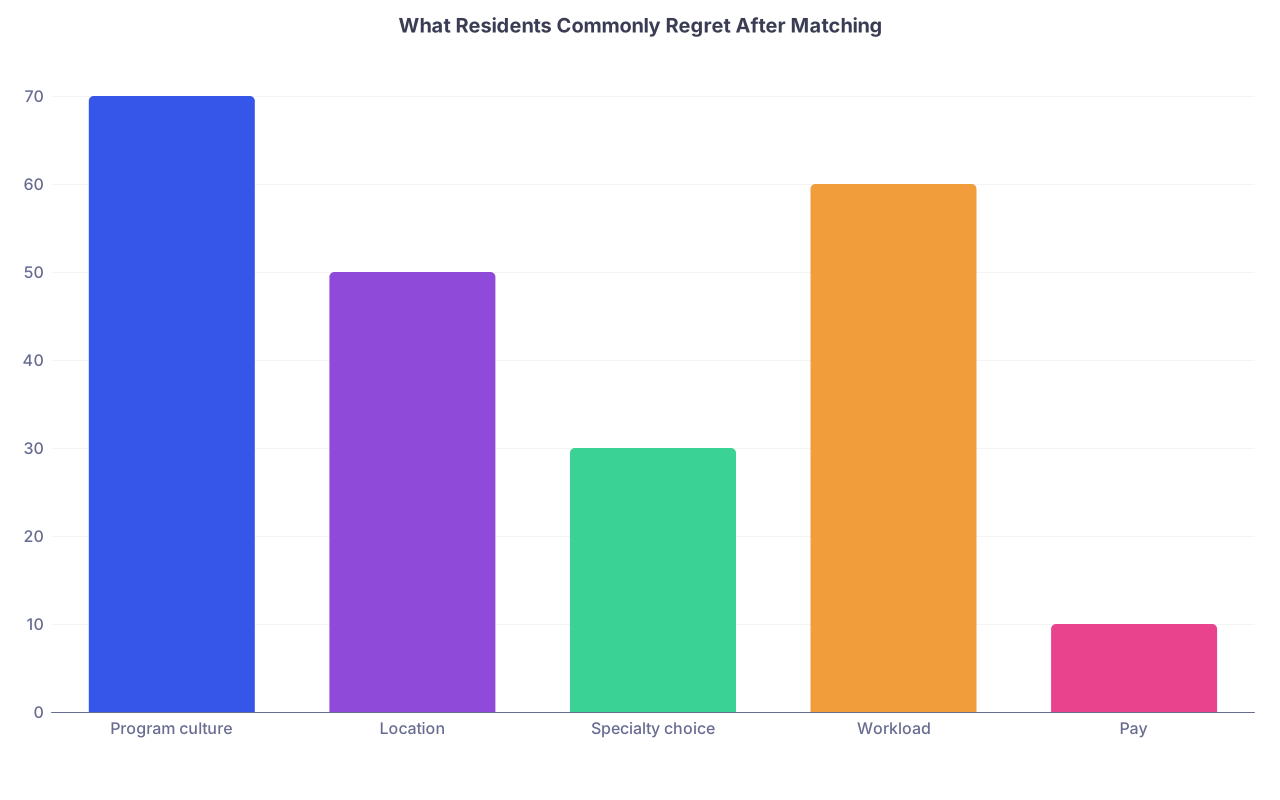
| Category | Value |
|---|---|
| Program culture | 70 |
| Location | 50 |
| Specialty choice | 30 |
| Workload | 60 |
| Pay | 10 |
Those numbers aren’t exact from a study; they’re an honest reflection of what I hear over and over. Notice “specialty choice” isn’t the top regret.
So if you’re splitting hairs between ENT and plastics or ortho and neurosurg, but you’re not scrutinizing program vibe, that’s where you’re more likely to get burned.
If You’re Still Panicking
If you’re still scrolling and your chest is tight, try this:
- Ask yourself: “If I had to choose today, what would I pick?”
Whatever popped up first before you started arguing with yourself again — that’s data. - Then ask: “What would I pick if I wasn’t scared of failing at it?”
That answer might be different. Also data.
You don’t need to solve your entire life. You just need to make a choice that’s:
- Aligned with what you’ve actually enjoyed
- Tolerable in its worst moments
- Flexible enough that Future You has options
You will not think about this decision every day for the rest of your career. You really won’t. Most people settle in, build relationships, get good at what they do, and the angst fades into background noise.
FAQs
1. Is general surgery the “default” if I’m not sure which surgical field to choose?
Not automatically. If you actively don’t like bread-and-butter general surgery cases (chole, appy, hernia, bowel stuff), then using gen surg as a “safe” fallback is a bad idea. But if you genuinely enjoy a wide range of cases and like the ICU/trauma piece, gen surg is a very reasonable choice when you’re uncertain. It’s broad, keeps fellowship doors open, and leaves room to pivot early if needed.
2. How late can I change my mind and still realistically switch specialties?
The earlier the better. PGY-1 is the most feasible time to change course, especially if you’re in a prelim spot or have strong relationships with another department. PGY-2 switches happen, but they’re logistically tougher. After PGY-3, people are more likely to finish and reshape their career with fellowships or practice changes rather than fully restart in another residency. Not impossible, just more costly.
3. Will switching specialties ruin my chances of getting a good job later?
Usually not. Programs and employers care more about how you perform where you end up than the fact that you changed paths. If anything, a well-explained switch can signal insight and maturity: “I realized X wasn’t a good fit early and moved toward Y, where my strengths actually line up.” The red flags are unprofessional behavior, burning bridges, or a pattern of quitting — not a single thoughtful redirect.
4. What if I never feel 100% sure about any surgical specialty before rank lists are due?
Then welcome to the club. Most people don’t get 100%; they get to maybe 70–80% and decide. At that point, look at: which field had the best average day, which program cultures felt healthiest, and where you can imagine growing without hating your life. Then commit. Doubt will follow you no matter what you choose; that’s your brain, not the specialty. Make the best choice you can with the data you have, and trust that you’ll still have ways to adjust later if you truly need to.
Key takeaways:
You’re not signing away your entire future with one rank list. Some paths are more flexible than others, but almost none are truly irreversible. Focus less on finding a “perfect” specialty and more on what kind of work, people, and environment you can tolerate — and even enjoy — on your worst days.