Malignant programs are the horror stories we all whisper about in hallways—and yes, some of them are real.
You’re not crazy for being scared. You’re not “too sensitive.” You’re trying to figure out where you’re going to spend five to seven of the hardest years of your life, in a specialty where people still brag about suffering. Of course your brain is running through every worst-case scenario at 2 a.m.
Let’s pull this apart before the anxiety eats you alive.
What “Malignant” Actually Means (And What’s Just… Hard)
First, a reality check: every surgical residency is hard, and most of them will feel a little “malignant” on your worst days.
Malignant doesn’t mean:
- They expect you to work hard
- You’re exhausted a lot
- Attendings push you and give blunt feedback
- You’re on call more often than your IM friends
That’s surgery. That’s the baseline.
When people say “malignant,” they usually mean some combination of:
- Systemic disrespect
- Psychological abuse or bullying
- Retaliation if you speak up
- Chronic violation of duty hours with zero interest in fixing it
- No support when residents are in real distress (mental or physical)
- A culture of fear, not just high expectations
You’re not trying to avoid any program that’s intense. You’re trying to avoid the places where you feel small, unsafe, and disposable.
And yes, those places exist. I’ve seen residents transfer. I’ve seen people quit. I’ve heard chiefs say, “We all suffered, you will too,” like it’s a badge of honor.
But here’s the part your brain probably doesn’t believe: truly malignant programs are the minority. The problem is the stories are so loud they feel like the norm.
How Much of the Horror Is Real vs. Resident Lore?
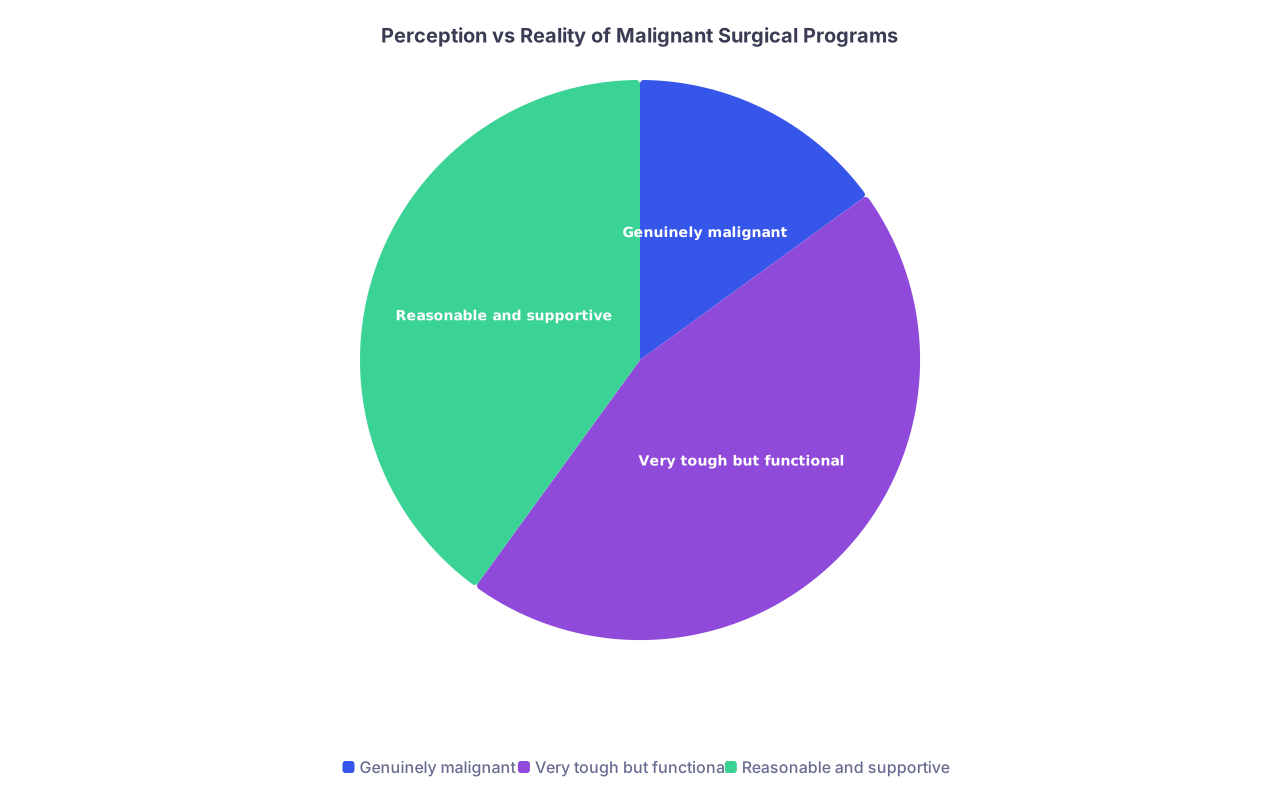
| Category | Value |
|---|---|
| Genuinely malignant | 15 |
| Very tough but functional | 45 |
| Reasonable and supportive | 40 |
Here’s the crappy part about our brains: one horror story outweighs ten normal experiences.
You’ll hear:
- “That place kills its interns.”
- “Nobody is ever happy there.”
- “Residents hide in the call room to cry.”
Sometimes that’s 100% accurate. Sometimes it’s:
- One horrible attending who finally retired
- A bad PD who got replaced two years ago
- Old culture that persists in people’s memories but not in the current program
- A resident who was legitimately treated unfairly—but their experience isn’t universal
The trick is not to dismiss any story (because those are real people getting hurt), but to ask: is this current, systemic, and consistent across multiple sources?
A single story = pay attention.
Repeated stories from different people = pattern.
Repeated stories across years = red flag.
Your anxiety wants to treat every negative comment like a massive warning. Don’t do that to yourself. You’ll end up ranking nobody.
Concrete Red Flags vs. Normal Surgical Misery
Let’s separate what should concern you from what’s just the reality of training in surgery.
| Category | Real Malignancy Red Flag | Hard but Normal in Surgery |
|---|---|---|
| Duty Hours | Chronic violations + discouraging reporting | Occasional overages when cases run late |
| Feedback | Public humiliation, yelling, insults | Blunt, critical, but focused on work |
| Support | PD dismisses concerns, calls you weak | PD acknowledges it’s hard, sets limits |
| Culture | Residents fear retaliation for speaking up | Residents complain, but feel heard |
| Wellness/Mental Hth | Residents punished for seeking help | Resources available, even if underused |
True red flags
If you keep hearing things like:
- “People are scared to log duty hours accurately.”
- “If you report a problem, it will get back to the person and you’ll pay for it.”
- “We had a resident go on leave for mental health and it was treated as betrayal.”
- “Chiefs brag about ‘breaking’ interns.”
- “Residents openly tell students: don’t come here.”
That’s not you being soft. That’s your survival instinct working.
Things that sound terrifying but might be normal
- “We work a lot; you’ll be exhausted all the time.”
- “We don’t coddle you here.”
- “The attendings are demanding.”
- “You’ll grow a thick skin.”
Those can exist in healthy programs too. The tone and follow-up matter. If in the same breath you also hear:
- “We’re a family.”
- “People have each other’s backs.”
- “The chiefs will go to bat for you.”
You’re probably looking at a tough but not malignant place.
How to Actually Read Between the Lines on Interview Day
The worst part? Programs never say, “We’re malignant, please come suffer with us.” They all talk about “family” and “support” and “team culture.”
So you have to look at the gaps between what they say and what they show.
Who’s doing the talking?
If only the PD and faculty talk, and residents are strangely quiet or super “on script,” that’s suspicious. I’ve been in those rooms. Residents look at each other before answering. Someone gives the same polished line in three different sessions.
Healthy-ish programs let residents be messy and real. You hear:
- “Yeah, we work a ton. But…”
- “That rotation is rough, no sugarcoating it. Here’s how we survive.”
- “We had some issues with X; they actually changed Y because of it.”
Programs that are always “amazing,” “perfect,” “so supportive” with zero specifics? Your radar should ping.
What do residents look like?
No, not their Instagram smiles. On interview day.
Watch for:
- Do they make eye contact with each other or seem tense?
- Are there moments where they gently roast the program in a loving way? That’s actually a good sign.
- Is there diversity in who talks—PGY1s, 3s, chiefs, different backgrounds—or just the golden child PGY5?
- Do they look like they hate their lives or just tired-but-functional?
You’re not looking for people who aren’t tired. Surgery is tiring. You’re looking for people who haven’t shut down emotionally.
Questions to Ask That Don’t Sound Accusatory (But Get You Real Info)
You’re afraid of being “that” applicant—the one who asks about wellness and gets silently blacklisted. Fair.
So you phrase it smartly. Not “Are you malignant?” but questions that force real examples.
Try things like:
“What changes has the program made in the last 2–3 years based on resident feedback?”
- If they can’t name anything or say, “We’re already great,” that’s not a good sign.
“Can you tell me about a time a resident struggled here and how the program handled it?”
- You want details: schedule adjustments, connecting them with resources, PD advocating, not “they just pushed through.”
“How are duty hour violations handled when they come up?”
- Good answer: acknowledgment + active solution + no blame.
- Bad answer: “We don’t really have those” (that’s a lie in surgery) or “We remind residents to be more efficient.”
“If a resident has an issue with an attending, what’s the process?”
- You’re listening for psychological safety: can they go to chiefs, PD, GME without fear?
At dinners or casual sessions, ask residents:
- “If you had to do it again, would you choose this place?” and really sit with their facial expression before they answer.
If they pause too long, or say something like, “Yeah, it’s… good training,” but their eyes are dead? That’s data.
Using Data Without Letting It Feed Your Paranoia
Data isn’t everything, but it’s not nothing.
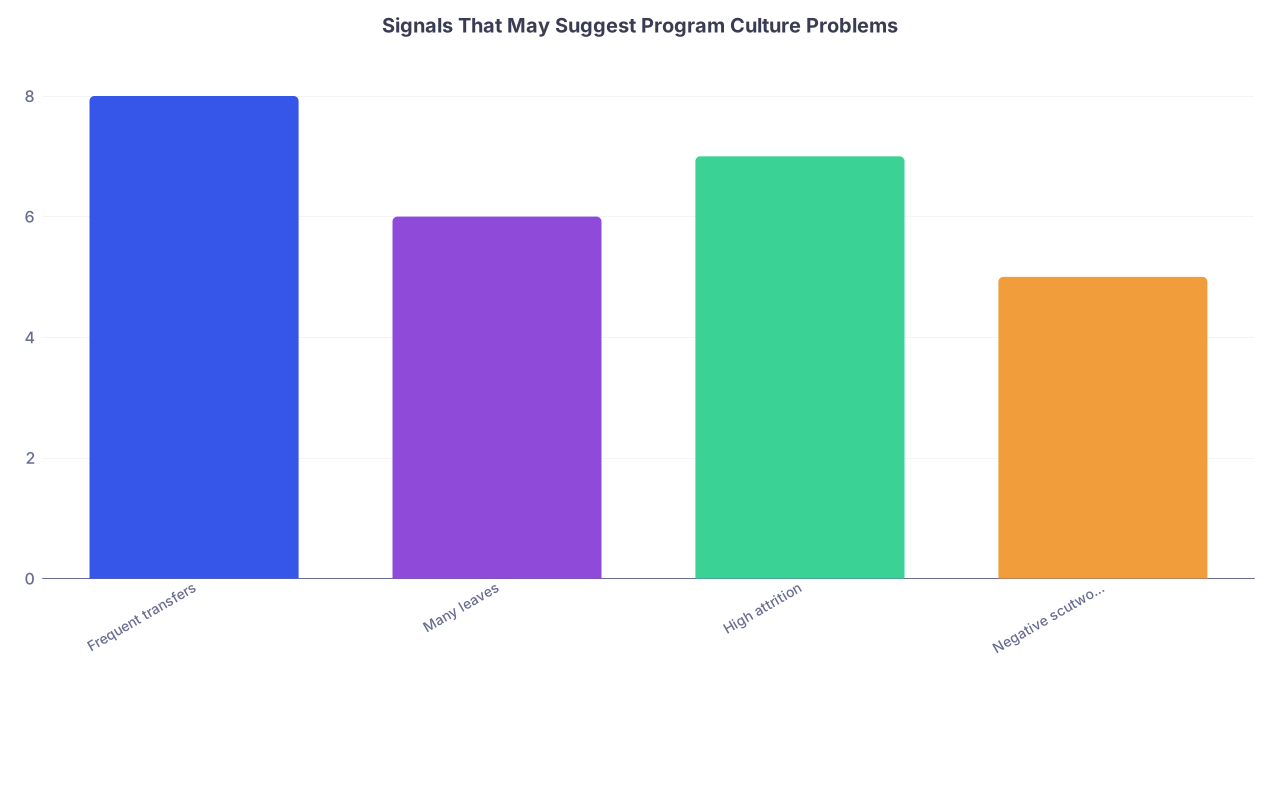
| Category | Value |
|---|---|
| Frequent transfers | 8 |
| Many leaves | 6 |
| High attrition | 7 |
| Negative scutwork rumors | 5 |
Red flags from numbers and patterns:
- High attrition: multiple residents leaving per class over years
- Regular resident transfers out but not in
- Reputation on forums consistently bad for 5+ years (not just one salty post)
- Zero public acknowledgment of wellness or support on their website
But keep this grounded:
- Surgery has higher attrition than some other fields. One person leaving isn’t proof of malignancy.
- Sometimes a resident leaves for family, geography, health, a specialty switch.
- Anonymous forums amplify the extremes. People in healthy programs don’t usually run to Reddit to say “Yeah it’s fine.”
Use data like a smoke detector, not a verdict. Smoke means look closer—not immediately run screaming.
How Much Should You Let This Fear Shape Your Rank List?
Here’s the loop I see over and over in anxious applicants:
- Hear horror stories.
- Assume all surgery programs are secretly terrible.
- Try to perfectly identify the One Safe Program.
- Convince yourself you’ll get trapped somewhere malignant and destroyed.
That loop will ruin your whole application season if you let it.
Let me be blunt:
You can do a hard program and be okay.
You can even do a borderline-toxic one and still come out as a good surgeon and human.
Would I choose that intentionally? Absolutely not. But your life isn’t over if you misjudge.
What you can reasonably aim for:
- Avoid the obvious, consistent red-flag programs.
- Prioritize places where residents seem like actual human beings with personalities.
- Put slightly more weight on culture than prestige if your gut is screaming.
I’ve seen people rank a big-name “brutal but famous” program over a solid, humane mid-tier one and regret it. I’ve never heard someone say, “I wish I’d chosen the more malignant place; I’d be a 2% better surgeon.”
You’re not weak for wanting to be treated like a person.
What If You End Up Somewhere Bad Anyway?
This is the core nightmare, right? You miss the red flags, match somewhere malignant, and you’re stuck.
You’re not as stuck as it feels.

| Step | Description |
|---|---|
| Step 1 | Match at concerning program |
| Step 2 | Seek mentorship and support |
| Step 3 | Document issues |
| Step 4 | Talk to chief or PD you trust |
| Step 5 | Stay with boundaries |
| Step 6 | Contact GME or ombuds |
| Step 7 | Explore transfer options |
| Step 8 | Finish with coping strategies |
| Step 9 | Toxic or just hard |
| Step 10 | Improves? |
| Step 11 | Still unsafe? |
If you land in a truly malignant place:
- You can document.
- You can talk to GME, ombuds, or a trusted faculty.
- You can seek transfer (it’s messy, but it happens every year).
- You can escalate if there are serious violations.
None of that is easy, but it’s not impossible. You’re not powerless, even if it feels like it at 3 a.m. in an empty OR lounge.
Also, programs change. A malignant PD leaves. A new chair comes in and actually cares. A few strong residents demand better and move the needle.
Will any of that feel comforting to you right now? Probably not. But it’s the truth: even worst-case is not the end of your story.
A More Grounded Way to Screen Programs (Without Losing Your Mind)
If you want something more concrete than “vibes,” here’s a simple way to rate each program on your list. Not perfect, but it keeps you from spinning out.
| Factor | Question to Ask Yourself |
|---|---|
| Resident Affect | Do they seem alive, honest, and connected? |
| Response to Struggle | Did I hear any specific example of support? |
| Feedback Culture | Is criticism described as harsh or humiliating? |
| Change Over Time | Have they changed anything based on feedback? |
| Gut Feeling | If I had to start there tomorrow, would I panic? |
Give each 1–5 in your notes after the interview. Don’t obsess, just go with first instinct. Programs that consistently sit at 1–2 in multiple categories? Push them down your list.
You’re allowed to rank places lower if your chest tightens thinking about working there, even if they operate on rare cancers and everyone online thinks they’re gods.
You’re Not Overreacting. You’re Trying to Protect Yourself.

You’re scared because this choice is huge. You’re also scared because everybody in surgery normalizes suffering like it’s noble.
Both can be true:
- Surgery training is inherently brutal.
- Some places cross lines that shouldn’t be crossed.
Your job isn’t to find a magical, suffering-free program. It’s to find a place where you’re pushed, not broken. Where you’re exhausted, not dehumanized. Where you can screw up, learn, and not be annihilated for being a human being.
You won’t get perfect information. You will have to make a decision with partial data. That’s terrifying. But you already do that every day on rotations—act with incomplete information and adjust.
You’ll do the same here. And you’re allowed to protect yourself while still being ambitious.
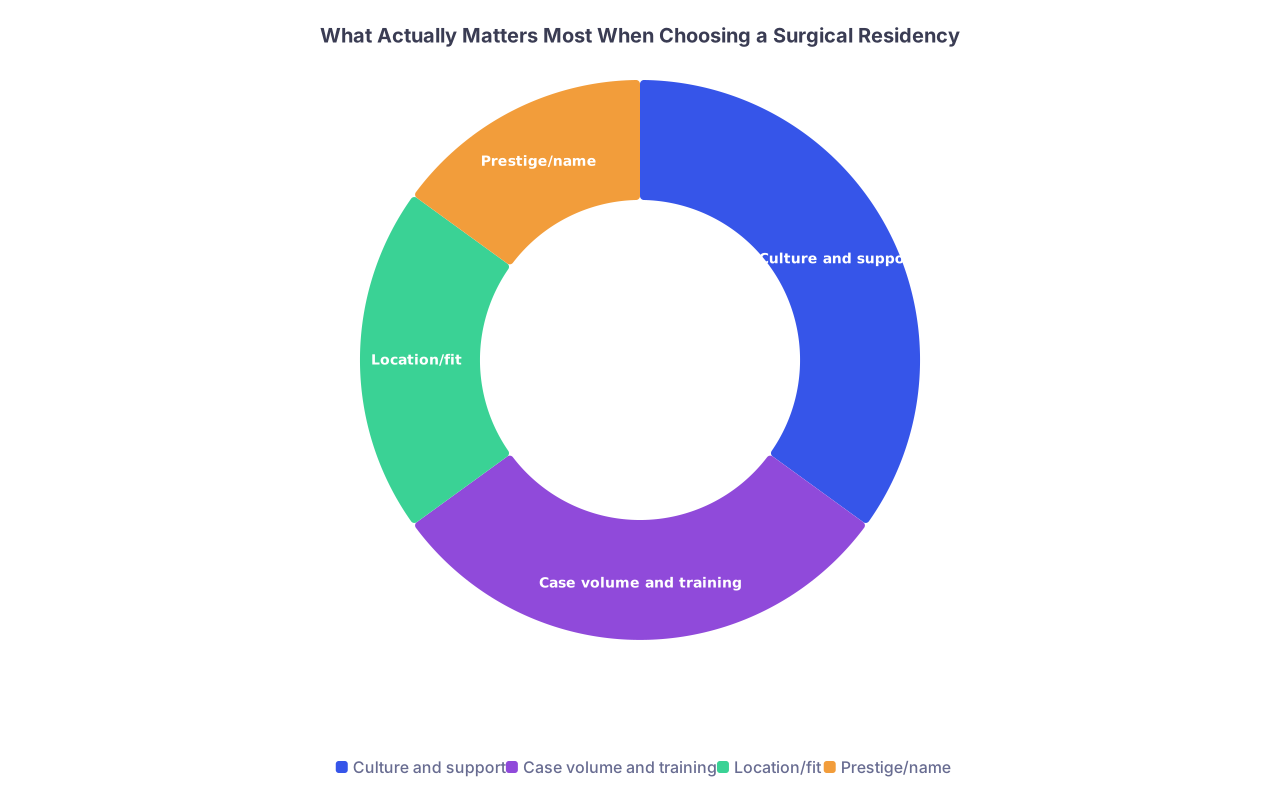
| Category | Value |
|---|---|
| Culture and support | 35 |
| Case volume and training | 30 |
| Location/fit | 20 |
| Prestige/name | 15 |
FAQ (Exactly 4 Questions)
1. Are all big-name surgical programs more likely to be malignant?
No. Some of the “top” places are actually shockingly humane now because they’ve been called out before and forced to evolve. Others are still resting on their reputation and treating residents like disposable labor. Prestige is neither a guarantee of malignancy nor protection from it. Treat big-name and mid-tier places the same way: listen to residents, look for patterns, and don’t let “fame” override your gut.
2. How much should online forums (Reddit, SDN) influence my view of a program?
They’re useful as a starting point, not a verdict. If a program has a decade-long trail of consistent negative posts and current residents are cagey or exhausted on interview day, I’d trust that pattern. But one dramatic rant from 2017 shouldn’t tank a program if your direct interactions feel solid and residents seem genuinely okay. Use forums to generate questions to ask, not decisions to finalize.
3. What if residents seem fine on interview day—can’t they just be faking it?
They can absolutely be coached. Programs do it. But it’s hard to fake everything. Watch their micro-reactions, how they talk about the worst parts. If every answer is perfect, polished, and weirdly identical, that’s suspicious. If they can acknowledge “this part sucks, but here’s how we deal with it,” that feels more real. You’re looking less for perfect answers and more for authenticity and consistency.
4. Is it weak to prioritize wellness and culture over prestige or case volume?
No. It’s smart. You can’t learn well if you’re constantly terrified, humiliated, or mentally falling apart. A slightly less “fancy” place where you’re supported will almost always produce a better, more functional surgeon than a prestigious pressure cooker that erodes your confidence and health. You’re not choosing between being a “real” surgeon and being soft; you’re choosing where you can grow without being crushed.
Key takeaways:
- “Malignant” means systemic disrespect, fear, and lack of support—not just hard work.
- Look for consistent patterns across residents, years, and specific stories, not one-off comments.
- Trust your gut when everything looks good on paper but your body tenses up thinking about training there.