Most applicants compare surgical programs’ operative autonomy in exactly the wrong way. They ask, “Do your residents get good hands-on experience?” and then believe whatever the PD says.
You know the answer you will get: “Our residents get excellent autonomy.” From everyone. Everywhere.
You want a systematic way to compare programs that does not rely on marketing, vibe, or one loud senior. You want something you can map, score, and use to make actual decisions when you are staring at a rank list with 12 “pretty good” places.
This is that system.
1. The Four Pillars of Operative Autonomy
Before you try to measure anything, you need a framework. Operative autonomy is not one thing. It is a mix of four:
- Case Volume – Are there enough cases, and are they the right types?
- Progressive Responsibility – Do residents move from observer → assistant → surgeon in a structured way?
- Culture of Trust and Teaching – Do attendings actually let go of the knife?
- System Structure and Constraints – Does the call schedule, case distribution, and fellowship presence support or choke autonomy?
If you skip any one of these, you will misread a program.
A community program can have tons of volume and still produce weak surgeons if staff never let residents drive. A big-name academic center can have excellent teaching but thin resident volume on key bread-and-butter cases because of fellows and advanced practice providers.
You will compare programs by scoring each of these pillars using concrete, reproducible questions. Not vibes.
2. Build a Simple Autonomy Scoring System (Before Interviews)
You need a tool in your head before you walk into the first pre-interview dinner. Otherwise you will be swept by personalities and fancy ORs.
Use a 1–5 score for each pillar:
- 1 = Major concern
- 3 = Acceptable / mixed
- 5 = Clear strength
Total possible: 20 points.
Here is the skeleton:
| Pillar | Weight | Score (1–5) | Notes |
|---|---|---|---|
| Case Volume | 30% | Numbers + case mix | |
| Progressive Responsibility | 30% | Graded independence | |
| Culture of Trust | 25% | How much residents operate | |
| System Structure | 15% | Call, fellows, logistics |
You will fill this for each program using:
- Public data (websites, ACGME case logs if shared, alumni outcomes)
- Interview day specifics
- Private conversations with multiple residents at different levels
3. Pillar 1 – Case Volume: How to Get Past the Hype
Programs love big numbers. “Our chiefs graduate with 1,500+ cases.” Sounds great. Often means nothing by itself.
You care about three things:
- Total volume per resident
- Distribution across critical categories
- Resident vs fellow vs APP case ownership
3.1. Hard Questions to Ask
Ask these to residents, not to faculty:
- “What were your case numbers at the end of PGY-2? PGY-3?”
- “By the time chiefs graduate, what is a typical total case number? Not the outliers.”
- “Are there categories where people are scrambling to meet minimums?”
- “Which cases do you feel almost overtrained on? Which ones are thin?”
You will get much more honest, specific answers if you put numbers on the table:
- “For general surgery, chiefs often finish with 900–1100 cases nationally. Where do your chiefs land?”
- “How many laparoscopic cholecystectomies have you done as primary by the end of PGY-3?”
Residents who actually operate will be able to give you rough numbers quickly. When you get vague answers like “Oh, plenty,” that is a red flag.
3.2. Interpreting Case Volume Data
Here is a quick benchmark comparison you can keep in your pocket. These are illustrative ranges, not hard rules, but they help frame what you are hearing:
| Level | Solid Volume Range | Red-Flag Range |
|---|---|---|
| End of PGY-2 | 250–400 total | < 200 total |
| End of PGY-3 | 450–700 total | < 350 total |
| Graduation | 900–1200+ total | < 800 total |
Again, raw numbers alone do not equal autonomy. A PGY-3 with 600 cases who has been second-assistant on half of them is less prepared than a PGY-3 with 400 cases who has driven 200 straightforward operations from incision to closure.
4. Pillar 2 – Progressive Responsibility: Map the Actual Trajectory
Programs love to say, “We believe in graduated autonomy.” Many say it. Some actually do it.
You want to know: At each PGY level, what is the default role in the OR?
4.1. The “Year-by-Year OR Role” Drill
Ask senior residents this exact series:
- “What are interns expected to do in the OR by the second half of the year?”
- “What are PGY-2s the primary surgeon on? Give me examples.”
- “By PGY-3, on a standard daytime elective list, how often are you the surgeon vs the assistant?”
- “As a chief, what percent of cases do you feel like you are truly running skin-to-skin?”
You are looking for something like:
- Intern: first-assisting on basic cases, closing, driving parts of simple operations.
- PGY-2: primary on appendectomies, cholecystectomies, simple hernias.
- PGY-3: running full straightforward cases, primary on more complex ones with backup.
- Chief: running almost everything appropriate for a graduating resident.
If you hear:
- “Interns mostly retract and close.”
- “PGY-2s still mostly first-assist. You really start doing cases on your own as a 4.”
Then autonomy is likely back-loaded. You can still become competent, but you will feel behind until late.
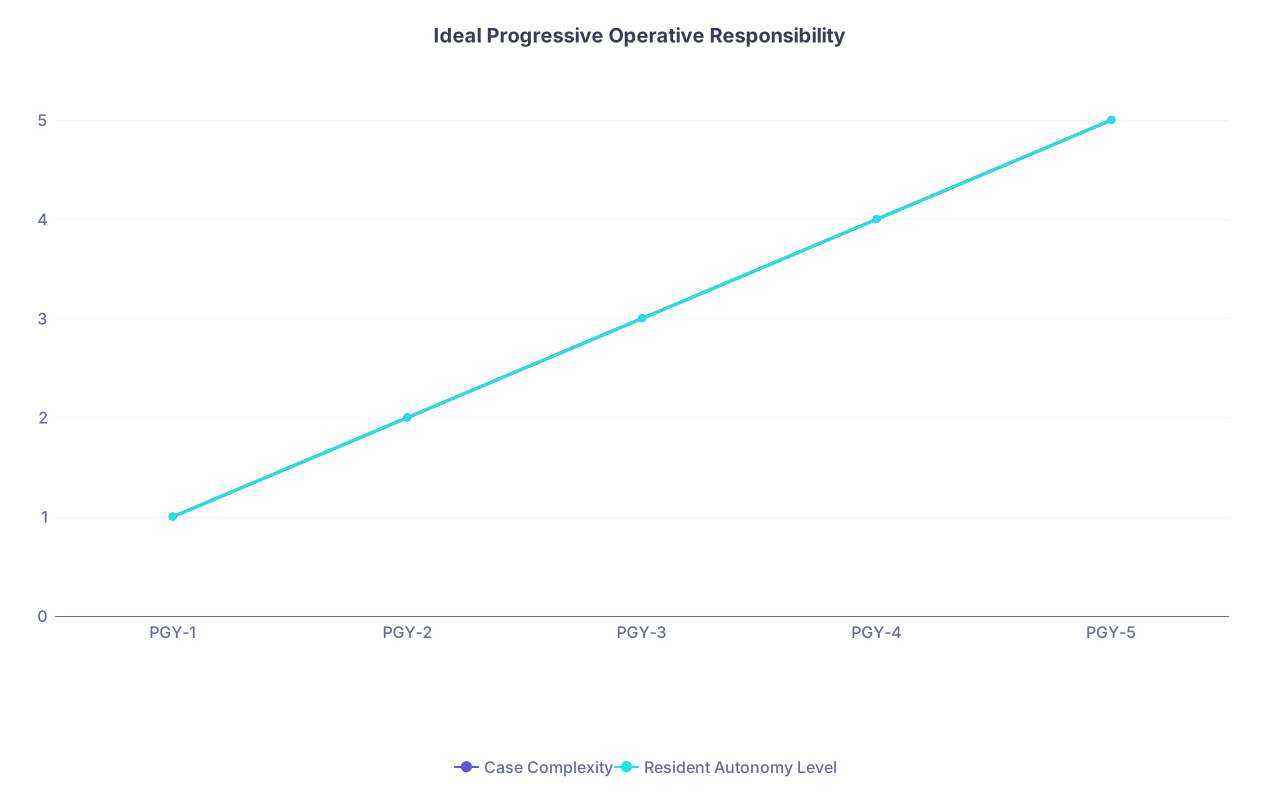
4.2. Use the Autonomy-Complexity Matrix
You want to see if autonomy increases in step with complexity, or if residents are stuck in assistant roles for too long.
Use a simple mental chart like this:
| Category | Case Complexity | Resident Autonomy Level |
|---|---|---|
| PGY-1 | 1 | 1 |
| PGY-2 | 2 | 2 |
| PGY-3 | 3 | 3 |
| PGY-4 | 4 | 4 |
| PGY-5 | 5 | 5 |
In a strong program, complexity and autonomy grow together. In a weak one, complexity rises but autonomy stays flat until late. That feels like:
- PGY-1–3: “You can help, but do not touch the critical parts.”
- PGY-4–5: “Now you can finally operate, but you are cramming autonomy into two years.”
Score Progressive Responsibility higher when junior residents are given honest ownership of simple cases early.
5. Pillar 3 – Culture: Who Actually Holds the Knife?
Culture is where most applicants get fooled. Fancy name + good reputation does not guarantee a culture of trust.
5.1. Signs of a High-Autonomy Culture
You want to hear residents say things like:
- “Our attendings expect you to take the case as far as you safely can.”
- “By the end of PGY-2, the default for lap appy/lap chole is that you are the surgeon.”
- “If you are prepared and show up having read, they really let you drive.”
You also want consistency. Not “There are two attendings who let us do a lot” and everyone else micromanages.
Ask these pointed questions:
- “Which attendings consistently let residents run the room?”
- “Any services where residents feel like glorified PAs?”
- “Give me an example of a case you ran earlier in training than you expected.”
- “And one where you felt your autonomy was blocked for no good reason.”
Residents will often laugh a little before they answer the last one. Listen closely.
5.2. Watch What People Complain About
At pre-interview dinners, stop making small talk about housing and city life. Ask:
- “What frustrates you most here day to day?”
- “If you could change one thing about the OR culture, what would it be?”
If the first complaint out of their mouths is about endless scut, useless documentation, or inefficient turnover, that is one set of issues.
If the first complaint is, “Certain staff never let you do more than skin,” that is a direct autonomy problem.
6. Pillar 4 – System Structure: How the Machine Shapes Your Hands-On Time
You can have great volume and attendings who want to teach, and still end up with weak autonomy because the system is badly designed.
Look at four structural factors:
- Service design and case distribution
- Fellows and their role in the OR
- Call structure and fatigue
- Non-operative workload
6.1. Fellows: Helpful, Neutral, or Harmful?
Fellows are not inherently bad. Some fellow-heavy places still have excellent resident autonomy. It depends on how cases are divided.
You want simple, honest answers to:
- “On services with fellows, who is the primary surgeon on typical cases?”
- “Do fellows mostly take the complex referrals, or do they take bread-and-butter too?”
- “Are there any rotations where residents rarely get to be the surgeon because of fellows?”
Pay attention to their tone when they talk about a “malignant” fellow service. That often means residents are losing autonomy.
6.2. Call and Fatigue: Do You Miss Cases?
Ask:
- “On a typical month, how many elective OR days do you lose post-call?”
- “Do you feel like nights and consults are stealing meaningful OR time or complementing it?”
- “Are there rotations where you are technically on the service but never make it to the OR because of floor / ICU responsibilities?”
If residents routinely miss the OR due to coverage demands, it will undercut even a strong operative culture.
7. Concrete Data Sources You Can Actually Use
You are not limited to vibes and anecdotes. There are hard data and semi-hard proxies you can systematically gather.

7.1. Case Logs (If You Can Get Them)
Some programs share anonymized or aggregate ACGME case log summaries on interview day or during second looks. If they do, jump on it.
Look at:
- Median vs outlier case numbers
- Specific key categories: hernia, lap chole, endoscopy, trauma, vascular, etc.
- Are there categories hovering just above minimums?
If a program will not share any concrete numbers, ask why.
7.2. Fellowship Match vs Autonomy
Strong operative autonomy programs tend to have:
- Graduates who feel comfortable going straight into practice, and
- Graduates landing competitive fellowships.
Ask programs to show:
- A list of last 5–10 years of graduates and where they went
- % going into community / rural practice directly vs fellowships
You are looking for this mix: people can and do operate independently after graduation, and those who want advanced training are competitive for it.
7.3. National Benchmarks and Word-of-Mouth
Talk to:
- Residents at your home program who have rotated externally
- Faculty who trained at or work closely with programs you are eyeing
- Recent graduates now in practice who can tell you who shows up “ready”
Their comments are biased, but patterns matter. If three unrelated people tell you “Program X graduates are technically excellent,” you pay attention.
8. How to Extract Real Answers During Interviews and Dinners
Most applicants ask fuzzy, low-yield questions. You will not.
You are going to run a structured playbook.

| Step | Description |
|---|---|
| Step 1 | Start Conversation |
| Step 2 | Ask PGY-specific role questions |
| Step 3 | Ask philosophy and structure |
| Step 4 | Follow up with concrete examples |
| Step 5 | Score Program Immediately After |
| Step 6 | Resident or Faculty? |
8.1. Questions for Residents (Junior vs Senior)
Ask PGY-1/2:
- “How many full cases have you done as surgeon so far this year?”
- “What do your clinic days and OR days actually look like in a typical week?”
Ask PGY-4/5:
- “What cases were you comfortable doing independently by the end of your PGY-3 year?”
- “Where do you feel your operative training is thinner than you would like?”
- “If you had to start as an attending tomorrow, what would you be happy taking call for? Anything you would avoid?”
If senior residents openly admit gaps and can name them, that is a sign of insight, not necessarily weakness. Biggest red flag is someone insisting everything is perfect.
8.2. Questions for Program Leadership
You are not going to get harsh truth from leadership about their own weaknesses, but you can get structure.
Ask:
- “How do you monitor progressive responsibility in the OR?”
- “What mechanisms are in place if residents are not getting enough primary surgeon experience?”
- “Have you made concrete changes to increase resident autonomy in the last 5 years? What were they?”
If they can cite recent changes such as:
- Shifted certain cases from fellows to residents
- Redesigned call or service coverage to protect OR time
- Introduced autonomy evaluation tools (e.g., Zwisch scale)
…that is a very good sign.
9. Turn All This Into a Real, Comparable Score
Gut feeling is useful, but you are building a systematic comparison. That means you put numbers on paper.
Right after each interview day (do not wait):
- Sit down for 10 minutes.
- For each pillar, write 2–3 specific observations.
- Assign a 1–5 score based on evidence, not emotion.
- Calculate a weighted score if you like (Case Volume and Progressive Responsibility slightly heavier).
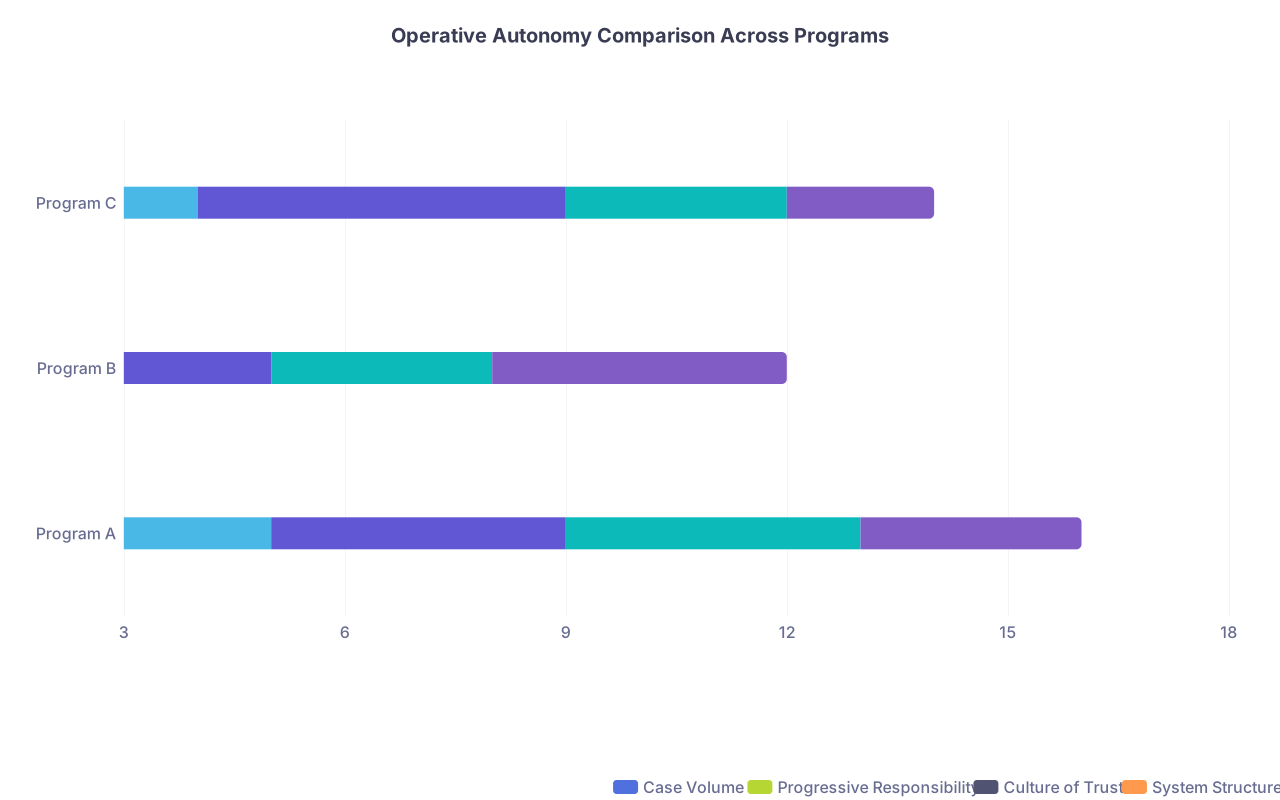
Example scoring for three hypothetical programs:
| Category | Case Volume | Progressive Responsibility | Culture of Trust | System Structure |
|---|---|---|---|---|
| Program A | 5 | 4 | 4 | 3 |
| Program B | 3 | 2 | 3 | 4 |
| Program C | 4 | 5 | 3 | 2 |
You might end up with something like:
- Program A: Strong volume and decent culture, earlier autonomy than most. Total: 16/20.
- Program B: Middle-of-the-road volume, back-loaded autonomy, but efficient system. Total: 12/20.
- Program C: Good early autonomy and volume, but fellows and structure sometimes steal cases. Total: 14/20.
Now at least you are arguing with yourself over specific tradeoffs, not vague impressions.
10. Second Looks and Away Rotations: The “Reality Check”
If you have done an away rotation or have the chance for a second look, this is where you verify everything you heard.

10.1. During Away Rotations
Watch:
- Who is holding the camera? The attending or the resident?
- Who opens and closes? Is that automatically delegated to residents or jealously controlled by staff?
- Does the resident verbalize a plan and execute it, or are they just hands following orders?
If the default is:
- Attending: camera, key steps, decision-making
- Resident: retract, suction, close skin
Autonomy is limited regardless of how friendly everyone is.
10.2. Use the Zwisch Scale as a Mental Filter
Many ORs now use the Zwisch scale (or similar) to describe autonomy:
- Show and Tell
- Active Help
- Passive Help
- Supervision Only
You can mentally tag cases you observe:
- “This was Active Help – attending guided most steps.”
- “This was Supervision Only – attending in the room, but resident clearly ran the case.”
Programs where senior residents are consistently at Passive Help or Supervision Only for bread-and-butter work are doing something right.
11. Weighing Autonomy Against Everything Else
Here is the part people forget: maximal autonomy at the cost of safety or education is not a win.
You want a sweet spot:
- You are pushed, but not hung out to dry.
- You have backup, but not micromanagement.
- You leave residency safe and efficient, not just “good enough.”
Use autonomy as a heavy but not exclusive factor in your ranking. If you are choosing between:
- A place with slightly less autonomy but strong mentorship, didactics, and fellowship placement
- A place where you will be “thrown in” with weak support
You should usually take the first.
12. Putting It All Together: A Simple Comparison Template
Make yourself a one-page sheet and use the same template for every program. For example:
| Factor | Evidence/Notes | Score (1–5) |
|---|---|---|
| Case Volume | ||
| Key Bread-and-Butter Ops | ||
| Progressive Responsibility | ||
| OR Culture and Trust | ||
| Fellows Impact | ||
| System Structure |
Fill it within 24 hours of each interview before your memory is contaminated by the next place.
Over 10–15 programs, you will start to see patterns. You will also see that your “rank by prestige” list often does not match your “rank by real operative autonomy” list.
That tension is where you must be honest with yourself about what you actually want your hands to be able to do five years from now.
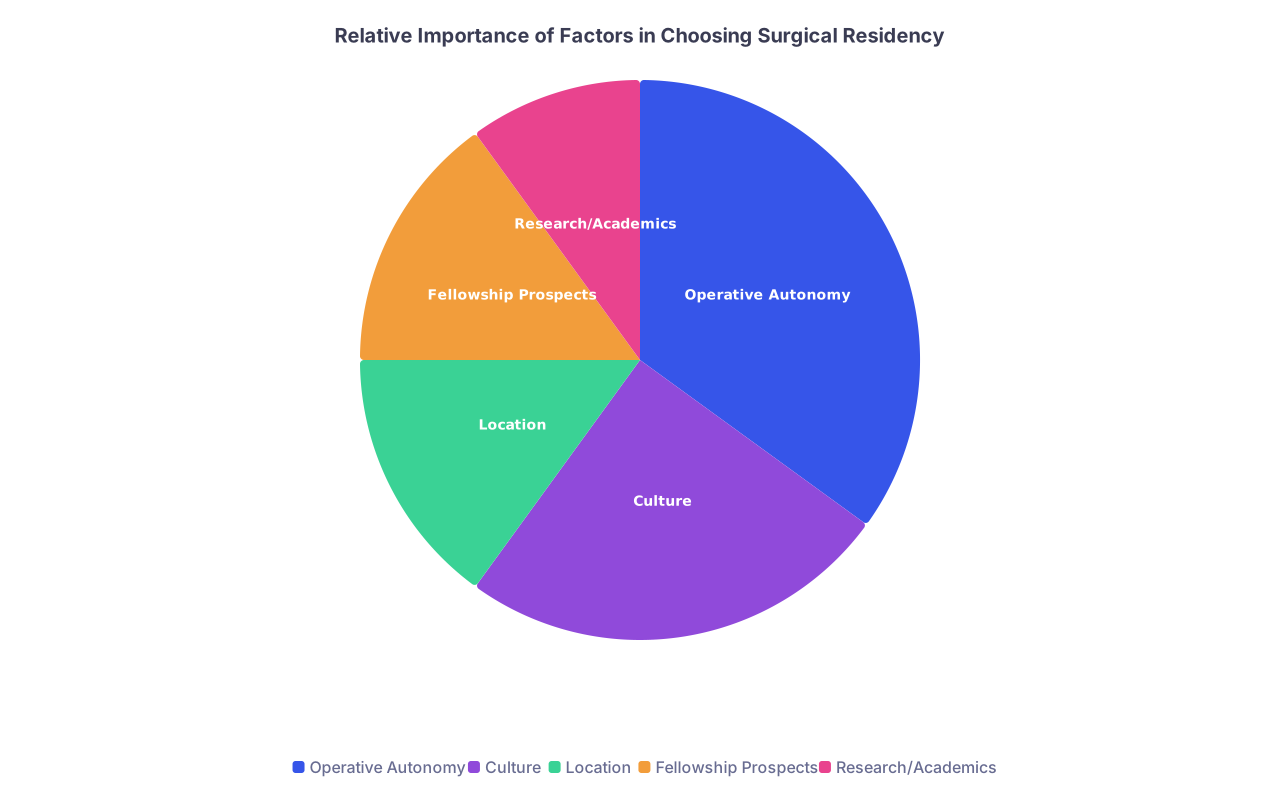
| Category | Value |
|---|---|
| Operative Autonomy | 35 |
| Culture | 25 |
| Location | 15 |
| Fellowship Prospects | 15 |
| Research/Academics | 10 |