
The way most residents “choose” between community and academic surgery is backwards.
They chase the brand name, the perceived prestige, or what their favorite attending did. Then two years later they are quietly miserable because their actual day-to-day life looks nothing like what they thought they signed up for.
You are not choosing a label. You are choosing a work-life pattern, a culture, a financial trajectory, and a set of tradeoffs that will show up in your calendar every single week.
This is fixable. You need a structured way to compare, not vibes and Instagram.
Below is exactly that: a practical, structured worksheet to decide between community and academic surgery, built around how decisions are actually made in residency and early practice.
Step 1: Understand the Real Differences (Not the Myths)
Let me cut through the usual lazy talking points.
What people say:
- “Academic surgery = research and teaching”
- “Community surgery = more money and better lifestyle”
- “You can always go community after academic, but not the reverse”
- “Academics are more ‘elite’ cases; community is bread and butter”
Some of that is partly true. A lot of it is half-right and dangerously oversimplified.
Here is the cleaner version you should actually use:
| Dimension | Community Surgery | Academic Surgery |
|---|---|---|
| Primary Incentive | Volume & efficiency | RVUs + academic output |
| Main Roles | Clinical care | Clinical + teaching + research |
| Common Schedule | OR + clinic, less fixed didactics | OR + clinic + regular conferences |
| Promotion Metric | Productivity & call coverage | Publications, teaching, reputation |
| Typical Comp (Gen) | Higher base + bonuses | Lower base, some incentives |
That table is the “30,000-foot” view. Useful, but not enough.
You need to translate this into your own values, tolerances, and goals. That is where the worksheet comes in.
Step 2: Build Your Personal Priorities Grid
You cannot decide between community and academic surgery until you know what problem you are actually solving for.
For most residents, the real question is not “community vs academic?” but:
- Do I care more about time control or case complexity?
- Do I want autonomy now or prestige/options later?
- Do I want to teach and publish or just operate and go home?
You will rank these wrong if you keep them in your head. Put them on paper.
2.1 Core Priority Domains
Use this list to create a grid with two columns: Importance (1–5) and Notes.
- Case mix and complexity
- Research and academic output
- Teaching and mentoring
- Income and financial trajectory
- Schedule predictability and lifestyle
- Geographic flexibility
- Institutional support / resources
- Administrative burden / meetings
- Speed to OR autonomy
- Prestige and long-term optionality
Now, actually rank them from 1 (do not care) to 5 (non-negotiable).
Here is what a typical PGY-5 thinks they prioritize:
- Case mix: 5
- Prestige: 5
- Research: 4
- Lifestyle: 3
Here is what they actually call me about three years later:
- “I never see my kids.”
- “Every week is another committee meeting.”
- “I do not care about my h-index anymore; I just want a predictable schedule.”
So be brutally honest now. This worksheet is not for your PD or your program letter. It is for you.
Step 3: The Structured Worksheet – Community vs Academic
Here is the core tool. Copy this into a spreadsheet, Notion, or a legal pad. But do not skim it. The value is in filling it out.
For each row, score Community and Academic from 1–5 for how well that pathway could give you what you want. Then multiply by your personal importance score from Step 2.
| Dimension | Your Importance (1-5) | Community Score (1-5) | Academic Score (1-5) |
|---|---|---|---|
| Case complexity | |||
| Research opportunities | |||
| Teaching residents/med students | |||
| Income potential (10-year view) | |||
| Lifestyle / predictability | |||
| Geographic options |
Extend this to 12–15 rows using the domains from Step 2.
Then:
- Community weighted total = sum(Community Score × Importance)
- Academic weighted total = sum(Academic Score × Importance)
Whichever is higher is your current “data winner.” It is not a verdict. It is a starting point for reality-testing.
Step 4: Reality Check With Actual Data, Not Stories
This is where most residents fail. They stop at vibes and one mentor’s experience from 2009.
You will do better.
4.1 Get hard numbers on workload and pay
You want specific, local data. Not national averages from Medscape summaries.
Ask recent grads (from your program) in both tracks:
- “How many clinical days per week are you in the OR vs clinic?”
- “How many calls per month, and what does a typical call night look like?”
- “What is your real compensation (base + call + bonuses) and about how many work hours per week for that?”
Capture answers and compare:
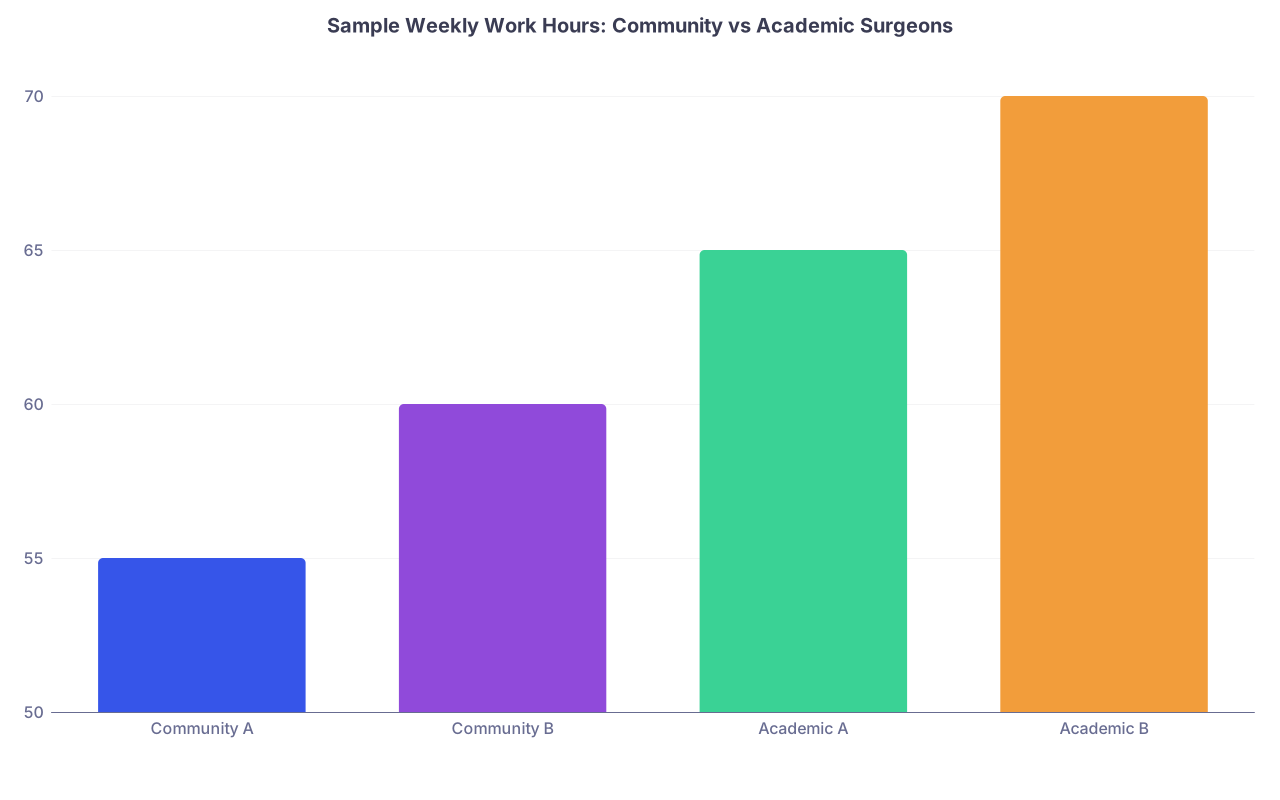
| Category | Value |
|---|---|
| Community A | 55 |
| Community B | 60 |
| Academic A | 65 |
| Academic B | 70 |
This is not theoretical. I have seen:
- Community general surgeon: ~55 hours/week, heavy OR, minimal meetings, high income.
- Academic general surgeon: ~65–70 hours/week, more meetings and admin, lower income, but doing advanced HPB or MIS cases that almost never hit pure community settings.
Plug your local numbers into your worksheet notes.
4.2 Clarify what “academic” actually means at a place
Some “academic” jobs are community jobs with residents and a university logo. Others are real research jobs with protected time and grant pressure.
You must ask:
- “How much true protected time do junior faculty actually get, and is it honored?”
- “How is promotion decided: RVUs only, or publications / teaching evaluations?”
- “How many surgeons here have R01 or equivalent funding?”
Red flag: An “academic” department where the junior hires are all on 100% clinical contracts with “maybe some research on your own time.”
4.3 Check for pseudo-community jobs
On the other side, many big health systems sell “community jobs” that function like academic-lite:
- Tons of meetings
- RVU pressure
- Limited autonomy because of corporate protocols
You want to know:
- “How many committees or regular meetings are you expected to sit on?”
- “Is there any expectation of hospital leadership / admin participation?”
- “Do you ever scrub with trainees from affiliated residencies?”
Again, write this into your worksheet.
Step 5: Map Your Career Timeline – Not Just Your First Job
You are not choosing a job for PGY-6. You are setting up what doors will be easier or harder to open at years 10 and 20.
Let us do it visually.

| Step | Description |
|---|---|
| Step 1 | Residency |
| Step 2 | Academic Fellowship |
| Step 3 | No Fellowship |
| Step 4 | Academic Faculty |
| Step 5 | Community with niche expertise |
| Step 6 | Pure Community |
| Step 7 | Leadership or Research Track |
| Step 8 | High volume local expert |
| Step 9 | Generalist community surgeon |
Key realities:
- Going academic → community later is usually straightforward.
- Going pure community → competitive academic is harder without strong research / fellowship / network. Not impossible. But harder.
- Hybrid models (academic-affiliate community hospitals, large systems) blur lines. That can be good or bad depending on how you like ambiguity.
Use this step to ask:
“Where do I want to be in 10 years, and which choice makes that easier, not harder?”
Write a 2–3 sentence “10-year snapshot” for each path:
- Academic path snapshot: “HPB surgeon at university center, 70% clinical, 20% research, 10% teaching, on promotion track.”
- Community path snapshot: “High-volume general surgeon in mid-size city, heavy laparoscopy, mentoring APPs, clinical only, strong income.”
Then ask: which picture makes you feel relieved? Which makes you feel trapped?
Your body’s reaction is useful data. Add it to your notes.
Step 6: Use Targeted Questions On Rotations and Interviews
You already have access to the laboratory for this decision: your rotations.
Stop just “doing the cases.” Start running your worksheet in the background.
On academic services, ask junior faculty privately:
- “What surprised you most about academic surgery after training?”
- “If you had to switch to community practice tomorrow, what would you miss most?”
- “How much of your job would you say is meetings and email versus OR and clinic?”
On community rotations or away sites:
- “How many nights per week are you really opening the abdomen at 2 a.m.?”
- “If someone loves teaching and some research, would they be happy here?”
- “What percentage of cases do you feel you ‘time pressure’ because of RVUs or block time?”
Then go back to your worksheet and adjust scores based on what you see and hear.
Step 7: Numerical Tie-Breakers and Red Flags
Sometimes your community and academic weighted scores end up close. That means one of three things:
- You are actually fine with either path and overthinking.
- You are lying to yourself about one or two importance ratings.
- You do not have enough real-world data yet.
Here is how to break the tie.
7.1 The 3 Non-Negotiables Test
Identify your top 3 non-negotiables from Step 2.
Example:
- Non-negotiable #1: Must have time at home most evenings.
- Non-negotiable #2: Want to operate a lot, not mostly clinic.
- Non-negotiable #3: Need to be in a specific geographic area for family.
Now deliberately ignore total scores and ask:
For each path, do I clearly get all three non-negotiables most of the time?
If one path fails even one, it is the wrong choice for now.
7.2 The “Worst Reason” Audit
Ask yourself bluntly:
“What is the worst, dumbest reason I am leaning toward this path?”
Common answers:
- “Everyone I respect is academic.”
- “It feels like I am ‘settling’ if I go community.”
- “My PD implied academics was ‘expected’ from our program.”
- “Money. Just money.”
If your leaning is heavily driven by a bad reason, adjust your scores down by 1–2 points in the relevant dimensions and recalculate.
7.3 Beware these red flags
If you see any of the following, pause:
- A “research-heavy” academic job with zero funded investigators and no formal protected time.
- A “lifestyle” community job with 1:2 or 1:3 call and a revolving door of burned-out surgeons.
- Any job (academic or community) that cannot give you clear numbers on hours, call, and compensation.
You are not choosing blind. If they will not give you data, walk.
Step 8: Money, Debt, and “Lifestyle” – Do the Math, Not the Fantasy
Residents often hand-wave this. Bad idea. The difference between a mid-range academic job and a strong community job over 10–15 years is not trivial.
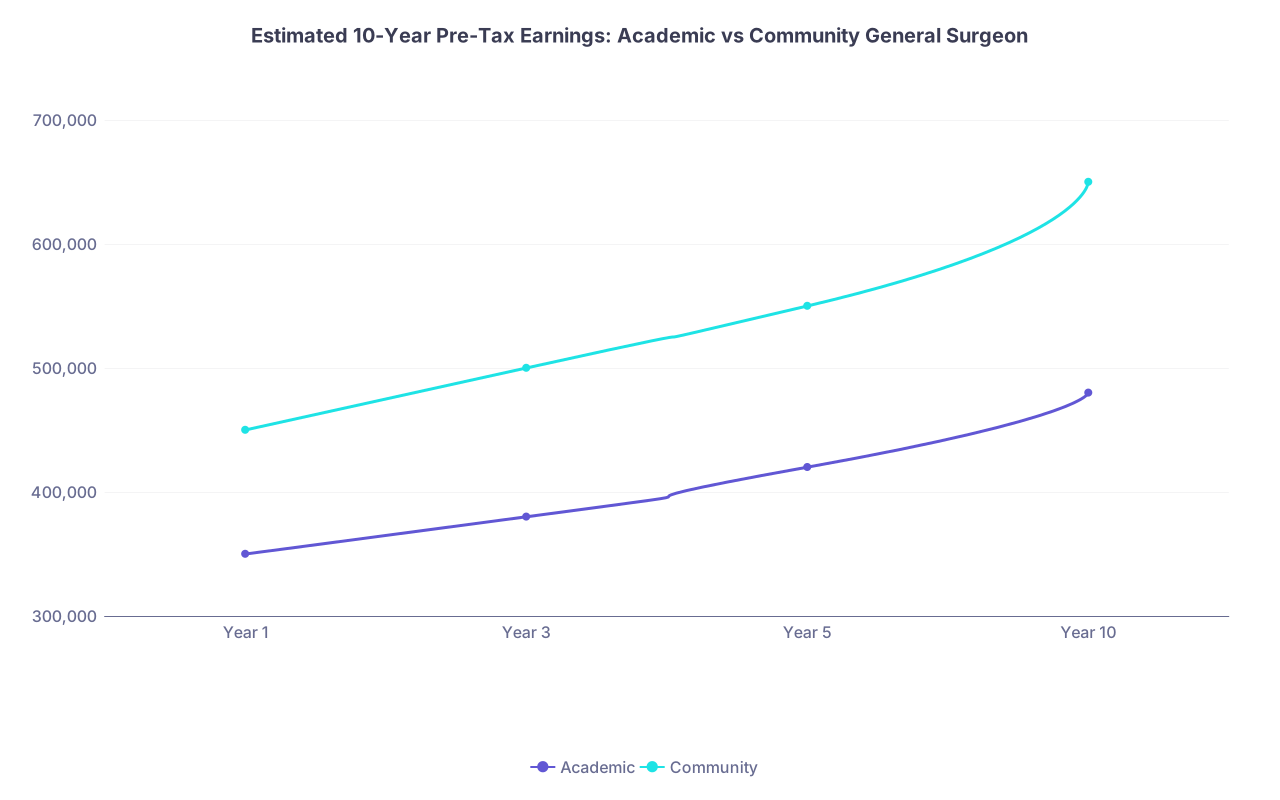
Let us sketch a very rough example for general surgery:
| Category | Academic | Community |
|---|---|---|
| Year 1 | 350000 | 450000 |
| Year 3 | 380000 | 500000 |
| Year 5 | 420000 | 550000 |
| Year 10 | 480000 | 650000 |
These are ballpark numbers, but the pattern is common:
- Community often offers higher initial and cumulative income.
- Academic sometimes catches up if you layer admin roles, leadership stipends, or side work – but that also costs time and energy.
Now overlay that with your debt:
- Write down your total educational debt.
- Look up realistic starting offers in your target region for both tracks.
- Estimate your annual loan payments under a standard or aggressive payoff plan.
Ask yourself:
“Does this job let me get out of debt on a timeline that does not make me resent my work?”
If the answer is “no,” do not pretend that a vague sense of “calling to academic medicine” will pay your loans.
Step 9: Hybrids and How To Use Them Intentionally
A lot of systems now are neither pure academic nor single-physician community shops. They are hybrids: large multispecialty groups, academic-affiliates, private groups staffing teaching hospitals.
These can be fantastic if you use them correctly.
Hybrids typically look like this:
- Residents and students present
- Some title with a university
- Mostly clinical work, light research, lots of teaching
- Compensation more like community than classic university faculty
They work well if your worksheet scores look like:
- High on teaching
- Low on hardcore research
- High on income and autonomous OR time
When you evaluate these, ask very specific questions:
- “Is promotion tied to the university track or the health system?”
- “Are there actual expectations for publications?”
- “How many residents rotate with you, and how often?”
Your worksheet should reflect them as a third column: “Hybrid.” Add it if you are seeing many of these jobs.
Step 10: Compress the Decision Into a One-Page Summary
After you have filled the worksheet, talked to real surgeons, and run the numbers, boil everything down into a one-page “Career Decision Snapshot.”
Include:
- Top 3 non-negotiables
- Community vs Academic weighted totals
- Your 10-year snapshot for each
- 3 biggest risks if you choose academic
- 3 biggest risks if you choose community
- Your current leaning in one sentence:
- “Given my priorities and data, I am choosing ___ because ___.”
This final compression matters. It forces you to own the decision in plain language.
Here is what a final statement might look like:
“Given that my top priorities are high operative volume, geographic flexibility, and aggressive debt repayment, I am choosing a community general surgery role in a mid-size city. I accept that I will do less complex HPB and have fewer national academic opportunities, but I will have more control over my time and finances, which matches where I am in life.”
That is a grown-up decision. No drama. Clear tradeoffs.
Quick Example: Two Different Residents Using the Worksheet
To show you how this plays out in real life, two composites I have seen repeatedly.
Resident 1: The Aspiring HPB Surgeon
- Loves complex cases, enjoys data and writing, not deeply attached to one city.
- Non-negotiables: case complexity, teaching, national reputation.
- Debt: moderate, but spouse works.
Worksheet result:
- Academic weighted score: 82
- Community weighted score: 56
Decision: Academic fellowship, then faculty at a university cancer center. Accepts lower income, more meetings, and moves to a different state. Ten years later, running a disease-specific program and happy.
Resident 2: The Surgeon-Parent With Anchors
- Two kids, partner with a stable local job, extended family nearby.
- Loves operating, neutral on research, likes teaching but not obsessed.
- Non-negotiables: geographic stability, evening family time, strong income to pay off $400k debt.
Worksheet result:
- Community weighted score: 88
- Academic weighted score: 61
Decision: Joins a group of 5 general surgeons at a regional hospital. Does some occasional precepting of residents from a nearby program. Incomes ramps quickly. No publications after residency and does not miss them.
Two good surgeons. Two different, correct choices.
FAQs
1. Can I start in academics and switch to community later without hurting my income?
Yes, in most cases. Starting in academics can even help you:
- Develop niche skills or a subspecialty reputation
- Build a CV that looks strong to high-quality community groups
- Clarify what you value once you see the tradeoffs up close
The key is not to stay in an academic job that drains you for 10–15 years if you already know you want out. A 3–7 year stint, then a planned transition to community, is a very normal path.
2. Is it realistic to do serious research in a community job?
Serious, grant-funded, high-output bench or translational research? Usually no. That still lives in academic centers.
But you can absolutely:
- Do outcomes or quality improvement projects
- Collaborate with academic partners as a site
- Publish case series or technique papers
- Participate in multicenter trials
If your worksheet says research is a 5/5 non-negotiable, you likely belong in academics. If it is a 2–3/5, a strong community or hybrid setting with some research options can be enough.
3. What if my program culture looks down on community surgery?
That is their problem, not yours. Some academic-heavy programs subtly (or openly) treat community as “less than.” That is short-sighted.
Your job is not to conform to your PD’s fantasy roster. Your job is to build a career you can sustain for 30 years without burning out or resenting everyone around you.
Fill out your worksheet. Talk to actual surgeons living the lives you think you might want. Then pick the path that best matches your real priorities, not the prestige hierarchy in your program.
Key points to carry forward:
- Do not choose “community vs academic” as an identity. Use a structured worksheet tied to your real priorities and non-negotiables.
- Get hard local data on workload, compensation, and expectations; plug that into your grid and adjust.
- Make a one-page summary that forces you to own a clear, intentional decision, with eyes open to the tradeoffs on both sides.