The fantasy of surgery is addictive. The reality can eat people alive.
If you like surgery but you’re already terrified of burnout… you’re not naïve. You’re paying attention. Most applicants shove that fear down and say, “I’ll just work hard and be fine.” A lot of them are wrong.
You’re smarter for asking this now.
Let me walk through the uncomfortable questions that actually matter, not the Instagram version of “follow your passion.” Because the question isn’t “Is surgery hard?” It is. The real question is:
Is there a version of surgical training and practice that’s hard… but survivable for you?
First: Are You Scared of the Right Thing?
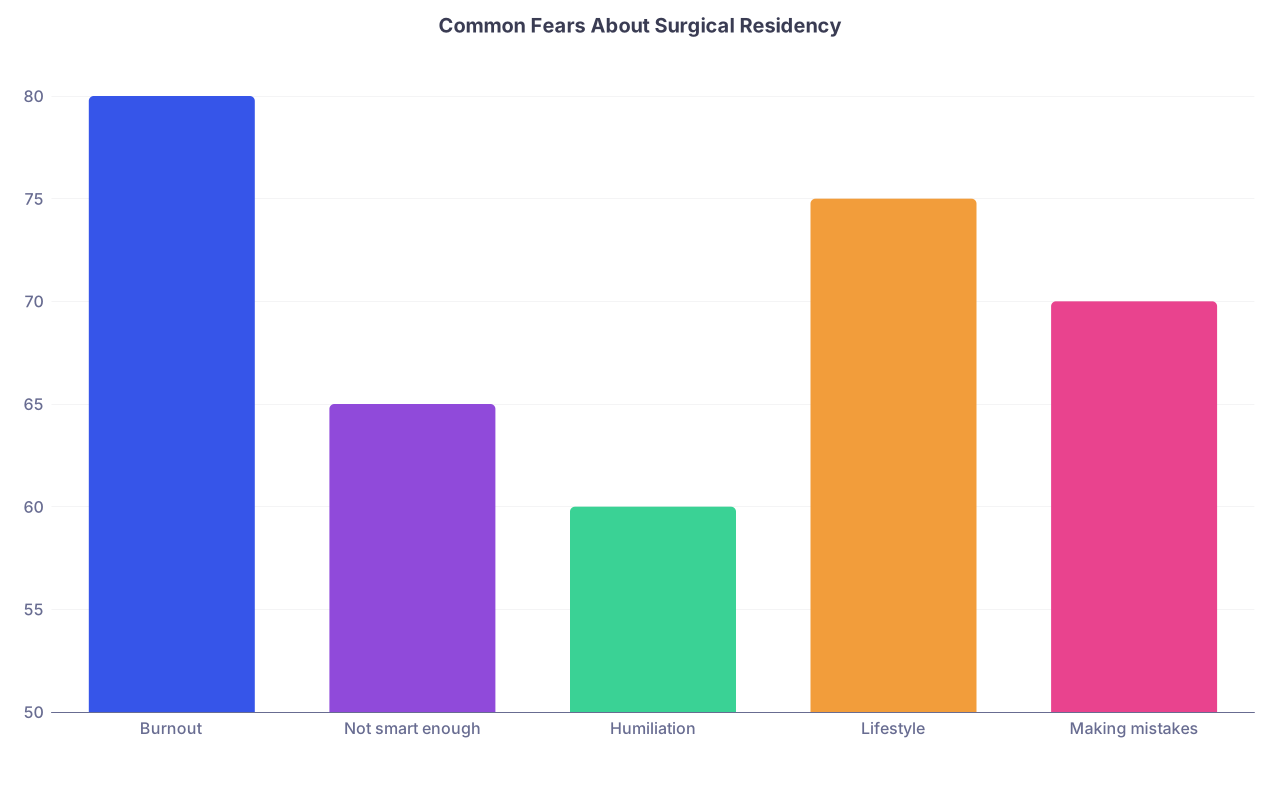
| Category | Value |
|---|---|
| Burnout | 80 |
| Not smart enough | 65 |
| Humiliation | 60 |
| Lifestyle | 75 |
| Making mistakes | 70 |
When people say “I’m scared of burnout,” they’re usually mixing together about five different fears:
- Chronic exhaustion – never sleeping, never recovering
- Losing yourself – hobbies gone, relationships ruined
- Emotional numbness – caring less and less about patients
- Being trapped – too deep in a specialty you now hate
- Becoming “that” surgeon – bitter, sarcastic, cruel
So first hard question:
What exactly are you picturing when you say “burnout”?
Don’t answer with a buzzword. Answer with scenes.
Are you seeing yourself:
- Standing in the OR at 2 a.m., brain fogged, fumbling a knot?
- Crying in your car post-call while your phone blows up with messages you don’t have energy to answer?
- Zoning out during sign-out because you’re thinking, “If I mess this up, someone dies”?
If you can actually name the nightmare scenario, we can start separating:
- What’s intrinsic to surgery
- What’s program-dependent
- What’s about your own wiring and coping style
Because some of what you’re scared of is unavoidable. Some is absolutely avoidable if you’re intentional. And some is you catastrophizing (yes, I’m calling it out — because I do it too).
The Brutal Questions About Who You Are (Not Just What You Like)
You don’t need to be a superhero to survive surgery. But you do need a specific kind of stubbornness and self-awareness.
Here are the questions I’d want you to answer honestly — even if the answers scare you.
1. How do you behave under sustained, ugly stress?
Not “big exam week” stress. I mean:
- Week 3 on trauma nights with no true day off
- 28-hour calls where your last two admissions died
- Scrubbed into a case that’s going badly and everyone in the room is tense
Ask yourself:
- Do you get sharper under pressure, or do you get scattered?
- When you’re exhausted, do you get mean, shut down, or oddly calm?
- After a horrible shift, do you spiral alone, or can you text/call someone and actually talk?
You don’t have to be perfect under stress. But if your pattern is:
“I shut down, avoid everyone, and stew in shame,”
surgery will hit that bruise over and over.
If your pattern is:
“I fall apart for a bit, then regroup, and I do reach out,”
that’s survivable. Even in rough programs.
2. Are you attracted to surgery… or to the identity of being a surgeon?
Be harshly honest here.
There’s “I love anatomy, procedures, fixing something with my hands.”
And then there’s “I like being the important one, the decisive one, the am-I-on-Grey’s-Anatomy one.”
Here’s the ugly truth:
If you’re pulled mainly by the status and drama, burnout hits faster. Because the reality is less “glory in the OR” and more:
- 5 a.m. pre-rounds on bowel obstructions
- 2 hours battling an EMR note
- Explaining to yet another family why their loved one can’t eat yet
So ask:
- When you shadowed or scrubbed, what moments lit you up? The quiet, tedious parts? Or only the flashy ones?
- Did you feel some weird satisfaction placing a Foley or suturing skin? Or did that feel beneath you?
If the work itself, even the boring pieces, felt intrinsically rewarding — that’s a protective factor against burnout.
If you mostly loved the idea of being a surgeon, but the grunt work annoyed you? That’s a red flag.
3. How much uncertainty can you emotionally tolerate?
Surgery is not just cutting. It’s owning consequences.
Post-op complications. Bleeds. Leaks. The patient who “should have” done well but didn’t.
Ask yourself:
- When something goes wrong on a rotation (even if it wasn’t your fault), do you replay it for days and feel sick?
- Can you hold “I did my best and this outcome still sucked” without feeling like a fraud?
- Or do you feel like any error means you shouldn’t be in medicine?
Every specialty has risk, but surgery shoves it in your face.
You don’t need to be fearless. But you do need to be able to function while afraid. If your brain immediately jumps to “I’m a failure and everyone knows,” that will erode you day by day.
The System: You vs. A Machine That Doesn’t Sleep
Let’s be clear: burnout is not just a “you” problem. The system is broken in many places.

Here are non-negotiable realities about most surgical residencies:
- Long hours. 70–80 is common. Some places skirt the rules.
- Physical exhaustion. Standing, retracting, late cases, pagers at 3 a.m.
- Emotional weight. High acuity, life-and-death decisions, angry families.
- Hierarchy. You will be yelled at somewhere, sometime. It’s not right, but it’s real.
So your question isn’t “Can I find a chill surgical residency with 50-hour weeks?” Probably not.
The actual questions to ask:
- Do I want surgery enough that I’d accept 5+ years of being tired and stretched, if the environment isn’t toxic?
- Am I willing to do the work upfront to find (and rank) programs that are intense but not malignant?
- Do I believe there’s a post-residency version of surgical life I’d actually enjoy living?
Because the crazy part is: for many people, post-residency is drastically better. But you have to survive residency first.
Concrete Questions to Ask About Programs (Burnout Filters)
You’re not powerless here. You can screen hard for programs more likely to destroy you vs. grow you.
Here’s what to look into, ask outright, or quietly observe:
| Aspect | Red Flag | Green Flag |
|---|---|---|
| Culture | Residents warn you off privately | Residents are tired but not bitter |
| Hours | Bragging about ignoring duty hours | Honest about busy but protected time |
| Support | No mention of wellness except a slide | Real examples of help after crises |
| Education | All service, minimal teaching | Protected teaching that people attend |
| Chiefs | Checked out, cynical | Protective of juniors, realistic but invested |
Questions to literally ask residents when faculty aren’t around:
- “What happens when someone is struggling or behind? Who helps?”
- “Are there attendings people avoid for being abusive?”
- “What’s your absolute worst rotation, and why?”
- “How many people have left the program in the last 5 years?”
If they dodge. If they laugh and say, “We all suffer together haha.” If someone says, “We had 3 people quit but that’s just surgery.”
Your burnout fear is justified there.
You vs. Lifestyle: Do You Actually Need a Chill Life?
Here’s a scary but necessary question:
Are you someone who needs a lot of recovery to feel human? Or can you function decently on less?
I don’t mean, “Do you like having free time?” Everyone does.
I mean:
- Do you fall apart emotionally if you lose sleep for multiple nights in a row?
- Do you get physically sick and stay sick when run down?
- Are hobbies and social time essential to your mental stability, or just really nice to have?
If you’re the type who genuinely unravels with:
- Chronic sleep deprivation
- Repeated social isolation
- No time for exercise or therapy for chunks of time
Then you need to ask:
Is there a surgical path that realistically gives you the minimum stability you need?
Sometimes that answer is:
- A more “lifestyle” surgical field (ophtho, ENT in some settings, certain plastics paths)
- A specific type of practice after training (suburban group with protected OR block, not 24/7 trauma center)
- Or… honestly… a non-surgical specialty that still does procedures (GI, cards, IR, EM, anesthesia).
None of that means you’re weak. It means you’re honest about what keeps you alive and not resentful.
The Actually-Smart “What If” Questions
Let’s weaponize your anxiety a bit. Use it on purpose.
Here are “what if” questions that are actually productive:
What if I pick surgery and hate residency by PGY2?
- Would I rather try and leave than always wonder “what if”?
- Could I see myself switching to another field if needed, even if it feels humiliating?
What if my worst-case program happens: malignant culture, constant yelling?
- Would I speak up? Transfer? Or would I silently absorb it?
- Am I willing to rank programs more conservatively to lower that risk?
What if I burn out and become the bitter attending I’m afraid of?
- Are there boundaries I am committed to, even if everyone else breaks them?
- Who in my life would call me out if I started turning into that person?
Those sound dark, but they force you to map out escape hatches and guardrails. That reduces fear, because “I have options” is the enemy of burnout.
Tiny Reality Check: Lots of Residents Are Tired… and Still Glad They Chose Surgery
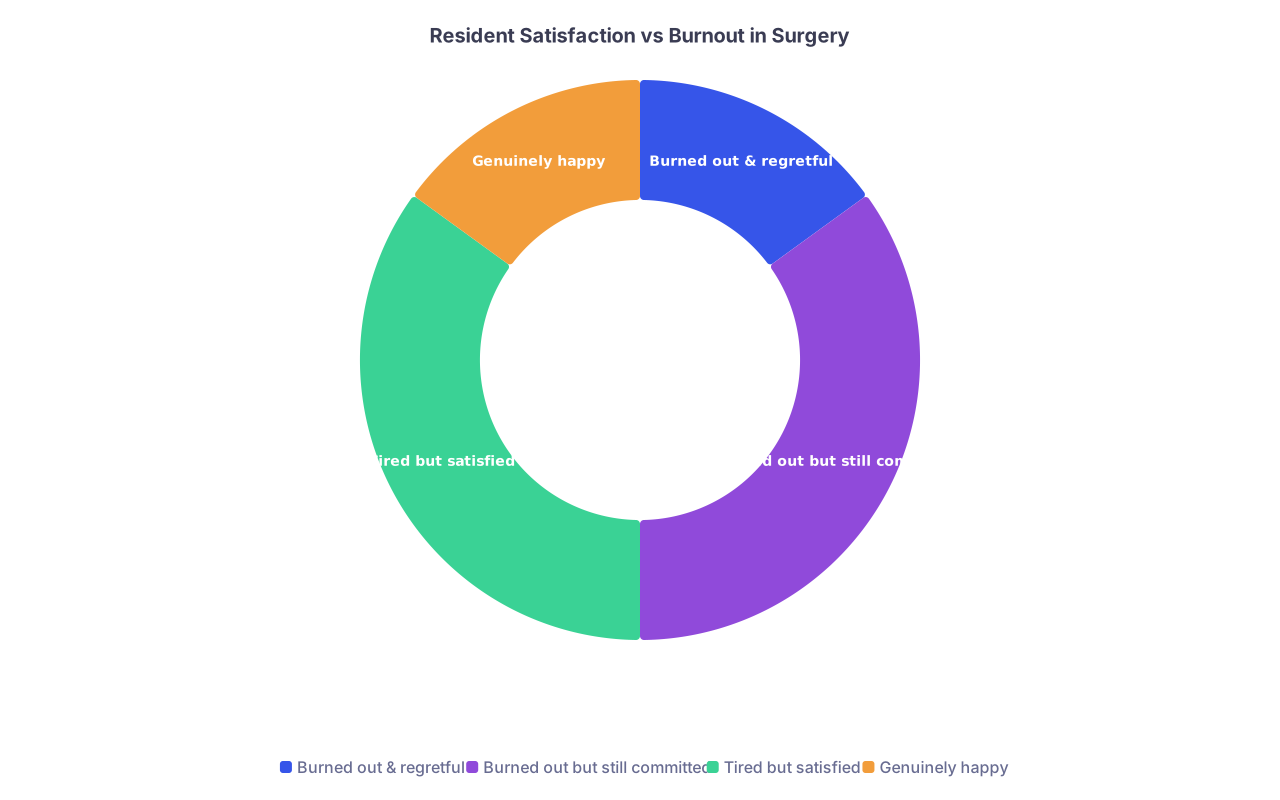
| Category | Value |
|---|---|
| Burned out & regretful | 15 |
| Burned out but still committed | 35 |
| Tired but satisfied | 35 |
| Genuinely happy | 15 |
I’ve seen residents who:
- Look wrecked post-call
- Complain constantly about notes, consults, and scut
- Still light up in the OR and say, “I can’t imagine doing anything else”
Are they at risk of burnout? Yes. Are they miserable 24/7? No.
You’re not signing away your soul. You’re signing up for a job that’s high-risk, high-demand, and yes, deeply fulfilling for a specific personality type.
The real self-test is this:
On your worst surgery days so far — exhausted, maybe humiliated, maybe hungry — did you still have some part of you that thought, “I want to be better at this”?
If even your bad days feel meaningful in a twisted way, that’s a strong signal.
If your bad days feel meaningless and degrading, pay attention to that.
A Practical Self-Interrogation Exercise (Do This, Not Just Think About It)
Take 30–40 minutes and actually write this out somewhere private. No polishing. Just answer:
- “If I woke up as a non-surgical physician 10 years from now, my first honest feeling would be…”
- “The last time I did or saw a procedure, the specific moment that made me feel alive was…”
- “The part of surgical training that scares me most is… and if it actually happened, here’s how I imagine I’d cope (realistically, not heroically)…”
- “The minimum life I need to not collapse is: ___ hours of sleep most nights, ___ close people I actually see/talk to weekly, ___ hours/month of something non-medical.”
- “3 programs or attendings I’ve heard about that felt like, ‘I could be that kind of surgeon, not the stereotype,’ are…”
You’ll probably find one of these three things when you write it out:
- “Wow, I’m terrified but I still clearly want surgery.”
- “I like parts of surgery but I’m more in love with being useful and procedural — maybe other fields fit that too.”
- “I think I’ve been forcing the surgery dream because I’m scared of being seen as ‘less intense’ if I pick something else.”
All three are valid. The first one just means: okay, now design a path that doesn’t crush you.
A Quick Visual: Your Next 10 Years If You Choose Surgery

The point of this diagram: there is no single fate. People switch. People thrive. People burn out and then recover. You’re not locking yourself into a single square forever.
FAQ – 6 Specific Fears You Probably Have
1. What if I start surgery and realize by PGY1 I hate it?
Then you talk to your PD, mentors, and honestly, yourself. People do switch. It’s painful, yes. Ego-bruising, yes. Career-ending, no. I’d rather you try and pivot than spend 30 years wondering “what if” while resenting your current specialty.
2. Am I weak if I’m already worried about burnout before I even start?
No. The delusional ones are the people who think, “I’ll just grind harder and be fine.” Concern about burnout is actually a sign you understand the stakes. The key is not to let that fear paralyze you. Use it to pick programs carefully and set non-negotiable boundaries.
3. How do I know if I’m “tough enough” for surgery?
“Tough enough” in surgery looks less like swagger and more like: you can get knocked down, embarrassed, exhausted, and still show up and learn. If you crumble with any criticism and hold onto it for months, that’s a problem. If you hurt, but you adapt and improve, you’re fine. Emotional sensitivity isn’t disqualifying — total fragility might be.
4. What if I love the OR but hate everything else about surgery?
Then you need to explore fields that let you be procedural without full surgical residency: interventional radiology, GI, cardiology, EM with lots of procedures, anesthesia, maybe even critical care. Loving the OR feeling isn’t unique to surgeons. But if the whole arc of surgical care — pre-op, post-op, complications — feels intolerable, pay attention.
5. Does choosing a “chiller” surgical subspecialty actually protect against burnout?
Sometimes. Ophtho, ENT, some plastics, certain community general setups — they can be saner. But residency can still be brutal. And the culture still matters. You can burn out in a “lifestyle” field if the environment is toxic. So don’t rely on reputation alone. Ask residents, look at call schedules, attrition rates, and how attendings act.
6. What’s one real sign I should not do surgery?
If, deep down, your honest thought is: “I could be happy in multiple other fields, but I’m choosing surgery mainly because it feels more impressive / hardcore,” that’s a red flag. You need some inner, stubborn pull toward the work itself — enough that you’d endure years of training for it. If that’s not there, you’re signing up for a long, painful performance.
Open a blank document or your notes app right now and write one brutally honest paragraph finishing this sentence:
“If I don’t choose surgery, the part of me that will feel most relieved is the part that’s afraid of ________.”
What you put in that blank will tell you whether your fear is protecting you from a bad fit, or just trying to keep you safe from something hard but worthwhile.