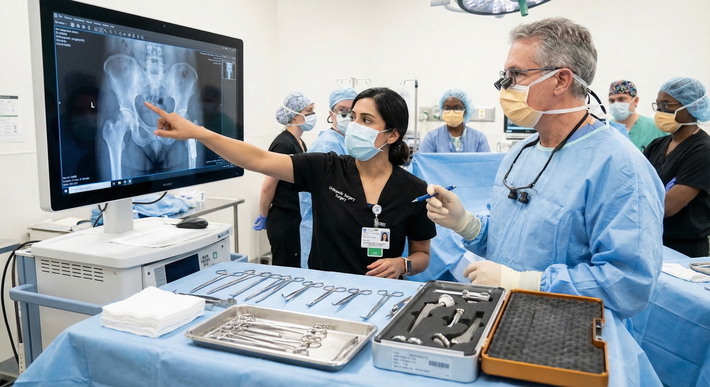
Last week I watched an introverted prelim surgery intern quietly stand in the corner of a crowded workroom while three loud residents argued over the OR schedule. She knew the answer to the question they were stuck on. She didn’t say a word. Later she told me, “I love the OR more than anything. But I feel like this field was built for extroverts, and I’m just…wrong for it.”
If your stomach just dropped because that feels a little too familiar, then yeah, this is for you.
The Fear You’re Probably Not Saying Out Loud
Let me just name the actual nightmare version you’re probably running on loop:
“I match into surgery, I’m quiet and awkward, everyone hates working with me, attendings think I’m disengaged, co-residents think I’m weird, I never get good cases, I burn out, I regret everything, and I’m trapped.”
You’re not asking, “Can introverts be surgeons?”
You’re asking, “Can I survive five brutal years in a culture that seems designed for aggressive, loud, hyper-social people when I need to go home and stare at the wall after a 15-minute group conversation?”
Here’s the uncomfortable truth first: surgical residency is very, very social. You can’t “opt out” of people. You will:
- Pre-round with teams
- Present on rounds
- Call consults
- Talk constantly in the OR
- Manage angry families at 2 a.m.
- Handle nurses, anesthesia, ED, consultants, admin…all day
It’s not a solitary job.
But.
Being socially introverted is not the same as being bad at people. It just means people drain you.
The real question is: can you build a version of yourself that works in public without erasing who you actually are?
I’ve seen residents do exactly that. Quiet, anxious, low-social-battery residents who absolutely thrived. And I’ve also seen people who tried to “fake extrovert” their way through and nearly broke.
So you need to be very clear on what parts of this are actually dealbreakers…and what’s just fear talking.
What Surgical Residency Really Looks Like for an Introvert
Let’s strip the Instagram-filtered “I love surgery!” stuff and look at the day-to-day of a typical general surgery resident if you’re introverted.
1. The OR: Your Safe Zone…Mostly
You already know this: you love the OR.
You probably feel calmer there. It’s structured. There are rules. Your hands are busy. You’re not making small talk about weekend plans every 5 minutes.
The OR is:
- Focused
- Hierarchical (you know who’s in charge)
- Task-based (“Do X, then Y, then Z”)
But here’s the part people don’t tell you: it is also a performance space.
You will be:
- Pimped constantly
- Expected to “think out loud”
- Watched for signs of interest/initiative
- Judged on how you communicate with scrub techs, nurses, anesthesia, attendings
If your introversion shows up as:
“I’m quiet, but when I’m comfortable I can answer confidently” → workable.
If it shows up as:
“I freeze when spoken to, go blank when put on the spot, and need 10 seconds of silence before I answer a question” → that’s trainable, but rough in the OR.
So yes, you can love the OR and still struggle with the social exposure inside it. And that’s the tension you need to be honest about.
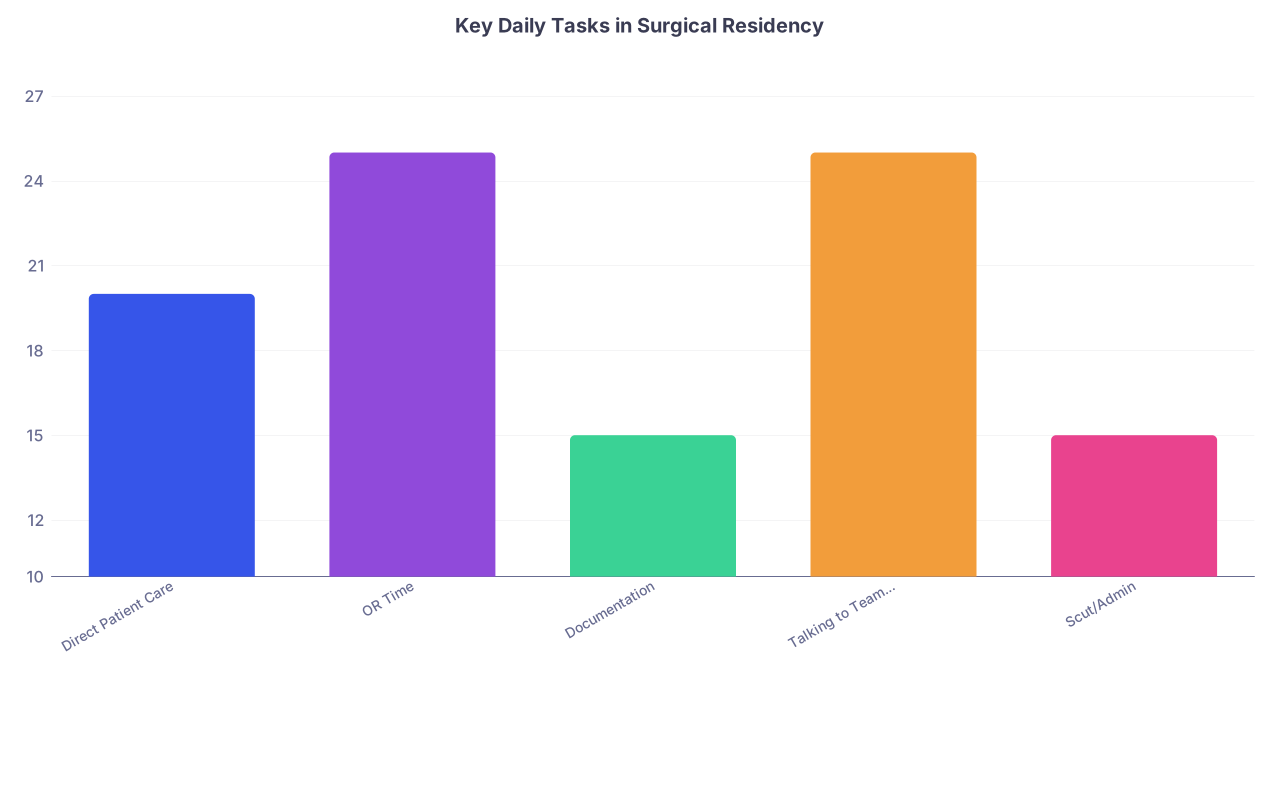
| Category | Value |
|---|---|
| Direct Patient Care | 20 |
| OR Time | 25 |
| Documentation | 15 |
| Talking to Teams/Families | 25 |
| Scut/Admin | 15 |
2. Workrooms, Rounds, and the Social Olympics
Workrooms are where introverts quietly die inside.
They’re loud. People are venting, joking, trauma-bonding. There’s always at least one resident who narrates everything they’re doing. If you’re the quiet one:
- People may assume you’re disengaged
- Or think you don’t like them
- Or just…forget you’re there
On rounds, you’re presenting constantly. No way around that. You don’t have to be entertaining, but you do have to be clear, efficient, and audible. Mumbled, hesitant, apologetic presentations get destroyed, especially by old-school attendings.
None of that requires you to be extroverted. It does require:
- Voice projection
- Organized thinking under pressure
- Willingness to speak even when you’re anxious
All of that is learnable. Not easy. But learnable.
Where Introverts Quietly Get Punished in Surgery
Let me be blunt about the actual risk zones, because pretending they don’t exist won’t help you.
1. Evaluations and “Perception”
Attendings and seniors often equate:
- Talkative = engaged
- Silent = checked out or uninterested
So you, sitting quietly at the back of M&M, taking notes and thinking hard? That can look like not caring. That’s infuriating but real.
You’ll see words like:
- “Could be more engaged”
- “Needs to speak up more”
- “Quiet, hard to read”
And if that piles up, it can affect:
- Letters of recommendation
- Fellowship support
- Who wants you on their team
This is where a strategic version of yourself has to show up. Not fake. Intentional.

2. Getting Cases and Opportunities
Here’s the crappy part: a lot of surgical culture is “you eat what you kill.” If you aren’t:
- Asking for cases
- Saying “I’d really like to do more vascular”
- Volunteering for tough consults
You can easily get overlooked. Not because people hate you. Because they’re busy and they give stuff to whoever’s in their face asking.
If your natural style is: “I’ll wait until someone offers” — you will lose. Every time. The louder, more in-your-face people will get more.
That doesn’t mean you have to become loud. It means you need a scripted version of asking:
- “Dr. X, I’m really interested in more lap chole cases. If one comes up and it’s appropriate, I’d love to scrub.”
- “On my next call, could I be the primary on any acute abdomens that need to go to the OR?”
Short. Direct. Not chatty. But visible.
Signs You Can Survive (And Maybe Even Do Well)
Let me flip it for a second, because I don’t want this to sound like: “introvert = doomed.” I’ve seen some absolutely phenomenal quiet residents.
The ones who did well tended to have these traits:
Task-and-detail focus – They were ridiculously reliable. Nurses loved them because when they said they’d do a thing, it got done.
Curiosity that shows up as preparation – They weren’t the loudest in the room, but they showed up having read, knowing the anatomy, anticipating next steps. Attendings do notice that.
One-on-one strength – They might shrink in groups, but in a single room with a patient or scrub tech, they were warm, steady, and reassuring. Introverts can be incredible at this.
Steady under chaos – They didn’t get louder when things got crazy. They got calmer. The room will forgive a lot if you’re the calm center in a bad trauma.
Capacity to “act extroverted” in short bursts – They treated talking like a procedure: “I’m going to go do this conversation, then I’ll recharge later.” Not 24/7, but in key moments.
If you read that list and thought, “Okay, that sounds like me or at least possible for me with practice,” that’s a very good sign.
If you thought, “Nope, I hate conflict, I crumble when someone snaps at me, I avoid phone calls at all costs, and I’d rather do anything than talk to someone angry” — that doesn’t automatically rule you out, but it means residency will hit your weak spots constantly.
| Specialty | OR-Heavy | Clinic-Heavy | Social Intensity | Notes for Introverts |
|---|---|---|---|---|
| General Surgery | High | Moderate | High | Most chaotic, very team-based |
| Plastics | High | Moderate | Moderate | More controlled, aesthetics-focused |
| ENT | High | Moderate | Moderate | Often smaller teams |
| Ortho | High | Low-Med | High | Very bro-culture in some places |
| Vascular | High | Low-Med | High | Very sick patients, lots of consults |
Things You Don’t Need to Be to Survive Surgery
Let’s clear out some fake “requirements” that freak introverts out.
You do not have to:
- Be the funniest person in the workroom
- Go to every social event, happy hour, or post-call brunch
- Be the resident who tells stories during every case
- Enjoy constant small talk
- Want to be “the face” of the program
What you actually need:
- Clear communication (even if it’s brief)
- Dependability
- Baseline social skills (not charm, just skills)
- Ability to tolerate conflict without melting
Notice what’s not on that list: “extroverted.”
You can be quiet and still check all those boxes.

| Step | Description |
|---|---|
| Step 1 | Pre-rounding |
| Step 2 | Present on rounds |
| Step 3 | Talk with nurses |
| Step 4 | Call consults |
| Step 5 | OR team communication |
| Step 6 | Update families |
| Step 7 | Sign out to night team |
Red Flags That Surgery Might Actually Be the Wrong Fit
I’m not going to sugarcoat this. There are situations where being socially introverted plus certain traits makes surgery miserable.
Big warning signs:
- You routinely shut down when corrected sharply or yelled at
- You avoid speaking up even when you know you should (patient safety issues)
- Phone calls terrify you and you procrastinate on them
- You never ever ask questions in front of others because it feels humiliating
- You need a lot of alone time during the day to feel functional
Those are survivable in med school. In residency, they aren’t just “personality quirks” — they become patient safety problems and evaluation problems.
Can those improve with therapy, coaching, practice? Absolutely. I’ve seen people transform. But you need to be honest:
- Are you already working on this?
- Or are you hoping “residency will force me to get better” (it won’t, it’ll just hurt more)?

How to Test This Before You Commit Your Life to It
If you’re early enough, you can still run some real-world experiments.
Do longer sub-internships in surgery-heavy services.
Not just 2 weeks. Do a full month. Watch not just your interest — watch your energy. Are you wiped but satisfied? Or wiped and hollow?Pay attention to feedback.
Do people say:- “You’re quiet, but solid and prepared”? Good.
- Or “You seem disengaged, you need to speak up more”? That’s fixable but a big warning.
Ask trusted residents privately:
“I’m more on the introverted side. You’ve seen me on this rotation — do you honestly think I’d do okay in a program like this?”Therapy or coaching specifically about assertiveness.
If even ordering food over the phone makes you anxious, practice here before you sign up for a field where you’ll be calling consults at 3 a.m.
Survival Strategies If You’re Introverted and Still Choose Surgery
If your gut still says, “I want the OR,” then fine. Let’s at least make a survival blueprint.
Pick program culture carefully.
Avoid the “shouty, malignant, everyone’s crying in the bathroom” reputation places. Look for:- Residents who are not all the same alpha personality
- Programs that talk about wellness without sounding fake
- Smaller programs where you can be known as a person, not a number
Protect your recharge time with your life.
You won’t get much alone time, but:- Eat at least one meal without forced socializing when you can
- Take 5 minutes alone in a stairwell after a rough case
- Don’t apologize for going straight home post-call instead of brunch
Script your “extrovert bursts.”
Literally plan lines for:- Asking for a case
- Updating a family
- Calling a consult
Treat it like learning lines for a role. You’re not faking your personality, you’re building skills.
Lean into your strengths.
- Be the resident whose notes are precise
- Be the one who always calls back promptly
- Be the steady, calm one when everyone else is spiraling
Find at least one attending and one co-resident who “get” you.
Tell them: “I’m more introverted, but I care a lot and I’m working on speaking up more. If you see me fading into the background, I’d appreciate a nudge.” That can change your entire experience.
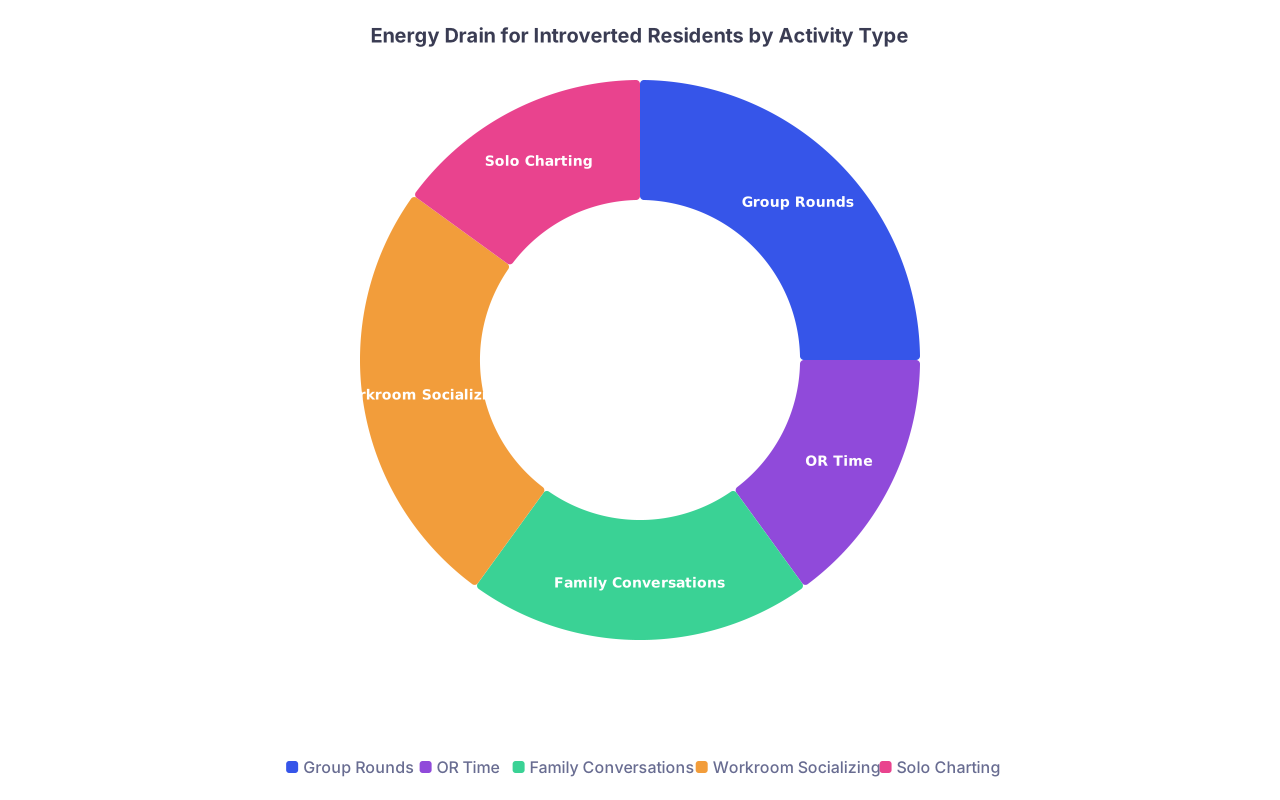
| Category | Value |
|---|---|
| Group Rounds | 25 |
| OR Time | 15 |
| Family Conversations | 20 |
| Workroom Socializing | 25 |
| Solo Charting | 15 |
The Hardest Part: You Won’t Know 100% Until You’re In It
Here’s the awful, anxiety-inducing reality: you can’t fully simulate surgical residency. There’s no “demo mode.”
What you can do is lower the risk that you’re walking into something fundamentally misaligned with who you are:
- Honestly assess your current social skills under stress
- Get blunt feedback from people who’ve seen you clinically
- Work on the weaknesses before you match
- Choose programs where quieter residents exist and are doing well
And you’re allowed to say, “I love the OR, but I can’t live this lifestyle,” and choose something like anesthesia, radiology, EM, or a surgical-adjacent field where you still touch procedures without the full social grind of surgery. That’s not failure. That’s self-preservation.
But if the OR pulls at you in a way nothing else does, and you’re willing to stretch yourself socially — not become a different person, just a more skilled version — then yes, you can survive. You won’t be the loudest. You don’t need to be.
You just can’t hide.