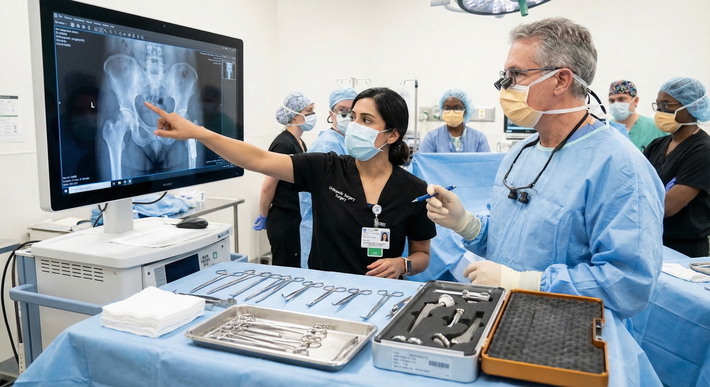
Last week a fourth-year pulled me aside after a case, still in her scrubs, hands shoved so deep into her pockets they almost disappeared. “I love the OR,” she whispered, “but my hands shake when I’m anxious. I don’t think I’m allowed to be a surgeon.” Then she looked at me like she was already grieving a career she hadn’t even started.
If you’re reading this, I’m guessing you’re doing a quieter version of the same thing alone in your room, staring at your fingers and wondering if they’re about to end your entire surgical future.
The fear you’re probably too embarrassed to say out loud
Let’s just name the worst-case scenarios your brain is throwing at you:
- “What if my hands shake and I cut something important?”
- “What if an attending sees and writes me off forever?”
- “What if I’m the one intern in the program who just isn’t ‘meant’ for surgery?”
- “What if I match and then they realize I can’t actually operate?”
And the big one you probably haven’t even fully said to yourself:
“What if I hurt someone because my hands aren’t good enough?”
You’re not crazy for thinking this. I’ve seen:
- Students hiding their tremor by gripping instruments too hard.
- Residents apologizing for “butcher hands” the first week of internship.
- People self-selecting away from surgical fields they love because they’re convinced their hands disqualify them.
But here’s the part nobody tells you when you’re spiraling at 2 a.m.:
Your baseline hands are not the final product.
They’re the starting material. And surgical training is literally the process of refining that material.
What “good surgical hands” actually means (not what you think)
There’s this myth that surgeons are born with magical, perfectly steady hands, like some kind of gifted violinist.
Nope.
In real life, “good hands” are a combination of:
- Fine motor control
- Economy of movement
- Ability to calm yourself under stress
- Reps. Reps. More reps.
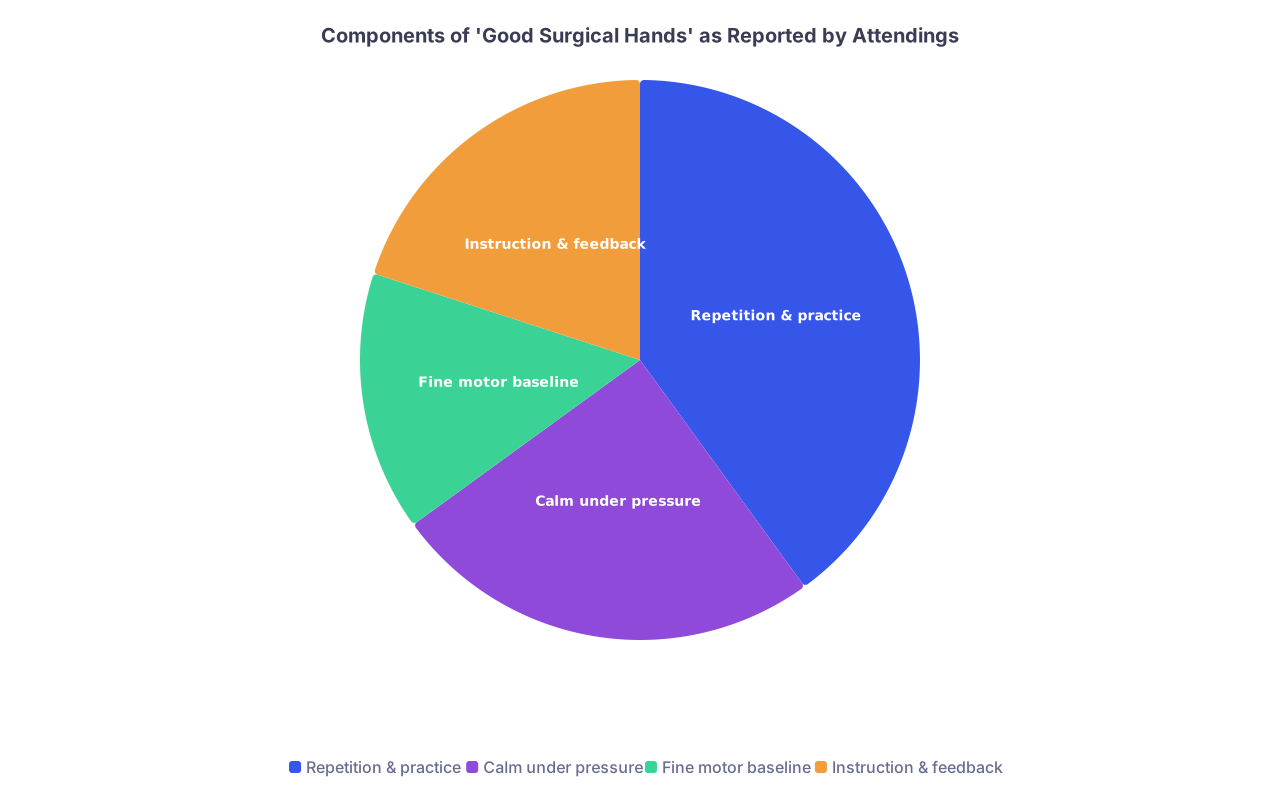
| Category | Value |
|---|---|
| Repetition & practice | 40 |
| Calm under pressure | 25 |
| Fine motor baseline | 15 |
| Instruction & feedback | 20 |
Notice what’s smallest in that pie: “fine motor baseline.” The thing you’re obsessing over.
When attendings say, “She has nice hands,” they usually mean:
- She doesn’t over-grip or fight the instrument.
- She listens to tissue – doesn’t tear or crush it.
- Movements are purposeful, not frantic.
- She can take feedback and adjust.
None of that requires superhuman anatomy of the hand.
I’ve watched a PGY-1 with a visible physiologic tremor become a PGY-5 who could put in a central line in a crashing patient faster and cleaner than the “naturally gifted” people, because he’d done the work of technique, positioning, and mental control.
But what about actual hand problems?
Different situation if:
- You have a diagnosed neurologic tremor (essential tremor, Parkinson’s, etc.)
- You have significant weakness, contractures, or deformities
- You’ve had major hand trauma or surgery with lasting limitations
If that’s you, the question isn’t “Are my hands good enough?” It’s, “What are my actual functional limits, and do they fit within most surgical tasks of this specialty?”
That’s not something to guess about alone in your apartment. It’s a “I need to talk to a real surgeon and maybe occupational therapy” situation.
Types of “hand anxiety” and what they actually mean
Most worried students fall into one of these categories. You might see yourself in more than one.
| Type of Worry | What It Often Really Is |
|---|---|
| Hands shake when watched | Performance anxiety, not neurological |
| Hands feel “clumsy” in OR | Normal early learning curve |
| Fingers tire quickly | Grip/positioning issue, not weakness |
| Fumbling with knots | Lack of reps, not lack of talent |
| Afraid of small spaces (lap/endo) | Visual–motor adaptation phase |
1. “My hands shake whenever anyone watches me”
I’ve seen this probably a hundred times.
A student holds the needle driver, attending leans in, and the tip of the instrument starts to vibrate. The student wants to disappear through the floor.
Usually:
- Hands look fine when the student is alone.
- There’s no shake when they’re doing non-OR stuff.
- Shake worsens the moment they notice it’s happening.
This is performance anxiety plus adrenaline. Your sympathetic nervous system is doing exactly what it’s designed to do: making your muscles twitchy, increasing your heart rate, tightening your grip.
That’s not “I can’t be a surgeon.” That’s “my nervous system doesn’t yet know how to operate under being watched.”
Guess what surgical residency gives you, over and over?
Being watched. Until your nervous system gets bored of reacting.
2. “My hands are just slow and clumsy compared to others”
Honestly? They might be. At first.
I remember a third-year on a vascular rotation who took three times as long to tie a basic knot compared to her classmates. She was embarrassed enough that she started volunteering to do the paperwork so she wouldn’t have to “perform” at the field.
Six months later she’d spent ridiculous amounts of time with a suture board and was one of the smoothest in her class.
Clumsy in the first 10–20 times you do a task tells me nothing about your ceiling. Only about your starting point.
3. “I get exhausted holding instruments; my hands feel weak”
Potential issues:
- You’re death-gripping the instrument because you’re scared to drop it.
- Your posture is terrible and you’re compensating with small muscles.
- You’ve had almost no conditioning – same way you’d feel trying to run 5 miles without building up.
All of those are fixable problems, not verdicts on your career.
Not all “procedural” fields demand the same from your hands
Picking “procedural” or “surgical” is not one giant on/off switch. Different specialties stress your hands in different ways.
| Specialty | Typical Hand Demands |
|---|---|
| General Surgery | Mix of open, laparoscopy, suturing, tying |
| Orthopedics | Power tools, force, hardware handling |
| Neurosurgery | Micro-instruments, extended delicate work |
| ENT / Plastics | Fine suturing, microsurgery, reconstruction |
| IR / GI / Cards | Catheters, wires, imaging-guided manipulation |
People assume, “If my hands aren’t perfect, I’m banned from all of these.”
Reality is messier:
- General surgery has a huge range: some cases are big open bowel resections, others are tiny hernia repairs, some are all laparoscopic. You’re not doing corneal transplant–level precision every minute.
- Orthopedics asks more from your upper body and spatial sense than ultra-fine finger tremor control.
- IR/cardiology/GI are very hand-intensive, but the motion is more arm–wrist–fingers guiding catheters than ultra-microscopic 10-0 suturing.
Where you probably need to be more cautious:
- Fields with heavy reliance on microsurgery (certain plastics/ENT/neurosurg subspecialties).
- Places where even tiny, tiny movements have huge consequences for a long continuous time.
Even there, I’ve seen surgeons with mild physiologic tremors compensate beautifully with:
- Good support (resting hands, wrists, forearms)
- Correct positioning
- Using both hands smartly
- Technology (loupes, microscopes, even robotics)
The part you really don’t want to hear: you have to test this in real life
This is where the anxiety brain screams, “But what if I try and they confirm I’m terrible?”
Yeah. You might get feedback that your hands need work.
That’s still better than you guessing yourself out of a specialty you’d love.
Here’s the uncomfortable but necessary experiment list:
Ask for early procedural exposure
On rotations, say out loud: “I’m interested in procedural/surgical fields and would really appreciate practice with suturing, knot-tying, and handling instruments.”Find someone who will be brutally honest kindly
A senior resident or junior attending who isn’t an outright jerk. Ask:
“Can you watch my hands and be honest about whether you see anything concerning long term, versus just ‘needs practice’?”Do real reps, not just YouTube watching
Knot boards. Foam models. Pig’s feet. Absolutely boring repetitive practice. Track your own progress over weeks, not days.Sim labs and standardized assessments
Use whatever your school has. Ask for feedback:
“Do my hands look within the normal range for someone at my level?”
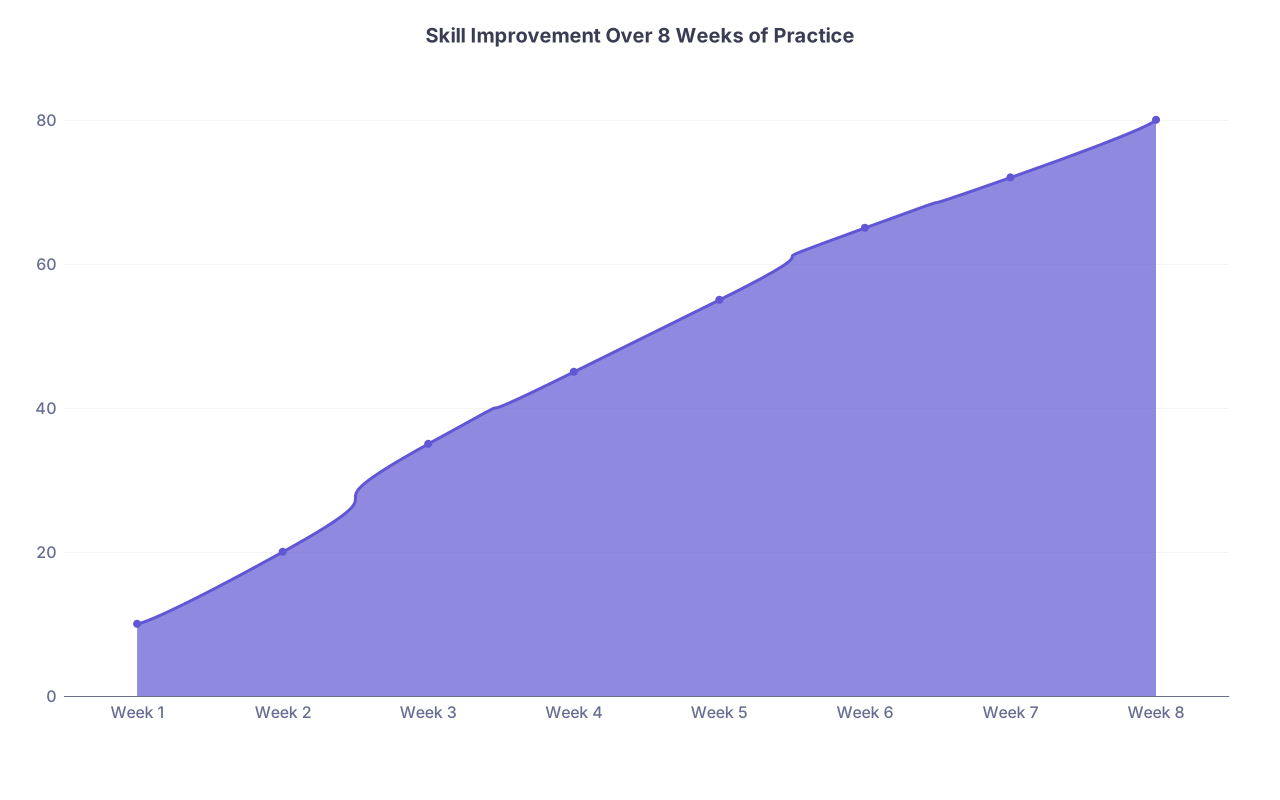
| Category | Value |
|---|---|
| Week 1 | 10 |
| Week 2 | 20 |
| Week 3 | 35 |
| Week 4 | 45 |
| Week 5 | 55 |
| Week 6 | 65 |
| Week 7 | 72 |
| Week 8 | 80 |
Most people who actually do this discover:
- Week 1: “Wow, I’m bad.”
- Week 4: “I’m still slower than some people.”
- Week 8–12: “Oh. I’m… fine? I’m actually kind of okay at this?”
Your brain conveniently skips how much improvement happened in the middle.
What if you do have a real tremor or diagnosed issue?
Then this is less about shame and more about logistics and ethics.
You need:
- An honest neurologic and/or orthopedic/hand evaluation.
- A candid conversation with at least one surgeon who knows your condition and your specialty of interest.
- To hear the sentence: “With your current function and expected progression, I think you can/can’t reasonably perform in X field.”
That might hurt. A lot.
But your goal is to take care of patients safely, not to enforce some ego-driven destiny.
Sometimes the conversation goes like this:
“Yes, you have a mild essential tremor, but with medication and good technique, I’ve seen surgeons do fine in general surgery, ENT, IR, etc.”
Sometimes it goes like this:
“If this progresses the way we expect, microsurgery is probably not wise as a long-term plan, but there are procedural fields where this is unlikely to be a limiting factor.”
And occasionally, harsh reality:
“Given your current motor limitations, a heavily manual surgical subspecialty is likely unsafe and unsustainable. Let’s talk about specialties where your brain and training will shine without that risk.”
That last one is rare. But if it’s true for you, avoiding that truth doesn’t make it less true.
How programs actually think about this (not your catastrophic version)
Your anxiety version:
“They’ll see one tremor, blacklist me from surgery, and write emails to every PD in the country warning them about my cursed hands.”
Reality version:
- They’re looking at your judgment, teamwork, work ethic, and basic ability to learn.
- They fully expect clumsiness early on.
- They’ve seen lots of anxious students with shaky first attempts turn into totally competent residents.
What freaks them out more than shaky hands?
- A student who refuses to try because they’re scared of looking bad.
- Someone who makes mistakes and then hides them.
- Someone who doesn’t take feedback or blames the instruments, the scrub tech, the lighting, the phase of the moon – anything but their own learning curve.
If you’re the person who:
- Shows up
- Admits what you’re worried about
- Asks for help
- Practices deliberately
You’re already more promising than the smooth, arrogant student who thinks they’re already a surgeon because they can throw a pretty stitch.
Concrete next steps if you’re spiraling about your hands
Here’s the plan, not the fantasy disaster version in your head.
Step 1: Baseline reality check (this week)
- Ask a trusted resident or attending on your rotation:
“I’m seriously considering a procedural / surgical field and I’m a little worried about my hands. Would you be willing to watch me suture/handle instruments and tell me if you see anything unusually concerning?”
Not “are my hands perfect.”
“Anything unusually concerning.”
Step 2: Deliberate practice plan (next 4–8 weeks)
Give yourself an actual trial window with real effort:
- Daily or near-daily knot tying and suturing, even 10–15 minutes.
- Record a video of yourself week 1 and week 4 doing the same task.
- Compare. Don’t trust your memory; it lies.
Step 3: Medical eval if indicated
If you truly suspect a neurologic or structural issue (not just nerves):
- Book with student health / PCP → possible neuro/hand referral.
- Ask directly: “Do you see any reason I should avoid a surgical/procedural career?”
Step 4: Specialty-specific reality testing
Use your rotations:
- On surgery: how do you feel about open and lap work after a month, not a day?
- On OB/GYN, ENT, Ortho, IR, GI: do any feel more natural for your hands/body?
- Ask residents: “Have you seen people with shaky or clumsy hands at first become good surgeons over time?” (Spoiler: yes.)

| Step | Description |
|---|---|
| Step 1 | Worried about hands |
| Step 2 | Ask senior for feedback |
| Step 3 | Start 4 to 8 week practice plan |
| Step 4 | Medical evaluation |
| Step 5 | Reassess after practice |
| Step 6 | Reconsider field mix |
| Step 7 | Decide on field with real data |
| Step 8 | Unusual concern? |
| Step 9 | Cleared for procedures? |
Bottom line you probably need someone to just say straight
Liking procedures and being anxious about your hands do not cancel each other out.
Most of the time:
- Your anxiety about your hands is bigger than the actual issue.
- Your idea of what “surgical hands” need to be is unrealistic.
- Your ceiling is much higher than your terrified brain is willing to admit.
And yeah, there’s a non-zero chance that after serious practice and honest feedback, you and trusted mentors conclude, “A high-precision microsurgical field probably isn’t the best fit.”
That’s not failure. That’s protecting patients and your future self.
But you don’t get to pre-reject yourself based on an anxious guess while staring at your fingers under your desk lamp.
You want a concrete step?
Open your calendar right now and block 30 minutes in the next 48 hours labeled:
“Ask someone I trust to watch my hands.”
Then keep that appointment like it’s an exam.