
The way surgery away rotations are scored is far more brutal – and far more simplistic – than anyone tells you on the front end.
You think it’s about your “clinical acumen,” your case log, your little presentation at journal club. That’s the brochure version. Behind closed doors, in the workroom at 6:15 am, they’re saying things like:
“Great in the OR, weird on rounds. I wouldn’t want to be on nights with him.”
“Quiet but solid. Never complained. I’d take her over half our own students.”
“Smart, but high‑maintenance. Pass.”
Let me walk you through how your month is actually converted into a score, because yes, in most surgery programs it is quietly quantified. And those numbers and phrases follow you straight into the rank meeting.
The Real Scoring Buckets: What Programs Actually Track
The exact form changes by institution, but the content is shockingly similar. I’ve seen the evaluation templates at places like Michigan, UPMC, Duke, and at smaller community programs. Names differ, but the buckets don’t.
| Domain | Typical Weight |
|---|---|
| Work Ethic/Reliability | 25–30% |
| Teamwork/Personality | 20–25% |
| OR Performance | 20–25% |
| Clinical Skills/Knowledge | 15–20% |
| Professionalism | 10–15% |
Almost every away student gets some version of a 1–5 or 1–9 score in each box, then an “overall” plus a free‑text comment. That “overall” and the free text matter more than the individual numbers.
Here’s the part no one spells out: most programs mentally collapse you into one of four categories:
- Hell yes – “must interview, could match here”
- Solid – “fine, would not be upset to match them”
- Meh – “interview only if we need more bodies”
- No – “do not bring this person back”
Your real goal is not to be perfect. Your goal is to avoid Category 4 and, if you can, sneak into 1.
Work Ethic: The Unofficial Primary Score
Work ethic is the currency of surgery. On paper it’s “initiative” and “dependability.” In real speak, it’s: “Do I trust you at 3 am when everything is on fire?”
Here’s how it actually gets judged.
They’re watching:
- What time you show up. Not the time you say you show up. The time they see you on the floor with your list done. There’s a difference.
- How often you ask, “Do you need anything else?” and actually mean it.
- Whether you disappear after cases or between cases.
- Whether you handle scut without whining – and without making the intern feel guilty.
Residents report this back in one-liners. I’ve heard them:
- “She was there before me every day and had vitals, overnight events, and notes started.”
- “He vanished after every case. No idea where he went. Probably ‘reading’.”
- “Good when present, but had to be chased to finish consults.”
That last one? That’s a 3/5 work‑ethic score even if your knowledge is great.
The quiet rules:
- If you are not in the OR, you should be on the floor or in the ED. Not buried in a corner “studying.” They don’t care about your studying if the list isn’t tight.
- You don’t leave before the intern, unless explicitly told to. And you don’t ask, “Can I go?” every day at 3:30 pm.
- “I’m only a student” is death. The students who act like mini interns get written up as “felt like a sub‑intern.”
Behind closed doors, the attending doesn’t say, “Her work ethic was 5/5.” They say, “She worked like one of ours.” That’s code for: green light.
Team Fit and Personality: The Hidden Power Multiplier
This is the part students always underestimate. Personality fit is not fluff. In borderline cases, it overrides everything.
No one writes “doesn’t vibe with team” in your evaluation. They write:
“Pleasant to work with.”
“Easy going, low ego.”
“Needed a lot of reassurance.”
“Did not integrate fully into team.”
That last phrase? That’s a kiss of death.
Let me translate the coded language programs use about away rotators:
- “Quiet but engaged” = introverted but clearly trying; fine for residency.
- “Quiet and reserved” = we couldn’t get a read; risk for being weird/aloof.
- “Confident” = spoke up, took ownership, but wasn’t an ass.
- “Very confident” = borderline arrogant; might be a problem.
- “Great team player” = residents liked you, you helped with non-glamorous tasks, no attitude.
- “Strong personality” = made people tired, argued, or graded tasks as “beneath them.”
Residents decide a shocking amount of this. Informally.
The conversations that really decide your “fit” score happen at 1 am in the call room, while someone is housing cold pizza, and your name comes up:
“Hey, how’s that away kid?”
“Oh, she’s great, actually. Super chill. Helped me with discharges last night without being asked.”
versus
“He’s smart, but he keeps correcting the intern in front of the attending. Would not want him as a co‑resident.”
Guess which one gets ranked higher four months later.
If you’re wondering how to show “fit” without being fake: match their energy but avoid their complaints. Laugh with them, not at the system. Residents clock which students side with them versus staying neutral; the smart ones stay neutral and useful.
OR Performance: Where Students Think They’re Being Judged (But Only Half Are)
Surgical hopefuls obsess over the OR. “If I just crush it in the OR, they’ll love me.”
That’s only partially true.
Here’s what actually goes in the OR section of your eval:
- Preparation: “Knew the steps of the Whipple cold.” or “Had not read about the case.”
- Aseptic technique: “Good with sterile field.” or “Repeatedly contaminated field.”
- Instrument handling: “Handled tissue respectfully; careful.” or “Rough; needed frequent correction.”
- Teachability: “Improved significantly over month.” or “Did not incorporate feedback.”
You know what doesn’t go in there? Your suture art project. Unless you’re unbelievably good, your “I can throw an instrument tie” doesn’t wow anyone. Most PDs assume they can teach you to tie. They want to know if you show up prepared and get better.
Still—OR is where some students blow their entire month. Not because they can’t tie, but because they act wrong.
Attending comments I’ve seen:
- “Too eager to be in spotlight. Cut others off answering questions.”
- “More focused on impressing faculty than helping team.”
- “Excellent humility and progression of skill.”
You want to be the third line.
The unspoken expectations:
- You should have read about the case last night. Not just the indication – the steps, the anatomy, the main complications.
- You don’t talk more than the chief resident unless you’re being directly asked.
- If you get pimped and do not know, you say, “I’m not sure, but I think…” and then a reasonable guess. And then you go look it up and circle back later.
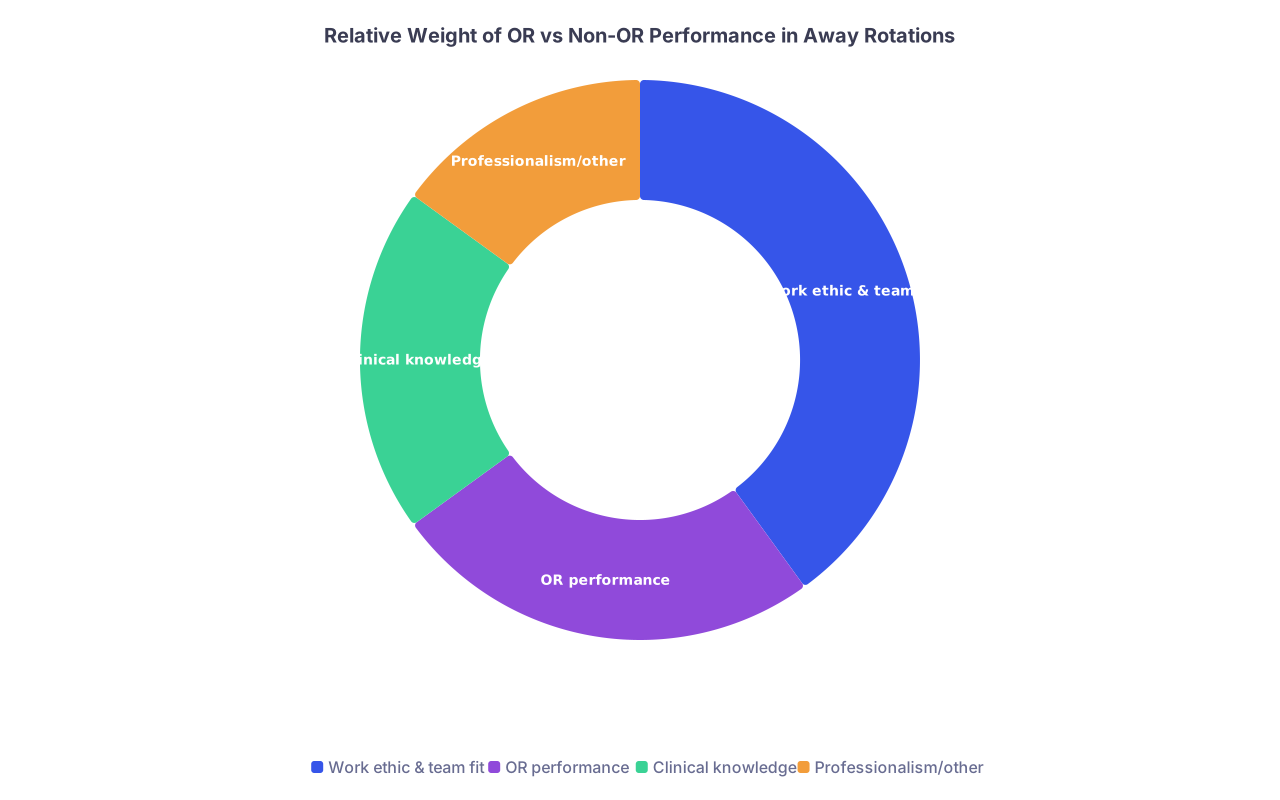
| Category | Value |
|---|---|
| Work ethic & team fit | 40 |
| OR performance | 25 |
| Clinical knowledge | 20 |
| Professionalism/other | 15 |
Behind closed doors, OR is rarely more than a quarter of the total mental score. The myth is that it’s 80%. It is not. I’ve watched mediocre-in-the-OR but insanely reliable students get ranked far above flashy “natural” operators who made everyone tired.
Clinical Ability and Knowledge: The “Ceiling Setter”
Here’s the subtlety: your knowledge and clinical skills don’t usually win you the spot, but they absolutely can cap your ceiling.
In other words: being brilliant rarely saves you if you’re a pain. But being clearly unsafe or clueless will quietly kick you out of contention.
On the evaluation form, this lives under “Clinical Judgment,” “Fund of Knowledge,” and “Presentation Skills.”
Attending shorthand:
- “Performing at or above intern level.” = huge compliment; triggers “we should interview this one.”
- “Appropriate for level.” = fine, not a standout, but safe.
- “Below expected level for sub‑intern.” = red flag.
You don’t need to sound like an R3. You do need to:
- Be able to present patients concisely. No five‑minute rambles.
- Close a basic SOAP note competently.
- Recognize sick vs not-sick. If the nurse tells you a post‑op is hypotensive and tachycardic, and you shrug and say you’ll tell the intern later, that story will make it into your eval.
Here’s the dirty little secret: one really sharp clinical save, even indirect, often gets remembered for months.
Examples I’ve seen repeated in rank meetings:
- “Remember that rotator who called us about compartment syndrome before anyone else noticed? That kid was sharp. What was his name? Find him.”
- “She was the one who picked up the bile leak on POD3 and pushed for imaging. I’d take her.”
No one cares that you misremembered one branch of the celiac axis. They care if you’re the kind of person who catches things.
Professionalism: The Category No One Thinks They’ll Fail
Almost no student thinks they have a professionalism problem. Yet “professionalism concerns” is the single easiest way to get yourself into the “Do Not Rank” pile.
What actually goes here:
- Showing up late more than once.
- Calling out “sick” suspiciously (the day after a big call night, before an exam, etc.).
- Dressing sloppily in clinic or showing skin/ink in ways the program regards as unprofessional.
- Rolling your eyes. Complaining loudly. Gossiping about residents to attendings or vice versa.
- Phone use. You’d be shocked how often this shows up.
And then there’s the nuclear option: nurses complaining about you. If a nurse goes to an attending and says, “That rotator was rude,” your month is over. You might not know it, but your score just tanked.
I’ve sat in those rooms. The tone changes instantly:
- “She was great with us but apparently snapped at the PACU nurse? Yeah, no.”
- “Nurse manager emailed me about him. I don’t care how smart he is, that’s a hard pass.”
On paper, your numerical scores might still look okay. But there will be a line in the comments: “Some concerns about professionalism.” That’s all it takes.
How All This Turns into an Interview or a Rejection
Here’s what students almost never see: the conversion of those month‑long impressions into “interview” and “rank” decisions.
Let me pull back the curtain.
Step 1: The Rotation Ends, The Form Appears
Within a week or two of your last day:
- Residents get a link or paper form: fill out “away rotator evaluation.”
- The chief or service attending is usually the one who writes the big overall comment.
- Sometimes, the program coordinator sends an email to the chief: “How was [Your Name]? Do you recommend an interview?”
Your fate is basically sealed here.

| Step | Description |
|---|---|
| Step 1 | End of Away Rotation |
| Step 2 | Resident and Attending Evaluations |
| Step 3 | Recommend Interview |
| Step 4 | Maybe List |
| Step 5 | Do Not Interview |
| Step 6 | PD Reviews File |
| Step 7 | Application Screened Out |
| Step 8 | Interview Invite or Waitlist |
| Step 9 | Overall Impression |
If the chief writes, “Outstanding, we should recruit,” you’re getting flagged. If they write, “Fine, but not a standout,” you’re just another ERAS app.
Step 2: Program Director Mental Math
Program directors don’t have time to read every word of every evaluation. They skim strategically.
What they actually look at:
- The overall score if there is one.
- The summary comment.
- Any red‑flag words: “concerns,” “below level,” “difficulty,” “professionalism,” “interpersonal.”
They also remember you. Or not.
The internal monologue goes something like:
- “Oh yeah, that’s the rotator that the residents loved. Invite.”
- “Who is this again? Let me skim… quiet, fine, appropriate. Okay, into the maybe pile.”
- “I remember a professionalism email about someone this month… oh, that was him. Pass.”
Step 3: Resident Veto Power (Informal but Real)
Programs pretend residents do not have veto power. They do, informally.
Before rank lists go in, some PDs ask:
“So, who from the aways did you like?”
and separately,
“Anyone we should not rank?”
If multiple residents say:
“Please do not bring X here,”
you’re done. Even with good scores on paper.
The converse is also true. One particularly beloved away rotator can get pulled up the rank list because everyone says:
“She worked like a dog and never complained. She’d fit right in.”
The Numbers You Never See: How Many Aways Actually Pay Off
Students often think, “If I rotate there, I’ll match there.” Programs do not see it that way.
Here’s a rough internal reality from mid‑to‑upper tier general surgery programs I’ve worked with or consulted for:
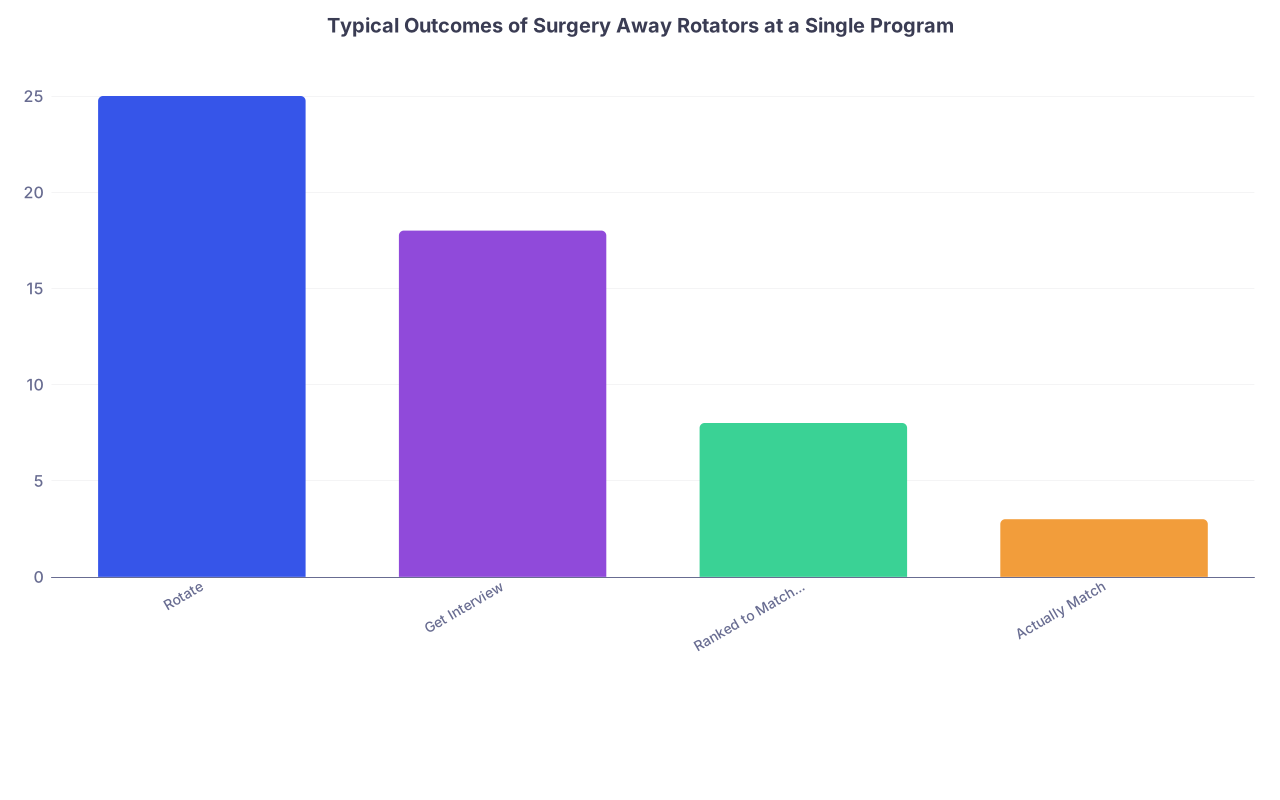
| Category | Value |
|---|---|
| Rotate | 25 |
| Get Interview | 18 |
| Ranked to Match Range | 8 |
| Actually Match | 3 |
Everyone rotates. Most get an interview. Only a handful land high enough on the list to have a real shot.
The away rotation moves you from “random ERAS applicant” to “known entity.” That is its power. If you are a strong “known entity,” your odds go up. If you are a weak one, you may have actually hurt yourself.
And yes, ugly truth: some PDs quietly penalize applicants who rotated and weren’t good fits, even if their paper stats are solid. They think: “We’ve already test‑driven this one. Pass.”
What Actually Moves the Needle in Your Favor
Strip away the noise. After watching dozens of away cycles, seeing who got interviews and who matched where they rotated, the pattern is not complicated.
The students who convert aways into offers usually have:
- Work ethic that residents talk about when you’re not there.
- A personality that does not drain people at 2 am.
- Under‑promised, over‑delivered OR performance (no ego, visible improvement).
- At least one specific story attached to their name in a good way.
That last point matters more than people think.
Stories like:
- “She stayed with that crashing patient for three hours and helped us call family, update everyone, and never complained.”
- “He came in on his post‑call day to see the patient he’d been following through their big case and discharge.”
- “She made all the post‑op calls on clinic day and I didn’t have to ask twice.”
In rank meetings, names blur. Stories stick. Your month should create at least one story people can tell about you that isn’t “remember when they dropped the sterile field.”
Do you need to be perfect? No. I’ve seen clumsy, slightly awkward students match over smoother ones because they were relentlessly reliable and clearly teachable.
But you cannot be high‑maintenance, checked‑out, or toxic. Surgery will excuse ignorance. It does not excuse being a problem.
Quick Reality Checks You Can Use During Your Rotation
Three ways to quietly gauge how you’re actually doing while there’s still time to adjust:
Who do the residents compare you to?
If they say, “You’re better than most of our rotators,” you’re likely in the top half. If they say, “You’re fine, about average,” that’s honest. Average rotator = maybe interview, not automatic match.Do they start giving you more responsibility?
Letting you run a portion of rounds. Letting you place orders (for review). Tossing you more consults. That’s a green light. If your role never evolves the whole month, you’re not inspiring confidence.What does the chief say in week 3?
If you ask, “Anything I should work on before the month ends?” and they say, “No, you’re doing great,” write that down. You’re probably okay. If they say, “Just speak up more, be a little more proactive,” they’re telling you that your current trajectory is “fine but forgettable.”
FAQs
1. If I have one bad day (or one bad case) on my away, does it tank my whole evaluation?
Usually, no. Single events rarely kill you unless they’re spectacularly bad (screaming at a nurse, blatant dishonesty, unexcused absence). What hurts more is a pattern: consistently late, repeatedly unprepared, chronically disengaged. If you know you had an off day, own it. Show up harder the next 48 hours. Residents notice course corrections.
2. How much do letters from away rotations really matter for surgery?
A strong letter from an away where you clearly impressed people is gold. But it needs to be from someone who actually saw you work – often the service attending or a PD who heard about you from residents. Generic “excellent student, pleasure to work with” letters from an away are almost useless. The behind‑the‑scenes reality: programs weight your reputation at that away (via calls, emails, resident comments) more than the letter itself.
3. Is it better to do more aways or one really strong one?
For general surgery, more than two aways starts to have diminishing returns, and your odds of burning out and being mediocre at one of them go up. One stellar away where residents are actively lobbying for you is more powerful than three lukewarm ones. I’ve seen PDs say, “He did three rotations here, here, and here… but none of them were excited about him.” That’s actually a negative signal.
4. Can a great away rotation overcome a mediocre Step 2 or mid‑tier school name?
Yes, sometimes. Not everywhere, but more often than students think. Programs use scores and school pedigree as screening tools for unknown applicants. Once you become a “known entity” with a strong rotation, those metrics soften. I’ve watched a student from a lower‑ranked MD school with a 230s Step 2 beat out 250+ applicants because the residents at his away rotation basically said, “We want him as a co‑resident.” That’s the whole point of doing an away: to become that person for at least one program.
Years from now, you won’t remember the exact words in your evaluations or the awkward pimping questions you missed. You’ll remember which rooms you walked into ready to work like you were already on the team – and which doors opened because of it.