The hierarchy in surgical programs is far more complicated—and far more ruthless—than anything you’ve been told on interview day.
You’re shown the conference room, the sim lab, the smiling chiefs. You’re told, “We’re very collegial,” and “We don’t have malignant attendings here.” Then the doors close behind you on July 1, and you realize: there’s a whole hidden ranking system that dictates who gets cases, who gets fellowships, who gets wrecked on rounds, and who quietly disappears after PGY-2.
Let me walk you through the hierarchy that actually exists, not the one in the brochure.
The Real Pyramid: Not Just PGY Levels
On paper, the hierarchy is clean: intern → junior → senior → chief → attending → chair. That’s the org chart. It’s not the power structure.
Behind the scenes, residents and applicants are really sorted on a different scale:
- Operative potential
- Political value
- Loyalty to the “house culture”
- Replaceability
Every decision—who gets the big Whipple, who gets the research award, who gets quietly blacklisted from a fellowship—comes from that invisible ranking. Programs will never say this out loud, but faculty absolutely talk this way in the work room.
“Great kid, but not an operator.”
“Super smart, but I’d never send her to my old program.”
“He’s fine, just… replaceable.”
You need to understand where you’d land on this spectrum at any given program. Because that determines your actual life for 5–7 years.
The Hidden Tiers of Residents
Let’s start with residents, because as an applicant you’re trying to predict: if I match here, what will I become in their system?
Tier 1: The Golden Children
Every surgical program has 1–3 residents that the attendings speak about like stock they bought early.
You know who they are by PGY-2. They:
- Get the “good” pages: “Hey, can you send X to my room for this case?”
- Are allowed to struggle at the table without getting destroyed.
- Get protected from the worst scut. Someone quietly reroutes them away from trivial consults when there’s a big case.
Why? Because faculty believe they’re future faculty, future fellowship stars, or someone who reflects well on the department.
They’re not always the smartest. They are always:
- Technically promising
- Agreeable without being weak
- Perceived as “trustworthy” in the OR
On interview day, you can sometimes spot them: The resident whose jokes the PD laughs at. The one who gets asked, “You remember that case with the SMA injury?” in front of you. That’s not random. That’s status signaling.
Tier 2: The Workhorses
Most residents live here. Solid. Reliable. “Good guy/gal.” The program needs them to function. They staff the floor, do the notes, carry the service, run night float without imploding.
They operate. But they don’t get first dibs.
They get:
- Standard bread-and-butter work
- Middle-of-the-night disasters to manage alone
- A decent letter—“worked hard, dependable, professional”—but not the type of phone calls that change a fellowship rank list
If you’re a tier 2 with self-awareness, you can still carve out an excellent career. But you have to accept reality: this program might not move mountains for you. You’ll have to move them yourself.
Tier 3: The Problem Files
Nobody will say this to your face, but there are residents the faculty expect to either scrape by or wash out.
The red flags:
- Repeated “professionalism issues” (which can mean anything from truly bad behavior to simply not fitting the cultural mold)
- “Not safe in the OR” comments that start to accumulate in behind-closed-doors meetings
- That resident whose name makes attendings exhale before they scrub in
Once you’re in this bucket, the program quietly adjusts expectations:
- Fewer complex primary cases
- Lots of clinic and floor-heavy rotations
- A subtle nudge toward “maybe general surgery in the community, no fellowship”
Here’s the part nobody tells you: this tier is sometimes determined way too early and based on biased impressions from 1–2 attendings. And it can be almost impossible to escape without a champion.
Attendings: Who Actually Runs Your Training
Applicants think the program director runs the show. No. The PD signs the paperwork and does the ACGME dance. Your actual day-to-day fate sits with a smaller set of influential attendings.
Roughly, they fall into categories.
The Kingmakers
These are the attendings with:
- National reputations
- Important fellowship ties
- Leadership roles (division chief, vice chair, former PD)
They don’t just grade your performance. They decide which version of you gets exported to the outside world.
When a fellowship director calls and says, “Tell me the truth about her,” this is whose opinion counts.
On a practical level, you can identify them easily:
- Everyone lowers their voice slightly around them
- Residents care—really care—about their impression with this one person
- They’re the ones “visiting” multiple rooms during cases, shaping who’s at the table
If you’re smart, you’ll aim to win over at least one of these people. Respectfully. Not desperately. They can make your career or quietly freeze it.
The Operators vs. The Academics
Here’s a division applicants underestimate.
“Big case” operators (the real technical animals) are usually the ones residents want to impress. They:
- Care a lot about hand skills
- Care less about you finishing your QI project
- Are more likely to throw you into a case early if they like your potential
Academic heavyweights might never be the best technical teachers, but:
- They control grants
- They sit on national committees
- They write the letters that fellowship PDs recognize instantly
Some programs skew heavily one way.
A place like MGH or UCSF: your research mentor’s voice may carry as much weight as your best OR evaluator. A highly clinical county hospital program: the chief trauma surgeon’s respect matters more than any PubMed page.
You’re choosing not just a hospital. You’re choosing which hierarchy—technical vs academic—will matter more when your name comes up in a closed-door meeting.
The Real Power: Chiefs and Mid-Level Seniors
Now let’s talk residents again, because here’s the nasty little secret: the chief who’s “so nice” on your interview dinner can completely change your life as an intern.
Chiefs: Mini-PDs on the Ground
On paper, they’re just senior residents. Functionally, they:
- Decide who gets early operative chances
- Decide who’s “ready” for more autonomy vs who needs “more floor time”
- Informally label you as “strong,” “fine,” or “concerning” after your first few months
The chiefs’ offhand comments show up later in meetings when faculty are deciding which PGY-2 gets the big cases or which PGY-4 gets recommended for competitive fellowships.
I’ve watched this happen. Somebody in a faculty meeting asks, “How’s that new class?” and the chiefs’ one-liner becomes gospel:
- “She’s sharp, very independent.”
- “He’s nice but slow.”
- “Honestly, I don’t trust him at night yet.”
That label sticks. You don’t even know it exists.
Mid-Level Seniors: The Quiet Gatekeepers
PGY-3s and PGY-4s are the ones who’ll decide if your life is hell or manageable.
They control:
- Case allocation on busy services
- Who scrubs in vs who “runs the floor”
- How much they shield you from trash work
They are watching for three things:
- Do you make their life easier or harder?
- Do you look like someone they’d want covering their ICU when they’re chief?
- Are you someone they’d be embarrassed to put in front of their favorite attending?
This is where the so-called “fit” actually hits. Not the fake “we’re a family” line from the residents’ panel. The real question is: when the service is drowning, are you useful, or dead weight?
The Unseen Axis: Home vs. Outside Applicants
This one stings for a lot of people. But you need to hear it.
Many programs run a clear, unspoken two-track system:
- Home-grown
- Outside
The home students or prelims who convert to categoricals are known quantities. Faculty have seen them since MS3. They know who their friends are, how they handle a 1am trauma, how they act when they’re exhausted.
You, as an outside applicant, show up with a glossy CV and some Step scores. You’re an unknown.
What this often means:
- Early benefit of the doubt goes to the home people.
- Assuming equality, home gets the better cases, at least initially.
- When something goes sideways, outsiders are scrutinized harder.
Do programs deny this? Every time.
Does it still happen? Every year.
When applying, you want to know:
- How many residents are internal vs external?
- Which of their recent chiefs were home-grown?
- Do they actually promote prelims into categorical spots?
If a place is essentially a closed loop, joining as an outsider means you’re behind from day one.
The Invisible Ranking of Programs Themselves
You’re obsessed with “prestige.” Your classmates talk endlessly about “top 10” and “brand name.” That’s not how program leadership talks.
Behind closed doors, programs sort each other differently:
- Pipeline programs vs terminal programs
- Feeder programs to certain fellowships
- “Operator factories” vs “academic incubators”
A PD at a big-name academic place will absolutely say things like:
- “We like residents from X—they know how to work hard.”
- “We do not take people from Y anymore. Always underprepared.”
- “Z is a good clinical program, but we don’t see much research from them.”
Those impressions are often wildly oversimplified. Doesn’t matter. They affect your life.
Here’s what you care about: what your target fellowship programs think of the residencies you’re ranking.
| Residency Program Type | How Fellowships Often See It |
|---|---|
| Elite Academic Flagship | Strong research, variable autonomy |
| High-Volume County/VA | Great operators, less research |
| Mid-Tier University | Mixed, depends on specific mentors |
| Community University Hybrid | Solid clinically, fewer connections |
| Pure Community | Good generalists, rare top fellowships |
Is this fair? Not always. Is it real? Yes.
So when you rank programs, think: “If I train here, whose phone call will mean something for my next step?”
What Applicants Never See on Interview Day
Let me be blunt: interview day is theater. Some programs are better actors than others.
Here’s what’s happening just outside your view.
The Back-Channel Files
By the time you show up for your visit, some PDs already have strong opinions about you from:
- Phone calls from your home chair
- Quiet DMs or texts from alumni (“Hey, this guy is great, but keep an eye on professionalism”)
- Patterns in your application that never get mentioned to your face
Your interview is not a blank slate. It’s confirmation or contradiction.
Residents are often told who the “high value” candidates are that day. They’ll treat you slightly differently without realizing it—more engaged, more protective, or more perfunctory.
The Resident Consensus Meeting
After you leave, there’s almost always a resident-only debrief. It’s not scripted. It can be surprisingly blunt.
You get talked about like this:
- “That DO from X was awesome, I’d take them in a second.”
- “The guy who kept bragging about his Step score? Hard pass.”
- “Quiet but seemed solid. Would be fine on nights.”
Then faculty hear a distilled version. Sometimes residents have real influence; sometimes it’s cosmetic. But your “vibe” absolutely gets documented.
You never see that, but it follows you right into rank list discussions.
The “No-Fly” List
Programs maintain mental lists of what they do not want again:
- The resident who flamed out from certain med schools
- The type of applicant that repeatedly struggled (for example, pure research savant with zero work stamina, or the absolute opposite)
- People with a certain pattern of letters: strong technical praise but question marks about teamwork
So when you walk in saying, “I did 3 gap years of pure lab work and honestly hate the floor,” some programs see risk, not value, no matter how fancy the lab.
Reading the Hierarchy Before You Rank
You can’t change the existence of hierarchy. You can, however, choose the one that benefits you.
Here’s how to read it from the outside.
Listen to How Residents Talk About Each Other
Not just what they say to you, but how. Ask:
- “Who in your program gets a ton of OR time?”
- “What makes someone really successful here?”
- “What happens if a resident struggles early on?”
Then shut up and watch their faces. The hesitation. The sideways glance at the chief. The answer they give when they think they’re off-script.
Programs where residents say things like:
- “Honestly, if you work hard and show improvement, they’ll go to bat for you”
are very different from places where you hear: - “You kind of have to prove yourself fast here, or you get stuck on the floor.”
That’s code for: the hierarchy is rigid, and redemption is rare.
Chart What They Really Value
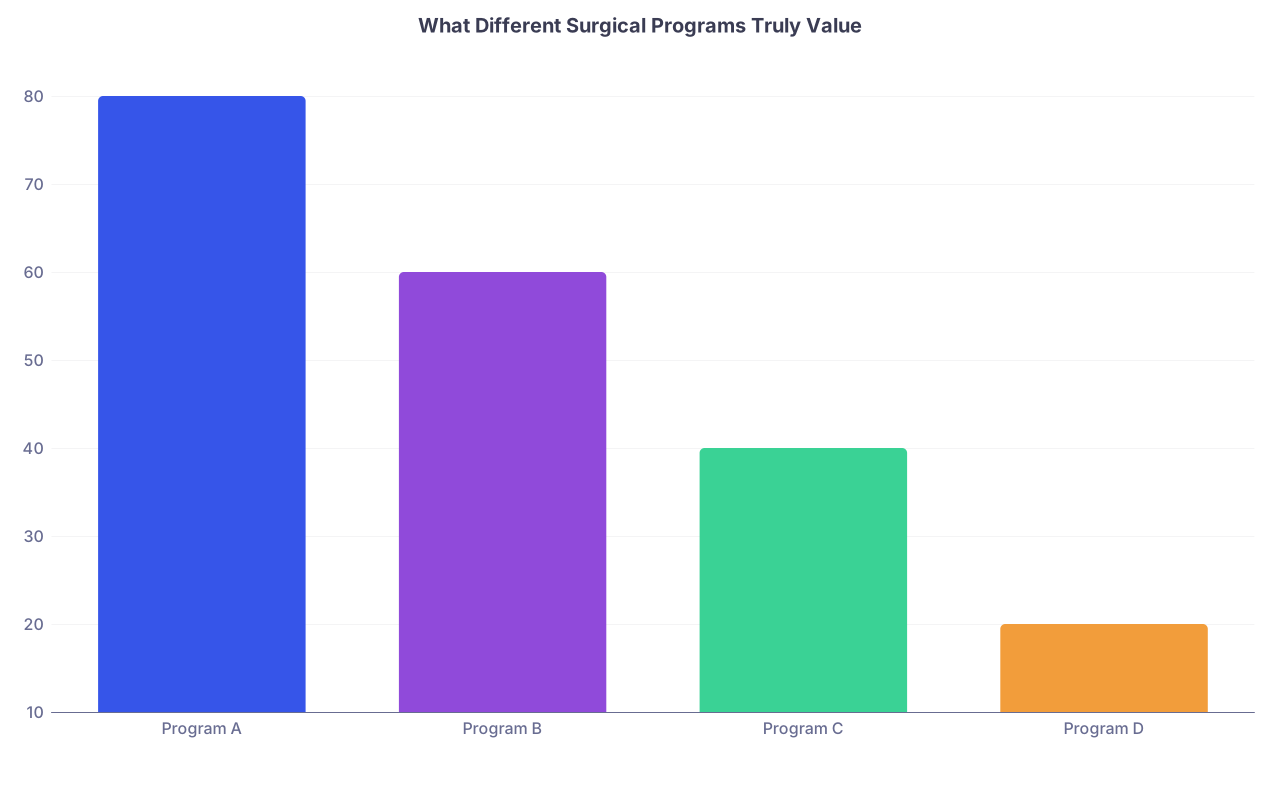
You can almost plot it.
| Category | Value |
|---|---|
| Program A | 80 |
| Program B | 60 |
| Program C | 40 |
| Program D | 20 |
Imagine the bars as “OR autonomy / technical development emphasis” vs “research / academic output.” You’ll feel it during the day.
- Program A: Talk constantly about cases, trauma, “we let our PGY-3s run the room.”
- Program B: Talk about NIH funding, T32s, lab time, publications.
- Program C: Balanced.
- Program D: Lots of “lifestyle” talk, limited complex volume.
Your job is to line up your strengths with their value system. If you’re a worker-bee operator going into a research-worshipping culture, you’ll live in tier 2 forever, no matter how hard you grind.
Pay Attention to Who Shows Up for You
Which attendings actually take the time to meet applicants?
If:
- Only junior faculty and APDs show up → the PD might be detached, or the program is overstretched.
- The big-name surgeons are there and clearly engaged → they care who they train. That often correlates with stronger advocacy later.
Also, watch how they talk to their own residents in front of you. The fake-nice attendings can’t hold the act all day. You’ll catch the eye-roll, the cutting joke that lands too hard, the resident who goes quiet in their presence.
That’s your real OR culture preview.
The Fellowship Endgame: Where Hierarchy Cashes Out
All of this culminates in one brutal stretch: when you’re applying for fellowships.
That’s when the behind-the-scenes hierarchy really shows itself.
Residents who’ve been groomed as “top” for years:
- Get the plum cases in PGY-4/5 to pad their logs
- Get more control over their schedule for away rotations or research
- Have their mentors making phone calls, not just sending letters
Others, just as capable but less politically connected:
- Are told, “Maybe target mid-tier programs.”
- Get boilerplate letters.
- Are never mentioned on those all-important backchannel calls.
Some PDs are honest with residents. Many aren’t. You’ll hear things like:
- “You’re very competitive”
when what they mean is - “You’ll match somewhere, but not at the places I’d send my favorites.”
The key variable isn’t just how hard you worked. It’s how high you rose in the internal ranking—operator, academic, political value.

| Step | Description |
|---|---|
| Step 1 | PGY1 Start |
| Step 2 | Golden Child Track |
| Step 3 | Workhorse Track |
| Step 4 | Problem Track |
| Step 5 | Elite Cases and Mentorship |
| Step 6 | Standard Cases and Limited Advocacy |
| Step 7 | Reduced Autonomy and Options |
| Step 8 | Top Fellowship Options |
| Step 9 | Mid Tier or General Practice |
| Step 10 | Struggle for Placement |
| Step 11 | Perceived Potential |
Looking at a program, ask yourself: “If I crush it here, will they actually promote me into those top opportunities? Or am I just one more warm body covering their call schedule?”
Not all programs are equal on that score.
How Not to Get Crushed by the Hierarchy
You’re not going to dismantle it. But you can stop it from steamrolling you.
A few strategic truths that most people only learn the hard way:
Early impressions matter more than you want to believe.
Your first few months can define your label. Reliability beats brilliance. Show up, follow through, own your mistakes, be a net plus to the team.You need one real champion.
Not five lukewarm mentors. One person with actual power who thinks, “I’ll put my name on this resident.” That requires humility, consistency, and actual relationship-building—not just perfunctory “can I get a letter” meetings.Fit the culture, then bend it.
You don’t walk into a very traditional, hierarchical program and act like a Silicon Valley startup bro. You’ll just get crushed. Learn the local rules first. Then, once you’ve proven yourself, you get more room to be yourself.Know what a program is and isn’t.
A county-heavy place might not send you to MSK for surg onc. A research fortress might not turn you into an independently confident acute care surgeon by PGY-5. Don’t demand what the system isn’t built to provide.

Quick Comparison: What You’re Really Choosing Between
When you line up programs, you’re not just ranking by city and prestige. You’re choosing which hierarchy to live inside.
| Program Culture Type | Who Rises Fastest | Who Gets Marginalized |
|---|---|---|
| Old-School Malignant | Thick-skinned workhorses | Sensitive, slower learners |
| Volume-Heavy County | Aggressive operators | Pure academics, hesitant in OR |
| Research-First Academic | Publication machines | Quiet but excellent clinicians |
| Balanced University | Consistent, adaptable folks | Extremes on either end |
| Lifestyle-Focused | Low-drama team players | Hyper-ambitious fellowship chasers |
Match yourself to the system that will naturally like what you offer. Do not assume you can “out-work” a culture that doesn’t value your type.
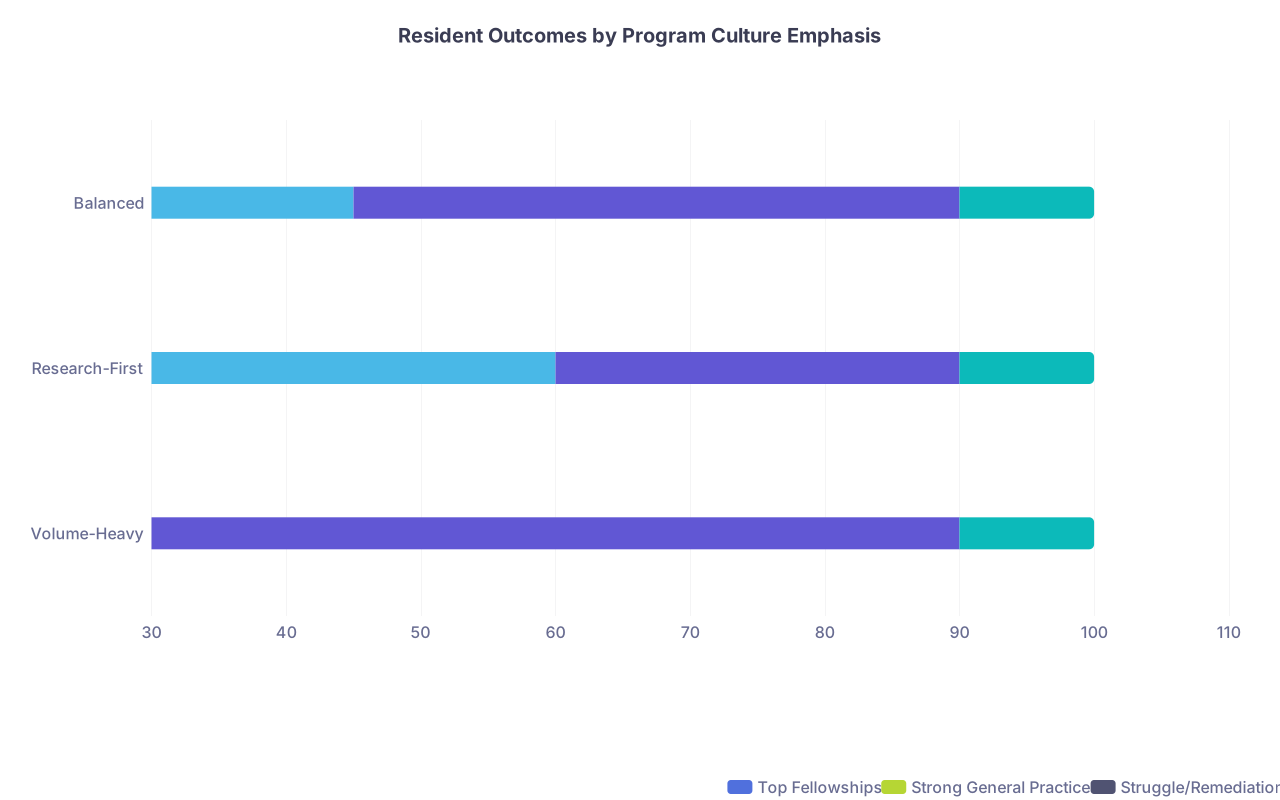
| Category | Top Fellowships | Strong General Practice | Struggle/Remediation |
|---|---|---|---|
| Volume-Heavy | 30 | 60 | 10 |
| Research-First | 60 | 30 | 10 |
| Balanced | 45 | 45 | 10 |
Again, this isn’t exact data. But it’s how program directors think. And that thinking shapes which residents they push and which they tolerate.
FAQs
1. How can I tell during interviews if a program has a toxic hierarchy?
You won’t see it labeled, but you’ll feel it. Watch how residents talk in front of attendings: are they relaxed, or overly deferential and guarded? Ask directly, “When someone makes a mistake here, what happens?” and see if they give a canned answer or a specific story. If residents walk you to the elevator and suddenly get more honest, listen to that version.
2. Is it better to be a mid-tier resident at a ‘top’ program or a top resident at a less famous one?
If you’re aiming for highly competitive fellowships at name-brand places, being a top resident at a strong but slightly less “famous” program often beats being anonymous in a giant machine. The exception: if you can crack the “golden child” tier at an elite place, the network effects are huge. But most people overestimate their odds of doing that.
3. As an introvert, am I automatically disadvantaged in this kind of hierarchy?
No. Quiet doesn’t hurt you. Invisible does. Some of the most respected residents are calm, low-drama introverts who consistently deliver. You don’t need to be loud; you do need to be known. Show up prepared, ask smart questions, follow through on tasks, and have a few key mentors who actually know you well enough to advocate.
4. What’s one concrete thing I should do on away rotations to avoid being mislabeled early?
Own the fundamentals relentlessly. Be the person who always knows the plan, the meds, the labs; who never disappears; who writes tight notes and calls when something’s off. Do not chase cases at the expense of reliability. Faculty remember the student they could trust at 2am more than the one who begged to scrub a big case and then fumbled basics. Reliability is your ticket out of the “unknown quantity” bucket.
Key points? Programs run on invisible hierarchies that determine who gets chances, not just who works hard. Those hierarchies differ by culture—volume, research, old-school, balanced—and you’re choosing which one to live under for years. Your smartest move as an applicant is to match yourself to the system that will actually value what you’re good at, then earn a spot near the top of that pyramid.