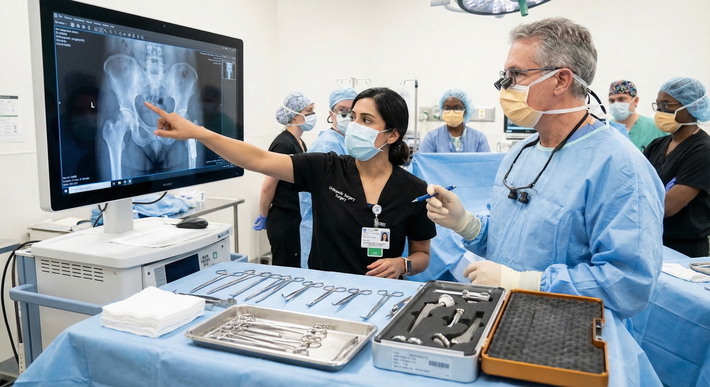
The attending writing your generic letter is not the power player. The department chair is.
When a chair throws their weight behind an applicant for their own residency program, they’re not “being nice.” They are spending political capital. Inside the selection committee room, that chair’s backing can move you from “maybe” to “we’re making this work.” But they do not do it lightly, and they absolutely do not do it for everyone.
Let me walk you through what really happens behind those closed doors and what chairs are actually looking for when they decide, “Yes, this one is mine.”
First, Understand What Chair Support Actually Means
Most students think chair support = “strong letter.” Wrong.
A “strong letter” from the chair is table stakes. Every program has a pile of “outstanding,” “exceptional,” “top 5%” letters that nobody believes anyway. What chairmen of surgical departments mean when they say, “I’ll support you to our program” usually falls into one of three levels:
| Level | What It Really Is | Impact |
|---|---|---|
| 1. Standard Letter | Polite, positive, formulaic | Minimal |
| 2. Advocated Applicant | Chair speaks up in committee, names you | Moderate |
| 3. Protected Applicant | Chair quietly signals you are a priority for their roster | High |
Level 1 is easy. They’ll write this for almost anyone who didn’t actively annoy them.
Level 2 is when they stand up in the rank meeting and say, “I know this student. I’d be happy to have them here. I recommend we rank them in our upper group.” That matters.
Level 3 is when they’ve decided you’re “one of ours.” They might say things like, “This is a homegrown candidate we should not lose” or “I’ll take responsibility if there are any issues.” That’s the golden ticket you think everyone gets, but very few actually do.
The entire article you’re reading is about what separates the Level 2–3 candidates from everyone else.
The Hidden Equation: Risk, Reputation, and Replaceability
Chairmen think in risk, not romance.
They’re not asking, “Do I like this student?” They’re asking, “If this person flames out as a CA-2 or PGY-3, is this going to blow back on me? And is there someone safer I could support instead?”
In their mind, every resident they push through is a reputational bet. Inside their heads, the calculation looks something like this:
- How likely is this person to:
- Embarrass the program?
- Require remediation?
- Quit?
- Hurt someone?
- Poison the culture?
Balanced against:
- How likely is this person to:
- Make the department look good?
- Be productive (research, QI, reputation, fellowship matches)?
- Fit the resident group and not create drama?
- Turn into a future faculty member I’d actually hire?
That’s the frame. If you don’t understand this, you’ll misread everything that happens on your home rotation.
The Non-Negotiables: Things That Will Kill Chair Support
Let’s start with the ugly side, because that’s what chairs notice first. I’ve sat in those pre-rank huddles where the chair says a single sentence that ends a student’s chances at that program. It’s almost always about one of these.
Reliability and Work Ethic (Not the Instagram Version)
Chairs don’t care how “hard” you say you work. They care about signals. They ask the residency coordinator. They ask the chief residents. They ask the OR charge nurse.
If they hear any version of:
- “Shows up close to start time, not early”
- “Charts are incomplete unless pushed”
- “Disappears when work needs to be finished”
- “Great when visible, but not always available”
You’re dead in the water for strong backing.
The chair is thinking: “If this person can’t grind as a student, they’re going to collapse as an intern. And everyone will ask why I backed them.”
What they want to hear is boring but powerful: “Always there. Reliable. No drama. Residents loved working with them.”
Professional Maturity (The Silent Dealbreaker)
This is where a shocking number of strong-applicant students implode.
Red flags:
- Too casual with staff or patients
- Complaining about hours or cases within earshot of attendings
- Overly familiar with residents (joining complaining, gossiping)
- Acting like a peer rather than a learner
- Social media nonsense that leaks back to faculty
I’ve heard chairs say: “Good scores, good letters, but there’s something…off. A little immature. We have other options.” And that’s it. You slide down the list behind every similarly qualified but lower-risk candidate.
They’re not looking for “perfectly polished.” They’re looking for “I can trust this person alone in a call room at 3 a.m. with a critically ill patient and a stressed senior.”
What Actually Moves a Chair to Back You
Now let’s talk about what gets you upgraded from “solid home applicant” to “we should not lose this person.”
1. Clear Evidence You’re Already Functioning Like a Junior Resident
This is the single biggest thing.
Chairs listen very closely when a chief or senior says, “Honestly, they functioned like an intern.” That sentence is gold.
What that looks like on the ground:
- You know your patients cold. Vitals, labs, operative details, comorbidities, all without reading.
- You anticipate, instead of react. You have orders ready. You call consults before being asked.
- You don’t whine about scut. You do the small tasks fast and correctly.
- You can present on rounds without being spoon-fed.
If chiefs are saying during evals, “We’d be lucky to have them as a resident,” the chair hears that.
They know residents don’t say that lightly.
2. Comfort in the OR – But Not Cowboy Behavior
Chairs watch you in the OR differently than attendings doing daily teaching.
They’re scanning for:
- How you handle pressure when the attending’s tone sharpens
- Whether you get flustered when corrected
- Your manual dexterity with basic tasks: knot-tying, simple suturing, handling instruments
- Your situational awareness: what the anesthesia team is doing, what the field looks like, when things are off
They are NOT impressed by bravado or overconfidence. If you’re asking to do more than your skill justifies and ignoring subtle cues to back off, you look unsafe, not “eager.”
The sweet spot is: “Steady hands, aware, coachable, knows limits, wants to learn.”
I’ve seen chairs quietly flag students as “too hot” (their actual phrase) because the student was trying to show off in big cases. Those students rarely get sponsored hard.
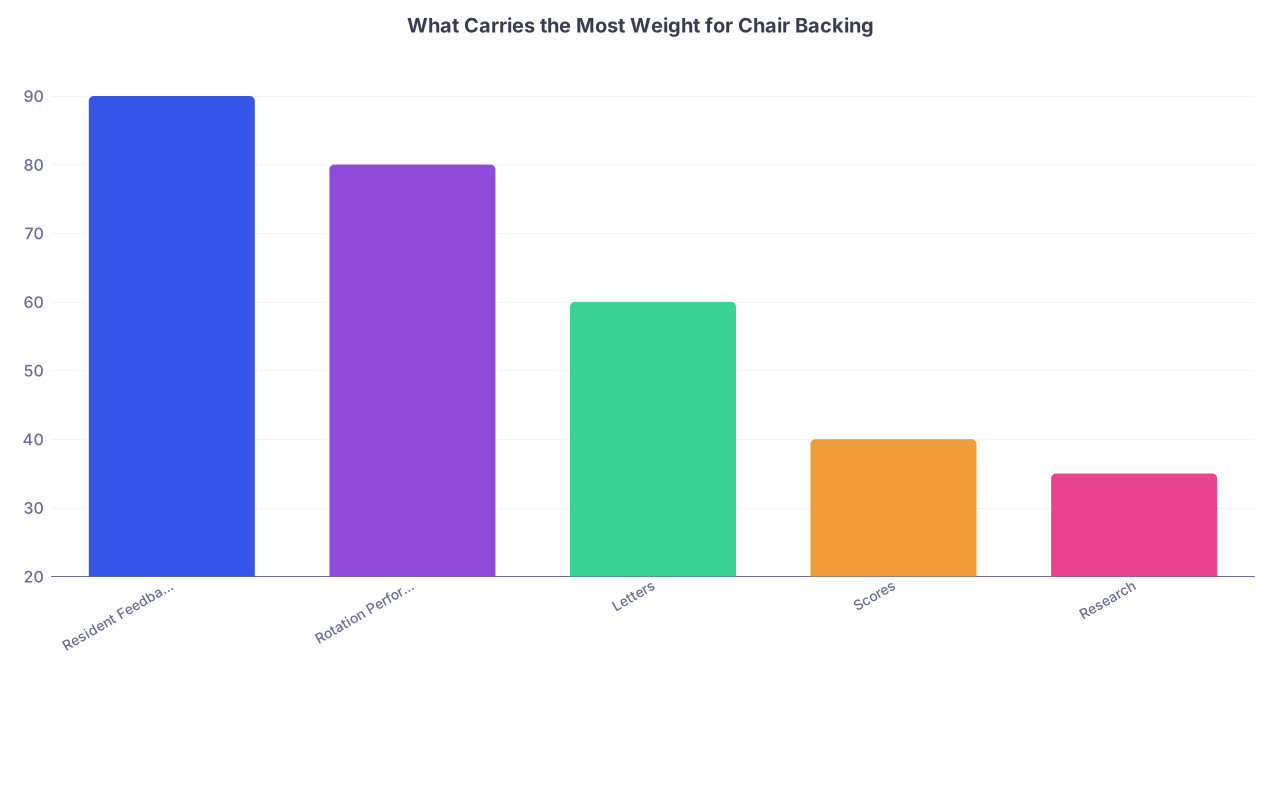
| Category | Value |
|---|---|
| Resident Feedback | 90 |
| Rotation Performance | 80 |
| Letters | 60 |
| Scores | 40 |
| Research | 35 |
3. Resident Feedback – The Real Currency
Forget what attendings told you. Chairmen take resident feedback extremely seriously, especially from chiefs and PGY-4/5s.
On most services, there’s an informal moment when the chair or PD asks: “How was our student? Would you want them here?” That answer is brutal and honest.
What residents notice far more than your fund of knowledge:
- Did you help or did you create work?
- Did you stay when things were busy or disappear at 4:30?
- Did you pick up social cues, or did you force yourself into everything?
- Were you teachable? Or did you argue, over-explain, or flex about what you “already knew” from some UpToDate article?
If residents say, “We liked them socially, but we’re not sure about work ethic,” you don’t get strong chair backing. If they say, “That student worked like crazy, never complained, and was easy to be around,” your stock goes way up.
4. Cultural Fit With Their Existing Residents
Chairmen are ruthless about chemistry.
They’re thinking: “Does this person slot into this group of residents without detonating it?”
Things that push chairs away from you, even if you’re individually strong:
- Too intense for a generally laid-back program
- Too quiet/withdrawn for a very social, team-heavy program
- Large ego walking into a culture defined by humility
- Very rigid, by-the-book personality in a “figure it out, improvise” kind of place
They listen when their most trusted residents say things like, “We just didn’t really mesh” or “They’re fine, but I don’t see them fitting our group.” That can drop you several spots on the rank list.
On the flip side, if the chiefs are literally asking, “Can we please get them?”—the chair will move mountains to try to keep you.
The Politics: What Chairmen Never Say in Public
Here’s the messy part nobody tells you as a student.
Home-Grown vs. Outside Stars
Every chair feels pressure: “We should take care of our own.” But they also want to protect the program’s national profile.
Quietly, the conversation goes like this:
- “We have three good home students.”
- “We also have five stellar external applicants with insane metrics.”
- “We can’t fill the class with only homegrown if it means passing on stronger outsiders.”
- “Who is the one or two home students we absolutely cannot lose?”
You’re not competing against some abstract standard. You’re competing against your classmates—and against outside applicants the chair believes might be “better bets.”
If you’re a home applicant and the chair sees you as “fine” but not exceptional, they may not burn their capital to push you above a stronger external candidate.
The “Do I Want Them as Junior Faculty?” Question
This one is very real, especially in surgical subspecialties.
Many chairs are quietly building a pipeline. They ask themselves:
“If this person wanted to stay on as faculty someday, would I be excited or hesitant?”
That single mental question changes how aggressively they back you.
You don’t need to declare lifetime loyalty, but if you show:
- Deep interest in the field beyond matching
- Early research productivity
- Good relationships with faculty
- Emotional stability and maturity
They start to picture you at their M&M in 8–10 years as a partner, not a liability. Those are the applicants they protect.

| Step | Description |
|---|---|
| Step 1 | Student on Home Rotation |
| Step 2 | Resident Feedback |
| Step 3 | Faculty Impressions |
| Step 4 | Standard Letter Only |
| Step 5 | Moderate Advocacy in Committee |
| Step 6 | Protected Applicant Status |
| Step 7 | Safe Bet? |
| Step 8 | Top Tier or Solid? |
How You Actually Signal You’re “Backable”
Now let’s translate all this into what you can control.
Own Your Home Rotation Like It’s a Month-Long Interview (Because It Is)
On your home surgical rotation or sub-I at your chosen specialty, you need to behave like everything is being watched—because it is.
Practical moves:
Be consistently early, not occasionally heroic
Chairs don’t care that you stayed until midnight once. They care that nurses say, “They were always here and available.”Be the answer, not another problem
Don’t constantly ask, “Is there anything I can do?” Watch. Anticipate. Grab the next task: consent forms, dressings, updated labs, imaging pulled, family updated (with appropriate supervision).Learn your patients better than the residents
When attendings or the chair ask a question about your patient, answer like it’s your job, not a quiz.
Ask for Feedback the Right Way
Chairs notice who actively seeks growth.
The right way is not: “What can I do better?” at the elevator as the attending is leaving. That’s noise.
Better:
“Dr. X, I’m very interested in [this specialty] and in training here if I’m fortunate enough. I want to make sure I’m working at the level you expect from someone you’d be comfortable backing. Are there one or two specific things I should work on this week to move in that direction?”
That language does two things:
- It signals your interest in their program explicitly.
- It puts “backing” and “comfort” in their mind associated with you.
And yes, residents will know you asked. That helps you.
Build a Direct Relationship With the Chair Without Being Obnoxious
You don’t stalk the chair. But you also don’t stay invisible.
Reasonable touchpoints:
Pre- or post-op brief conversations when they scrub with you
Not small talk about sports. Ask targeted, thoughtful questions about the specialty, the program, or clinical judgment.A short end-of-rotation email
Something like: “Dr. [Chair], thank you again for the opportunity to work on your service this month. The experience confirmed my desire to pursue [specialty], and your team set a standard I hope to train under. I’d be grateful for any feedback you have, and I’ll be applying this cycle with your program as a top choice.”
That tells them clearly: “This student wants us. Do I want them?”
If you’ve done the on-the-ground work, that’s when they start thinking about how hard they’re willing to push.

Specialty-Specific Nuances Chairs Care About
Since you’re reading this under “Choosing a Surgical Residency,” let’s briefly hit some subspecialty flavors. The core framework is the same, but emphasis shifts.
General Surgery
Chairs want: grinders with resilience, people who won’t crumble under call and who can handle a very steep growth curve.
Extra weight on:
- Grit and attitude on trauma nights
- Ownership on floor patients and consults
- Long-term potential for academic productivity or leadership
A gen surg chair will absolutely back a “slightly lower-Step-score but unbelievably tough and reliable” home student over a fragile 270 from outside.
Orthopedic Surgery
In ortho, chairs are balancing brand-consciousness with team chemistry.
Extra weight on:
- Athletic/”team sport” mentality – can you function like part of a high-intensity team?
- Technical aptitude and enthusiasm in the OR
- Early interest in a subspecialty with potential for future fellowship placement (which also helps the program’s map)
They also listen heavily to the residents’ vibe. A chair won’t back someone who rubbed the ortho residents the wrong way, no matter how strong on paper.
Neurosurgery
Here, “backing” is almost like adoption.
Extra weight on:
- Extreme reliability and emotional stability
- Intellectual horsepower and genuine curiosity
- Long-term research commitment, not just a token project
A neurosurgery chair will not stick their neck out for someone with even mild professionalism concerns. Too risky.
ENT / Plastics / Urology / Smaller Surgical Fields
Chairs are thinking in “pipeline” and “fit.”
Extra weight on:
- Do we see this person becoming one of ‘our people’ in a very small world?
- Can we trust them with high-stakes patients and delicate dynamics?
- Will they help our fellowship match stats and academic output?
In these fields, one negative story about you travels fast. One positive story travels even faster. Chair backing is extremely personal here.

What To Do If You’re Not the Obvious Golden Child
Maybe you’re not the top scorer. Or you had a slow start to medical school. Or you didn’t realize you wanted that specialty until late. You can still earn chair backing, but you have to be intentional.
Specific plays that actually work:
Own your story up front
Chairs respect honest, concise explanations: “First-year grades were rough while I adjusted to [X], since then I’ve been straight honors.” Do NOT hide and hope they miss it. They don’t.Outwork every other student
When the chair hears, “They might not have the best CV, but nobody outworked them,” that matters more than you think.Build a visible track record over time
Show up to grand rounds. Volunteer for small research/QI roles. Be a familiar, reliable presence long before ERAS season.Line up residents to vouch for you
If three residents independently tell the PD or chair, “We should really consider [Your Name], they’d be great here,” that shifts you from “borderline” to “worth spending capital on.”
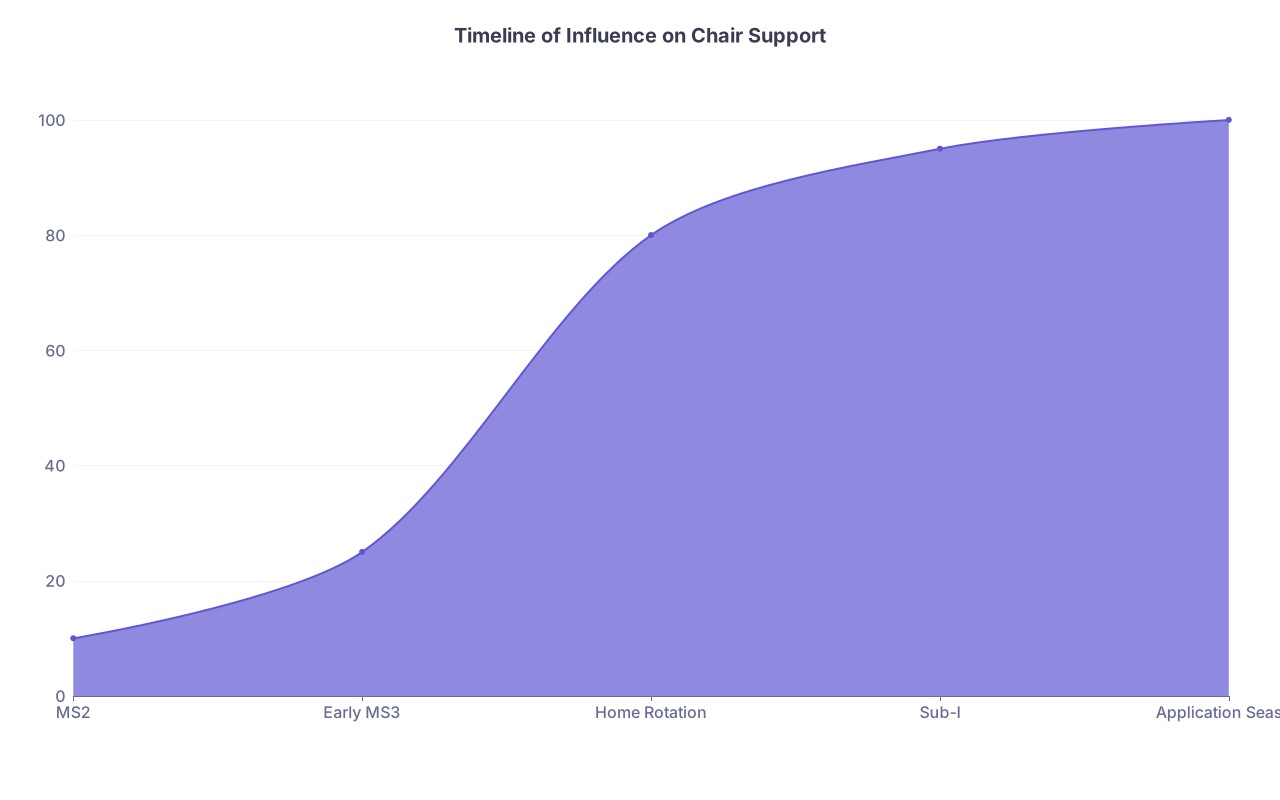
| Category | Value |
|---|---|
| MS2 | 10 |
| Early MS3 | 25 |
| Home Rotation | 80 |
| Sub-I | 95 |
| Application Season | 100 |
How Chair Support Plays Out on Rank Day
I’ll end with what you never see.
There’s a closed-door meeting. PD, APDs, chair, key faculty, chief residents. A draft rank list on the screen.
They’re stuck about a cluster of applicants, including you.
Then the chair says one of three things about you:
“They’re fine.”
Translation: No risk, no passion. You’ll sit wherever your raw application placed you.“I know this student. Solid. I’d be happy to have them here.”
Translation: You’ll probably get bumped up a bit, especially if others are unknown quantities.“This is a homegrown student I feel strongly about. They worked incredibly hard on our service, residents loved them, and I’d like to see us get them.”
Translation: People move down to make room for you. That’s what backing actually does.
Your goal is to be the student who earns that third sentence. Not by begging for it. By being the kind of resident they’d bet their name on.
With that foundation in your head, you’re ready to start thinking strategically: which rotations to prioritize, which relationships to build, and how to position yourself as “one of ours” at the places you care about most. Turning that into an actual game plan for your specific specialty and school—that’s a conversation for another day.