
Most medical students pick their surgical specialty too late—and for the wrong reasons.
You are not choosing “what seems cool.” You are choosing a decade of your life, a sleep schedule, a body habitus, and a divorce risk profile. That decision starts now, in MS2, not in the middle of your sub‑internship.
Here is a year‑by‑year, season‑by‑season roadmap from MS2 to Match to choose a surgical specialty with your eyes open.
Big Picture: The Four-Phase Timeline
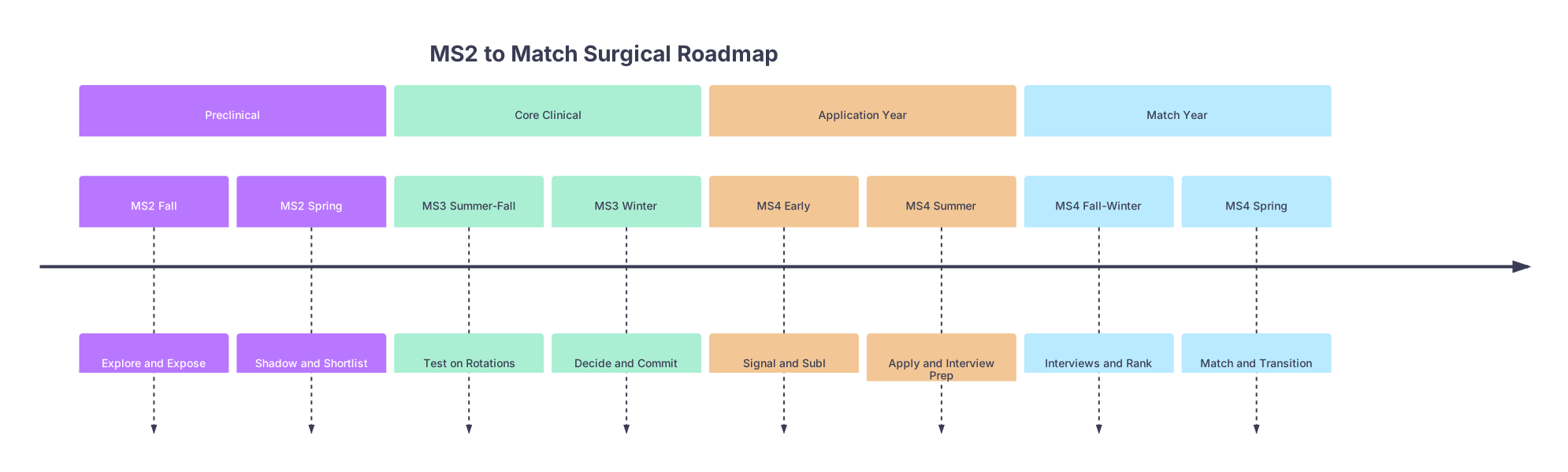
| Period | Event |
|---|---|
| Preclinical - MS2 Fall | Explore and Expose |
| Preclinical - MS2 Spring | Shadow and Shortlist |
| Core Clinical - MS3 Summer-Fall | Test on Rotations |
| Core Clinical - MS3 Winter | Decide and Commit |
| Application Year - MS4 Early | Signal and SubI |
| Application Year - MS4 Summer | Apply and Interview Prep |
| Match Year - MS4 Fall-Winter | Interviews and Rank |
| Match Year - MS4 Spring | Match and Transition |
Think of your journey in four phases:
- MS2 – Exploration with intent
- MS3 – Field-testing your options on the wards
- Early MS4 – Committing and building a competitive application
- Late MS4 – Surviving interview season and ranking wisely
I will walk you through each phase chronologically with “at this point you should…” checklists.
MS2: Exploration With Intent (Not Vibes)
At this point you should stop saying “I like surgery” as if it is specific. There is no “general surgery versus ortho” in the real world. There are lifestyles, call patterns, and patient populations that match you—or do not.
MS2 Fall (Aug–Dec): Broad Exposure, Low Commitment
Your priorities:
- Get concrete exposure to at least three operative fields.
- Start tracking your own reactions systematically.
- Quietly rule out what is clearly wrong for you.
At this point you should…
Set up structured shadowing
- Aim for half‑days in:
- General surgery
- Orthopaedic surgery
- Obstetrics & gynecology or urology
- Neurosurgery or ENT if available
- Do not just wander in. Email residents or clerkship coordinators and request specific OR days.
- Aim for half‑days in:
Use a simple post‑day scorecard After each OR session, rate 1–5:
- How much did I enjoy the cases?
- How much did I like the patient population?
- How tolerable was the team culture?
- Could I live with these hours/call long term?
Keep these in a simple spreadsheet or notes app. Your feelings will blur later. The data helps.
Join (but do not marry) surgical interest groups
- Attend meetings for:
- Surgery interest group
- Ortho/Neurosurg/ENT/Urology/Plastics, depending on availability
- Do not sign up for every leadership role. You are scouting, not committing.
- Attend meetings for:
Start one low‑lift research involvement
- Contact a surgeon whose field you might consider.
- Ask for:
- Chart review
- Case report
- Retrospective study
- You are not trying to be first author in JAMA Surgery in MS2. You are testing “Do I like the questions this specialty asks?”
Red flags this field may not be for you (even now):
- You are bored in clinic and only “wake up” in the OR.
- You hate the patient population (e.g., “I cannot stand trauma nights”).
- You consistently dislike the residents’ demeanor in that field.
MS2 Spring (Jan–May): Narrowing and Shortlisting
Now you shift from “anything with a scalpel” to 2–3 realistic contenders.
At this point you should…
Shadow more deeply in 2–3 fields
- One full clinic half‑day + one OR day in each.
- Ask to follow the same attending through clinic to OR. Watch the whole arc of care.
Track objective lifestyle factors Ask residents (privately, not on rounds):
- Typical weekday start/finish times
- Weekend call frequency
- How many nights per month truly wreck their sleep
- Whether attendings in that field usually operate into their 60s or shift toward clinic / admin
Log it. Feelings lie; patterns in call schedules do not.
Start realistic competitiveness checks
| Specialty | Typical Step 2+ | AOA/Top Quartile Helpful | Research Heaviness |
|---|---|---|---|
| General Surg | 240+ | Preferred | Moderate |
| Ortho | 250+ | Strongly Preferred | High |
| Neurosurgery | 255+ | Almost Expected | Very High |
| ENT | 250+ | Strongly Preferred | High |
| Urology | 245+ | Preferred | High |
These are not absolute, but they are directionally correct. If you are sitting at the class mean with no research and aiming at neurosurgery, you need a plan, not blind optimism.
- Build a tentative “Shortlist of 2–3” by May
By the end of MS2, you should have:
- 1–2 primary target surgical specialties.
- 1 backup that is still acceptable, not just “less competitive.”
Write it down. Commit to testing this shortlist during MS3.
MS3: Field-Test Your Shortlist On The Wards
This is where former “I love surgery” students discover they actually hate 3 am pages and crusty attendings. Good. Better now than as a PGY‑2.
Early MS3 (Jun–Sep): Core Rotations – Data Collection Mode
Most schools place surgery and medicine early. Use that.
At this point you should…
Front‑load your surgery rotation if possible
- Ask scheduling if you can take core Surgery in the first half of MS3.
- Reason: letters, connections, and clarity.
On surgery, compare specialties in real time While on general surgery, pay attention to:
- Which consults interest you:
- “Hip fracture in 80‑year‑old female” (ortho)
- “GI bleed” (general)
- “Pelvic pain” (OB/Gyn)
- Which teams you envy when they walk in. If you are on general but constantly wish you were with ortho in room 3, that is a data point.
- Which consults interest you:
Ask every resident one question
“If you could redo specialty choice today, same scores and CV, what would you pick?”
I have seen GS residents say plastics. Ortho residents say radiology. ENT residents say they would absolutely do ENT again. The pattern matters.
Start Step 2 CK planning with specialty in mind
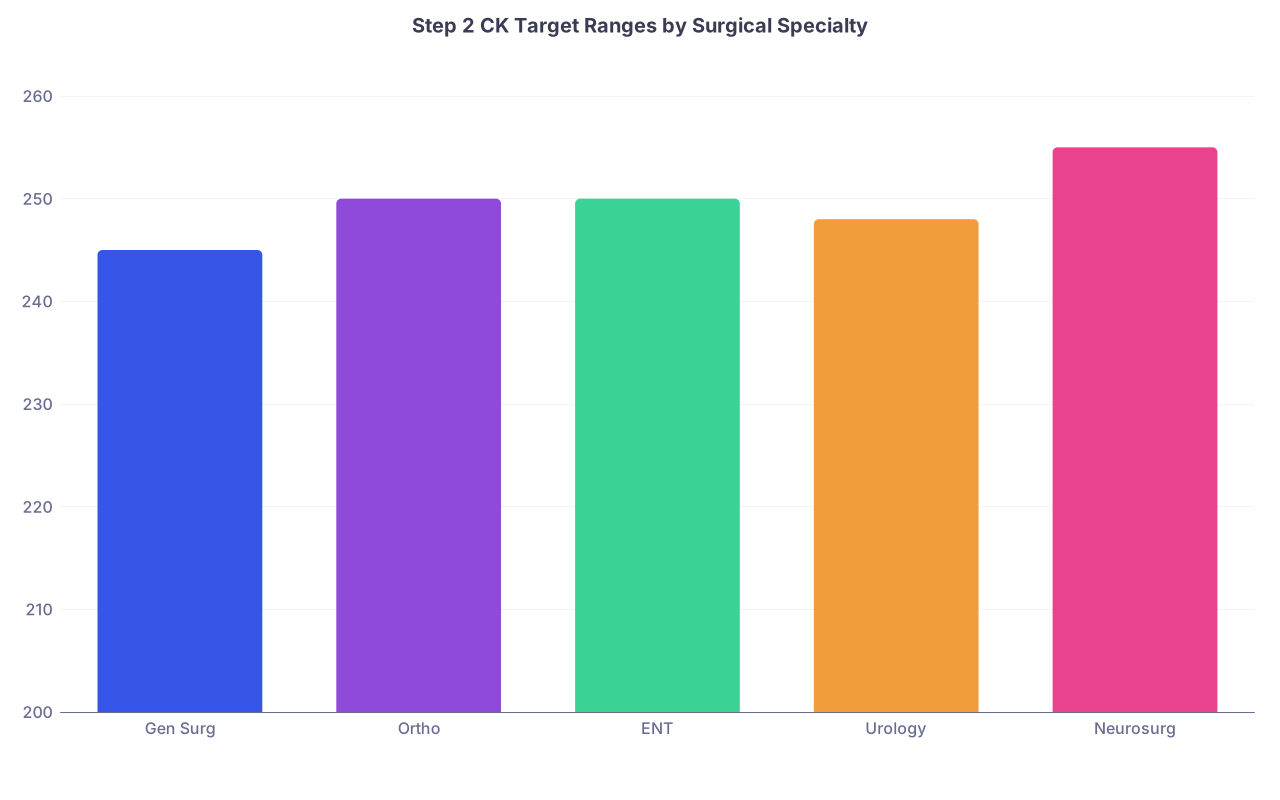
| Category | Value |
|---|---|
| Gen Surg | 245 |
| Ortho | 250 |
| ENT | 250 |
| Urology | 248 |
| Neurosurg | 255 |
You do not control the exact number, but you control:
- Taking Step 2 before ERAS if you need the score.
- Giving yourself 4–6 dedicated weeks if aiming at more competitive fields.
Mid MS3 (Oct–Dec): Decision Point Approaching
By the midpoint of MS3, you should be brutally honest with yourself.
At this point you should…
Do targeted electives in shortlist fields
- 2‑week or 4‑week electives in at least two of your shortlist specialties.
- Tell the clerkship director quietly: “I am genuinely considering this field.”
Notice:
- How attendings react to that statement.
- Who offers to mentor you.
- Whether the residents try to recruit you—or warn you.
Assess “fit” using three filters
- Cases: Do you like the operations themselves? Complexity? Pace?
- People: Do you enjoy the dominant personality type?
- Pendulum: Will the lifestyle tradeoffs feel worth it at age 40, not just 28?
If a field fails two of three, stop forcing it.
Start specialty‑specific research in earnest
- By now you should have one surgeon in a target field who knows your name.
- Ask for:
- Ongoing project you can join.
- Abstract or poster for regional/national meeting. For competitive specialties, a couple of posters or abstracts in the field goes a long way.
Begin lining up letter writers
- Identify 2–3 attendings (ideally in your target field) who:
- Have worked with you on the wards.
- Saw you take responsibility (notes, presentations, following patients).
- Tell them: “I am strongly considering [specialty]; I would love to work with you more because I may ask for a letter in MS4.”
- Identify 2–3 attendings (ideally in your target field) who:
They should not be surprised when you return for a sub‑I.
Late MS3 (Jan–Mar): Decide and Commit
This is the uncomfortable part. You need to choose.
At this point you should…
Make a decision by March at the latest You need a “primary specialty” and a “realistic backup strategy”:
- Primary: The surgical field you will build your MS4 around.
- Backup: Either:
- A less competitive surgical field you would tolerate; or
- A non‑surgical field you genuinely could be content in.
Delaying this choice into MS4 is how people end up in SOAP.
Meet with specialty advisors Schedule meetings with:
- Department / program director or associate PD.
- A resident mentor in that field. Bring:
- CV
- Step scores (or practice scores)
- Research list Ask direct questions:
- “Am I a realistic candidate for this specialty?”
- “How many programs should I apply to with this profile?”
- “Do I need an away rotation?”
Plan MS4 year with purpose Tentatively schedule (subject to school rules):
- 1–2 sub‑internships in your primary specialty at your home program.
- 0–2 away rotations if:
- The field is competitive (ortho, ENT, neurosurg, plastics, urology).
- Your home program is weak or nonexistent.
- Step 2 CK timing: usually by July/August if you need it on ERAS.
Lock in your narrative You should be able to answer, in one paragraph:
- Why surgery, not medicine.
- Why this surgical specialty, not any other.
- How your experiences back that up (specific rotations, cases, mentors).
If you cannot articulate this, you are not ready to apply in that field yet.
Early MS4: Commit, Prove It, and Apply
Now you stop shopping and start demonstrating you are a safe bet for that specialty.
MS4 Early (Apr–Jul): Sub‑I and Away Logistics
At this point you should…
Do a home program Sub‑I in your primary specialty
Treat this as an audition for your own program and for your letters.Show up as:
- First in, last out.
- Owning your patients: notes, follow‑up, calling consults (with supervision).
- Person the interns trust, not just the attendings.
You want at least one stellar letter from this month.
Choose away rotations strategically Away rotations are expensive and exhausting. They are not vacations.
Good reasons to do an away:
- Your specialty is highly competitive.
- You lack a strong home program.
- You are geographically targeting a specific region.
Bad reasons:
- “Everyone else is doing 4 aways.”
- “I want to see a cool city.”
Lock in your Step 2 CK
- Take it before ERAS submission if:
- Your Step 1 is pass only and you need an objective signal.
- You are aiming at a competitive surgical subspecialty.
- Delay only if your prep is clearly inadequate and a later, higher score outweighs timing.
- Take it before ERAS submission if:
Craft your ERAS application with specialty coherence
- Personal statement tells a specific story anchored in the field.
- Experiences list highlights:
- Surgical research
- Leadership relevant to teamwork / resilience
- Longitudinal patient care
Do not submit a generic “I like surgery and hard work” essay. Every program director has read that a hundred times.
MS4 Late Summer (Aug–Sep): ERAS Submission
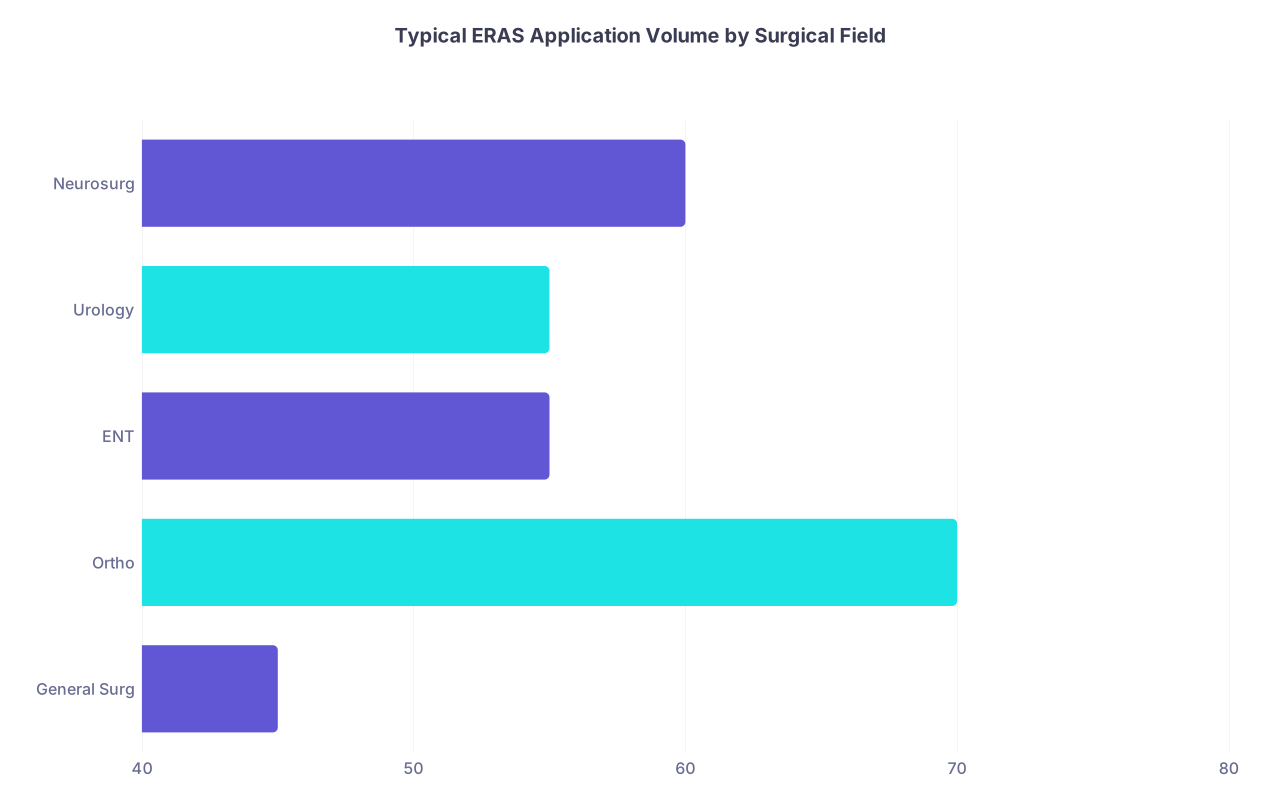
| Category | Value |
|---|---|
| General Surg | 45 |
| Ortho | 70 |
| ENT | 55 |
| Urology | 55 |
| Neurosurg | 60 |
Numbers vary, but note the trend: competitive fields = more applications.
At this point you should…
Submit ERAS early in the opening window
- Your app should be ready to go day one or close to it.
- Letters:
- 2–3 from surgeons in your specialty.
- 1 from medicine or another core to show you are not a one‑trick OR pony.
Finalize your program list with mentors
- Stratify into:
- “Reach” programs
- “Target” programs
- “Safety” (as close as exists in competitive fields) Programs know when your list is unrealistic. Your mentors can usually smell that.
- Stratify into:
Prepare for interview season before invites hit
- Run practice interviews with:
- Surgery faculty
- Residents
- Prepare answers for:
- “Why this specialty?”
- “Tell me about a complication / conflict on the team.”
- “What will be hard for you in residency?”
- Run practice interviews with:
MS4: Interviews, Ranking, and Match
Now you test if the specialty you chose actually wants you back. And you decide where you can stand to live and work for 5–7 years.
MS4 Fall–Winter: Interview Season

At this point you should…
Use interviews to reality‑check your assumptions During Q&A with residents:
- Ask specifics:
- “What did you actually do on your last call?”
- “How many cases does a typical chief graduate with?”
- “What are people’s fellowship plans and how successful are they?”
Watch:
- Do residents seem burned out or collegial?
- Do women and underrepresented residents seem supported?
- Is there actual joy anywhere in the program?
- Ask specifics:
Take notes immediately after each interview 10–15 bullet points:
- Gut feeling (1–10)
- Strengths: operative volume, culture, location, fellowship match.
- Concerns: malignant attendings, poor didactics, weak case mix.
Do it the same day. Your 8th mid‑tier academic program will blur with your 11th without notes.
Stay professional but human Programs see through desperate emails and robotic thank‑yous. Reasonable follow‑up:
- Thank‑you email to PD and any faculty you had meaningful conversations with.
- Brief updates if something major changes (publication accepted, award).
Do not pester with “Am I ranked?” emails. They hate that.
MS4 Winter–Spring: Rank List and Match

At this point you should…
- Build your rank list based on three tiers
| Priority Level | Factor |
|---|---|
| Tier 1 | Program culture |
| Tier 1 | Operative volume |
| Tier 2 | Location / family |
| Tier 2 | Fellowship outcomes |
| Tier 3 | Prestige / name |
People overvalue prestige and undervalue whether they will be tortured for 6 years. Do not make that mistake.
Use a simple comparison system For each program, rate 1–5:
- Culture / resident happiness
- Case volume / autonomy
- Location support system
- Fellowship prospects (if relevant) Sum it. Look at the numbers next to your feelings. Often they agree; if they do not, interrogate why.
Accept that there is no perfect choice Every specialty, every program has tradeoffs.
- General surgery: longest hours, broadest scope.
- Ortho: physically demanding, very procedural.
- ENT: niche but competitive; life can be good in practice. The question is not “Is this perfect?” It is “Can I thrive here and not hate my life?”
Quick Year-by-Year Checklist

| Time Point | Key Tasks |
|---|---|
| MS2 Fall | Shadow 3+ fields, join interest groups |
| MS2 Spring | Shortlist 2–3 specialties, start research |
| Early MS3 | Core surgery rotation, targeted electives |
| Mid MS3 | Specialty meetings, decide primary field |
| Late MS3 | Plan MS4, sub‑Is, possible aways |
| MS4 Early | Sub‑I, Step 2, finalize ERAS materials |
| MS4 Fall | Interviews, ongoing specialty check |
| MS4 Winter/Spring | Rank programs, prepare for Match |
FAQ (exactly 2)
1. What if I realize late in MS3 that I chose the wrong surgical specialty?
You are not trapped, but you do need to be strategic. If you pivot from, say, ortho to general surgery late MS3, talk to both departments immediately. You may be able to:
- Do a late MS3 or early MS4 sub‑I in the new field.
- Get at least one strong letter from that specialty.
- Reframe your existing research and experiences to emphasize general surgical themes.
If your new target is more competitive than your original plan, you will need a ruthless reality check on scores and CV. Sometimes the right move is to apply in your more realistic field now and consider fellowship or later transition rather than betting everything on a last‑minute switch.
2. Do I need research in my exact surgical specialty to match?
For very competitive fields (neurosurgery, ENT, plastics, ortho, urology), yes, you generally need something specialty‑specific. It does not all have to be first‑author original research, but having no scholarly activity tied to that field looks lazy. For general surgery, surgical‑adjacent work (critical care, outcomes, quality improvement) can still carry weight. Bottom line: programs want evidence that you understand what their field actually studies and that you have stuck around long enough to complete a project with surgeons. That is part academic ability, part commitment signal.
Three truths to walk away with:
- Decide your surgical specialty early enough that your rotations, research, and letters all point in the same direction.
- Judge specialties by the lives of their residents and attendings, not just by how “cool” the OR looks for a day.
- Build your timeline deliberately from MS2 to Match—because drifting into a surgical field is how people end up miserable, and you can do better than that.