The strongest ortho applicants are not beaten by scores. They are quietly killed by their letters.
If you treat orthopedic surgery letters of recommendation like a generic box to check, you are walking straight into the most avoidable trap in this specialty. I have seen applicants with 260+ scores, honors in every rotation, and legit research get filtered out because their letters were bland, mismatched, or came from the wrong people. No drama. No explanation. Just no interview.
This is not paranoia. It is pattern recognition.
Let me walk you through the orthopedic letter mistakes that quietly sink strong applicants—and how to avoid joining that pile.
1. Treating “Any Strong Letter” as Good Enough for Ortho
The worst assumption you can make: “A strong letter is a strong letter, regardless of specialty.”
Wrong. For orthopedic surgery, the type of letter and the identity of the writer matter almost as much as the content.
Here is the mistake pattern I see constantly:
- Two “amazing” letters from medicine and pediatrics
- One letter from an orthopedic surgeon who barely knows you
- Optional: a research letter from a PhD who thinks you walk on water
On paper, this feels safe. In reality, it sets off warning bells.
Orthopedic programs look for:
- Clear evidence that surgeons in their own field know you
- Confirmation you understand the grind and culture of ortho
- Proof you performed under surgical pace, expectations, and pressure
A glowing letter from a hospitalist does not answer that.
Minimum standard for a serious ortho applicant:
- 2–3 letters from orthopedic surgeons (preferably faculty at academic centers)
- At least 1 from a place where you rotated on an orthopedic service
- 1 “home” ortho letter almost always expected if you have a home program
If you are applying to orthopedic surgery and your letters are mostly non-ortho, programs will quietly assume one of three things:
- You did not impress ortho faculty enough to ask
- You did impress them but did not understand how letters work (bad judgment)
- You are not fully committed to ortho and are hedging or “ortho-curious”
All three are fatal in a competitive match.
2. Picking Letter Writers Based on Fame Instead of Fit
Another classic self-sabotage: chasing big names who barely know you.
You know the move:
- “I want the Chair because they are known nationally.”
- “That surgeon is on multiple national committees; their letter will be gold.”
Then the letter arrives, and it reads like this:
“I have had limited but positive interactions with [Student]. They appeared interested in orthopedic surgery. I believe they will succeed in residency.”
I can tell within three sentences if a letter writer truly knows you. So can every selection committee.
Red flags committees notice in “famous but weak” letters:
- Vague praise: “hard-working,” “pleasant,” “a good team member” with no examples
- No mention of specific cases, call shifts, or patient interactions
- No discussion of how you compare to peers (“top 10% of students I have worked with”)
- No details about work ethic, technical skill, or grit
Better strategy:
Pick the surgeon who:
- Saw you on call at 1 a.m. and watched you still push on rounds at 6 a.m.
- Let you close skin, reduce a fracture, or run part of a case
- Commented directly on your growth: “You really improved over the last two weeks”
- Gave you feedback face-to-face (even if it was blunt)
Given a choice between:
- Letter from the Chair who remembers your name but not your work
- Letter from the junior faculty who scrubbed 15 cases with you and knows your ceiling
The second wins. Every time.
3. Asking Too Late—and Getting the “Template Letter”
You know those generic, safe, bloodless letters that program directors read in 6 seconds and never think about again? Many of those come from otherwise good letter writers who were asked way too late.
Common timeline mistakes:
- Asking for letters at the very end of the rotation, on your last day, in a hallway rush
- Emailing three months later, when they barely remember you
- Requesting letters in September for an early-September ERAS submission
When you ask late, faculty default to:
- Minimal detail
- Vague positives
- No ranking language
- A recycled paragraph they use for every “solid” student
That is how you get your application quietly downgraded from “top candidate” to “meh, maybe.”
Fix it:
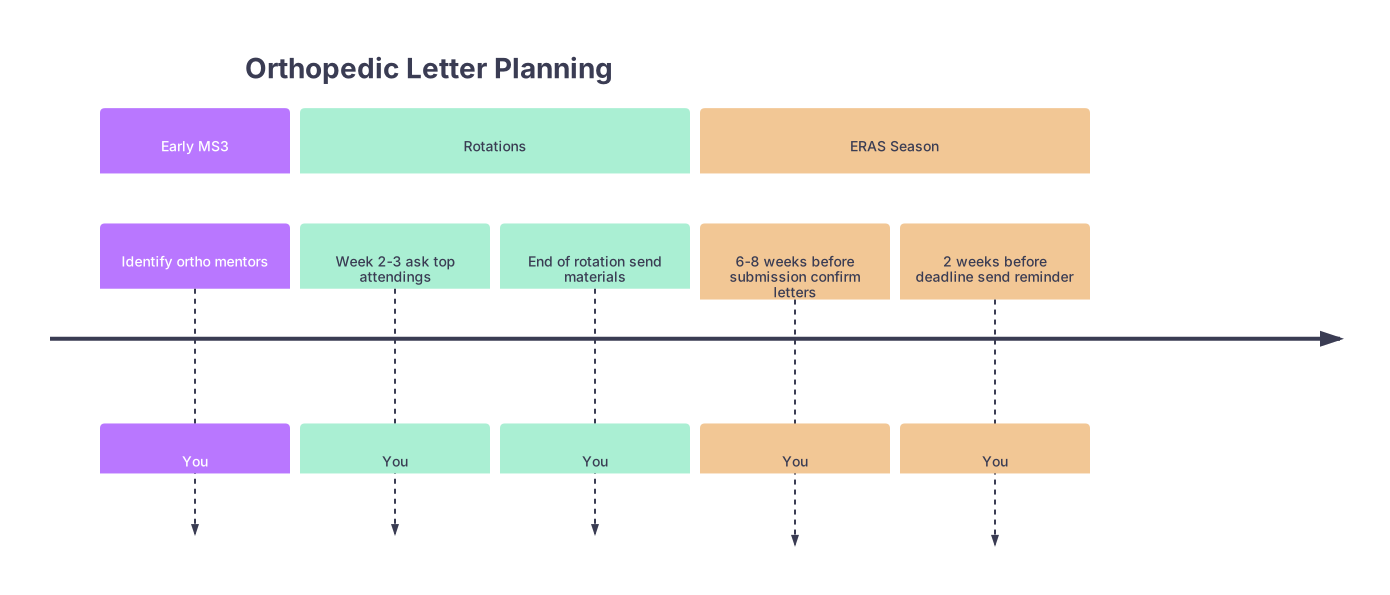
| Period | Event |
|---|---|
| Early MS3 - Identify ortho mentors | You |
| Rotations - Week 2-3 ask top attendings | You |
| Rotations - End of rotation send materials | You |
| ERAS Season - 6-8 weeks before submission confirm letters | You |
| ERAS Season - 2 weeks before deadline send reminder | You |
Ask early:
- Around the midpoint of the rotation, once you have shown consistent value
- Face-to-face: “Dr Smith, I am planning to apply to orthopedic surgery. If you feel you know my work well enough, I would be honored to have a letter from you.”
Then follow up:
- Within 24–48 hours with an email containing:
- CV
- Draft of personal statement
- Brief bullet list of cases you worked on with them, memorable moments, or feedback they gave you
- A reminder of deadlines
You are not “bugging them.” You are making it easy for them to write a real letter.
4. Underestimating How Much the Content of Ortho Letters Must Signal Grit
Programs are not just asking, “Are you smart and nice?” They are asking:
- Will this person survive 5 years of low sleep, heavy volume, and high expectations?
- Will I trust them holding a drill or saw next to the femoral artery?
- Will they show up at 5 a.m. after a bad call night and still push?
Weak letters dodge those questions. Strong orthopedic letters answer them directly.
Red-flag letter content that quietly hurts you:
“[Student] is dependable and completes tasks when assigned.”
→ Translation: average, needs direction, not a self-starter.“I did not see significant operative experience with [Student], but they seemed engaged in the OR.”
→ Translation: we did not trust them enough to give much responsibility.“They were respectful and worked well with others.”
→ Translation: nothing to say about work ethic, ownership, or resilience.
Ortho letters should hit core themes:
- Work ethic: pre-rounding, staying late, volunteering for cases
- Grit: bounced back from mistakes, handled high workload without complaining
- Technical aptitude: deliberate practice, improving knot tying, positioning, splinting
- Ownership: following labs, calling consults, knowing all their patients cold
- Genuine interest in ortho: reading, asking case-relevant questions, following up
If your letter writer has not seen those behaviors from you, the problem is upstream. It is not a letter issue. It is a rotation performance issue.
5. Ignoring the “Home Program” Letter Problem
Programs absolutely read between the lines of your home institution’s behavior.
Common silent disaster: You have a home ortho department, and:
- None of your letters come from home faculty
- Or your home letter is conspicuously generic while your away rotation letters glow
Selection committees notice that. Very quickly.
The unspoken interpretation is simple and brutal:
“If their own orthopedic department is not strongly supporting them, something is off.”
Sometimes the story is innocent:
- You had limited face-time with home attendings
- The rotation structure is odd
- You were late to commit to ortho
But committees do not see the backstory. They only see the output.
Avoid this by:
- Locking in a home ortho rotation early in your application year
- Identifying 1–2 home attendings to work closely with and ask for support
- Being explicit: “I hope to have a strong home letter supporting my ortho application.”
And if you know your home department is lukewarm on you? Do not pretend that problem does not exist. You need:
- Outstanding away rotation letters from respected places
- A personal statement that clearly frames your growth and late interest (without sounding flaky)
- A realistic list of programs that do not heavily bias for home support
6. Overloading Non-Ortho Research and “Character” Letters
Here is another silent way strong applicants sink themselves: they overvalue research or character letters outside ortho.
Typical setup:
- 1 letter from an orthopedic attending
- 1 letter from a medicine attending
- 1 letter from a PhD research mentor in biomechanics
- 1 “optional” letter from a coach or volunteer director
And they think: “More data points. That has to help.”
It often does not.
Most orthopedic programs are looking for 3–4 letters. Beyond that, extra letters can dilute the impact of your best ones, especially if:
- The additional letters are long on adjectives and short on clinical specifics
- They emphasize vague qualities (“kind,” “trustworthy,” “passionate”) over performance
- They distract from what ortho really wants to know: Can you function as a surgical intern?
Use non-ortho letters strategically:
Research letter: helpful if you are targeting academic programs or have substantial ortho-related research. It should:
- Comment on your independence, tenacity, and ability to move projects forward
- Avoid sounding like you are a pure scientist miscast as a surgeon
Non-surgical clinical letter: helpful if:
- You had no chance for more ortho letters (small program, limited exposure)
- The letter writer can compare you to dozens of students and call you “top 5%”
But if your non-ortho letters are the best thing in your file, that is a problem—because ortho programs still want evidence from their own tribe.
7. Letting ERAS or Your School Randomly Assign Letter Order
This one feels trivial. It is not.
Programs skim. They may read your first letter in detail, then skim the rest. Some faculty look at letter writers before they read anything.
If your strongest letter is buried in slot #4, you wasted it.
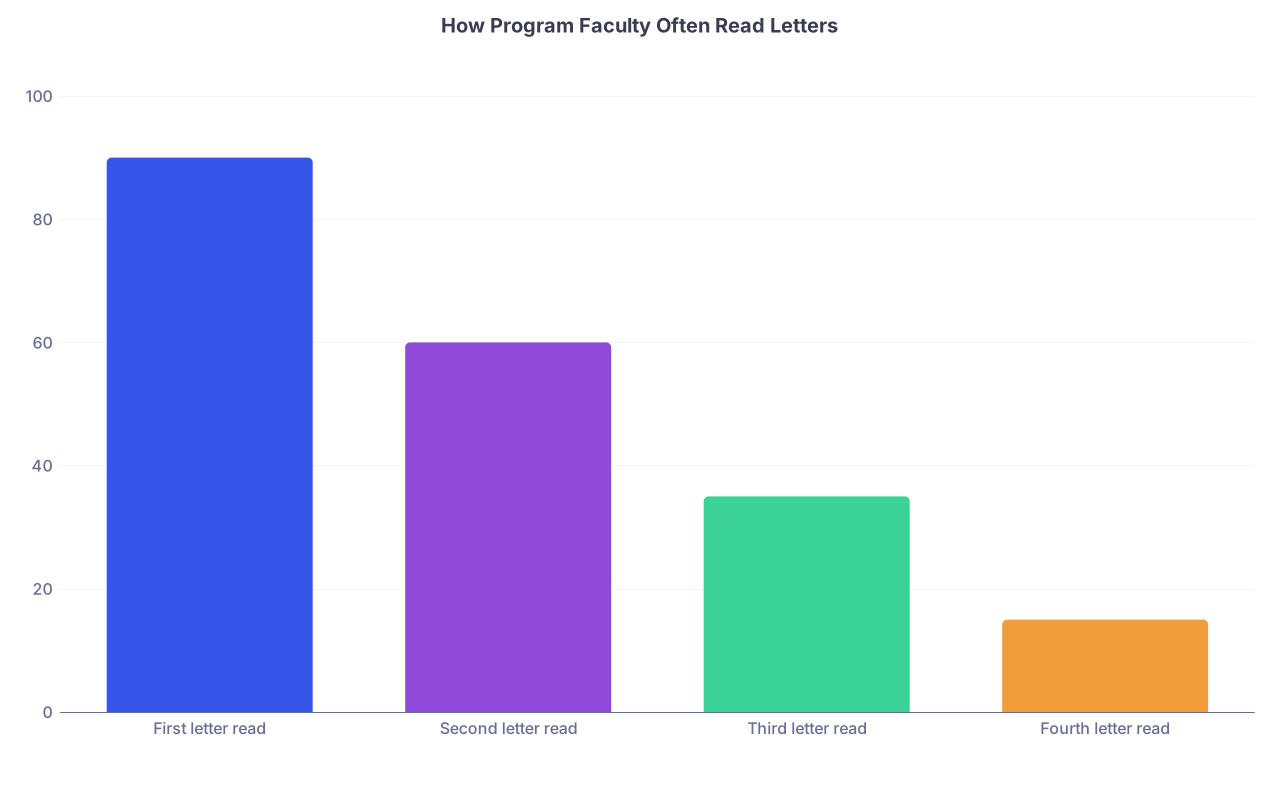
| Category | Value |
|---|---|
| First letter read | 90 |
| Second letter read | 60 |
| Third letter read | 35 |
| Fourth letter read | 15 |
Do not:
- Let your school upload and assign letters blindly
- Assume “they will read them all carefully”
You should:
- Rank letters in ERAS so that:
- #1: Your single strongest, most detailed orthopedic letter
- #2: Another ortho letter that complements the first
- #3: Either a home letter or ortho research/clinical letter
- #4 (if used): Only if it adds new information
Every letter should earn its spot. If you would have to explain “why” a letter is there, it probably should not be.
8. Failing to Give Letter Writers Any Direction
The biggest avoidable mistake: acting like you are not allowed to guide your letter writers.
You are not writing the letter for them. That is unethical and obvious. But you are absolutely allowed to:
- Provide context: “Here are the programs I am targeting; here is what they care about.”
- Highlight specific encounters they might have forgotten.
- Mention traits you hope they can speak to, if accurate: work ethic, resilience, teachability.
What most students do:
- Send a bare email: “Can you write me a strong letter? Deadline is Sept 10. Thanks.”
Then they act surprised when the letter is generic.
What you should send:
- CV
- Draft personal statement
- Short paragraph about:
- Why ortho
- Your top strengths
- Any weaknesses you have worked on (that the writer has seen you improve)
- 4–6 bullet points reminding them of:
- Cases you did together
- Extra efforts you made (came in early, stayed late, followed a patient)
- Feedback they gave you that you took seriously
Most attendings are relieved when you do this. It jogs their memory and makes the letter specific, which is what programs trust.
9. Not Realizing How Lack of Standardized Phrases Hurts You
Orthopedic letters are full of “coded” language. Programs recognize it instantly.
Here is what quietly kills applicants: their letters lack comparative or ranking language.
Examples of missing signals:
- No phrase like “top X%”
- No statement like “I give my highest recommendation”
- No comparison to residents or peers
On selection committees, people literally skim for these patterns.
| Phrase | How Committees Often Read It |
|---|---|
| "Top 10% of students I have seen" | Strong endorsement |
| "Outstanding among their peers" | Very positive, near top tier |
| "Above average medical student" | Lukewarm, usually not competitive |
| "Solid and dependable" | Safe but not strong |
| No ranking language at all | Unknown, often read as average |
You cannot force someone to write, “Top 5% student of my career.” But you can:
- Choose attendings who are actually likely to feel that way about you
- Perform at a level that compels them to make that comparison
- Politely say, “If you feel comfortable, language comparing me to peers is very helpful in these letters.”
Do not script them. Do not pressure them. But do not be so timid you fail to communicate what programs look for.
10. Ignoring Red Flags or Mediocre Letters When You Get Hints
Sometimes you get warning signs:
- An attending hesitates when you ask for a letter
- They say, “I can write you a letter,” but never say “strong” or “supportive”
- They seem lukewarm or noncommittal
That is not subtle. That is them telling you the letter may be generic or even mildly negative.
Do not make this mistake:
“I already asked, so I have to use it.”
You do not. You are not obligated to assign that letter in ERAS, even if it is uploaded.
What you can do instead:
- Ask another attending on the same rotation who gave you positive feedback
- Target a surgeon you worked with more intensely on a different service or at an away rotation
- Leave the lukewarm letter unused, even if it took time to get
One mediocre letter can drag three excellent ones down. Programs are always asking: “Is there any hesitation here?” Do not hand them reasons to hesitate.
FAQ (Exactly 3 Questions)
1. How many orthopedic letters should I have, and how many should I actually use?
Aim to collect 4–5 letters total:
- 2–3 orthopedic surgery letters (prioritized)
- 1 optional research or non-ortho clinical letter if it truly adds value
- 1 backup in case a planned letter turns out weak or is delayed
On ERAS, use 3–4 total per program. For most applicants:
- 3 letters is enough if all three are strong ortho letters
- Use a 4th only if it adds new, meaningful information (research, home support, or an outstanding non-ortho letter that truly differentiates you)
Weak or generic letters are worse than no letter.
2. What if I do not have a home ortho program—how do I avoid looking under-supported?
You are not penalized for what you genuinely do not have. Committees know some schools lack home ortho departments. Your job is to:
- Get multiple letters from away rotations at reputable institutions
- Make sure at least one letter writer explicitly notes you come from a school without a home program and still excelled
- Choose rotations where you will have real responsibility and face-time, not just shadowing
Programs will judge you on what you did with the opportunities you had.
3. Is it ever acceptable to keep a non-ortho letter as my strongest letter?
If your strongest letter is from non-ortho, that is a structural problem you should try to fix while you still can. Programs expect your best advocates to be surgeons in the field you claim to want. A stellar medicine letter can complement your ortho letters, but it should not be carrying your application.
Your next move: open your current letter plan and write down your actual letter writers by name and specialty. Then ask yourself, bluntly: “If I were a program director in orthopedic surgery, would these letters convince me this person is meant for my field?” If the answer is anything short of yes, change your lineup now—starting with who you scrub with this month.