The six months before ERAS can either clarify your surgical future or quietly sabotage it.
If you drift through this window “keeping options open,” you will end up with a generic application that excites no one. Programs can spot that in ten seconds. At this point you are not “exploring.” You are committing. You are building an application that clearly says: I am becoming a surgeon in this field, and my choices already show it.
Here is how to run those six months like a professional project, month by month, then week by week, so your surgical specialty choice is locked in and defensible by the time you click “certify and submit” on ERAS.
Big Picture: The 6‑Month Arc
Assume ERAS opens for editing in early June and submission is mid–late September. Count back six months: you are in roughly March. Here is the high-level arc.
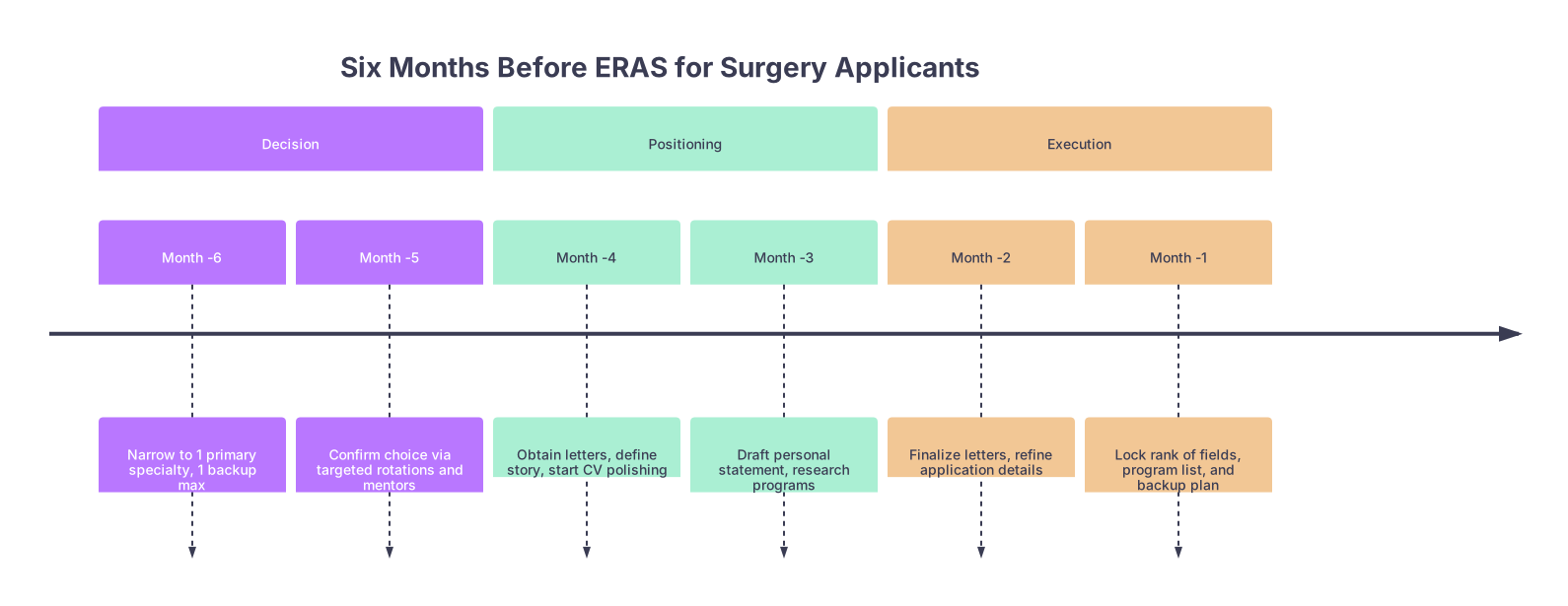
| Period | Event |
|---|---|
| Decision - Month -6 | Narrow to 1 primary specialty, 1 backup max |
| Decision - Month -5 | Confirm choice via targeted rotations and mentors |
| Positioning - Month -4 | Obtain letters, define story, start CV polishing |
| Positioning - Month -3 | Draft personal statement, research programs |
| Execution - Month -2 | Finalize letters, refine application details |
| Execution - Month -1 | Lock rank of fields, program list, and backup plan |
The rule of this phase is simple:
- One primary surgical specialty.
- One realistic backup (maybe two if carefully coordinated).
- Every major choice—rotations, letters, research, statement—must point primarily at that field.
If you are trying to “equally” apply to general, ortho, plastics, and ENT, stop reading and fix that first. No timeline can save a scattered strategy.
Month −6: Force the Decision
Time frame: ~March (6 months before ERAS submission)
At this point you should stop pretending you are “undecided” and start behaving like a future specialist who is aligning their life accordingly.
Week 1–2: Reality Check and Shortlist
Tasks:
- Limit your list to 2 specialties (max)
- One primary (the field you actually want)
- One backup (realistic based on scores, letters, and competitiveness)
If you are between, say:
- General surgery vs. vascular
- Ortho vs. PM&R
- ENT vs. general surgery
Then your real immediate choice is between broad category (e.g., “cutting” field vs. more conservative) and competitiveness tier. Do not let fantasy win over data.
| Specialty | Competitiveness Tier | Typical Step 2+ | Letters Needed |
|---|---|---|---|
| General Surgery | Moderate | 240–250+ | 3–4 surgery |
| Orthopedic Surg | Very High | 250–260+ | 3 ortho |
| Neurosurgery | Extreme | 255–265+ | 3–4 neuro |
| ENT | Very High | 250–260+ | 3 ENT |
| Plastics (indep) | Very High | Varies by track | 3 surgery |
You are not picking with vibes. You are matching your record and risk tolerance to real data.
- Hard review of your file
- USMLE/COMLEX scores
- Class rank / AOA / Gold Humanism
- Research output in each field
- Existing letters: who already loves you?
If your only serious relationships are with general surgeons, you are not an ENT applicant in six months. You are a general applicant with ENT curiosity.
Week 3–4: Mentors and Contingency Planning
Tasks by end of Month −6:
- Schedule 3 mentor meetings:
- One with a surgeon in specialty A
- One with a surgeon in specialty B (if you truly have two)
- One with a program director or APD-level person (often in general or your home field)
You are asking very specific questions:
- “Given my current scores and CV, am I competitive for X?”
- “What would you change between now and ERAS if you were me?”
- “If I do not match in X, what is the realistic next step? Prelim year? Different field?”
If you walk out of these meetings with three different answers, you do not average them. You pick the most conservative, realistic path and commit.
By the end of Month −6 you should have:
- Primary specialty chosen.
- Backup identified and sanity-checked.
If you are still “unsure,” you are procrastinating on a hard choice, not gathering more data.
Month −5: Align Rotations with Your Choice
Time frame: ~April
At this point you should lock in rotations that signal your choice to programs.
Week 1–2: Schedule and Reshuffle
You need:
- 1–2 away/audition rotations in your primary specialty.
- Additional home rotations that keep you in the OR and in front of letter writers.
If you are late to the game and slots are full, you:
- Email the clerkship coordinator and PD directly.
- Take whatever month is available, even if it is “bad timing.”
- Consider one away and one home intensive block rather than three half-hearted experiences.
Rotations should now be purposeful:
- Ortho applicant: prioritize ortho, trauma, sports, maybe radiology MSK.
- ENT applicant: ENT, anesthesia (airway management), SICU with ENT exposure.
- General surgery applicant: high-volume general, trauma, ICU, maybe subspecialty where your research lives.
Week 3–4: Letter Strategy Begins
Start thinking about who will write you letters. Not names on a wish list. Realistic humans you will work with.
Target:
- 3 letters in your primary field (4 for very competitive fields).
- 1 “flex” letter: medicine/surgery chair, research PI, or someone who will say you are the best student they have seen in 5 years.
By the end of Month −5:
- Rotations for the next 3–4 months are aligned with your chosen specialty.
- You have a mental list of 4–6 potential letter writers you need to impress.
Month −4: Performance and Relationship Building
Time frame: ~May
Now you are on service with the people who can make or break your application.
At this point you should treat every day as a long interview.
Week 1–2: On-Service Behavior
On any surgical service, what gets you remembered positively is not complicated:
- Show up early. Earlier than the intern.
- Know your patients cold.
- Read about tomorrow’s cases the night before.
- Be visibly useful: pulling drains, dressing changes, writing drafts of notes.
Surgical attendings do not write strong letters for students who “seemed nice.” They write them for students who:
- Made their day easier.
- Cared about the patients.
- Showed actual technical interest and growth.
Tell your attending or service chief early:
- “I am planning to apply in [X specialty] this cycle and am hoping to earn a strong letter. I would appreciate any feedback now so I can improve.”
Yes, that sentence out loud. It works.
Week 3–4: Confirming the Fit
While you are on service, check your own reactions:
- Are you energized by the OR or counting minutes?
- Do you care enough to read about the cases after a 12–14 hour day?
- Can you imagine doing more of this rather than less?
If during a dedicated ortho month you dread the OR but love clinic, you probably should not force ortho as your primary specialty. This is still the last safe moment to pivot to a less procedurally intense route.
By the end of Month −4:
- You should feel more certain, not less, about your primary specialty.
- You should have at least one attending and one senior resident who clearly know you and your work.
Month −3: Construct the Application Skeleton
Time frame: ~June (ERAS opens for editing)
At this point you should move from “proving to myself this is the right field” to “proving to programs I belong here.”
Week 1: CV and Experience Inventory
Open ERAS. Start filling it out. Do not wait.
Tasks:
- Update all activities, roles, dates.
- Mark those most relevant to your chosen specialty:
- Surgical interest group leadership.
- Research in that field or related fields.
- Longitudinal clinical experiences that show ownership and follow-through.
Pattern programs want to see:
- Long-term commitment.
- Increasing responsibility over time.
- Clear surgical identity.
Week 2–3: Personal Statement – First Draft
Draft a specialty-specific personal statement. You are not writing poetry. You are building a clear argument:
- Why this field.
- Why you are suited for it.
- What you have actually done that backs this up.
- Where you see yourself going within it (even if vague: academic, community, subspecialty interest).
Do not:
- Make your entire narrative about “loving to work with my hands” or “enjoying anatomy.”
- Tell the same “grandparent’s surgery inspired me” story as everyone else.
Instead:
- Use one or two concrete clinical experiences from your own rotations.
- Show you understand the real grind: call, complications, unscheduled returns to OR.
This month is for ugly first drafts. Perfect is later.
Week 4: Research and Scholarship Packaging
If you have ongoing or incomplete projects, decide:
- What will realistically be submitted, accepted, or presented before ERAS.
- What will stay as “research experience” without products.
Be honest but strategic:
- Get abstracts submitted to any decent regional or national meeting.
- Make sure your name appears on departmental publications pages where possible.
- Ask your PI if they can mention your contribution specifically in a letter.
By the end of Month −3:
- ERAS skeleton filled.
- First draft of your specialty-specific personal statement written.
- Clear list of all scholarly work and where it stands.
Month −2: Letters and Final Specialty Lock
Time frame: ~July
Now you stop hand‑waving and start locking in commitments from other people.
Week 1–2: Ask for Letters
You ask in person whenever possible.
Script:
- “Dr. X, I have really appreciated working with you this month. I am applying in [specialty] and would be honored if you felt you could write a strong letter of recommendation for my ERAS application.”
If they hesitate, back off. A lukewarm letter is worse than no letter.
You want:
- 2–3 letters from attendings who primarily practice in your selected specialty.
- 1 departmental or chair letter, if your specialty expects this.
- 1 flex letter (research PI, medicine/surgery attending who knows you very well).
Make sure you:
- Provide them with your CV, draft personal statement, and a short “reminder” of cases or scenarios where you worked closely with them.
- Clarify deadlines. Aim for letters uploaded 3–4 weeks before ERAS submission.
Week 3: Backup Plan Check
At this point, your backup specialty must be realistic or you abandon it.
You review:
- Step 2 score (if back).
- Strength of letters in primary vs backup fields.
- Feedback you have received from mentors.
If your backup would require a totally different set of strong letters that you do not have, you are not actually dual‑applying. You are mentally soothing yourself.
You choose one of these:
- True dual-apply with tailored letters and statements for both fields.
- Single-apply to your primary field with a plan for prelim year if no match.
Both are valid. Blurry half-measures are not.
Week 4: Personal Statement Revision
Now that letters are underway and your identity is clearer, you revise your personal statement.
- Cut generic lines.
- Add specific experiences with your letter writers if appropriate.
- Make sure the tone matches what attendings might say about you.
By the end of Month −2:
- All critical letters requested.
- Backup plan is defined and executable.
- Near-final draft of personal statement ready.
Month −1: Final Positioning and Program List
Time frame: ~August–early September
This is where most people panic and lose focus. You cannot afford that. Your job now is to sharpen, not reinvent.
Week 1: Program List Construction
Start with honest self-assessment and build a spread of programs.
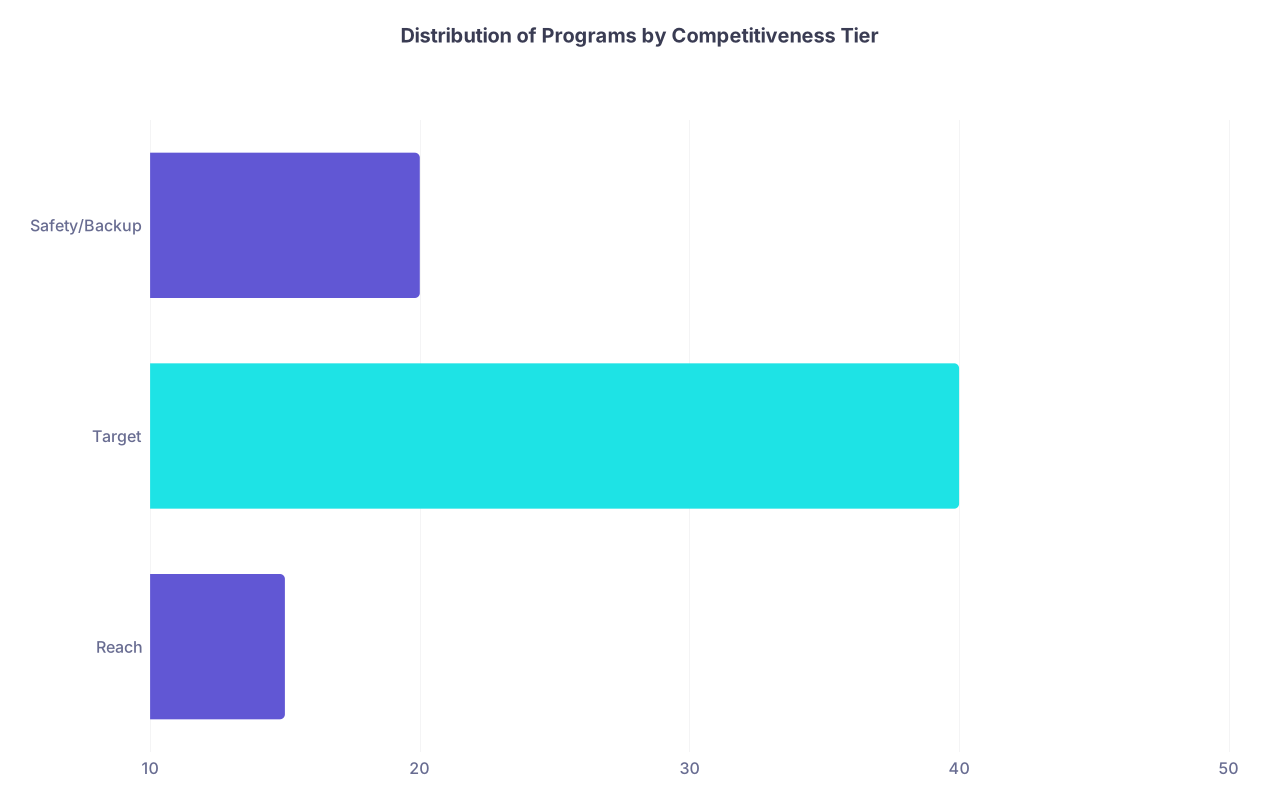
| Category | Value |
|---|---|
| Reach | 15 |
| Target | 40 |
| Safety/Backup | 20 |
For a reasonably competitive general surgery applicant, a 60–80 program list is not insane. For super-competitive subspecialties (ENT, ortho), broad is mandatory unless you have a golden CV.
Categorize:
- Reach: top academic, high Step cutoffs, big research engines.
- Target: solid academic or hybrid programs where your metrics match or slightly exceed their averages.
- Safety/Backup: smaller community or less sought-after geographic locations you would still be willing to attend.
Rank programs by:
- Chance you will realistically interview.
- Willingness to actually go if matched.
If there is any program you “would never go to,” delete it now. You are wasting everyone’s time.
Week 2: Tailoring Application Details
Clean up ERAS:
- Reorder experiences to highlight surgical leadership and continuity.
- Use activity descriptions to show impact and ownership, not just duties.
- Make sure your “most meaningful” experiences align tightly with your chosen specialty.
If dual-applying:
- Prepare two versions of your personal statement.
- Decide which letters go to which specialty. Do not send a glowing ortho letter to an ENT program unless there is a clear narrative bridge.
Week 3–4: Final Checks and Mental Prep
By now:
- Letters should be uploaded (or close).
- Personal statement final.
- CV polished.
Use this time for:
- One more mentor check: “Here is my final program list and application. Any red flags?”
- A brief review of specialty-specific interview questions and current controversies in the field.
Do not start major new projects now. You can add late things later if they truly materialize, but the foundation must already be solid.
Last 1–2 Weeks Before ERAS Submission
You are no longer “deciding” your specialty. You are executing.
Checklist:
- Personal statement: spell-checked, specialty-specific.
- ERAS activities: finalized with consistent dates, no obvious gaps.
- Letters: minimum required uploaded, with at least 2–3 in your primary specialty.
- Program list: balanced by tier and geography, free of “I would never go there” options.
- Backup: clearly defined—either dual-apply strategy or prelim year plan.
- Email once (once) to any letter writer who has not uploaded, with a polite reminder and the exact deadline.
Then you submit. On time. Not weeks late.
Two Non-Negotiable Takeaways
By three months before ERAS submission, your specialty choice should be effectively final, and your rotations, letters, and research must point clearly toward it. Waffling after that point dilutes your entire application.
Every week in the six months before ERAS either strengthens or blurs your surgical identity. Choose rotations, mentors, letters, and programs that tell one coherent story: “I am becoming a surgeon in this field, and my record already looks like it.”