
It is January of your M3 year. You just finished a general surgery clerkship where you loved the OR. One week you were helping pack a neck dissection. The next week you were holding a leg for a total knee. Now your schedule for the next 12 months is about to lock in… and you are straddling ENT vs Ortho with zero room for error on away rotation timing, letters, or research.
Here is the reality: for ENT and Ortho, the calendar is an admissions committee. If you hit the wrong months with the wrong rotation, you will quietly fall behind people who decided 6 months earlier.
I am going to lay this out as a timeline. Month by month and then week-level detail around the critical windows, so you know exactly what decision you need to have made by when.
Big-Picture Timeline: When ENT vs Ortho Must Be Decided
Before we slice into month-by-month, you need the “no later than” anchors in your head.
| Milestone | ENT Latest Reasonable | Ortho Latest Reasonable |
|---|---|---|
| Commit to primary specialty focus | Feb–Mar M3 | Feb–Mar M3 |
| Start targeted research | Mar–Apr M3 | Mar–Apr M3 |
| Lock in first away rotation | Jan–Feb M3 planning | Jan–Feb M3 planning |
| First away rotation occurs | May–Jul before M4 | May–Jul before M4 |
| Second away (if done) | Jul–Aug M4 | Jul–Aug M4 |
| Final switch possible without chaos | Jun M3 (early) | Jun M3 (early) |
If you are reading this after July of M3 and still “open” between ENT and Ortho, you are behind. Not doomed. But behind.
M2 Winter – Early M3: Set the Stage (6–12 Months Before ERAS)
Where you are: Before or just entering core clerkships. You like surgery, but that is as precise as it gets.
At this point you should…
1. Get real exposure to both ENT and Ortho (Jan–Apr, M2 or very early M3)
You cannot pick between these two from YouTube or Reddit threads. You need actual mornings in the OR.
Concrete actions (over 4–8 weeks):
- Ask the surgery clerkship director or department coordinators:
- “Can I shadow in ENT clinic and OR for 2–3 half days?”
- “Can I do the same in Ortho?”
- On ENT days, watch for:
- Comfort with narrow workspaces (ear under microscope, sinus with endoscope).
- Tolerance for long standing with fine motor, minimal big movements.
- Enjoyment of head and neck anatomy + cancer cases.
- On Ortho days, watch for:
- Comfort with power tools, sawing, drilling, hammering, reaming.
- Enjoyment of sports injuries, fractures, joints, large anatomy.
- Physicality of cases (retractors, manipulating limbs).
You are not deciding yet. You are ruling out obvious mismatches.
2. Start “low-stakes” networking (ongoing, monthly)
By now you should have:
- 1–2 ENT attendings who recognize your name.
- 1–2 Ortho attendings or residents who do as well.
Do simple things:
- Ask: “Can I see your clinic one afternoon and ask about residency later?”
- Go to:
- ENT grand rounds once.
- Ortho fracture conference or sports conference once.
You are scouting cultures. ENT tends to feel smaller, tighter, slightly more academic by default. Ortho is bigger volume, sports-heavy in many places, with a different vibe. Pay attention to what feels like “your people.”
3. Decide how hard you are willing to chase competitiveness (Mar–May, M2 or early M3)
Both are competitive. Ortho currently is slightly more volume heavy, ENT slightly more niche.
Look at your record honestly:
- Step/Level scores (or practice scores if you have not tested yet).
- Class rank / clinical evals trend.
- Any research to date.
If you are sitting at:
- Mid-class, no research, mediocre surgery evals, and no interest in academic work
then both ENT and Ortho are uphill. Not impossible, but you will need a strong home program and excellent away performance. Decide if that is a hill you actually want to climb.
Core Clinical Year (M3): The Decision Year
Now we get to the meat: your M3 year. I will break it roughly into three phases.
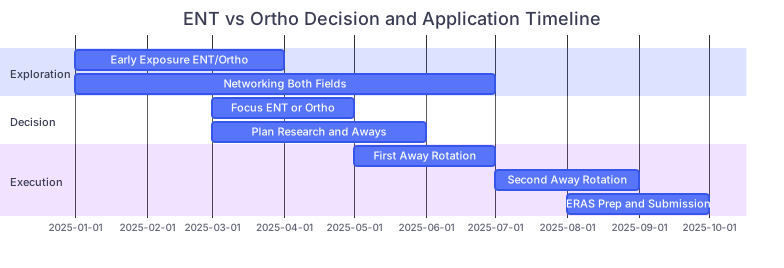
| Task | Details |
|---|---|
| Exploration: Early Exposure ENT/Ortho | a1, 2025-01, 3M |
| Exploration: Networking Both Fields | a2, 2025-01, 6M |
| Decision: Focus ENT or Ortho | b1, 2025-03, 2M |
| Decision: Plan Research and Aways | b2, 2025-03, 3M |
| Execution: First Away Rotation | c1, 2025-05, 2M |
| Execution: Second Away Rotation | c2, 2025-07, 2M |
| Execution: ERAS Prep and Submission | c3, 2025-08, 2M |
Early M3 (Jul–Nov): Broad Surgical Lens, Quietly Comparing
At this point you should…
- Use your general surgery and elective time smartly.
On general surgery:
- Make sure you scrub at least a couple ENT-adjacent cases if available:
- Thyroid, parathyroid, parotid, neck masses.
- And Ortho-adjacent:
- Trauma call, fractures, amputations, wound vacs.
Take notes right after shift:
- Which post-op patients did you enjoy talking to more?
- Which postop problems interested you?
- Vocal cord dysfunction vs ACL rehab vs nonunion fractures.
You will forget feelings by month’s end. Write them down.
- Pick a short focused elective if possible (Oct–Dec).
If scheduling allows a 2-week surgical subspecialty elective:
- Slot ENT or Ortho (or both, back-to-back if you are truly undecided).
- Treat it like a mini-audition:
- Show up early.
- Read the night before on 1–2 cases.
- Ask one intelligent question per case. Not ten.
The goal is not to “match” here. It is to see if you like the daily grind of that specialty enough to live it for 5 years.
- Begin filtering based on non-negotiables.
By late fall of M3 you should be asking:
- “Do I want anatomic variety (ENT: ear, nose, sinus, skull base, head & neck) or mechanical problem-solving (Ortho: joints, spine, trauma, sports)?“
- “Do I care about facial aesthetics / airway / voice?”
- “Do I care deeply about return-to-sport, biomechanics, hardware?”
If none of those questions moves you emotionally one way, that is a problem. Keep pushing for more exposure.
Mid M3 (Dec–Mar): Decision Point + Research and Away Planning
This is the critical fork. If you are still saying “maybe both” in March, you are stepping onto thin ice.
By January–February M3 you should:
- Choose a primary direction: ENT-first or Ortho-first.
You can keep a backup specialty in your mind (e.g., ENT primary, Ortho as “if ENT implodes” is not realistic; a medicine backup is more realistic), but you need one flag planted.
How to force the decision:
- Imagine two emails on Match Day:
- “Congratulations, you matched into Otolaryngology–Head & Neck Surgery.”
- “Congratulations, you matched into Orthopaedic Surgery.”
- Which one would make you more excited and relieved?
If you truly cannot answer that, you have not exposed yourself enough. Go back for 1–2 extra days of shadowing in each right now.
- Line up a specialty mentor (Feb–Mar).
Once you lean ENT or Ortho:
- Email 1–2 attendings in that field:
- “I am seriously considering ENT/Ortho and would appreciate 20 minutes to talk about timelines and away rotations.”
- In that meeting, you must leave with:
- A sense of which months they recommend for away rotations.
- A realistic read on your competitiveness at that home department.
- Names of people to talk to about ongoing research projects.
If they dodge you or give vague answers, find a different mentor. You do not have months to waste.
- Lock in at least one research lane (Mar–Apr).
For ENT or Ortho, the bar is not “Nobel prize.” It is:
- You show commitment to the field.
- You can talk coherently about one project on interview day.
At this point you should:
- Commit to 1–2 concrete projects that can realistically yield:
- Poster, abstract, or publication before application season.
- Clarify timeline with your PI:
- “I need something submitted by roughly July–August. Is that possible here?”
If the answer is no, get onto an additional shorter-term project (chart review, case series, QI).
Late M3 – Early M4: Away Rotations and Letters
This is where timing will absolutely burn you if you are sloppy.

Away Rotation Planning (Applications: Jan–Apr; Rotations: May–Aug)
At this point you should…
- Decide which months you will be “on stage” (Jan–Feb scheduling).
For both ENT and Ortho, the sweet spot for away rotations is:
- First away: May–July before M4 (late M3 / early M4 depending on your school).
- Second away (if you do it): July–August M4.
Why:
- Early away gives you:
- A full month to earn a strong letter before ERAS opens.
- Time to adjust if things go badly.
- Second away helps:
- Demonstrate consistency and get another letter.
- Target a different geographic or program tier.
If you are undecided between ENT and Ortho past February, you cannot intelligently reserve these months.
- Apply early through VSLO/VSAS (Feb–Apr).
For competitive ENT and Ortho sites, spots go fast.
- ENT:
- Smaller field. Limited away slots per cycle.
- Some programs expect at least one away, often at a place you could realistically rank highly.
- Ortho:
- Heavy emphasis on aways. You are often partially “auditioning” for interviews.
You should:
- Have your CV and Step scores ready for upload by February.
- Apply to:
- 2–4 ENT aways if ENT.
- 3–5 Ortho aways if Ortho. You may only do 2, but offers are unpredictable.
- Plan backup if an away falls through.
Programs deny or cancel away spots all the time. I have watched people lose a June away in April and scramble.
Your contingency:
- Have 1–2 additional VSLO applications ready to submit quickly.
- Keep your home ENT/Ortho rotation scheduled such that:
- If aways implode, you can still have a strong home month and letter by July–August.
On the Away Rotations (May–Aug): Weekly Priorities
Once you land on an away, the clock is day-by-day. You are being ranked. Hard.
Basic expectation every week:
- Week 1:
- Learn the system.
- Be early, prepared, ask for feedback once.
- Week 2:
- Start volunteering for small responsibilities:
- ENT: patient calls, instrument checks, simple scopes.
- Ortho: pulling images, writing notes, basic splinting.
- Start volunteering for small responsibilities:
- Week 3:
- Show you can function like a good intern with supervision.
- Ask an attending or key resident if they would consider writing you a letter.
- Week 4:
- Solidify letter writers.
- Ask about your performance; correct any issues now, not in an email later.
If at the end of the first away, no one seems enthusiastic about a letter, you have your signal. You either had a bad month or it is not the right fit. Your second away matters even more.
Letters, ERAS, and Final Commitment (Jul–Sep, M4)
By mid-summer of M4, there is no more “deciding.” You are in execution mode.
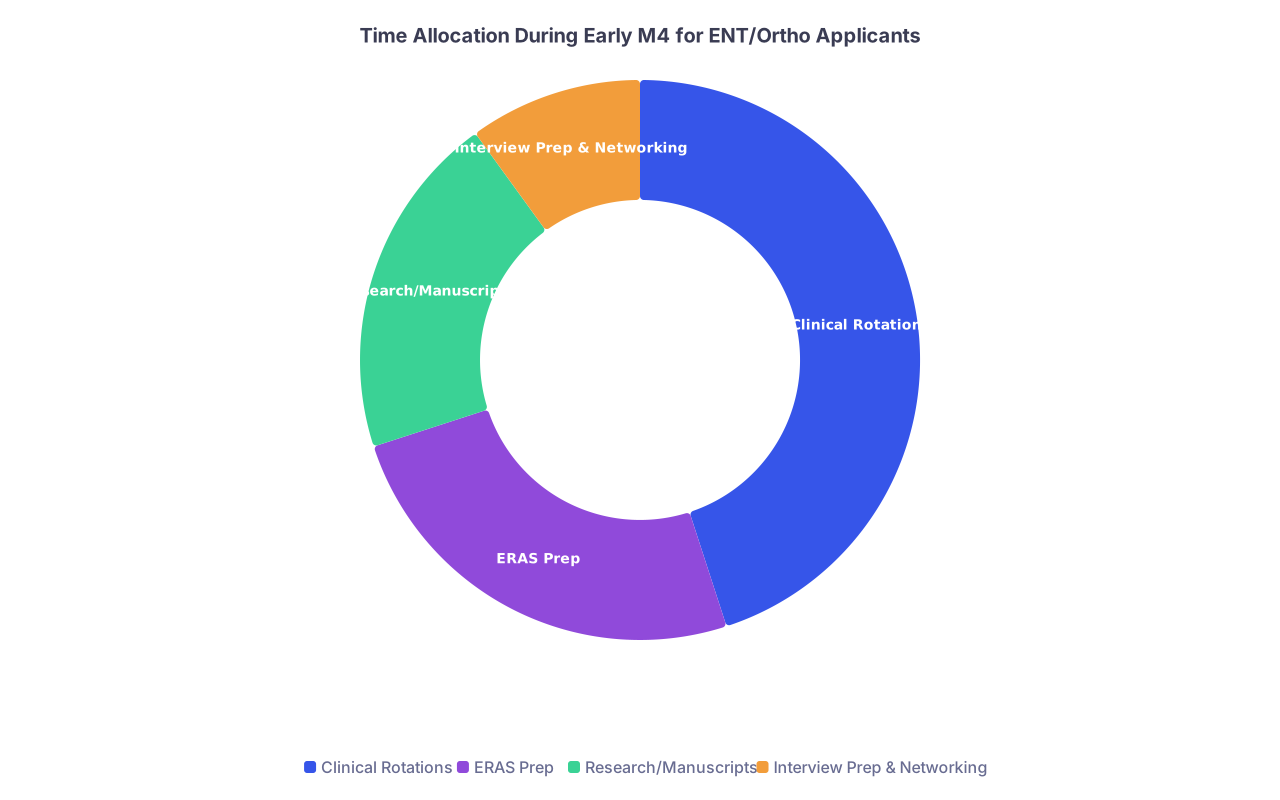
| Category | Value |
|---|---|
| Clinical Rotations | 45 |
| ERAS Prep | 25 |
| Research/Manuscripts | 20 |
| Interview Prep & Networking | 10 |
At this point you should…
- Have at least 3 strong letters from the chosen field.
For both ENT and Ortho, an ideal letter set looks like:
- 2 letters from the specialty (at least 1 from away, 1 from home).
- 1 general surgery or medicine letter that speaks to your work ethic / clinical acumen.
- Optional: 1 research letter (especially helpful in ENT if academic-heavy).
If you are splitting letters half ENT, half Ortho, programs will see you as unfocused. Pick one.
- Cleanly close the door on the other specialty (mentally and on paper).
Trying to keep both ENT and Ortho active until ERAS submission is a mess:
- You dilute letters.
- You cannot truthfully tailor your personal statement.
- You look noncommittal.
So by July:
- Tell the “losing” specialty mentors:
- “I decided to apply ENT/Ortho this cycle, but I really appreciate your guidance.”
- Stop collecting new experiences in the other field unless it is a minor required rotation.
- Submit a clearly aligned application (Aug–Sep).
Your ERAS should scream one thing: “I am an ENT person” or “I am an Ortho person.”
That means:
- Personal statement:
- Vivid, specific stories from that field.
- 1–2 cases that pushed you toward that specialty.
- Experiences section:
- ENT/Ortho research near the top.
- Leadership and extracurriculars tied to surgery, anatomy, biomechanics, etc.
- Program list:
- ENT: balanced mix of academic centers, including your away and home program.
- Ortho: broad list; Ortho is numbers heavy, so cast a wide but realistic net.
What If You Change Your Mind Late?
It happens. I have seen people finish an Ortho away, hate it, and suddenly realize they are actually ENT people. Or vice versa.
Here is how late you can switch without total chaos:
Switching ENT → Ortho or Ortho → ENT after May M3:
Very difficult. You will not have targeted research, away rotations, or letters.More realistic late pivots:
- ENT or Ortho → General Surgery, PM&R, Anesthesia, or another less-competitive surgical-adjacent field.
- Use your “surgical interest” story and pivot to a new angle.
If you are mid-M4 and trying to flip ENT ↔ Ortho entirely, expect:
- Fewer interviews.
- Confused letters.
- A likely need to:
- Do a research year, or
- Reapply after a prelim or transitional year.
Not impossible. But rough.
Quick Comparison: What You Must Decide by When
| Timepoint | ENT Must-Haves | Ortho Must-Haves |
|---|---|---|
| Feb–Mar M3 | Chosen specialty focus | Chosen specialty focus |
| Mar–Apr M3 | ENT mentor + research path | Ortho mentor + research path |
| Jan–Apr M3 | ENT away applications submitted | Ortho away applications submitted |
| May–Jul (before M4) | 1st away completed or scheduled | 1st away completed or scheduled |
| Jul–Aug M4 | 2+ ENT letters lined up | 2+ Ortho letters lined up |
| Aug–Sep M4 | ENT-focused ERAS application | Ortho-focused ERAS application |
FAQ (Exactly 4 Questions)
1. Can I realistically apply to both ENT and Ortho in the same cycle?
You can physically click both specialties in ERAS, but I strongly advise against it. You will split your aways, split your letters, and water down your narrative. Both fields expect clear, committed applicants. If you try to keep both doors open, programs will assume you are not serious about either. If you absolutely insist, you will need separate aways and letters for each, which is logistically brutal and usually not worth the cost.
2. How many away rotations do I need for ENT or Ortho?
For ENT, 1–2 aways is typical. One strong away plus a solid home rotation is adequate if your performance and letters are excellent. For Ortho, 2 aways is more common and functionally expected at many programs; some applicants do 3, but that can be overkill and exhausting. Quality of performance matters far more than the raw count. A single outstanding away beats three lukewarm ones.
3. What if my Step scores are mediocre—should that push me toward ENT or Ortho?
Neither of these specialties is “score-light.” Ortho tends to lean harder on Step scores, but ENT is not forgiving either, especially at academic places. With mid-range scores, you will need to compensate with strong clinical performance, convincing letters, and possibly a research year if you are aiming high. Do not pick ENT vs Ortho based solely on score myths; pick the field you can actually imagine grinding for five years, then build the strongest profile you can within that lane.
4. How early should I tell attendings that I am interested in ENT or Ortho to get good letters?
Once you are reasonably sure—usually by late fall or early winter of M3—start behaving like a future ENT or Ortho resident on every relevant rotation. Tell 1–2 attendings directly: “I am planning to apply ENT/Ortho and would really value feedback on how I am doing.” You are not asking for a letter yet; you are signaling commitment. Then, during your home rotation and aways (May–Aug), explicitly ask for letters in Week 3 or early Week 4 when they have seen your best work.
Final Takeaways
- You cannot “wing” timing for ENT or Ortho. By February–March of M3 you need a primary specialty selected, or everything downstream gets squeezed.
- Aways and letters are the currency in both fields. Protect May–August, perform like an intern, and secure 2+ strong specialty letters early.
- Once you commit—commit. Build a clean, coherent ENT or Ortho story in your application. Straddling both will usually cost you interviews in each.