What do you do when your dream city has a weak operative experience, and the powerhouse surgical program is in a place you really do not want to live for five years?
Let me be direct: for surgery, case volume beats location most of the time. But that is not the whole story, and if you treat this like a simple either/or, you are going to screw up your rank list.
Let’s break the decision down the way actual surgeons think about it.
The One Thing You Cannot Fix Later
You can move cities. You cannot redo your surgical training.
If you graduate feeling underprepared in the OR, there is no reset button. Yes, you can do a fellowship. Yes, you will still learn as an attending. But if your core training is weak, you will:
- Feel behind your co-fellows
- Hesitate on cases you should be comfortable with
- Need more supervision for longer
- Carry that insecurity for years
I have sat in conference rooms where new attendings quietly admitted, “I never did this case as primary during residency.” That is not where you want to be.
Location affects your happiness. Case volume and case quality affect your competence and career ceiling.
If you are forced to choose, for surgery specifically, the default should be:
- Lean toward the stronger operative program
- Only override that if there are serious personal constraints (partner career, kids, health, visa, etc.) that would genuinely make a location untenable
What “Good Case Volume” Actually Means
You are not just counting raw RVUs. A 2,000-case log full of skin lesions and simple hernias does not equal a high-quality operative experience.
Here is what actually matters.
1. Breadth and graduated complexity
You want:
- A healthy mix of bread-and-butter (lap chole, appy, hernias, colectomies)
- Enough complex cases: reoperative abdomen, advanced laparoscopy, major oncologic resections, trauma, emergent cases
- “By PGY3, what are your expectations for independent primary surgeon cases?”
- “How many laparoscopic colectomies does a typical chief graduate with?”
- “Who does the index cases – fellows, senior residents, or attendings?”
2. Chief-level autonomy
Autonomy is where a “busy” program can still be bad.
- Lots of high-end cases on paper but mostly done by fellows
- Chiefs who cannot run a straightforward case skin-to-skin
- Residents saying things like, “You get your numbers, but you do not really feel like the surgeon until late – if at all”
During your interviews and second looks, pay attention to exact wording. Residents who have autonomy say things like:
“By the end of PGY4 I was comfortable running a straightforward lap colectomy with faculty scrubbed but mostly hands-off.”
Location: When It Actually Should Come First
Now the other side. There are times when prioritizing location is not only reasonable, it is smart.
Strong reasons to put location first
You should seriously weight location heavily if:
- You are the primary caregiver for a family member and need to stay nearby
- Your partner’s career is geographically restricted (e.g., one major hub for a subspecialty, military assignment, visa limitations)
- You have kids settled in school and moving would be a huge financial / emotional hit
- You have medical or mental health needs that are genuinely better served in a specific region
In those scenarios, you do not martyr yourself for “the best” surgical program if it blows up the rest of your life.
The key is this:
If you must prioritize location, then within that geographic constraint, you do everything possible to choose the strongest surgical training available.
The Tradeoff Matrix: How to Actually Compare Programs
Let’s simplify this. When two programs are in play, here is how I’d rank priority for a surgical resident:
- Training quality (case volume, complexity, autonomy, teaching culture)
- Program stability and support (malignant vs. supportive, leadership, call system)
- Location and life circumstances (family, partner, cost of living, support system)
- Prestige and “name” (far less important than people think unless you’re chasing ultra-competitive academic niches)
To make this less abstract, think of programs in buckets:
| Program Type | Location | Case Volume & Autonomy | Overall Choice |
|---|---|---|---|
| A | Great | Weak | Usually avoid |
| B | Great | Strong | Ideal |
| C | Meh | Strong | Often best career choice |
| D | Meh | Weak | Do not rank high |
Program B is the unicorn: good location, strong training. Easy pick.
Your real decision is usually A vs. C:
- A: Fun city, mediocre operative experience
- C: Less exciting location, but you will come out technically strong
For surgery, I would tell almost everyone: pick C unless your personal situation makes A the only viable life option.
How to Judge Case Volume vs. Location Without Lying to Yourself
You are biased. Everyone is. You will be tempted to rationalize the city you like most.
Here is how you keep yourself honest.
Step 1: Separate emotion from data
For each program, literally make two lists:
- Training: case numbers, autonomy, trauma level, subspecialty exposure, fellowship match, faculty engagement, resident attrition
- Life: family proximity, partner’s job, city, outdoor activities, cost of living, commute time, support network
Then ask:
- “If I ignore the city for a minute, how does this program train surgeons?”
- “Would I feel comfortable being the only surgeon in a community hospital after this residency?”
If the answer to that second question is “I’m not sure” or “No,” that program should fall down your list.
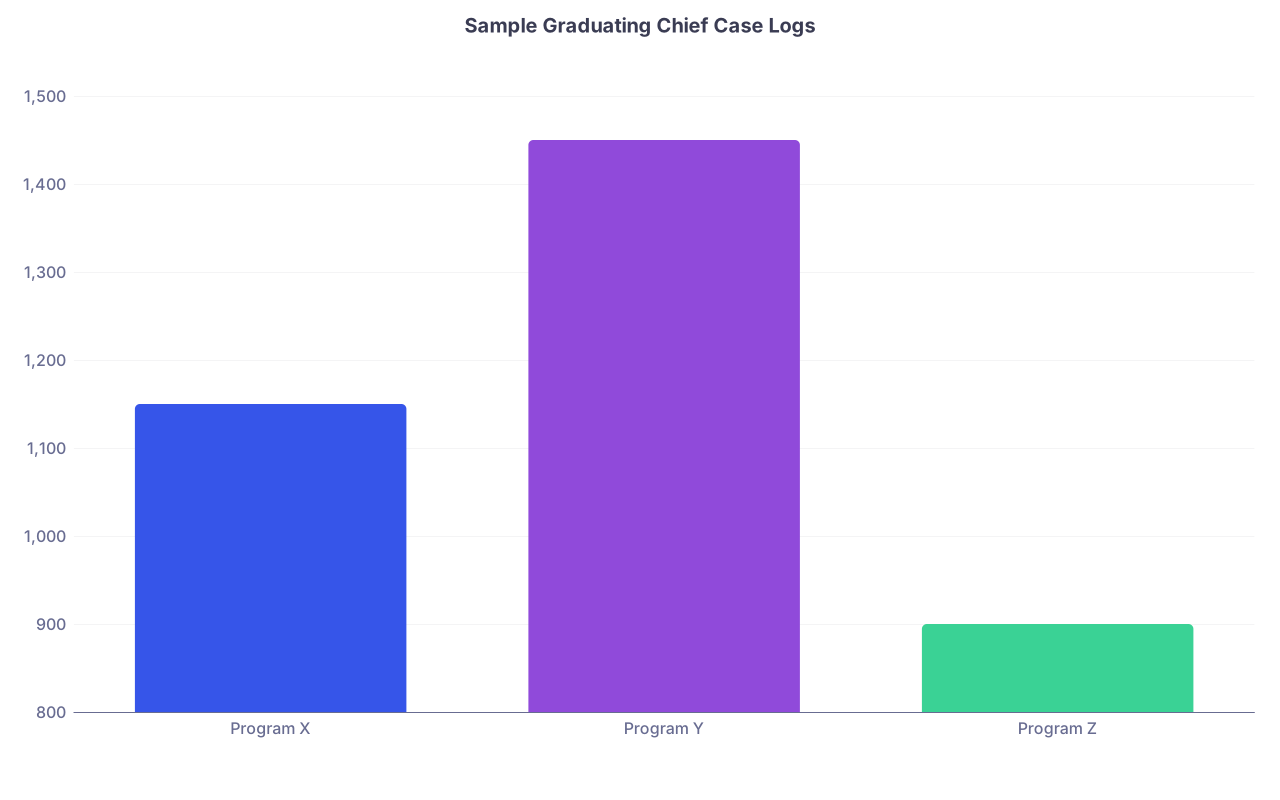
Step 2: Look at actual numbers and outcomes
Ask for:
- Graduating case logs (even approximate ranges)
- Recent fellowship match list for general surgery
- Percentage of graduates going straight into independent practice vs. fellowship
- Trauma center level and trauma volume (for general surgery / trauma interest)
| Category | Value |
|---|---|
| Program X | 1150 |
| Program Y | 1450 |
| Program Z | 900 |
You are not chasing a magic number, but if a community program is graduating chiefs with ~900 cases while another similarly structured program is sending out chiefs with 1,300–1,500 diverse cases, that difference is real.
Step 3: Talk to the mid-levels, not just the chiefs
PGY2–3s will often be more honest than PGY5s sitting next to their PD during the interview social.
Ask them quietly:
- “Do you feel like you get enough reps on bread-and-butter cases?”
- “Who actually does the index cases when fellows are involved?”
- “What would you change about operative exposure here if you could?”
Listen for hesitation, canned-sounding answers, or weird overcompensation like, “We definitely get enough cases… I mean, I think so.”
What If the High-Volume Program Seems Malignant?
Now we’re in the real world. Some of the highest-volume programs also have… rough cultures.
Here is the hierarchy:
- Strong training, supportive culture, decent location → top of list
- Strong training, culture is intense but fair, meh location → still strong option
- Strong training, truly malignant, dangerous or abusive culture → big red flag
- Weak training, nice people, great city → vacation, not residency
Do not sacrifice your mental and physical safety for case numbers. Sleep-deprived, humiliated, unsupported residents burn out, quit, or make errors.
That said, surgery is not gentle. You are not choosing between spa and spa. You are choosing between:
- High expectations with support vs.
- High expectations with blame vs.
- Low expectations with low growth
Aim for the first category. Avoid the third. Be very cautious with the second.
How Family, Partners, and Kids Change the Equation
If you are single, it is simple: lean hard toward training quality and acceptable, not perfect, location.
If you have a partner or kids, you cannot pretend they are a footnote.
Here is a more realistic ranking for residents with serious family commitments:
- Places where your family can reasonably thrive
- Among those, pick the best training you can get
- Only sacrifice family stability for training if the gap is huge and your partner is truly on board
A high-volume program is not “better” if your marriage implodes, your partner is miserable, or you never see your kids. People rarely admit it, but I have watched that story play out more than once.
You need a grown-up conversation with your partner that includes:
- What they are giving up for each location
- What support system (family, friends, childcare) exists in each place
- How much call, nights, and weekend work you are realistically expecting
Then rank within the subset of programs that do not blow up your real life.
A Quick Decision Framework You Can Actually Use
Boil it down like this for each program:
Training Score (1–10)
- Case numbers (not just total but diversity)
- Autonomy and complexity
- Fellowship match and faculty quality
Culture/Support Score (1–10)
- Resident happiness, attrition
- Responsiveness of leadership
- Call fairness, schedule transparency
Life Score (1–10)
- Location fit, family/partner situation
- Cost of living, commute, support system
Then do this:
- If Training < 6 → do not rank high, no matter how great the city
- If Culture < 5 → extreme caution, even with high volume
- If Life < 4 and you have a family → think very hard before ranking high
You are aiming for programs where Training and Culture are solid, and Life is at least livable.
Visualizing Your Tradeoffs Over 5 Years
One last perspective: residency is long, but not forever. About five to seven years for many surgical specialties.

| Step | Description |
|---|---|
| Step 1 | Match Day Emotions |
| Step 2 | Year 1-2 Adaptation |
| Step 3 | Year 3-5 Skill Building |
| Step 4 | Graduation and First Job |
| Step 5 | Location Satisfaction |
| Step 6 | Operative Competence |
- In PGY1–2, location feels huge. You notice the city every day.
- By PGY3–5, you mostly notice: OR time, call, your chiefs, and whether you feel competent.
- After graduation, your location for those years fades, but your surgical skills stay.
That does not mean location does not matter. It does. But its emotional weight is front-loaded. Training quality matters for the rest of your career.
FAQ: Location vs. Case Volume for Surgical Programs
1. Is high case volume always better, even if it means brutal hours?
No. High volume with unsafe staffing, nonstop q2 call, or ignoring duty hours is not a flex; it is a liability. You want high-quality, well-supervised volume, not chaos. If residents look exhausted and bitter and attrition is high, that is a warning sign, not a brag.
2. What if I am not sure I even want to operate a lot long-term (e.g., more research or admin)?
You still need solid operative training. You do not know how your interests will evolve, and weak hands-on training closes doors. You can always pivot into admin, research, or niche practice later. You cannot easily “add” surgical reps once you are an attending.
3. How much should fellowship placement influence my choice?
Fellowship match lists are a proxy for training quality and institutional reputation, but they are not everything. If a program consistently sends grads to strong fellowships in your interest area, that is a plus. But I would still take a program with better autonomy and culture over one with only a slightly flashier fellowship list.
4. Is it dumb to choose a mid-tier program in a city I love over a top-tier place in a city I hate?
Not necessarily. If both programs provide solid operative experience and you would be objectively miserable in the “top-tier” city (no support system, partner cannot work, serious mental health concerns), the mid-tier in the right location can absolutely be the better overall choice. Just do not kid yourself if the operative difference is massive.
5. How do I spot programs where fellows take all the good cases?
Ask residents directly: “How do cases get assigned between fellows and residents?” Listen for specifics. If you hear a lot of “it depends” without clear patterns, or “You can get good cases if you really fight for them,” that usually means fellows come first. Also watch who is actually holding the knife when you observe: fellows or residents.
6. Would you ever rank a weaker surgical program first strictly for location?
I would only do that if I had serious non-negotiable constraints: co-parenting in one city, dependent family with no relocation option, immigration/visa limitations, or a partner whose career cannot move. Even then, I would try very hard to find the strongest-possible training inside that constraint. If you have the freedom to move, you should lean toward the program that will make you the best surgeon, even if the zip code is not your first choice.
Key Takeaways:
- For surgery, training quality and real operative autonomy almost always matter more than an ideal location.
- Only let location win when there are real-life constraints that you cannot responsibly ignore, and even then, choose the strongest program within that boundary.
- Be brutally honest with yourself: you can move cities later; you do not get a second shot at learning how to operate.