Most applicants judge “operative autonomy” completely wrong. They look at case logs, prestige, or the number of robots instead of the only thing that matters: how attendings actually behave in the OR, day after day, year after year.
Here’s how to judge operative autonomy before you match, with a framework that works across programs and specialties.
Step 1: Stop Using the Wrong Signals
Let me be blunt: these things are overrated and often misleading.
- “We’re a high-volume program”
- “Our chiefs graduate with 1200+ cases”
- “We have every fancy technology you can imagine”
- “We send grads to top fellowships”
None of that alone tells you whether you will actually get your hands on the knife.
High volume is meaningless if:
- Attendings never let go of the instruments
- Fellows do all the fun parts
- Residents are constantly bumped by “VIP” cases or block time politics
Strong fellowship placement can even be a bad sign for autonomy in residency if the culture is “protect the brand” and keep chiefs looking perfect while juniors retract.
So, yes, still note volume and fellowship outcomes. But treat them as context, not the main metric. The real question is: What do residents actually do in the OR, at each PGY level, with each type of attending?
Step 2: Understand What Operative Autonomy Really Is
Autonomy is not “chiefs doing a lap chole.” Every program on Earth says that.
Real operative autonomy has three parts:
Progressive responsibility
- You’re doing more complex and more critical parts as you move from PGY2 → PGY3 → PGY4 → PGY5.
- Not token steps. The key portions.
Decision-making ownership
- You’re not just a pair of hands.
- You pick port placement, decide whether to convert, choose the anastomosis, manage intra-op complications (with backup, obviously).
Supervision that flexes
- Early on, they’re right next to you.
- Later, they’re scrubbed but hands-off.
- By the end, they can be unscrubbed, doing documentation while you run the room.
If a program can’t describe those 3 things clearly, they probably don’t do them consistently.
Step 3: The Only Opinions That Matter (and How to Get Them)
The glossy slide deck is irrelevant. You care about current residents, ideally PGY3–5, and you want to talk to them without faculty present.
Ask them these exact questions. Don’t paraphrase. Don’t soften.
“Walk me through a typical PGY2, PGY3, PGY4, and PGY5 day in the OR. What cases do they actually do?”
- Good answer: detailed, specific, sounds like “PGY2 runs most lap appys and lap choles with attending scrubbed but hands-off; PGY3 starts doing colectomies; PGY4 runs open cases with attending unscrubbed for parts; chiefs run service lists.”
- Bad answer: “It depends… we get great exposure… lots of volume…” = nobody’s thought about structure.
“Tell me about the last case where a resident was primary surgeon and the attending was unscrubbed for most of it.”
- If they struggle to think of one, that’s your answer.
“Who are the most hands-on attendings? The most hands-off?”
- Good programs: residents can clearly tell you which attendings give autonomy and which don’t.
- Red flag: “Everyone’s pretty similar. It’s fine.” That usually means they’re all very hands-on.
“Do fellows take cases away from residents?”
- Honest answer: “On X service, yes, but on Y we own the cases. Here’s how we split it.”
- Fake answer: “We’re a team; we all work together.” Translation: you’ll retract while the fellow does the critical parts.
“What percent of your operative days do you actually feel like the surgeon, not just the assistant?”
- You want to hear numbers increasing with PGY year.
- If the chief says “maybe 30–40%,” that’s rough for a categorical surgery program.
Step 4: Use a Simple Framework to Compare Programs
You need a way to compare what you’re hearing. Use this 4-part mental scorecard.
| Dimension | What 1 Looks Like | What 5 Looks Like |
|---|---|---|
| Culture of Trust | Attendings anxious, grab instruments | Attendings calm, let residents struggle |
| Structured Progression | No clear expectations by PGY | Clear milestones and graduated autonomy |
| Fellow Dynamics | Fellows lead most key portions | Fellows present but residents primary |
| Resident Ownership | Residents reactive, attendings decide | Residents lead plans, attendings support |
Aim for programs that feel like solid 4’s in at least 3 of these. A shiny “name” program with 2’s across the board will leave you technically weak and frustrated.
Step 5: What to Look for on Interview Day (Even When People Are Lying to You)
Everyone is on their best behavior on interview day. You have to read around the edges.
Red flags in how people talk
Listen for these phrases in presentations and OR tours:
“We’re a very safe program. Attendings are always there and very hands-on.”
Translation: micromanagement; attendings don’t let go.“Our fellows are integral to the resident experience.”
Translation: residents get pushed to the side a lot.“We don’t really believe in residents operating independently—patient safety is our first priority.”
Translation: they fundamentally don’t trust training-level autonomy.
Better phrases to hear:
- “We expect our chiefs to run their own rooms with attending outside but available.”
- “On X rotation, juniors are primary on these cases; on Y rotation, seniors lead.”
- “Residents are expected to present their operative plan primary, and the attending refines it.”
Body language and vibe
Watch the interactions between:
- Chiefs and attendings
- Juniors and chiefs
- Residents and OR staff (scrub techs, nurses)
Healthy autonomy programs:
- Chiefs speak confidently around attendings without flinching
- Juniors ask questions without being shut down
- OR staff clearly see residents as “the surgeon” for many cases (“Dr. Smith, how do you want this set up?” to the resident, not just the attending)
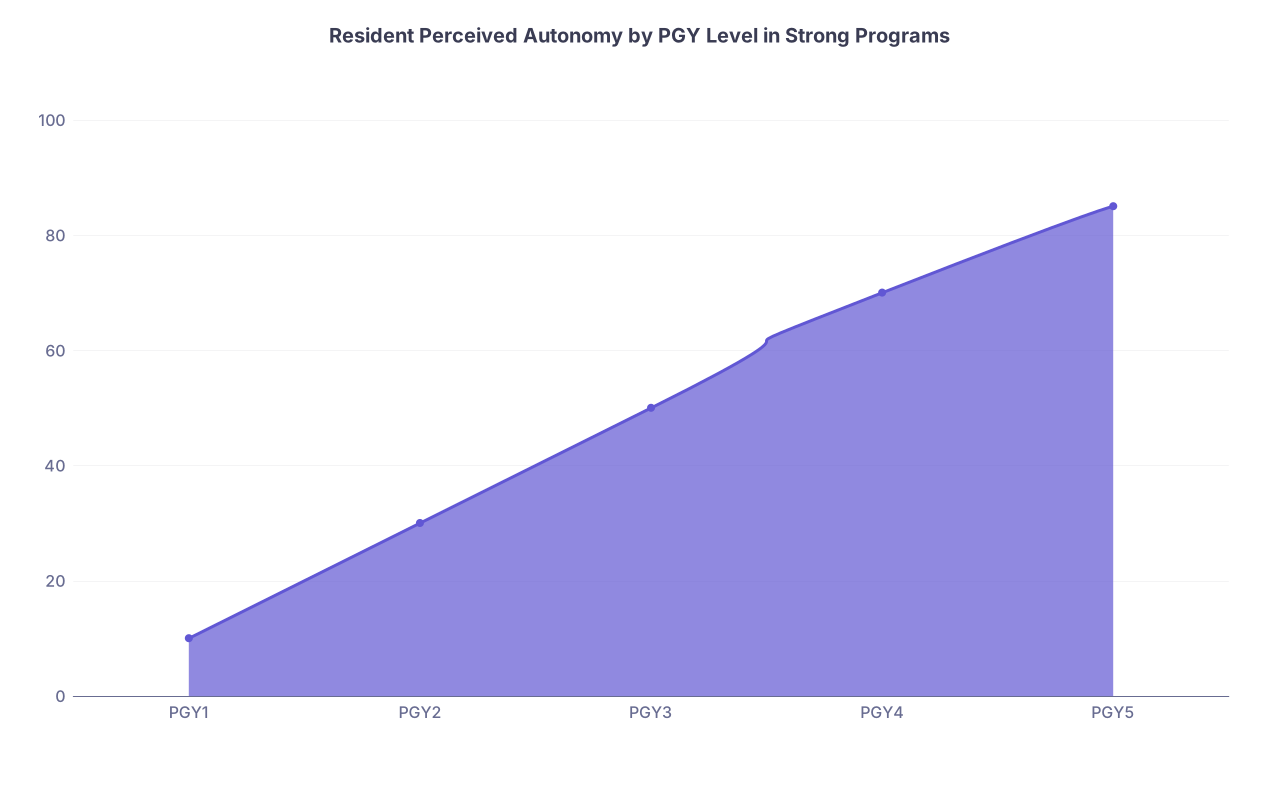
| Category | Value |
|---|---|
| PGY1 | 10 |
| PGY2 | 30 |
| PGY3 | 50 |
| PGY4 | 70 |
| PGY5 | 85 |
In a good program, the curve looks roughly like that: steep increase each year. In a bad one, it’s flat until chief year, then jumps a little.
Step 6: Use Away Rotations the Right Way
If you rotate at a program, your mission isn’t to impress people. It’s to see how they really train.
Here’s how to use that month intelligently:
Track who’s holding the instruments.
Literally. On a lap chole or appy, is the PGY2/3 on the camera or on the working port? Is the attending doing the Calot’s triangle dissection, or is the resident?Watch complication management.
When something goes sideways:- Does the attending rip the case away and push everyone aside?
- Or do they say, “Okay, tell me what you want to do next,” then guide?
Ask juniors privately.
“What were you actually doing in the OR 6 months ago vs now?”
If they shrug and say “About the same,” that’s bad.See who is stressed.
If the OR feels tense every time a resident touches tissue, attendings do not trust their residents. That’s a culture issue, not just an “early in the year” thing.
Step 7: Understand How Fellows Really Impact Autonomy
Fellows are not automatically the enemy. But they can absolutely wreck resident autonomy if the structure is lazy.
You want programs that can clearly answer:
- “On the HPB/foregut/trauma/vascular service, how do residents and fellows divide cases?”
- “Are there fellow-free sites where residents own the room?”
- “Do fellows help teach residents, or do they just do the critical steps?”
Healthy model:
- Fellows take the ultra-complex stuff and advanced cases residents shouldn’t independently own yet.
- Residents still do bread-and-butter and a meaningful chunk of intermediate cases.
- Fellows are expected to teach, not hoard.
Toxic model:
- Every big case has a fellow as the primary.
- Residents only clip and close.
- Attendings default to “I trust my fellow, I’m not risking this on a resident.”
Step 8: Specific Questions to Ask on Interview Day
Steal this list. Use verbatim if you want.
For residents:
- “Can you give me examples of what a typical PGY3 runs as primary surgeon in a regular week?”
- “At what level did you first feel like you owned a case from incision to closure?”
- “Are there attendings you avoid because you know you won’t get to operate?”
- “Who is the most autonomy-giving attending and what makes them different?”
- “Have any chiefs graduated recently feeling underprepared technically?”
For faculty (asked politely but directly):
- “How do you decide which parts of the case the resident is ready to do?”
- “When a chief is about to graduate, what level of independence do you expect from them?”
- “Can you think of the last case where you stayed unscrubbed while a resident ran the room?”
If they can’t answer that last one easily, the autonomy isn’t robust.
Step 9: Don’t Forget the Boring but Critical Stuff
A few structural things absolutely shape autonomy:
Case mix
You need enough bread-and-butter: appys, choles, hernias, trauma ex-laps, colectomies, etc. You learn by repetition.Night float / trauma experience
Nights with genuine trauma and emergent cases are autonomy goldmines—if residents are allowed to operate, not just assist the fellow.Community vs university balance
Many strong academic programs depend on community hospital rotations for real autonomy.
Ask: “Where do seniors go to get chief-level experience? How many months?”

| Step | Description |
|---|---|
| Step 1 | PGY1 - Exposure |
| Step 2 | PGY2 - Basic Cases |
| Step 3 | PGY3 - Intermediate Cases |
| Step 4 | PGY4 - Complex Portions |
| Step 5 | PGY5 - Running Rooms |
If they don’t have a community site or clear “chief-heavy” rotations, ask what practically replaces that.
Step 10: When You Have Competing Offers
Let’s say you’re down to two programs: one big-name academic, one mid-tier with a reputation for “strong operative experience.”
Here’s the brutal truth: for surgery, I’d rather see you at the place that makes you a surgeon, not the place that looks good on a LinkedIn header.
Ask yourself:
- At which place could I confidently take call as a new attending and handle a perforated viscus, a bad gallbladder, a trauma ex-lap, a small bowel obstruction… mostly on my own with backup?
- Where did chief residents sound more like surgeons and less like permanent assistants?
Your career is long. The first 5 years out, nobody cares what your hospital logo was. They care if you can safely get them out of the OR alive.
FAQ (Exactly 5 Questions)
1. Is case volume a good proxy for operative autonomy?
No. Case volume tells you there are opportunities to operate, not that residents get them. I’ve seen high-volume programs where attendings and fellows did almost everything while residents watched or held the camera. Volume + culture + structure together matter. If residents can describe in detail what they do at each level, and logs match that, then case volume starts to mean something.
2. Are community programs always better for autonomy than academic ones?
Not always, but they often have fewer fellows and more resident ownership. Some academic programs have excellent autonomy through strong community affiliates. Some community programs are chaotic and unsafe, with “autonomy” that’s really just lack of supervision. You’re looking for structured, supervised autonomy—not just being thrown into cases you’re not ready for.
3. How much should I worry about fellows taking my cases?
You should absolutely ask about it, but don’t automatically avoid fellowed programs. Good programs clearly separate fellow vs resident cases and have fellow-free sites where residents run the show. If residents roll their eyes when you ask, or say, “Yeah, on HPB we barely touch the big cases,” you’ll feel that for five years.
4. Can I rely on online forums or word-of-mouth reputation about autonomy?
Use them as smoke detectors, not final truth. If everyone says “Program X has terrible autonomy,” pay attention, then verify on interview day and (ideally) on a rotation. But don’t let one bitter anonymous comment override what you see and hear repeatedly from multiple current residents across PGY levels.
5. What if I care a lot about a competitive fellowship—will choosing autonomy hurt me?
Strong autonomy and top fellowships are not mutually exclusive. In fact, many elite fellowships prefer residents who can genuinely operate. The key is finding programs that do both: solid research or academic output and serious OR time. If you have to choose, I’d lean slightly toward autonomy—being technically strong makes you more valuable long-term than an extra line on your CV.
Key takeaways:
- Operative autonomy is about culture, structure, and trust—not just case volume or prestige.
- The only reliable source is what current residents honestly tell you about what they do at each level.
- Choose the place that will make you a real surgeon, not just a well-branded assistant.