The blunt answer: No, you should not do an away rotation in every surgical specialty you’re considering. That strategy backfires more often than it helps.
You’re asking the right question, though. Because a lot of students quietly panic and start stacking aways like trading cards—one in ortho, one in ENT, one in plastics, maybe a trauma month—hoping the answer will magically reveal itself. What they end up with: thin impressions everywhere, no depth anywhere, and a tired, scattered application.
You can do better than that.
Let’s walk through how to actually decide where and how many aways to do if you’re considering multiple surgical fields.
Step 1: Get Clear on What Aways Are For
If you don’t know the real purpose of an away rotation, you’ll misuse them.
Away rotations in surgery typically have three main functions:
Auditioning for a specific specialty and program
You go to show them: “I belong here.” They watch you on the wards/OR and decide if they can tolerate—and maybe like—seeing your face at 3 a.m. for the next 5–7 years.Getting letters from that specialty
You need strong, detailed letters: “I saw them take care of X, they did Y, they’re ready for this specialty.” That usually comes from one home rotation plus maybe one away.Reality check for lifestyle and fit
You experience the day-to-day. Not the Instagram version of surgery, but the actual: cases, clinics, call, personalities, team culture.
Notice what’s not on that list:
“Sampling every possible option so I don’t have to decide.”
Aways are not a tourism package for undecided students. They’re a targeted tool.
Step 2: Understand How Many Aways You Actually Need
Most applicants overestimate this. Badly.
If you have a decent home program in the specialty:
- One strong home rotation + 1–2 aways is usually plenty for most competitive surgical fields (ortho, ENT, plastics, neurosurgery, urology).
- For less competitive or mid-range competitiveness (general surgery, vascular in some places), home + 0–1 aways can be enough unless you’re geographically tied or trying to overcome weaker stats.
If you do not have a home program in that specialty:
- Then yes, aways matter more. You’ll probably need 2 aways in that field to:
- Prove exposure
- Get letters
- Show you understand the specialty
Trying to do 3–4 different specialties at away sites? That usually signals indecision and can dilute everything: letters, commitment, your story.
Here’s the core principle:
Depth in 1–2 specialties beats superficial exposure to 3–4.
Step 3: When You’re Torn Between Multiple Surgical Specialties
This is where people get into trouble and start thinking: “I’ll just do an away in all of them.”
Do not do that. Use this decision framework instead.
Ask yourself three very direct questions
If I had to submit ERAS tomorrow, what would I list as my primary specialty?
If one clearly wins—even 60/40—that’s your anchor. Build your aways around that field first.What does my CV already lean toward?
Look at:- Research projects
- Mentors
- Electives
- Longitudinal experiences If 80% of your experiences point to ENT and you’re now thinking plastics because of one cool case, you don’t fix that by tacking on a random plastics away.
What risk level can I tolerate?
- Applying to two surgical specialties is possible, but messy.
- Applying to three is usually a sign your real problem is fear, not lack of information.
General rule:
- If you’re serious about one primary surgical field and one backup:
- Do most aways in your primary.
- Consider 0–1 exploratory rotation in the “maybe” specialty, ideally at home or locally, not as an away unless you already feel strongly about it.
Step 4: When It Does Make Sense to Rotate in More than One Specialty
There are scenarios where sampling two fields with aways is reasonable. Not three or four. Two.
Here are legitimate setups:
| Situation | Away Rotation Plan |
|---|---|
| Strongly leaning to one specialty | 1 home + 1–2 aways in that field |
| No home program in specialty | 2 aways in that specialty |
| Truly 50/50 between two fields | 1 home + 1 away in each (max 4 total) |
| Using one as backup specialty | 2–3 aways primary + 0–1 home/short rotation backup |
If you’re genuinely 50/50 between, say, ortho and neurosurgery:
- Aim for:
- A home ortho month + a home or local neurosurgery month
- Then one away in ortho and one away in neurosurgery
- By the time you finish those four months, you should not still be “undecided.” If you are, the problem is not lack of exposure.
What you should not do:
- Ortho away
- ENT away
- Plastics away
- Vascular away
…because you “like the OR.” That just tells programs you’re not committed to any of them.
Step 5: The Hidden Costs of Too Many Aways
Students underestimate the downside of stacking aways across multiple specialties.
Here’s what I’ve watched happen, repeatedly:
Your letters get weaker
If you do three different surgical aways, each team sees you for 3–4 weeks. That’s enough to say:- “They worked hard”
- “They were pleasant” Not enough to say:
- “They took ownership”
- “They drove patient care” Depth with one team beats fly-by impressions with three.
Your story gets muddled
PDs are not stupid. They read your application and see:- Research in ENT
- Two aways in plastics
- One away in general surgery
- Personal statement that sounds generic “I love surgery, I love the OR”
That doesn’t scream “future academic surgeon.” It screams “couldn’t decide.”
You burn time and money
Aways are expensive: travel, rent, lost time for research or Step 2 prep. Using them as “I’ll just see what I like” is a poor return on investment.You fatigue yourself before residency even starts
Back-to-back high-intensity rotations in three different environments and cultures will wear you down. By the third, you’re not showing your best self anymore, you’re surviving.
Step 6: How to Decide Where to Do Aways (Once You Pick a Specialty)
Once you’re reasonably committed to a field, then the question becomes smart, not panicked: where should you actually go?
Here’s a simple prioritization:
Programs where you’d seriously rank them in your top 5–10
Don’t waste an away at a program you’d never move to. You’re auditioning. Only audition where you’d actually work.Places that fill with their rotators
Some fields, like ortho and ENT, have programs that clearly favor away rotators. Ask residents or recent grads which programs “take their own.”Geographic anchors
If you must end up in a certain region (partner, kids, family), favor aways there. Rotating in your target region is generally smarter than chasing brand names across the country you don’t actually want to live in.
Here’s how the tradeoffs often look:
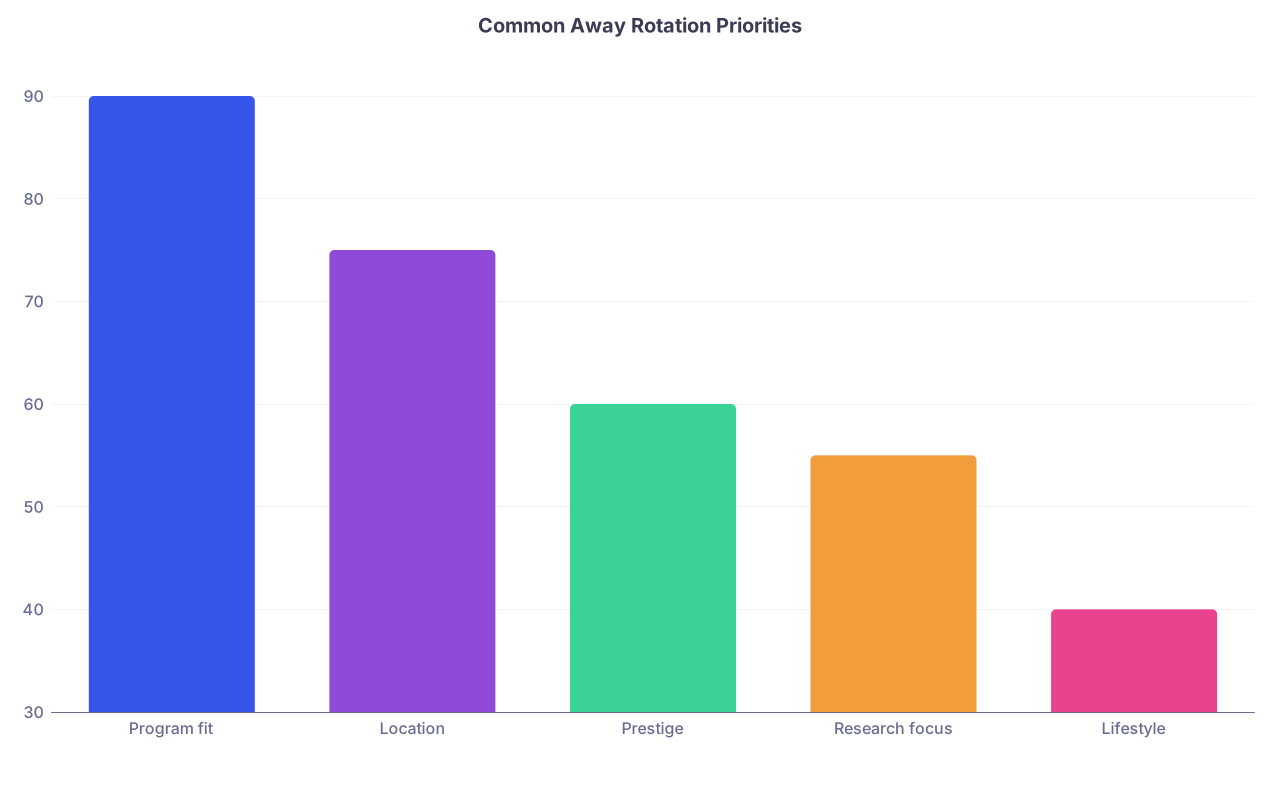
| Category | Value |
|---|---|
| Program fit | 90 |
| Location | 75 |
| Prestige | 60 |
| Research focus | 55 |
| Lifestyle | 40 |
That’s roughly how most successful applicants implicitly prioritize, even if they never say it out loud.
Step 7: What If You’re Still Honestly Undecided?
If you’re MS3 going into MS4 and still unsure between multiple surgical options, here’s the cleanest way to handle it.
Use home and local rotations first, not aways
- General surgery sub-I
- Specialty elective at home (ENT, ortho, urology, etc.)
- Another elective at an affiliated or nearby institution if available
Do as much as possible without burning away slots yet.
Talk to actual residents in both fields, not just attendings
Attendings have survived the system. Residents are in it. Ask:- “What sucks more than you expected?”
- “What did you underestimate about call?”
- “If you had to reapply, would you pick this again?”
Pay attention to what you miss
When you’re on ENT, do you miss the big belly cases of general surgery? On ortho, do you miss clinic and longitudinal follow-up? Your sense of “what I miss” is more honest than “what seems cool today.”Then commit to a primary field by the time you schedule aways
Use aways to deepen and signal commitment, not to avoid making a decision.
If, after doing this, you’re still split, you may be overthinking. Most surgeons could have been happy in several fields. You just need to pick one and lean into it.
Step 8: Special Cases Where Multiple-Specialty Aways Aren’t Crazy
There are a few edge cases where more than one specialty’s aways can be part of a rational plan:
You’re choosing between two related fields and might dual-apply
Example: general surgery and vascular, or general surgery and surg onc fellowships later.
Then you might:- Do 2 aways in general surgery
- Do 1 focused elective/short away in vascular or surg onc
But your ERAS stays primarily general surgery with a clear through-line.
You’re considering a competitive field and a true backup
Example: neurosurgery (dream) and general surgery (backup)
Plan could look like:- 2–3 neurosurgery aways
- Strong neurosurgery home rotation
- 1 robust general surgery sub-I at home to keep that door open
Not three scattered aways in three different fields.
Your home institution is very weak in exposure to some fields
Maybe your general surgery volume is strong, but there’s essentially no plastics or ENT.
Then doing:- 1 early “explorer” away or outside elective in a field you’re curious about
- Followed by committed aways after deciding
…can make sense. But you still should not be doing an away in every option.
Step 9: The Timing Trap
A lot of students try to use very late away rotations (Sep–Nov) to “try out” a second specialty.
The problem: by then, ERAS is submitted or about to be. Letters are done. Personal statement is written. You’re not trying out a new specialty—you’re just torturing yourself with “what if.”
Use this rough mental timeline:
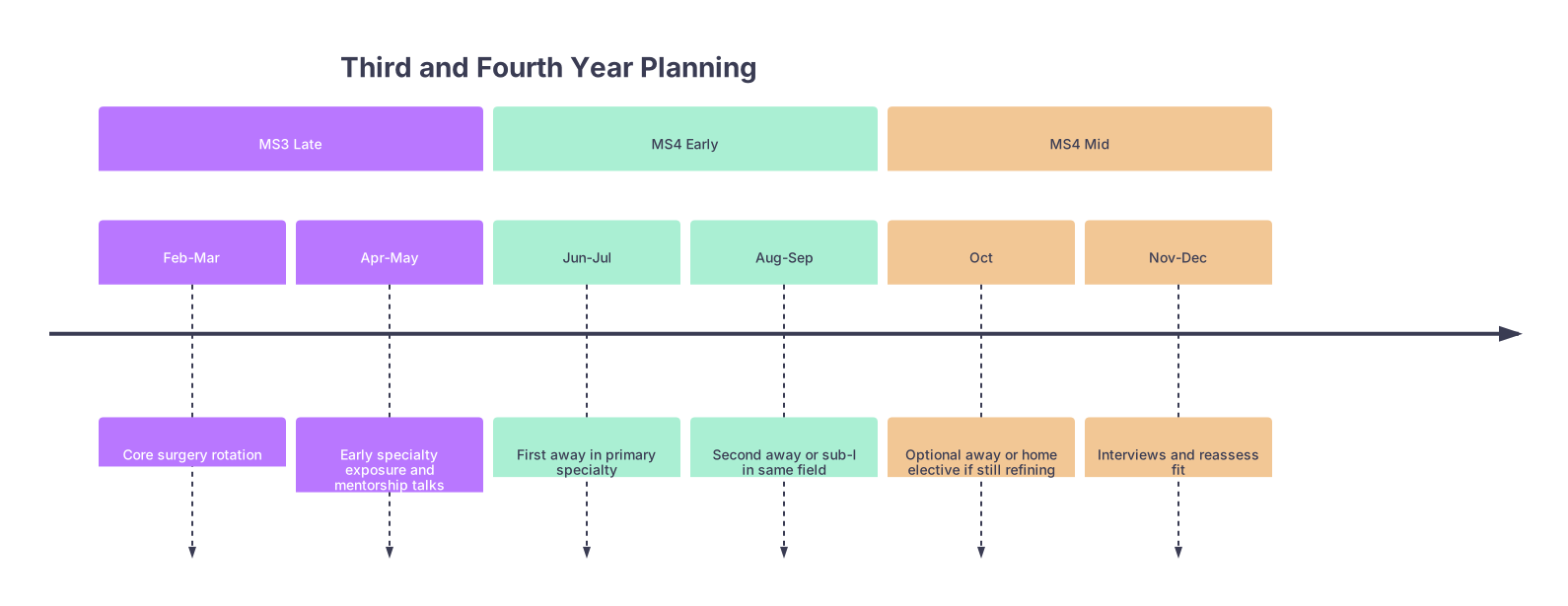
| Period | Event |
|---|---|
| MS3 Late - Feb-Mar | Core surgery rotation |
| MS3 Late - Apr-May | Early specialty exposure and mentorship talks |
| MS4 Early - Jun-Jul | First away in primary specialty |
| MS4 Early - Aug-Sep | Second away or sub-I in same field |
| MS4 Mid - Oct | Optional away or home elective if still refining |
| MS4 Mid - Nov-Dec | Interviews and reassess fit |
Notice what’s not happening in October: discovering a totally new specialty and pivoting your life.
Step 10: A Checklist Before You Commit to Multiple-Specialty Aways
Ask yourself this, bluntly, before you hit “submit” on several different specialty requests:
- Can I clearly state my top choice specialty in one sentence?
- Do I have at least one strong mentor in that field?
- Do I know roughly which programs/regions I’d be happy training in?
- Can I explain to a PD why my aways make sense together?
If you can’t answer those cleanly, you don’t need more aways. You need more thinking and better advising.
The Bottom Line
You’re not supposed to do an away rotation in every surgical specialty you’re considering. That’s a fear-based strategy, not a smart one.
Three key points to walk away with:
- Use aways to deepen commitment, not to avoid decisions. One primary specialty with 1–2 aways is far stronger than three specialties with scattered, weak exposure.
- Letters and fit beat raw aways count. A couple of well-chosen, well-executed months where you crush it will do more for you than four “tourist” rotations.
- Decide early, then align your aways with that decision. Explore locally first, talk to residents, then use aways surgically—aimed at programs and regions where you’d actually want to match.