The belief that “more prestigious is always better” in surgical residency is wrong. And it quietly ruins careers.
You are about to make one of the most high‑consequence decisions of your professional life. If you get this wrong and choose name‑brand prestige over actual program fit, you can limit your operative growth, your career options, and your mental health for years. I have seen it. More than once. Usually from very talented people who should have had stellar careers.
This is the specific mistake: ranking the most “famous” or “research‑heavy” surgical programs above better‑fit options because you are afraid of “wasting your potential” at a less known place.
Let me be very clear: prestige matters some, but fit matters more for your long‑term surgical competence, career satisfaction, and ability to do what you want after residency. The trap is that students systematically underestimate the cost of a bad fit and wildly overestimate the power of a big‑name logo.
Let us dissect the error before you lock in your rank list.
The Prestige Trap: What You Think You’re Buying (But Often Are Not)
Most students chasing prestige think they are buying four things:
- Better fellowship options
- Better operative training
- Better “doors” for academic careers
- Better reputation forever
Parts of this are true for a tiny fraction of programs and a tiny fraction of residents. But you are not ranking statistical trends; you are choosing your actual life for 5–7 years.
Here is the catch: prestige is a very blunt instrument. It tells you almost nothing about:
- How often chiefs actually operate vs staff doing the entire case
- How malignant the call culture is
- Whether the chair and PD will go to bat for you when you struggle or when you apply to fellowship
- Whether you are allowed to say, “I want to be a community colorectal surgeon,” without being treated like you quit the team
I remember an MS4 telling me proudly after an interview season: “I’m ranking all the top‑10 NIH funding places first. I want to keep every door open.” He matched. Two years later he quietly asked about transferring. Why? He had logged fewer meaningful index cases than his med school friend at a “no‑name” community‑based academic program. And he had not published anything he actually cared about—just data‑entry grind for someone else’s machine.
That is the prestige trap. You think you are expanding your options. You may actually be shrinking them.
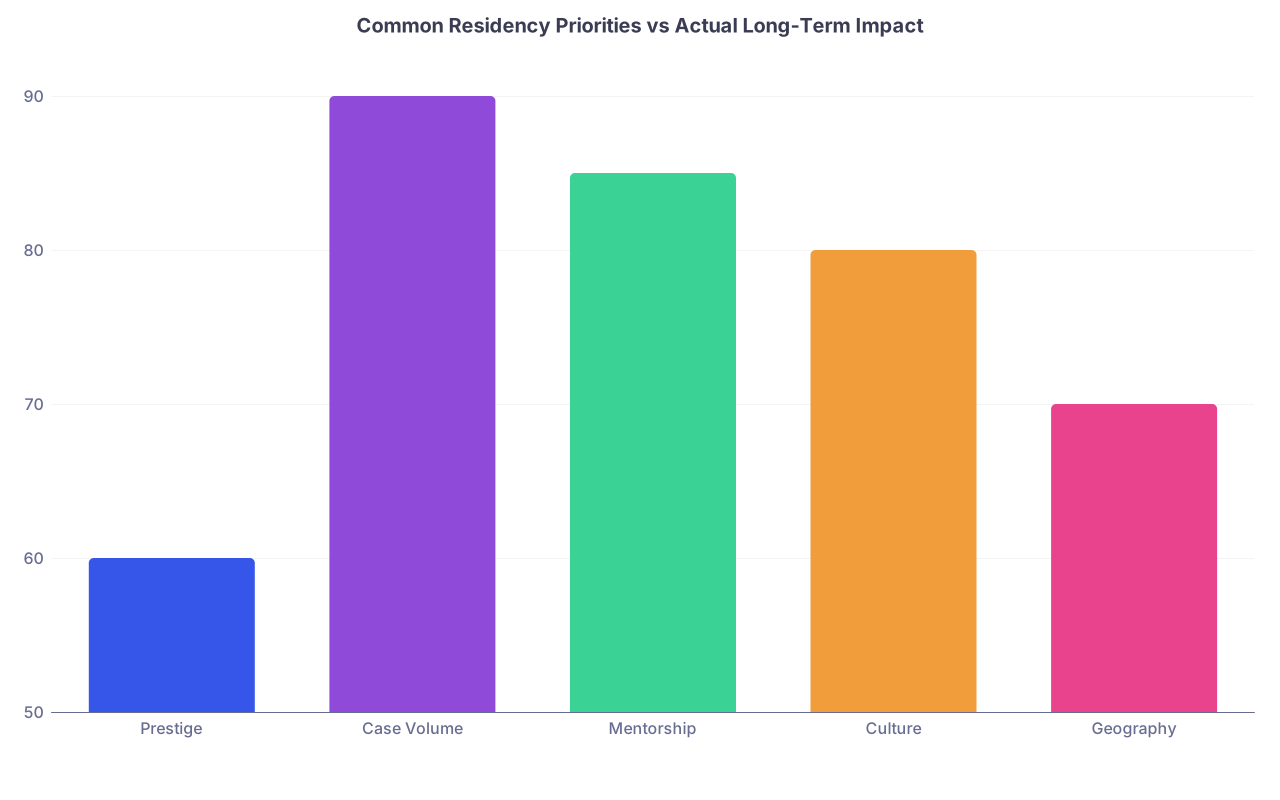
| Category | Value |
|---|---|
| Prestige | 60 |
| Case Volume | 90 |
| Mentorship | 85 |
| Culture | 80 |
| Geography | 70 |
(Values here are a rough “importance for long‑term career success” ranking I would actually use, not what students say on interview day.)
How Prestige Can Quietly Undercut Your Training
The wrong prestige‑driven choice does not usually blow up in one dramatic event. It bleeds you out slowly.
1. Low Case Ownership at the “Flagship” Center
This is the big one no one talks about loudly enough.
At certain elite quaternary centers, the rarest and most complex surgical cases go to:
- The senior staff who built the program
- The “golden children” on a research or leadership track
- The fellow who is on their last year before attending life
You, the resident, may actually get less hands‑on responsibility than at a solid regional or community‑based academic program that handles a huge volume of bread‑and‑butter plus some advanced work.
I have seen chiefs at big‑name places scrambling to log minimum index cases. While their classmates at “middle‑tier” programs were already comfortable running a room independently on day one as attendings.
If you are ranking a program primarily for its international reputation in, say, pancreatic surgery, you had better ask very specifically:
- Who is actually doing the Whipples—attendings, fellows, or chiefs?
- How many has the current chief logged?
- How many primary surgeon cases by PGY‑3? PGY‑4?
If the answer is vague or heavily filtered, that is a red flag. A huge one.
2. “You’re a Research Body, Not a Trainee”
Prestigious academic surgical departments often have pressure to push out large volumes of papers, grant dollars, and clinical trials. That itself is not the problem. The problem is when residents become cheap labor to maintain that machinery.
The classic prestige‑over‑fit error: a student with only mild interest in research chooses the biggest‑name research program “just in case” they want academics later. They imagine protected time, mentorship, and high‑yield projects.
Two years later, reality looks more like:
- Nights and weekends spent cleaning databases for someone else’s R01
- Being 7th author on a paper you do not even care about
- And ironically, still not having a coherent academic “story” attractive to real fellowship directors
Meanwhile, their friend at a less prestigiously branded place:
- Did 1 dedicated research year with a focused mentor
- Came out with 3–4 first‑author papers directly related to their chosen fellowship
- Operated more, with better ownership on cases
Prestige alone does not guarantee meaningful academic development. Fit with the research culture, mentor availability, and your genuine interest matters far more than the hospital logo.
The Culture Problem: Malignancy Hidden Behind a Shiny Name
This is where people get burned the worst. Because students routinely excuse warning signs when the name is big enough.
“I know the residents looked tired and kind of miserable, but the fellowship list is amazing.”
I have heard that sentence almost verbatim. More than once.
Red Flag Patterns At Some “Top” Surgical Programs
You should be very suspicious when you see:
- Residents who cannot or will not speak honestly on interview day
- Jokes about “it gets better after PGY‑3” that do not sound like jokes
- Alumni described as “survivors” rather than “graduates”
- A PD who brags more about match stats than about specific residents’ growth
Program culture is not a soft, optional thing. It directly affects:
- How safe it is for you to ask questions in the OR
- Whether you will be supported if you have a complication
- Whether anyone will notice when you are circling burnout and making dangerous mistakes
Surgery is already punishing. If you add a toxic, prestige‑drunk culture on top of that, you are not “toughening yourself up.” You are putting your development and your patients at risk.

Fellowship and Jobs: You Are Overrating the Logo
Here is the uncomfortable truth: fellowship directors and hiring groups are not as hypnotized by prestige as fourth‑year medical students are.
They care about:
- How well trained you are in the OR
- Whether your letters are strong and specific
- Whether you are teachable, safe, and collegial
- Your concrete output (operative experience, projects, quality initiatives)
Of course, some fellowships love getting applicants from certain “feeder” programs. But it is not the logo alone—they trust that those residents are well prepared and well supported. And good programs know who does—and does not—actually train their residents.
I have seen people from “mid‑tier” residencies match competitive fellowships because:
- They had excellent case volume and ownership
- Their PD personally called the fellowship director and went to bat for them
- Their letters described real operative skill and professionalism, not just name recognition
I have also seen residents at elite places quietly pushed toward less competitive fellowships because everyone knew they were not ready to operate independently.
Prestige without competence is a very fragile currency. It collapses the second you stand at the table and cannot perform.
| Factor | Overrated by Students | Actually Critical for Career |
|---|---|---|
| Hospital name/logo | Very | Low–Moderate |
| Case volume & ownership | Moderate | Very High |
| Mentorship & advocacy | Low | Very High |
| Research brand | High | Moderate |
| Program culture/support | Low | Very High |
Concrete Signs You’re Prioritizing Prestige Over Fit
Let us be blunt. You are chasing prestige at the expense of fit if:
- Your rank list order mostly mirrors “US News” or NIH rankings
- You justify red flags with “but their fellowship matches are insane”
- You tell yourself “I can survive anywhere; it’s only 5–7 years”
- You find yourself ignoring what actual residents told you and listening only to your own fear of “missing out”
If you felt more at ease, more seen, and more excited about actually being there at a “lesser‑known” program—but you are ranking it lower because of reputation—that is your warning alarm.

| Step | Description |
|---|---|
| Step 1 | Make Rank List |
| Step 2 | Reconsider ranking |
| Step 3 | Keep high on list |
| Step 4 | Top choice based on logo? |
| Step 5 | Did residents seem happy? |
| Step 6 | Good case volume and mentorship? |
| Step 7 | Top choice felt like home? |
If your honest answers push you toward D repeatedly and you still keep the program high “because it’s famous,” you are making the prestige‑over‑fit error.
How to Evaluate “Fit” Like Someone Who Has Seen Careers Go Sideways
You cannot control everything. You also cannot collect perfect data. But you can avoid the dumb mistakes I see over and over.
On Interview Day (or Second Looks), You Should Be Laser‑Focused On:
- Resident demeanor and honesty
- Case ownership and graduated responsibility
- Culture of feedback and support
- How the program handles struggle and failure
Do not waste your limited time asking the PD to recite the program website. Instead, ask questions that malign programs cannot fake well.
Try these:
- “If a resident falls behind on a key index procedure, what happens?”
- “In the last 5 years, has anyone transferred out, and why?”
- “Can you give an example of how the program supported a resident going through a rough personal time?”
- “Who actually does your complex cases—attendings, fellows, or chiefs?”
- “What are you trying to change about your program in the next 3 years?”
Then watch who answers. And how.
If you get vague nonsense, or the room suddenly becomes tense, believe that.
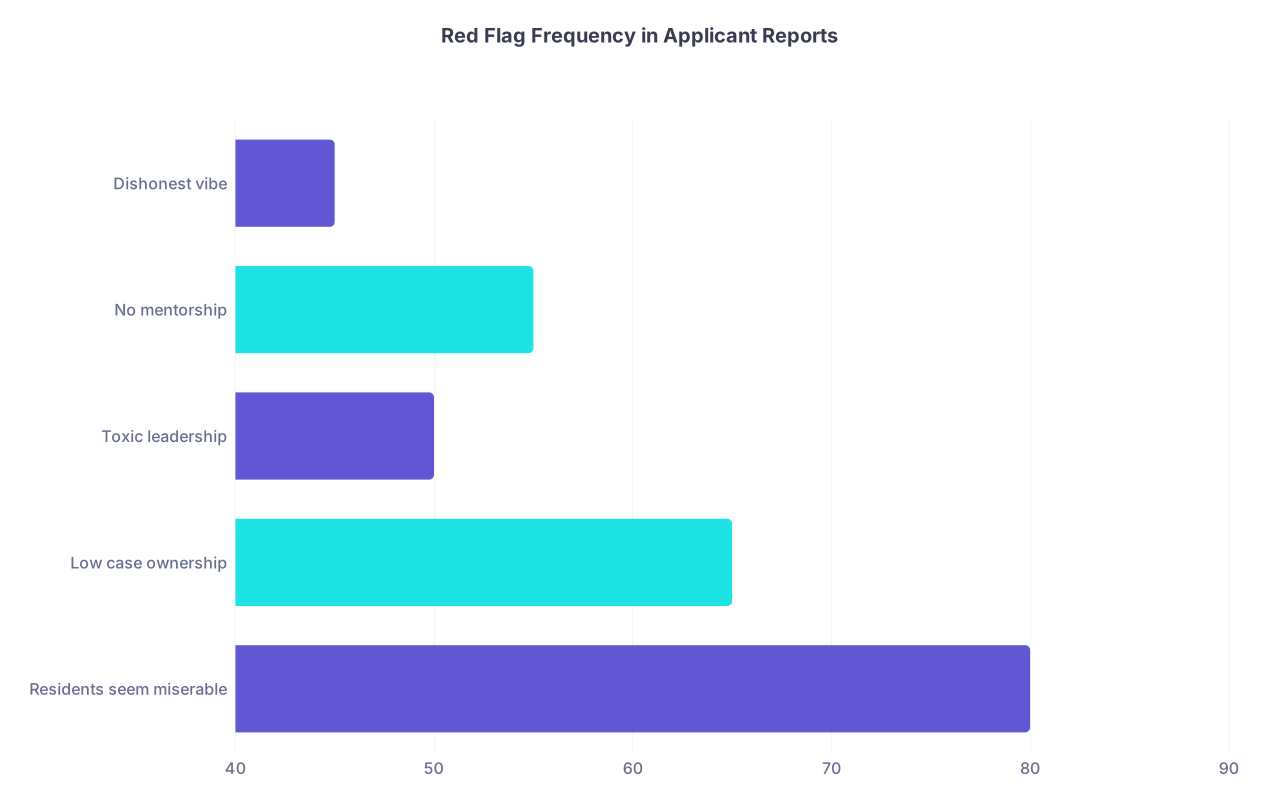
| Category | Value |
|---|---|
| Residents seem miserable | 80 |
| Low case ownership | 65 |
| Toxic leadership | 50 |
| No mentorship | 55 |
| Dishonest vibe | 45 |
(These are the patterns I hear about most often from residents who regret their prestige‑driven choice.)
Personal Risk: Burnout, Attrition, and Quiet Quitting on Your Own Career
There is this macho myth in surgery: “If you are tough enough, you can handle any program.”
No. You are not proving anything by subjecting yourself to an environment that does not train you, does not protect you, and does not see you as a person. You are just increasing the odds that:
- You burn out and mentally check out
- You develop unhealthy coping mechanisms (I have seen too many: alcohol, affairs, rage)
- You graduate under‑trained and scared to operate independently
- You drop your earlier goals because you are in survival mode
The most tragic version of this: brilliant, motivated students who dreamed of academic leadership end up barely holding things together in a malign, hyper‑prestige program. By PGY‑4, they no longer want anything to do with academics. They just want out.
Meanwhile, someone at a smaller, healthier program with strong mentorship is:
- Publishing thoughtfully
- Getting real teaching opportunities
- Actually enjoying surgery
Guess whose career has more upside long term.

When Prestige Does Make Sense (And How Not to Misuse It)
I am not saying prestige is irrelevant. That would be dishonest. It can matter—if it is layered on top of good fit. Not instead of it.
Situations where a more “prestigious” surgical program can be worth the trade‑offs:
- You are genuinely committed to a highly competitive niche (pediatric CT, transplant at top‑tier centers) and know you thrive in high‑pressure, research‑heavy environments.
- You have already demonstrated you enjoy and can produce high‑quality research (first‑author papers, grants, presentations).
- You visited, spoke with residents, saw high case volume and real camaraderie, not just polite misery.
- You honestly liked the place and could see yourself there even if the logo vanished.
If those are all true, then yes, the big‑name place may be right for you.
But if your reasoning is mostly fear‑based—
- “What if I regret not shooting for the top?”
- “What will my classmates think if I pick this smaller program?”
- “My advisor said I’m ‘too strong’ to go to a community‑heavy place”
—then step back. You are at high risk of making a prestige‑over‑fit mistake.
A Simple Sanity Check Before You Submit Your Rank List
Do this exercise. Honestly. Alone.
For each of your top 5 programs, write down:
- One sentence: “What excites me about being a resident here day‑to‑day?”
- One sentence: “What worries me most about being a resident here?”
- A score 1–10 for:
- Case volume and ownership for me
- Mentorship and advocacy
- Culture (how they treat each other)
- Geographic and personal life fit
- Name recognition / prestige
If prestige is the highest or only strong score for a program that otherwise worries you, that program should not be your top choice. Full stop.
You will not operate better, sleep more, or feel supported because the badge on your white coat impresses your med school classmates on Instagram.

FAQs
1. Will choosing a less prestigious surgical residency hurt my chances for a competitive fellowship?
It can, if the program truly has poor training, low volume, and no academic output. But that is not about prestige; that is about quality.
Fellowship directors care about strong letters, demonstrable operative skill, a coherent CV, and evidence you will function well in their environment. A resident from a “mid‑tier” program with:
- Strong case numbers
- Excellent advocacy from mentors
- Focused, relevant academic work
will usually outcompete a resident from a top‑name place who is under‑trained, poorly supported, and has a scattered CV. Do not confuse “less famous” with “inferior.” Some of the best pipeline programs into competitive fellowships are not the ones dominating rankings.
2. How do I know if a program’s culture is truly malignant versus just demanding?
Demanding is normal in surgery. Malignant is different.
Signs of demanding but healthy:
- Residents tired but still joking with each other
- Chiefs praise juniors and attendings in front of you
- They acknowledge hard days but can also describe growth and support
- You hear specific examples of faculty going to bat for residents
Signs of malignant:
- Residents warn you “We survive, we do not thrive”
- Turnover stories, transfers out, or unexplained gaps in classes
- Normalization of humiliation in the OR as “just how it is here”
- PD or chair dismisses concerns with “We only want the strongest”
If you walk away feeling slightly sick and telling yourself you are overreacting, you are probably not. Your gut is catching something your brain is trying to rationalize away because of the name.
3. I am genuinely undecided about fellowship. Shouldn’t I pick the most prestigious place to “keep options open”?
No. You should pick the place most likely to make you a strong, confident surgeon with mentors who know you and will actually answer your emails in five years.
The “I am undecided” group needs breadth of exposure, good general training, and time and space to explore. A program that over‑indexes on one hyper‑subspecialized service, or one that sees residents as cogs in a research machine, can actually narrow your options by burning you out or pigeonholing you early.
A well‑balanced, solid‑quality program with high volume and healthy culture keeps your options open far better than a hyper‑prestige, poor‑fit program that crushes your enthusiasm.
4. My advisor is pressuring me to rank the big‑name program higher. How much weight should I give that?
Listen, but do not outsource your life. Advisors often carry their own biases:
- Some trained at those elite centers and cannot imagine choosing differently
- Some overvalue brand because that is what impressed them in their era
- Some are thinking about how your match result reflects on the school, not you
You can absolutely say: “I appreciate your guidance. When I visited, I felt that Program X was a better fit for me in culture and operative experience, even if it is less well known. I believe I will train better there.”
If an advisor cannot respect that, that is their limitation, not yours.
Key points to remember:
- Prestige is not a substitute for operative volume, mentorship, and a sane culture. If it is the only strong point of a program, you are walking into a trap.
- Your long‑term career depends far more on how well you are trained and supported than on the logo on your scrubs. Choose the place where you will actually grow, not just the place that impresses people for 10 seconds.